Why Should Working Professionals Consider Entrepreneurship Courses?
Best Entrepreneurship Courses in India for Working Professionals
What Do You Learn in Entrepreneurship Courses?
How to Choose the Best Online Entrepreneurship Certificate Programs?
Key Insights
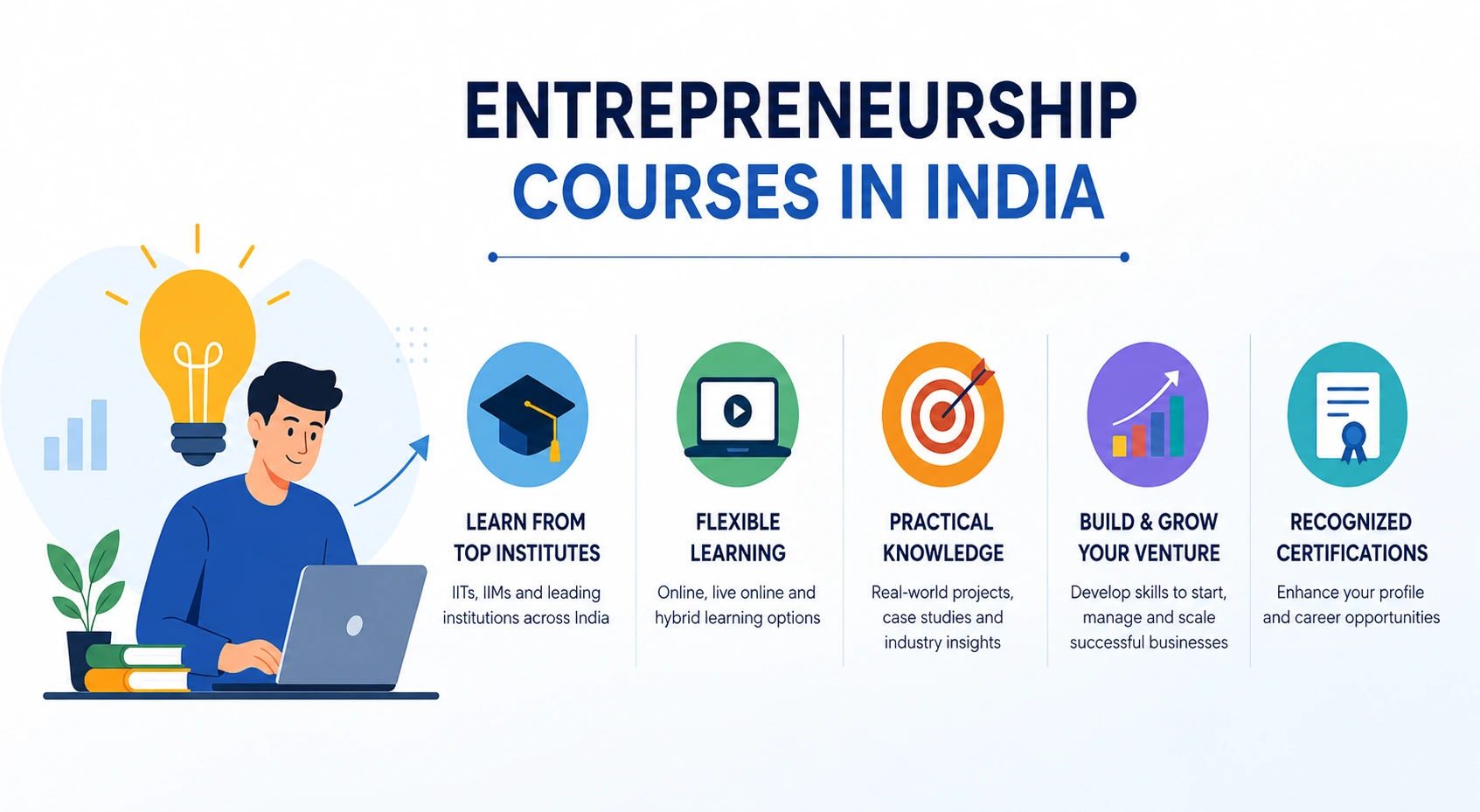
Entrepreneurship courses can help working professionals develop skills in opportunity identification, customer needs, business models, finance, marketing, innovation, and strategic decision-making.
Professionals can choose from structured executive programmes, online courses, hybrid learning options, Startup India initiatives, and short-term certifications based on their career goals and available time.
Comprehensive programmes cover the entrepreneurial journey, including idea validation, business model development, finance and business planning, marketing, innovation, leadership, and decision-making.
When choosing a programme, professionals should consider the institution’s credibility, curriculum depth, learning format, practical components, flexibility, faculty, certification, and overall learning experience.
In this blog, you'll learn about the best entrepreneurship courses in India for working professionals, what these programmes teach, how to choose the right online certificate, available learning formats, and career opportunities after completing entrepreneurship courses.
Entrepreneurship is no longer limited to first-time founders or fresh graduates with a business idea. Today, professionals across industries are exploring entrepreneurship to launch a venture, build a family business, develop an innovative product, or move into leadership and business strategy roles. However, turning an idea into a sustainable business requires more than ambition. It demands an understanding of opportunity identification, customer needs, business models, finance, marketing, innovation, and strategic decision-making.
This is where structured entrepreneurship courses in India can make a difference. For working professionals, the right program can provide practical knowledge while allowing them to continue their careers. With flexible formats becoming increasingly common, professionals can choose from classroom-based executive programs, live online courses, and hybrid learning options.
Among the available choices, thee-Post Graduate Diploma in Innovation and Entrepreneurship from IIT Bombay, offered through Jaro Education, is a strong option for professionals looking for structured learning in innovation and entrepreneurship. Beyond this program, learners can also explore short-term certifications, government-backed learning initiatives, and specialized online entrepreneurship courses based on their career goals.
Why Should Working Professionals Consider Entrepreneurship Courses?
Entrepreneurship involves much more than starting a company. Professionals who understand entrepreneurial thinking can identify business opportunities, evaluate market needs, develop innovative solutions, and make informed decisions in established organizations as well.
For someone already working, formal entrepreneurship education can provide a structured way to learn these concepts without having to learn everything through trial and error. A well-designed program can also help professionals connect theoretical concepts with business situations through case studies, projects, discussions, and practical assignments.
IIT Bombay’s Desai Sethi School of Entrepreneurship, for example, focuses on entrepreneurial thinking, innovation, opportunity identification, customer discovery, business planning, and venture creation across its entrepreneurship education initiatives.
The availability of flexible learning has also made Entrepreneurship for Working Professionals more accessible. IIT Bombay’s Educational Outreach notes that its continuing education initiatives are designed to meet the upskilling needs of working professionals, with several programs available through online formats.
Best Entrepreneurship Courses in India for Working Professionals
1. ePGD in Innovation and Entrepreneurship – IIT Bombay
For professionals seeking a structured and academically oriented entrepreneurship program, the ePGD in Innovation and Entrepreneurship from IIT Bombay is an option worth exploring.
The program is designed around the broader areas of innovation and entrepreneurship, making it relevant for professionals who want to understand how ideas can be developed into viable business opportunities. It can be particularly relevant for individuals considering entrepreneurship, innovation-led roles, business development, or leadership responsibilities.
The IIT Bombay ecosystem has a dedicated focus on innovation and entrepreneurship through the Desai Sethi School of Entrepreneurship (DSSE). The school works across entrepreneurship education, innovation, experiential learning, online programs, and pre-incubation initiatives.
For working professionals, a structured program can be useful because it provides a learning framework rather than requiring learners to navigate entrepreneurship concepts independently.
Who can consider it? Professionals interested in entrepreneurship, innovation, new business development, startup creation, or strengthening their entrepreneurial mindset can explore the program.
Why consider it? The IIT Bombay ecosystem provides exposure to an institution with a strong focus on technology, innovation, entrepreneurship, and interdisciplinary learning.
2. Startup India Learning Program
Professionals who want to begin with a free online learning option can explore the Startup India Learning Program. It is a government-backed online entrepreneurship program designed to help entrepreneurs develop their ideas and ventures through structured learning.
According to Startup India, the program covers important areas of starting a business and includes insights from more than 40 Indian founders. The four-week program also covers areas such as idea validation, finance andlegal foundations, business planning, pitching, and funding. Participants can receive an official Startup India and Invest India certification after completing the program.
This can be a useful starting point for professionals who are still evaluating an entrepreneurial idea and want to understand the fundamentals before investing in a longer program.
3. Harvard Business School Online – Entrepreneurship & Innovation
Harvard Business School Online’s Entrepreneurship & Innovation offerings are designed for professionals, aspiring entrepreneurs, and business leaders who want to develop a structured understanding of how new ventures are identified, evaluated, and developed. The courses focus on areas such as recognising promising business opportunities, assessing market potential, developing innovative ideas, understanding business models, and making informed entrepreneurial decisions.
The programme is particularly suitable for working professionals who want to strengthen their entrepreneurial thinking while continuing their careers. Participants who successfully complete an eligible HBS Online course receive a Certificate of Completion, adding a recognised credential to their professional profile.
4. IIM Mumbai – Certificate Program in Entrepreneurship and Startup Mastery
This program is designed for aspiring entrepreneurs and professionals interested in developing and managing startups. It covers key areas such as idea validation, product development, marketing, fundraising, and business strategy. The program also provides exposure to startup-building concepts and practical entrepreneurial challenges. It can be suitable for professionals looking to turn business ideas into structured ventures.
5. IIM Mumbai – Post Graduate Program in Entrepreneurship and Innovation Management (PGPEx-EIM)
The program focuses on entrepreneurship, innovation, and business management for professionals looking to build or scale ventures. Participants learn about areas such as strategy, finance, marketing, product development, leadership, and fundraising. Its broader management focus can help learners understand different aspects of running a business. It is particularly relevant for professionals seeking structured learning in entrepreneurship and innovation.
6. EICTA Consortium – Entrepreneurship Essentials
This online program focuses on the fundamentals required to transform an idea into a potential business venture. The curriculum covers customer discovery, idea validation, MVP development, business models, unit economics, go-to-market strategy, and fundraising. Learners can develop a practical understanding of the startup-building process. It can be considered by aspiring entrepreneurs who want a focused and structured learning experience.
This program is aimed at entrepreneurs and professionals who want to understand how businesses can grow and scale. It covers advanced business models, financial analytics, fundraising, leadership, governance, and global expansion. The program also includes mentoring and investor-style pitching exposure. It can be useful for individuals who already have a business idea or venture and want to strengthen their growth strategy.
8. Short-Term Entrepreneurship Certifications
Short-term certifications are another option for professionals who have limited time. These programs generally focus on a particular area rather than providing an extensive entrepreneurship curriculum. Some of the platforms offering these include Udemy, Coursera, etc.
Depending on the course, professionals may find learning options around innovation, startup management, business planning, entrepreneurial finance, marketing, leadership, or business strategy.
These programs can work well for professionals who already have substantial business experience and want to strengthen one particular skill. However, someone planning to build a venture from the ground up may benefit more from a comprehensive curriculum covering the complete entrepreneurial journey.
The curriculum can differ considerably between programs. However, comprehensive entrepreneurship courses in India online generally cover multiple stages of the entrepreneurial journey.
Entrepreneurial Mindset
Entrepreneurship begins with the ability to identify opportunities and approach problems differently. Courses often introduce learners to entrepreneurial thinking, creativity, innovation, and opportunity recognition.
Idea Identification and Validation
A business idea is only a starting point. Professionals need to understand whether an identified problem is meaningful to customers and whether a potential solution can create value. Learning about customer discovery and opportunity assessment can help entrepreneurs evaluate ideas more systematically.
Business Model Development
A promising idea needs a viable business model. Entrepreneurship programs can introduce concepts related to value propositions, target customers, revenue models, costs, channels, and business operations.
Finance and Business Planning
Financial understanding is essential for entrepreneurs. Programs may cover areas such as financial statements, break-even analysis, budgeting, funding requirements, and business planning. Startup India, for instance, includes finance fundamentals and business planning in its entrepreneurship learning program.
Marketing and Go-to-Market Strategy
Building a product is not enough. Entrepreneurs must understand their customers and determine how to reach them. Learning around marketing, positioning, customer acquisition, and go-to-market planning can help professionals approach market entry more strategically.
Innovation and Product Development
Innovation is closely linked to entrepreneurship. Professionals can learn how to identify opportunities for innovation, develop products or services, and align solutions with customer needs.
Leadership and Decision-Making
As a venture grows, entrepreneurial success increasingly depends on leadership. Professionals may learn about team building,strategic decision-making, communication, organizational challenges, and managing growth.
How to Choose the Best Online Entrepreneurship Certificate Programs?
Choosing among best online entrepreneurship certificate programs requires more than comparing fees. Working professionals should first determine what they want to achieve.
If your objective is to launch a startup, prioritize programs that cover opportunity identification, customer discovery, business models, finance, marketing, and venture development. If you are already managing a business, a program focused on scaling, strategy, leadership, and innovation may be more relevant.
The institution also matters. Look at the academic or industry credibility of the institution, the faculty involved, curriculum depth, learning format, practical components, and certification.
Flexibility should be another important consideration. Professionals should check whether sessions are conducted on weekdays or weekends, whether classes are live or recorded, and whether the program requires campus visits.
Finally, consider the learning experience. Case studies, projects, founder interactions, peer learning, and practical assignments can make entrepreneurship education more applicable to real business situations.
Online Entrepreneurship Courses vs Classroom Programs
The growth ofentrepreneurship programs online has made professional learning more convenient. Online programs allow learners to attend classes from their location and continue working while studying.
Classroom programs, on the other hand, may provide greater opportunities for face-to-face interaction and networking. Hybrid programs attempt to combine the advantages of both formats through online learning and selected campus experiences.
There is no universally superior format. The right choice depends on the professional’s schedule, location, learning preferences, and career objectives.
For working professionals, online and hybrid programs can be particularly practical because they reduce the need to take an extended career break.
Career Opportunities After Entrepreneurship Courses
Entrepreneurship education does not necessarily mean that every learner must become a startup founder. The skills developed can also be applied within established organizations.
Professionals may use entrepreneurial capabilities in areas such as business development, innovation, product management, strategy, consulting, venture building, and new-market development.
For aspiring founders, the knowledge can support activities ranging from identifying a business opportunity and validating a concept to developing a business model and planning market entry.
Entrepreneurship education can also be valuable for family-business professionals who want to introduce new ideas, explore new markets, or strengthen business practices.
Who Should Enroll in Entrepreneurship Courses?
Entrepreneurship for Working Professionals can be relevant to several types of learners. Mid-career professionals considering a transition into entrepreneurship can use these programs to build foundational knowledge before making a major career decision.
Business owners can also benefit by strengthening their understanding of innovation, strategy, finance, and growth. Professionals working in product, marketing, consulting, technology, operations, or business development may find entrepreneurial skills useful in their existing roles.
Even professionals without an immediate plan to launch a company can benefit from entrepreneurial thinking because organizations increasingly need employees who can identify opportunities, solve problems, and contribute to innovation.
The best entrepreneurship program is not necessarily the one with the longest curriculum or the most prominent title. It is the program that aligns with your experience, career goals, schedule, and learning requirements.
Professionals looking for structured learning can consider the ePGD in Innovation and Entrepreneurship from IIT Bombay, while those seeking flexible introductory learning can explore Startup India’s free entrepreneurship program and other online entrepreneurship courses.
The key is to treat entrepreneurship education as more than a certificate. The right program should help you develop an entrepreneurial mindset and understand how ideas, customers, innovation, finance, strategy, and execution come together to create sustainable business opportunities.
Frequently Asked Questions
The best option depends on your career objective, experience, preferred learning format, and desired level of specialization. Working professionals can consider structured programs such as the ePGD in Innovation and Entrepreneurship from IIT Bombay, along with executive and online entrepreneurship programs.
Yes. Entrepreneurship courses in India online can be suitable for professionals who want to continue working while developing entrepreneurial skills. Online and hybrid formats can offer greater flexibility than full-time classroom programs.
Depending on the program, the curriculum can cover entrepreneurial mindset, innovation, opportunity identification, customer discovery, business models, finance, business planning, marketing, and venture development. The exact subjects vary by course.
An entrepreneurship certificate can demonstrate structured learning and help professionals strengthen knowledge in innovation, business strategy, and venture development. Its value ultimately depends on the institution, curriculum, practical learning, and how the learner applies the knowledge professionally.
Yes. Several entrepreneurship programs online and executive education initiatives are designed with working professionals in mind. Before enrolling, check the class schedule, attendance requirements, duration, delivery format, and any in-person components.
Nuthana Reddy
Nuthana Reddy is a Senior Manager at Procter & Gamble, specializing in operations, digitization, and cross-functional leadership. She has driven multimillion-dollar impact through innovation, process optimization, and strategic execution across global markets.
Get Free Upskilling Guidance
Fill in the details for a free consultation
Related Courses
Explore our programs
e-Postgraduate Diploma in Innovation & Entrepreneurship
 HOME > BLOG > Business Management > Best Entrepreneurship Courses in India for Working Professionals
 August 24, 2026
 9 min read





 Key Insights
 ChatGPT
 Perplexity
 Claude
 Grok
Grok








 ROI Calculator



