The Validity Myth: Is a Digital Degree 'Real' in India?
Online vs. Distance vs. Regular: Clearing the Confusion
The Executive Verdict: Which MBA is Best for You in 2026?
Something significant is happening in Indian business education—and it's moving faster than most executives realize. The Indian online education market is forecast to grow by USD 7.40 billion between 2026 and 2030, accelerating at a CAGR of 23.0%. That's not gradual evolution. That's a structural shift.
But growth alone doesn't tell the full story. What matters more is who is now driving it.
2026 marks the tipping point where institutional prestige, not just scheduling convenience, is becoming the primary reason senior professionals choose digital MBA formats.
The proof is in regulatory momentum. The number of Indian universities approved to offer online degree programs surged from 53 in 2020 to 113 by late 2025—a 168% increase in just five years. Tier-1 institutions that once dismissed online formats are now architecting programs specifically for experienced professionals who refuse to compromise on quality.
This shift from "convenient fallback" to "prestige-first choice" reframes the entire decision. For senior executives evaluating their options in 2026, the question is no longer whether a non-traditional MBA carries weight—it's which format delivers the right combination of rigor, flexibility, and real-world networking.
That's precisely where the hybrid MBA India conversation becomes critical—and why understanding the distinction between hybrid and fully online programs is the essential first step.
Before deciding which path fits your career, you need to understand exactly what separates these two formats — because the differences go far deeper than where you attend class.
Feature
Online MBA
Hybrid MBA
Delivery
100% virtual
Online + mandatory campus sessions
Schedule
Asynchronous or live
Structured with fixed immersion dates
Networking
Digital-first
In-person + digital
Flexibility
Maximum
Moderate
Preferred by
Self-directed learners
Executives seeking peer depth
The Online MBA: Pure Flexibility, Zero Compromise on Location
A fully online MBA India 2026 program is built around one core promise: learn entirely on your terms. Coursework is delivered through recorded lectures, live virtual sessions, and digital collaboration tools. There are no mandatory campus visits. For a senior executive managing cross-functional teams or frequent travel, this format removes every logistical barrier. However, the trade-off is reduced spontaneous human connection — the kind that often produces lasting professional relationships.
The Hybrid MBA: Structured Flexibility with Strategic In-Person Depth
Hybrid MBA programs combine rigorous online coursework with mandatory on-campus immersions — typically weekend residencies or week-long modules scheduled quarterly. These sessions aren’t optional extras; they’re deliberately designed for case-based learning, leadership simulations, and high-density networking. According to GMAC CEO Joy Jones, 52 percent of hybrid programs globally are already reporting growth in applications — a signal that professionals are actively seeking this structured blend.
Why Tier-1 Institutions Are Embracing the ‘Hybrid’ Label
IIMs and comparable institutions are consciously repositioning their executive programs under the hybrid umbrella. The reason is credibility. Hybrid signals rigor — it communicates that a degree involved genuine faculty interaction and peer collaboration, not just screen time. This rebranding matters enormously when the degree lands on a recruiter’s desk.
That credibility question, of course, connects directly to something many executives still quietly wonder about: whether an online or hybrid degree carries full legal and institutional weight in India.
The Validity Myth: Is a Digital Degree 'Real' in India?
This is the question that stops most senior executives mid-search. You’ve compared the hybrid vs online MBA India options, weighed the formats, and then the doubt creeps in: Will this degree actually count?
The answer is clear — and it’s backed by regulatory authority.
The University Grants Commission (UGC) has explicitly mandated that online MBA degrees awarded by recognized institutions are legally equivalent to traditional on-campus MBAs. That means eligibility for government jobs, promotions in public sector roles, and admission to doctoral (PhD) programs — no asterisks, no exceptions.
A degree’s value isn’t determined by where you sat. It’s determined by who issued it.
That said, recognition isn’t automatic. Two conditions matter significantly:
The institution must hold UGC-DEB approval for online program delivery.
The program must meet the minimum 2-year duration requirement for full recognition under current norms.
Shorter accelerated programs — regardless of how aggressively they’re marketed — may not qualify for the same equivalence. That’s a caveat worth taking seriously before enrolling.
Legal Checklist: Verifying Your Program’s Validity
Before committing, confirm these points directly with the institution:
Is the university listed on the UGC’s approved institutions registry?
Does the online/hybrid MBA program carry explicit UGC-DEB accreditation?
Is the program duration a minimum of 2 years?
Is the degree certificate identical in format to the campus equivalent?
Is the program recognized by AICTE or equivalent bodies, if required for your sector?
Once you’ve confirmed validity, the next natural question shifts — and it confuses even well-informed candidates: how does an online MBA actually differ from a distance MBA, and does that distinction still matter in 2026?
Online vs. Distance vs. Regular: Clearing the Confusion
Three terms. Three very different realities. Yet countless senior professionals use them interchangeably — and that confusion can cost you years of career momentum.
Format
Delivery Method
Interaction Level
Flexibility
Distance MBA
Printed study materials, self-study
Minimal to none
High, but isolated
Online MBA
Live LMS, video lectures, and real-time sessions
Moderate to high
High, with engagement
Regular MBA
Full-time, on-campus attendance
Maximum
Near zero
Distance MBAs are losing ground fast — and the technology gap is the reason.
According to the UGC Distance Education Bureau (DEB) 2025 Report, MBA programs now account for approximately 38% of all 1,200 available online degree programs in India — a figure that reflects a decisive market shift away from outdated correspondence-style learning.
Why Distance is fading:Distance MBAs were built for an era before broadband. They deliver printed modules, offer limited faculty access, and provide virtually no peer interaction. For a senior executive, that model doesn’t just feel outdated — it is outdated.
Online MBAs, by contrast, operate through structured Learning Management Systems with live cohort sessions, recorded lectures, and active discussion forums. The difference in professional experience is significant, not cosmetic.
Regular MBAs offer peak networking density — but at enormous opportunity cost. Two years off the job, full tuition, and zero income. In practice, that trade-off rarely makes sense for professionals already in senior roles.
What this means: format literacy matters before you evaluate anything else — including whether top-tier 1 hybrid MBA programs 2026 actually justify their premium positioning. That’s exactly where the real executive decision begins.
The Executive Verdict: Which MBA is Best for You in 2026?
You’ve cleared the terminology confusion. You understand what’s legitimate and what isn’t. Now comes the decision that actually matters — the one tied to your specific career trajectory, not someone else’s.
Answering which MBA is best for working professionals in India 2026 isn’t a single-answer question. It depends on where you are, where you’re heading, and how much friction you’re willing to accept on the journey.
Choose Hybrid If…
You’re targeting C-suite or board-level roles. At that altitude, peer relationships are the primary currency. Hybrid programs typically include 1–2 weeks of on-campus immersion, giving you face-to-face cohort time that a 100% online program structurally cannot replicate. The colleague you collaborate with during that immersion week may be your next co-founder, investor, or internal sponsor.
Your industry is relationship-driven. Think consulting, private equity, enterprise sales, or strategic partnerships — sectors where who you know shapes what you’re offered.
You can absorb 3–4 travel days per semester without derailing your work or personal commitments.
Choose Online If…
You’re a technical specialist — in data, product, engineering, or finance — seeking the credential primarily to unlock a salary band or qualify for a promotion.
Geographic constraints are real. Not everyone can travel to a campus twice a year. An accredited online MBA removes that barrier entirely.
Speed and cost efficiency are non-negotiable priorities.
The ‘Tier-1’ Factor
Institution reputation still outweighs format every time. A hybrid MBA from a recognized, accredited institution consistently outperforms a generic online MBA from an unranked program — in recruiter perception, alumni network quality, and long-term career leverage. As covered in the Online MBA vs Executive MBA comparison, the brand attached to your credential shapes how it’s received long after graduation.
A practical rule: Prioritize school quality first, format second. The right institution in the wrong format still beats the wrong institution in the right format.
Of course, the decision ultimately comes down to numbers — and that’s exactly where the conversation needs to go next.
ROI and Career Trajectory: Salary Expectations
The MBA debate ultimately comes down to one question: What do you get back for what you put in? For senior professionals in India, the numbers are increasingly favorable — and the format you choose shapes not just your learning experience, but your earning trajectory.
Working professionals who complete an MBA report salary hikes ranging from 30% to 50% post-graduation, with those inleadership-track roles seeing even steeper jumps when they leverage their degree into a promotion cycle strategically. The cost-benefit logic is compelling: while tuition for a quality hybrid program runs between ₹3–8 lakhs, you never stop drawing your salary during the program. That’s a fundamentally different financial equation compared to a full-time residential MBA.
Career benefits senior executives consistently gain post-MBA:
Eligibility for VP, Director, and C-suite roles that formally require a postgraduate management degree
Credibility when negotiating compensation packages or transitioning industries
Access to alumni networks that open doors in private-sector leadership pipelines
A structured credential that complements years of informal experience
On the recruiter’s desk, format perception matters. In 2026, the distinction isn’t simply online MBA vs distance MBA — it’s about whether the program signals rigor. Hybrid programs, with their mandatory campus touchpoints, consistently score higher in recruiter confidence surveys. Notably, the UGC Regulatory Framework 2026 confirms that online and hybrid graduates are eligible for private-sector leadership roles, provided the program spans a minimum of two years.
The Networking Premium: Hybrid MBA holders report measurably stronger peer-to-peer professional networks than fully online counterparts — and in senior hiring, it’s often that network, not the degree title, that closes the deal.
The decision is clear. Choose the format that matches your ambition, then commit fully. Your next career chapter is waiting.
Conclusion
Choosing the right online MBA program requires careful evaluation of key regulatory and academic factors. First, ensure that the institution holds a valid UGC-DEB approval, as this guarantees the program’s credibility and acceptance. The program should also meet the mandatory minimum duration of two years to be fully recognized under current guidelines. Additionally, verify whether the university is listed on the official UGC-approved institutions registry. It is equally important to confirm that the online or hybrid MBA carries explicit UGC-DEB accreditation. By checking these essential criteria, you can make an informed decision and invest in a program that delivers long-term career value.
Jaro Education
Jaro Education is a leading EdTech and India’s most trusted online higher education and upskilling company, offering online and executive education programs in partnership with IITs, IIMs, Ivy League institutions, and NIRF-ranked universities. Through JaroEducation, expert-led, research-backed content on higher education, career growth, and skill development empowers professionals and learners to make informed career decisions.
 HOME > BLOG > Online MBA > Hybrid vs. Online MBA India 2026: Why the ‘Middle Ground’ is Winning for Senior Executives
 May 13, 2026
 8 min read





 ChatGPT
 Perplexity
 Claude
 Grok
Grok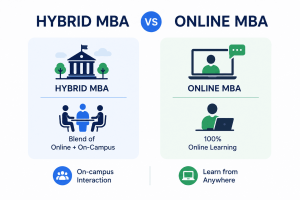






 Admission Open
 Admission Open
 Admission Open
 ROI Calculator