HOME > BLOG > AI and Machine Learning > AI in Education 2026: How Generative AI Is Changing Online MBA and Executive Learning in India
AI and Machine Learning
AI in Education 2026: How Generative AI Is Changing Online MBA and Executive Learning in India
J
By Shubham Lal
June 19, 20267 min read
Last updated on August 17, 2026
SHARE THIS ARTICLE
Table Of Content
The Evolution of Online Education in India
What Is Generative AI and Why Does It Matter?
How AI Is Transforming Online MBA Programs
The Impact of AI on Executive Education
The education landscape is undergoing one of the most significant transformations in its history. From traditional classrooms to digital learning platforms and now AI-powered education ecosystems, technology continues to redefine how learners acquire knowledge and develop professional skills.
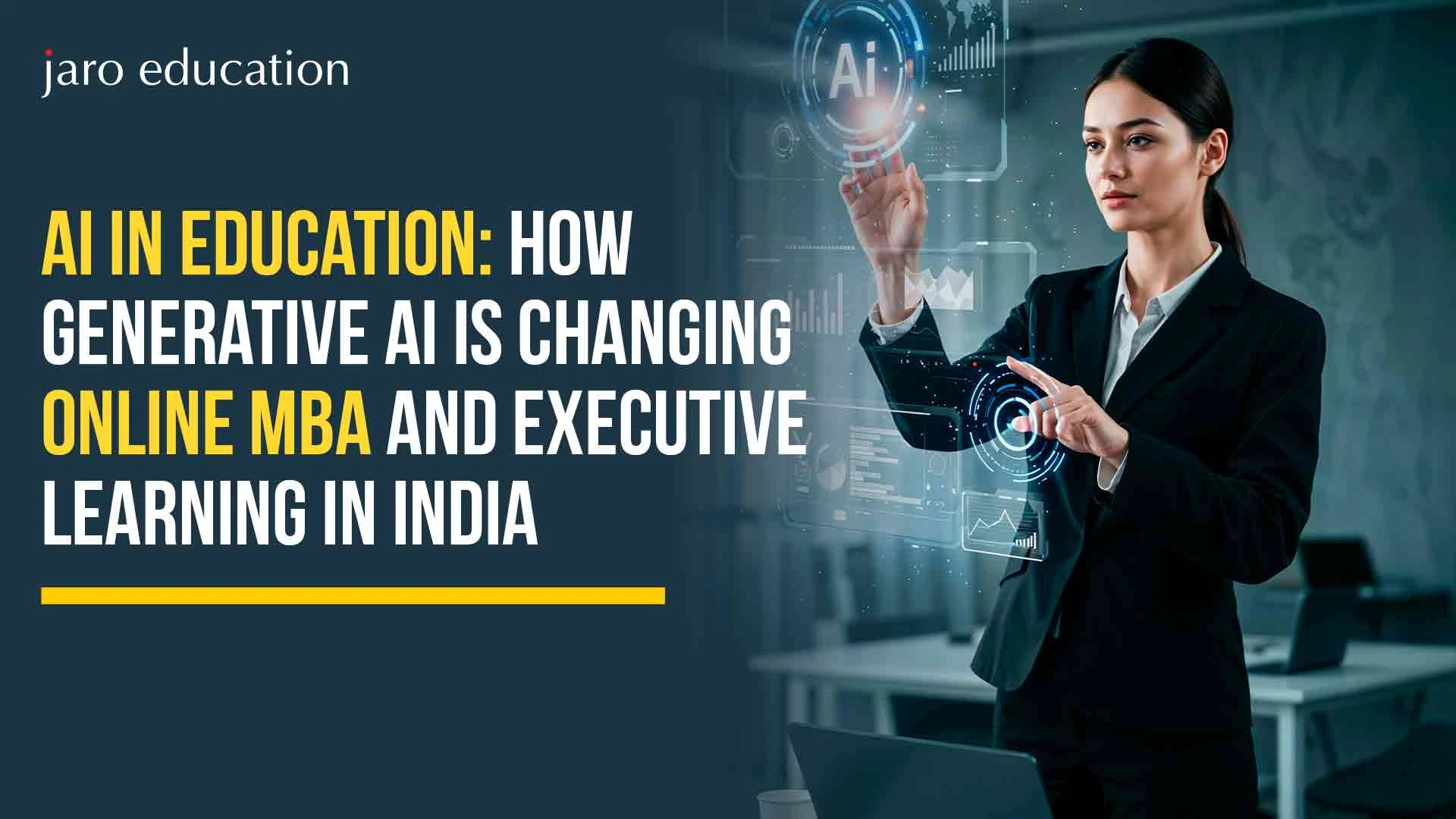
In 2026, Artificial Intelligence (AI) and Generative AI have moved beyond being emerging technologies. They are now actively shaping how educational institutions design courses, deliver content, assess performance, and personalise learning experiences. For professionals pursuing Online MBA programs and executive education, AI is creating opportunities that were unimaginable just a few years ago.
The growing adoption of AI-driven learning assistants, intelligent assessment systems, personalised study recommendations, and virtual mentoring is transforming the online learning experience across India. What was once a one-size-fits-all approach to education is rapidly evolving into highly customised learning journeys tailored to individual goals, learning styles, and career aspirations.
This shift is particularly evident in Online MBA and executive education programs, where learners seek practical skills, industry relevance, and flexibility. Institutions are increasingly integrating AI technologies into learning management systems, content delivery mechanisms, and career support services to improve learner outcomes.
As AI continues to reshape higher education, professionals who understand both business and technology stand to gain a significant advantage. In this article, we explore how Generative AI is changing online education in India, its impact on Online MBA and executive learning programs, and what professionals should expect from the future of AI-powered education.
Online education in India has evolved dramatically over the past decade.
Initially, online learning was primarily viewed as a convenient alternative to traditional classroom education. However, advancements in technology, widespread internet access, and growing acceptance of digital credentials have transformed online learning into a mainstream educational pathway.
Several factors have contributed to this evolution:
Improved internet accessibility
Growth of mobile-first learning platforms
Increased demand for flexible education
Rise of working professionals seeking upskilling opportunities
Expansion of UGC-recognised online degree programs
Adoption of advanced learning technologies
The emergence of Artificial Intelligence represents the next major milestone in this journey. AI is enabling educational institutions to move beyond simple content delivery and create more engaging, personalised, and outcome-driven learning experiences.
Generative AI refers to artificial intelligence systems capable of creating new content such as text, images, videos, code, and simulations based on user prompts and data inputs.
Unlike traditional AI systems that primarily analyse information, Generative AI can actively produce content and support complex problem-solving activities.
In education, Generative AI is helping institutions create dynamic learning environments where students receive immediate feedback, personalised guidance, and access to customised educational resources.
Online MBA programs are among the biggest beneficiaries of AI-driven innovation.
Traditional online learning platforms often relied heavily on recorded lectures and standardised course materials. AI is changing this by making learning more interactive, adaptive, and learner-centric.
Personalised Learning Paths
AI can analyse learner behaviour, performance, and preferences to recommend:
Relevant learning modules
Additional study resources
Skill development pathways
Career-focused electives
Instead of following a rigid curriculum, students can receive customised recommendations aligned with their career goals.
AI-Powered Learning Assistants
Virtual AI tutors are increasingly supporting students throughout their learning journey.
These assistants can:
Answer academic questions
Clarify concepts
Recommend study materials
Provide assignment guidance
Support exam preparation
This enables learners to access assistance whenever they need it.
Intelligent Assessments
AI-powered assessment systems are making evaluations more efficient and insightful.
These immersive experiences help bridge the gap between theory and practice.
The Impact of AI on Executive Education
Executive education programs are also experiencing significant transformation through AI integration.
Senior professionals often seek executive programs to address specific business challenges and acquire targeted skills. AI enables institutions to deliver more personalised and relevant learning experiences for this audience.
Hyper-Personalised Learning
Executive learners often have diverse backgrounds and goals.
AI systems can monitor learner progress throughout a program and provide recommendations for improvement.
This helps professionals focus on areas that offer the greatest career impact.
Better Industry Relevance
AI can analyse market trends, emerging technologies, and skill demands to help institutions continuously update program content.
As a result, executive education remains aligned with evolving industry requirements.
Benefits of AI in Online Education
The integration of Artificial Intelligence into education is creating significant value for students, professionals, institutions, and employers alike.
1. Personalised Learning Experiences
One of the biggest advantages of AI-powered education is personalisation.
Traditional education often follows a standardised approach where all learners consume the same content in the same format. AI changes this by adapting learning pathways based on individual performance, preferences, and goals.
Students can receive:
Personalised study recommendations
Custom learning schedules
Targeted skill development plans
Individualised feedback
This improves learning efficiency and engagement.
2. Improved Learning Outcomes
AI-powered analytics can identify learning gaps early and recommend corrective actions.
For example, if a student consistently struggles with financial management concepts in an MBA program, AI systems can suggest additional resources, practice exercises, or revision modules.
This proactive approach improves knowledge retention and overall performance.
3. 24/7 Learning Support
Unlike traditional classroom environments, AI-powered learning assistants are available around the clock.
Students can receive support for:
Academic queries
Assignment guidance
Course navigation
Concept clarification
This accessibility enhances the learning experience, particularly for working professionals managing education alongside career responsibilities.
4. Better Career Alignment
Modern AI systems can analyse industry trends and emerging skill requirements.
As a result, learners receive recommendations that align with:
Career aspirations
Industry demands
Future job opportunities
Leadership development goals
This helps professionals make more informed learning and career decisions.
5. Enhanced Accessibility
AI-powered technologies are making education more inclusive by supporting:
Real-time translation
Speech-to-text capabilities
Adaptive learning interfaces
Accessibility tools for diverse learners
This allows institutions to reach wider audiences across geographic and demographic boundaries.
Professionals who understand how AI impacts business processes will be better positioned for leadership roles in the future.
Employers increasingly value candidates who possess:
Strategic thinking skills
Digital literacy
Data-driven decision-making capabilities
Technology awareness
Business acumen
This is why many professionals are turning to Online MBA and executive education programs to strengthen their leadership capabilities while developing a deeper understanding of emerging technologies.
The goal is not necessarily to become AI experts but to become business leaders who can effectively leverage AI-driven tools and insights.
How Online MBA and Executive Programs Are Adapting
Leading educational institutions are actively redesigning their programs to reflect the realities of the AI-driven business environment.
Modern Online MBA and executive programs increasingly include topics such as:
Artificial Intelligence for Business
Learners gain an understanding of:
AI applications
Business transformation
AI strategy
Emerging technologies
Data Analytics and Decision-Making
Professionals learn how to interpret data, generate insights, and make informed business decisions.
Digital Transformation
Programs increasingly explore how technology is reshaping organisations and industries.
Innovation and Leadership
As automation handles routine tasks, leadership, creativity, and strategic thinking become even more important.
Modern programs therefore place greater emphasis on:
Change management
Innovation
Problem-solving
Strategic leadership
For professionals looking to remain competitive in a rapidly changing business environment, pursuing an Online MBA can provide both management expertise and exposure to emerging technologies.
The future of education is unlikely to be fully AI-driven or fully traditional. Instead, the most effective learning environments will combine technology with human expertise to deliver richer educational experiences.
Final Thoughts
The rise of AI in online education India 2026 represents a fundamental shift in how knowledge is delivered, consumed, and applied.
Generative AI is transforming Online MBA programs and executive education by making learning more personalised, accessible, and aligned with industry demands. From intelligent learning assistants and adaptive assessments to AI-powered career guidance and immersive simulations, technology is redefining what modern education looks like.
At the same time, the growing adoption of AI across industries means that professionals must continuously upgrade their skills to remain relevant in an increasingly competitive job market.
Whether you are an aspiring manager, a working professional, or a senior executive, investing in future-ready education can help you navigate this transformation with confidence. Online MBA and executive learning programs that integrate technology, leadership development, and business strategy are likely to play a crucial role in preparing professionals for the AI-powered future of work.
Frequently Asked Questions
AI is transforming online education through personalised learning pathways, intelligent tutoring systems, automated assessments, real-time feedback, and AI-driven career guidance.
Generative AI refers to AI systems that can create content such as text, images, simulations, and learning materials, helping students and educators improve productivity and learning experiences.
AI enhances Online MBA programs through adaptive learning, virtual tutors, personalised recommendations, intelligent assessments, and advanced business simulations.
Key benefits include personalised education, improved learning outcomes, 24/7 support, better career alignment, enhanced accessibility, and more efficient assessments.
Yes. Challenges include data privacy concerns, potential bias in AI systems, academic integrity issues, and the risk of excessive dependence on technology.
AI is transforming business functions across industries. Understanding its applications can help professionals make better decisions, improve productivity, and remain competitive in the job market.
Absolutely. Online MBA programs continue to be highly relevant because they help professionals develop leadership, strategic thinking, and business management skills while increasingly incorporating AI and digital transformation concepts into their curriculum.
Shubham Lal
Lead Software Developer
Shubham Lal joined Microsoft in 2017 and brings 8 years of experience across Windows, Office 365, and Teams. He has mentored 5,000+ students, supported 15+ ed-techs, delivered 60+ keynotes including TEDx, and founded AI Linc, transforming learning in colleges and companies.
 HOME > BLOG > AI and Machine Learning > AI in Education 2026: How Generative AI Is Changing Online MBA and Executive Learning in India
 June 19, 2026
 7 min read




 ChatGPT
 Perplexity
 Claude
 Grok
Grok




 Admission Open
 Admission Closed
 Admission Open

 ROI Calculator