Velocity: The Speed of Data in the 5 Vs of Big Data
Variety: Different Forms of Data Explained
Key Insights
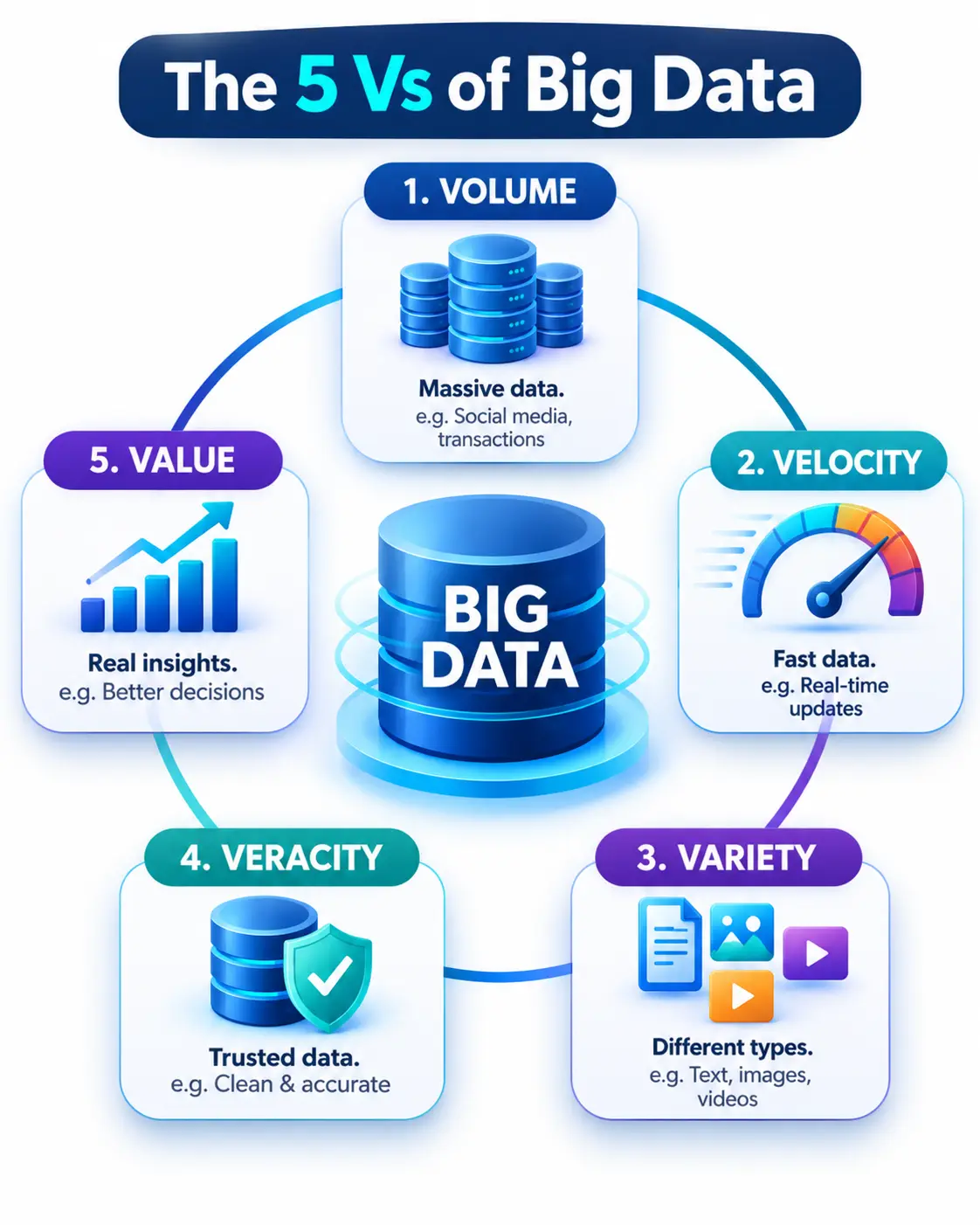
The 5 Vs of Big Data are Volume, Velocity, Variety, Veracity, and Value. Together, they explain the size, speed, diversity, quality, and usefulness of large datasets.
Volume focuses on the amount of data generated, while Velocity refers to how quickly data is created, collected, and processed. Technologies such as Hadoop, Apache Kafka, and Apache Spark help manage these challenges.
Variety covers structured, semi-structured, and unstructured data, while Veracity focuses on data accuracy and reliability through data cleaning, validation, and governance.
Value highlights the importance of converting data into meaningful business outcomes, such as better decisions, improved efficiency, personalised customer experiences, and new revenue opportunities.
In this blog, you'll learn the meaning and importance of the 5 Vs of Big Data, their practical applications through Netflix and healthcare examples, the technologies used to manage them, and their relevance to data science careers.
Every time you stream a movie, tap a payment app, or scroll through social media, you create data. Multiply that by billions of people, and you get a flood of information that traditional tools simply cannot handle. This is where the 5 Vs of big data come in. They offer a simple framework for understanding what makes big data different, difficult, and valuable. Whether you are a student, a working professional, or a business leader, knowing these concepts is the first step toward a career in analytics. If you are planning to build that career with a structured, industry-aligned curriculum, you may also explore theOnline Master of Science in Data Science from Christ University, which covers these foundations in depth. In this blog, we explain the 5 Vs of big data in plain language, with practical examples.
The 5 Vs in big data are five characteristics used to describe large and complex datasets: Volume, Velocity, Variety, Veracity, and Value. The idea began with three Vs (Volume, Velocity, and Variety), introduced by industry analyst Doug Laney in the early 2000s. As organizations began working with real-world data at scale, two more Vs were added: Veracity, which focuses on data quality, and Value, which focuses on business benefit.
Together, these five characteristics help us answer important questions. How much data do we have? How fast is it arriving? What forms does it take? Can we trust it? And, most importantly, can we turn it into something useful? Let us look at each one closely.
Volume refers to the sheer amount of data generated and stored. We no longer measure data in megabytes or gigabytes. Modern organizations deal with terabytes, petabytes, and even exabytes. To put this in perspective, global data creation is now measured in zettabytes every year, and the number keeps climbing.
Where does all this data come from? Social mediaposts, online transactions, sensors, security cameras, mobile apps, medical devices, and emails all contribute. A single airplane engine, for example, can generate several terabytes of data during one flight.
Volume matters because traditional databases were never built for this scale. Storing and processing such quantities requires distributed systems like Hadoop, cloud storage platforms, and data lakes. These technologies spread the load across many machines, making it possible to handle enormous datasets without a single system collapsing.
However, more data is not automatically better. The real challenge is deciding what to store, how long to keep it, and how to manage the cost. A company that collects everything without a plan often ends up with expensive storage and very little insight.
Velocity: The Speed of Data in the 5 Vs of Big Data
Velocity describes how quickly data is created, collected, and processed. In many industries, data does not arrive in neat daily batches anymore. It streams in continuously, often every second.
Think about a stock market. Prices change in milliseconds, and traders need to act on that information instantly. Think about a ride-hailing app that must match drivers and passengers in real time, or a credit card company that must detect a fraudulent transaction before it is approved. In each case, delayed analysis means lost money or lost trust.
To manage velocity, organizations use real-time processing tools such as Apache Kafka, Apache Spark Streaming, and Apache Flink. These systems ingest, analyze, and respond to data as it flows, rather than waiting until it is stored.
Velocity also shapes customer experience. When an online store recommends a product moments after you view a similar one, that is velocity at work. The faster a business can turn incoming data into action, the stronger its competitive edge.
Variety: Different Forms of Data Explained
Variety refers to the many types and formats of data. In the past, most business data was neat and structured, stored in rows and columns inside relational databases. Today, that is only a small part of the picture.
Big data typically falls into three categories:
Structured data: Organized and easy to search, such as customer tables, sales records, and bank statements.
Semi-structured data: Partly organized, such as JSON files, XML documents, and emails with tags.
Unstructured data: No fixed format, such as images, videos, audio recordings, social media posts, and PDF documents.
Experts estimate that a large majority of the data produced today is unstructured. That makes variety one of the hardest of the 5 Vs in big data to handle. Analyzing a spreadsheet is straightforward. Analyzing thousands of customer voice calls, product photos, and chat messages together is far more complex.
Technologies such as NoSQL databases, natural language processing, and computer vision help organizations make sense of this diversity. When businesses combine different data types, they uncover patterns that a single source would never reveal.
Veracity deals with the accuracy, reliability, and trustworthiness of data. Having a huge amount of fast, varied data means little if it is wrong, incomplete, or biased. As the saying goes, poor input leads to poor output.
Data can become unreliable for many reasons: duplicate records, human entry errors, faulty sensors, outdated information, missing values, or inconsistent formats across systems. Social media data adds another layer, as it often includes opinions, sarcasm, and even fake accounts.
The consequences are serious. A hospital relying on incorrect patient records could make unsafe decisions. A bank using flawed data may approve the wrong loans. A business that trusts misleading numbers may invest in the wrong strategy.
To protect veracity, organizations follow practices such as data cleaning, validation checks, data governance policies, and clear ownership of data sources. Data scientistsspend a large portion of their time on this step, because high-quality data is the foundation of every reliable model and report.
Value: Turning Data into Business Benefit
Value is often called the most important of the 5 Vs of big data. It asks a simple question: what do we gain from all this data? Collecting and storing information is pointless unless it leads to better decisions, improved efficiency, new revenue, or happier customers.
Value appears in many forms. A retailer may use purchase history to personalize offers and increase sales. A hospital may use patient data to predict health risks early. A logistics company may analyze delivery routes to cut fuel costs. A government may study traffic patterns to reduce congestion.
Unlocking value requires more than technology. It needs clear business goals, skilled professionals, and the right analytical methods, including statistics, machine learning, and data visualization. Without these, even the best data infrastructure remains an expensive archive.
In short, the first four Vs describe the nature of data, while Value describes its purpose. Everything else exists to support this final goal.
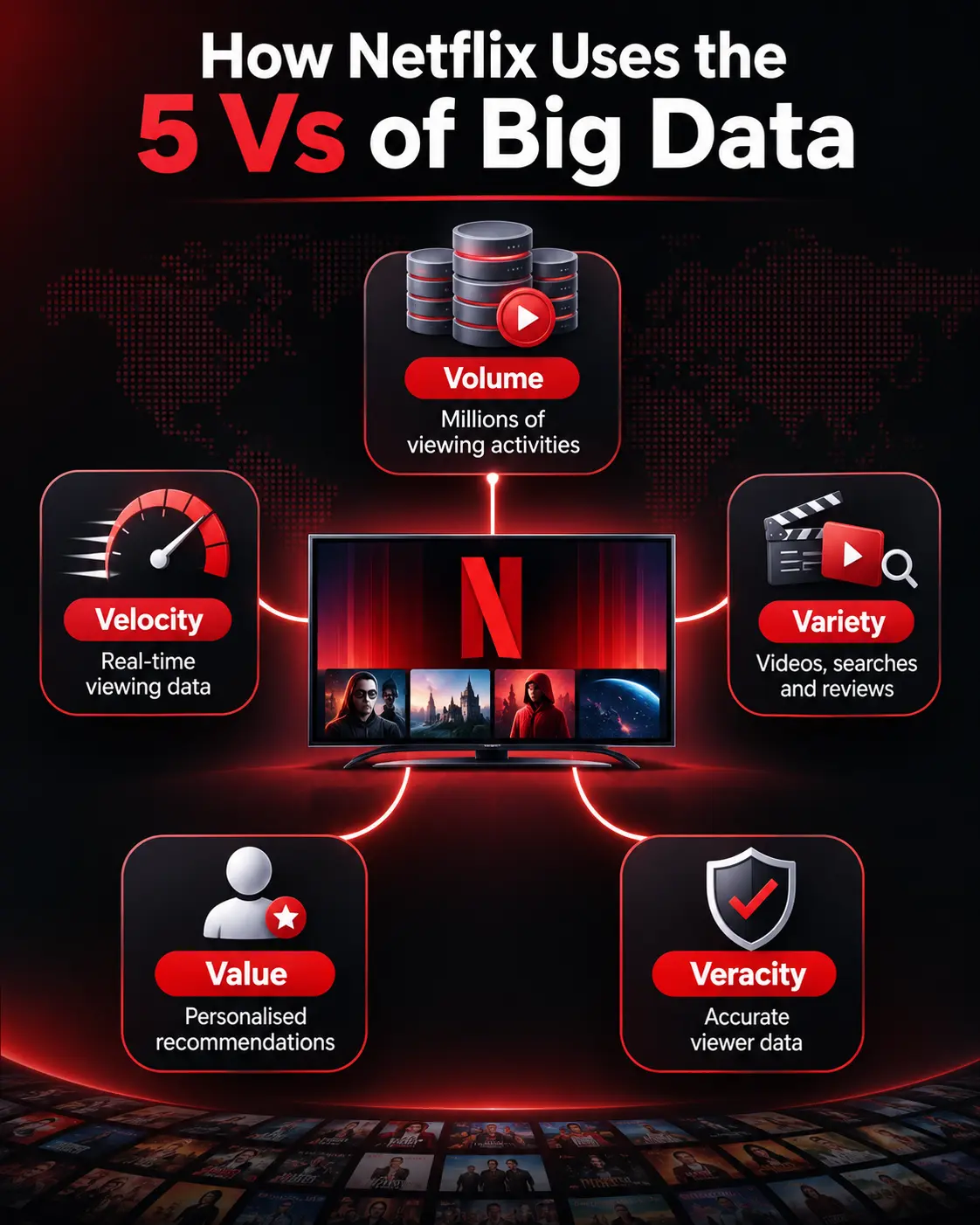
5 Vs of Big Data with Example: How Netflix Uses Them
Theory becomes clearer with a real case. Here is a 5 Vs of big data with example using Netflix, a platform many of us know well.
Volume: Netflix serves hundreds of millions of subscribers worldwide. Every play, pause, rewind, and search adds to a massive pool of viewing data.
Velocity: This activity happens continuously. Netflix processes viewing events in near real time to update recommendations and monitor streaming quality as it happens.
Variety: The data includes structured records such as subscription details, semi-structured logs from devices, and unstructured content such as thumbnails, subtitles, and user reviews.
Veracity: Netflix must ensure its data is accurate. Duplicate profiles, shared accounts, and inconsistent device logs can distort what it believes about viewer taste, so cleaning and validation are essential.
Value: The payoff is significant. Personalized recommendations keep viewers engaged, reduce cancellations, and guide decisions about which shows to produce or license.
This example shows how all five characteristics work together. Remove any one of them, and the system becomes weaker.
Another quick illustration comes from healthcare. Wearable devices produce a high volume of health readings every second (velocity), in formats ranging from heart rate numbers to ECG images (variety). If the readings are accurate (veracity), doctors can detect warning signs early, which delivers real value to patients.
Understanding the 5 Vs of big data is not just an academic exercise. It shapes how data professionals design systems, choose tools, and solve business problems. Roles such as data analyst, data engineer, data scientist, and business intelligence specialist all rely on these concepts daily.
Demand for such skills continues to grow across banking, healthcare, retail, telecom, e-commerce, and government. Employers look for professionals who can handle large datasets, ensure data quality, and translate findings into clear recommendations. A solid grounding in big data principles, combined with hands-on training in Python, SQL, machine learning, and analytics tools, can open many doors.
For learners, the best approach is to start with the fundamentals, practice on real datasets, and gradually move toward advanced topics such as cloud computing and artificial intelligence. A structured program with expert faculty and industry projects can make this journey smoother and more rewarding.
Conclusion
The 5 Vs of big data (Volume, Velocity, Variety, Veracity, and Value) give us a clear and practical lens for understanding modern data. Volume tells us how much data exists. Velocity shows how fast it moves. Variety reveals the many forms it takes. Veracity checks whether we can trust it. Value confirms whether it actually helps us. When organizations balance all five, they move from simply collecting data to making smarter, faster, and more confident decisions. For anyone aiming to work in analytics, mastering these basics is a strong and necessary starting point.
Frequently Asked Questions
The 5 Vs of big data are Volume, Velocity, Variety, Veracity, and Value. They describe the size, speed, diversity, quality, and usefulness of large datasets.
They help organizations understand the challenges and opportunities of handling large datasets. By studying each V, businesses can choose the right tools, improve data quality, and focus on outcomes that truly matter.
Many experts consider Value the most important, because the purpose of big data is to deliver useful insights. That said, the other four Vs support it. Without good volume, speed, variety, and veracity, value is difficult to achieve.
Yes. Some experts have proposed additional Vs, such as Variability (changing data meaning), Visualization (presenting data clearly), and Validity. However, Volume, Velocity, Variety, Veracity, and Value remain the most widely accepted framework.
Shubham Lal
Lead Software Developer
Shubham Lal joined Microsoft in 2017 and brings 8 years of experience across Windows, Office 365, and Teams. He has mentored 5,000+ students, supported 15+ ed-techs, delivered 60+ keynotes including TEDx, and founded AI Linc, transforming learning in colleges and companies.

 November 21, 2026
 7 min read





 Key Insights
 ChatGPT
 Perplexity
 Claude
 Grok











 ROI Calculator