Growth hacking combines creativity, data, and continuous experimentation to find cost-effective ways to achieve business growth.
It focuses on the entire customer journey, including acquisition, activation, retention, referrals, and revenue, rather than only brand awareness.
A successful growth hacking strategy involves setting clear goals, understanding customers, prioritising ideas, running experiments, analysing results, and scaling what works.
Popular growth hacker marketing techniques include referral programmes, content marketing, SEO, email campaigns, free trials, A/B testing, social proof, and partnerships.
Growth hackers need analytical thinking, digital marketing knowledge, creativity, basic technical understanding, communication skills, and customer empathy.
In this blog, you'll learn what growth hacking is, how it differs from traditional marketing, the role and skills of growth hackers, the step-by-step strategy, popular techniques, real-world examples, and commonly used tools.
Every business wants to grow, but not every business has a large marketing budget. Startups and small companies, in particular, need to find smart, low-cost ways to attract and keep customers. This need gave rise to growth hacking, an approach that combines creativity, data, and constant experimentation to achieve rapid and sustainable growth. In this comprehensive guide, we explain what growth hacking means, how it works, who growth hackers are, and how you can build a practical strategy of your own, all in simple and clear language.
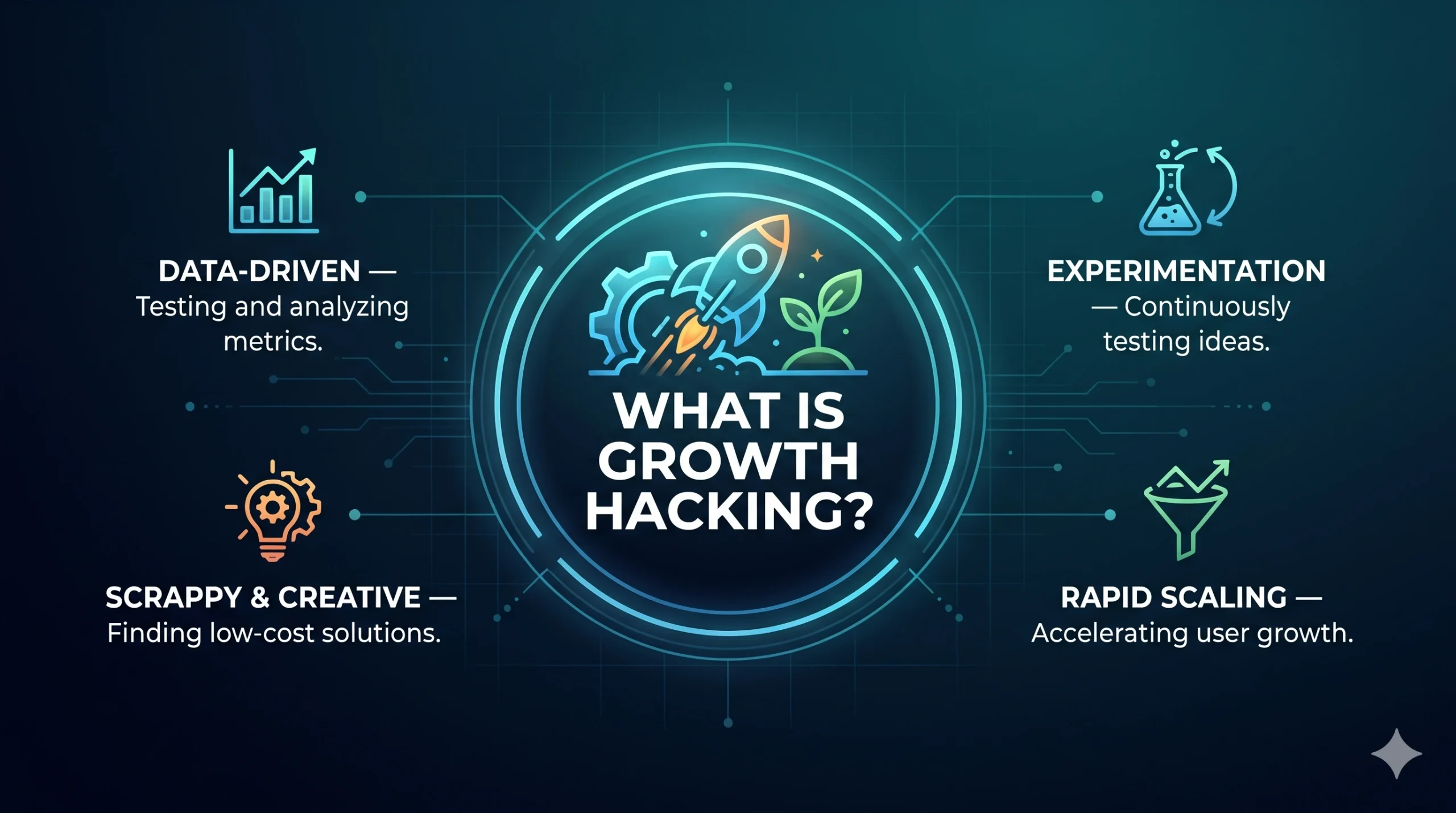
Growth hacking is a process of rapidly testing ideas across marketing, product, and sales to discover the most effective ways to grow a business. Instead of relying on one big campaign, growth teams run many small experiments, measure the results, and then put more effort into what works.
The word “hacking” does not mean anything unethical. It refers to finding clever shortcuts and unconventional solutions to common business problems. A growth hack could be as simple as adding a referral reward, improving a sign-up page, or changing the wording of an email subject line. What matters is that every idea is tested and measured.
Three principles sit at the center of growth hacking:
Experimentation: every idea is treated as a hypothesis to test, not a certainty.
Data: decisions are based on numbers and customer behavior, not opinions.
Speed: teams learn quickly, drop what fails, and scale what succeeds.
The term was introduced in 2010 by entrepreneur Sean Ellis, who used it to describe people whose main focus is growing a company, with every decision tied to that goal. Early technology startups such as Dropbox, Airbnb, and Hotmail made the approach popular because they needed fast growth with limited resources. Since then, companies of all sizes, from small online stores to global brands, have adopted growth thinking.
Growth Hacking vs. Traditional Marketing
Traditional marketing often follows a long planning cycle. A team creates a large campaign, runs it for months, and reviews the results afterward. Growth hacking works differently.
Focus: Traditional marketing focuses mainly on awareness and brand building. Growth hacking focuses on the full customer journey, including activation, retention, and referrals.
Budget: Traditional campaigns often need large budgets. Growth experiments are typically low-cost and easy to start.
Speed: Traditional campaigns can take months. Growth teams run tests in days or weeks.
Team: Marketing teams may work separately from product and engineering. Growth teams work across departments.
Measurement: Growth hacking is built around clear metrics and quick feedback.
Neither approach is better in every situation. Many successful companies combine brand marketing with growth experiments to get the best of both.
Free Courses
Free Digital Marketing Course – Marketing in New Age Digital World
Growth hackers digital professionals are marketers, analysts, product thinkers, and sometimes developers whose job is to find new and efficient ways to grow a business online. They sit at the meeting point of creativity and analytics. One day they may be reviewing website data, and the next day they may be writing a new email sequence or testing a different pricing page.
A typical growth hacker does the following:
Studies customer behavior and identifies where people drop off.
Comes up with ideas to improve acquisition, activation, and retention.
Works with product, design, sales, and engineering teams.
Shares learnings so the whole organization improves.
This role has become popular in startups, e-commerce companies, software businesses, mobile app companies, and digital agencies.
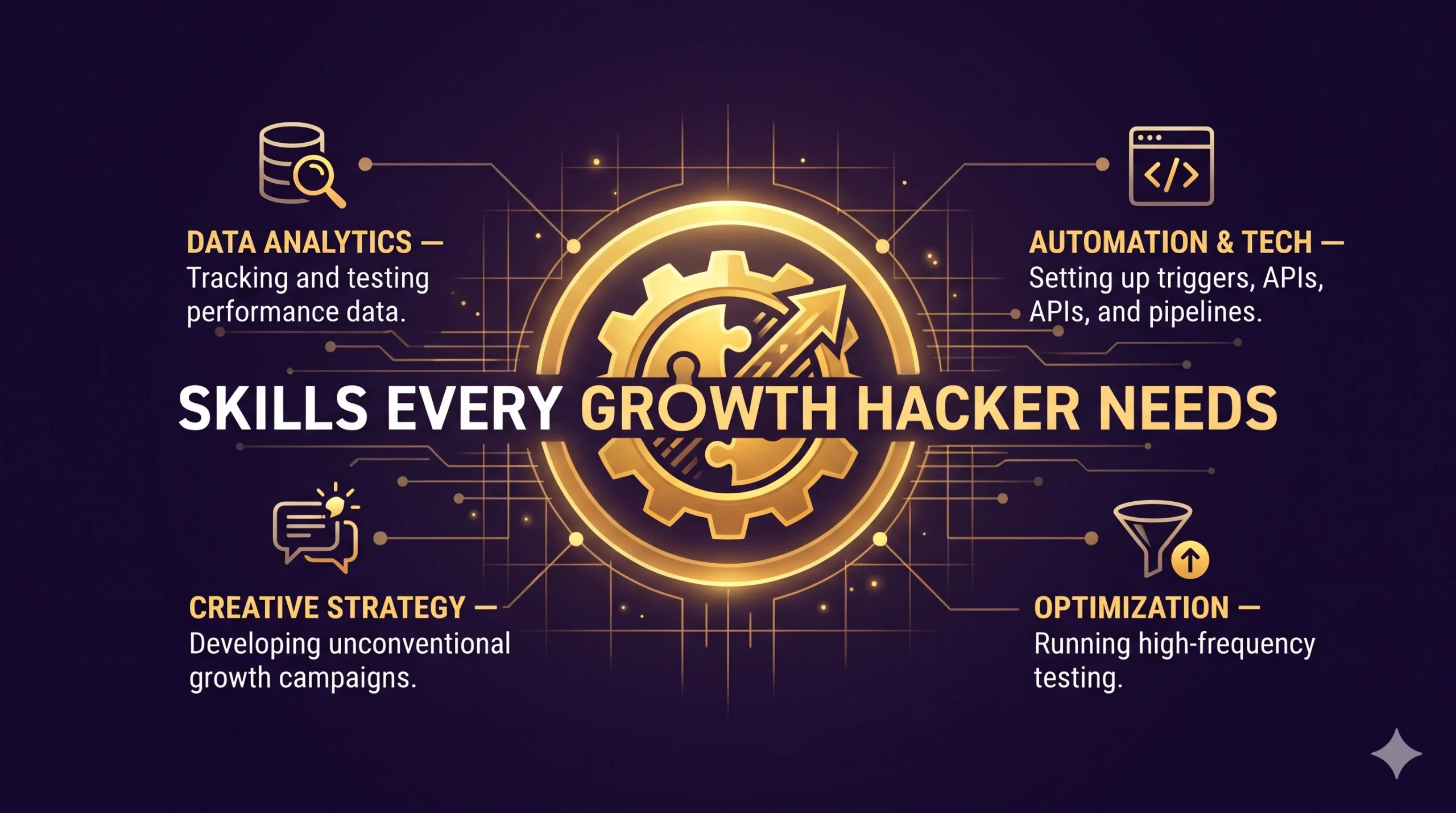
Skills Every Growth Hacker Needs
Good growth hackers are curious, flexible, and comfortable with numbers. Important skills include:
Analytical thinking: reading data and spotting patterns.
Digital marketing knowledge: SEO, content, email, social media, and paid advertising.
Basic technical understanding: familiarity with websites, tracking tools, and simple automation.
Creativity: generating fresh ideas that others may overlook.
Communication: explaining results and ideas clearly to different teams.
Customer empathy: understanding what people truly need and why they act the way they do.
You do not need to be an expert in everything. Many professionals start in one area, such as content or analytics, and build the other skills over time.
Growth Hacking Strategy: A Step-by-Step Framework
A strong growth hacking strategy gives structure to your experiments so that you are not just trying random tactics. Here is a simple framework that you can follow.
Step 1: Set a clear goal
Decide what you want to improve. This could be website sign-ups, monthly active users, repeat purchases, or revenue. Many teams choose one main metric, often called the North Star Metric, to keep everyone focused.
Step 2: Understand your customers
Use surveys, interviews, reviews, and analytics to learn who your customers are, what problems they face, and how they find you. Good ideas often come from real customer insights.
Step 3: Confirm product-market fit
Growth tactics work best when people already want what you offer. If customers leave quickly or rarely return, improve the product first. Marketing cannot fix a product that people do not value.
Step 4: Generate ideas
Hold brainstorming sessions with your team and collect ideas for every stage of the customer journey. At this point, quantity matters more than perfection.
Step 5: Prioritize your ideas
You cannot test everything at once. Many teams score each idea on its potential impact, confidence in success, and ease of execution, often called the ICE method. Start with ideas that score highest.
Step 6: Run experiments
Test one idea at a time, set a clear success measure, and run the experiment for a fixed period. For example, you might test two versions of a landing page to see which leads to more sign-ups.
Step 7: Analyze and learn
Review the results honestly. Even failed experiments are valuable because they show what does not work and help you avoid wasting resources.
Step 8: Scale what works
When an experiment succeeds, expand it to a larger audience or additional channels. Then return to your list and begin the next test. Growth hacking is a continuous cycle, not a one-time project.
Understanding the Growth Funnel (AARRR)
Many teams use a model known as the AARRR framework, sometimes called pirate metrics. It breaks the customer journey into five stages:
Acquisition: how people discover your business.
Activation: whether they have a good first experience.
Retention: whether they come back and keep using your product.
Referral: whether they recommend you to others.
Revenue: how they generate income for your business.
By checking each stage, you can find the weakest point in your funnel and focus your experiments there. For instance, if many visitors arrive but few sign up, the problem is probably activation, not acquisition.
Popular Growth Hacker Marketing Techniques
Growth hacker marketing uses many channels, and the right mix depends on your business and audience. Some widely used techniques include:
Referral programs: rewarding existing customers for inviting friends.
Content marketing and SEO: publishing helpful content that attracts search traffic over time.
Email marketing: sending personalized messages, onboarding sequences, and re-engagement campaigns.
Freemium and free trials: letting people try a product before they pay.
A/B testing: comparing two versions of a page, email, or advertisement to see which performs better.
Social proof: displaying reviews, testimonials, and user numbers to build trust.
Partnerships and collaborations: reaching new audiences through other brands or creators.
Viral loops: designing products so that normal use encourages sharing.
The best growth hacker marketing feels natural and useful to the customer. It does not rely on tricks or pressure.
Real-World Growth Hacking Examples
Looking at well-known cases helps you understand how simple ideas can create big results.
Dropbox: The company offered extra storage space to users who invited friends. This gave both the existing user and the new user a reason to join, and the product spread quickly through referrals.
Hotmail: Early on, every email sent from the service carried a short message inviting recipients to get their own free account. Each user became a small advertisement for the service.
Airbnb: The company found ways to reach people who were already searching for accommodation on other platforms, helping it attract early users without a large advertising budget.
The common lesson is that these companies built growth into the way their products worked, instead of treating marketing as a separate activity.
The right tools make experiments faster and easier to measure. Teams commonly use:
Analytics tools such as Google Analytics to track website and app behavior.
A/B testing tools to compare different versions of pages and messages.
Email and automation platforms to manage campaigns and customer journeys.
Customer feedback tools such as survey and heatmap software.
SEO tools to research keywords and monitor rankings.
Start with a few simple tools and add more only when you truly need them.
Final Thoughts
Growth hacking is not a magic formula. It is a disciplined way of thinking that encourages curiosity, learning, and steady improvement. By understanding your customers, testing ideas quickly, and focusing on the entire customer journey, you can grow even with limited resources. Whether you are a business owner, a marketer, or a student planning a career in digital marketing, learning the basics of growth hacking strategy will give you a valuable advantage. Begin with a clear goal, run small experiments, learn from every result, and keep improving.
Frequently Asked Questions
Growth hacking is a method of growing a business quickly by running many small, low-cost experiments and focusing on what produces the best results. It combines marketing, data, and product thinking.
No. It began in startups because of their need for fast, affordable growth, but companies of all sizes now use it. Any business that wants to improve results through testing and data can benefit.
A digital marketer often focuses on specific channels such as social media, email, or search. A growth hacker looks at the entire customer journey, including product and retention, and uses constant experimentation to find the fastest paths to growth.
Begin by learning the basics of digital marketing and analytics. Practice by running small experiments on a personal website, blog, or social media page. Build a portfolio that shows your tests and results, and keep learning about new tools and techniques.
Priya Sahu
Sales & Digital Marketing Strategist
Sales and Marketing professional with 6+ years of experience in B2B and B2C growth, specializing in business development and digital marketing. Skilled in CRM systems, paid campaigns, and AI-driven strategies to drive revenue, optimize performance, and build lasting client relationships.
Get Free Upskilling Guidance
Fill in the details for a free consultation
Related Courses
Explore our programs
Achieving Excellence in Marketing: Programme for Marketing Executives

 November 25, 2026
 7 min read





 Key Insights
 ChatGPT
 Perplexity
 Claude
 Grok












 ROI Calculator