Edge AI processes data directly on local devices, enabling faster decisions, better privacy, and reduced dependence on internet connectivity.
Unlike cloud AI, edge AI performs real-time processing on or near devices, while cloud AI relies on remote servers. Both technologies often work together, with the cloud training models and edge devices running them.
Edge AI uses a six-step process involving data collection, cloud-based model training, model optimisation, deployment, real-time inference, and continuous improvement.
Techniques such as quantization, pruning, knowledge distillation, and federated learning help make AI models more efficient while supporting local processing and data privacy.
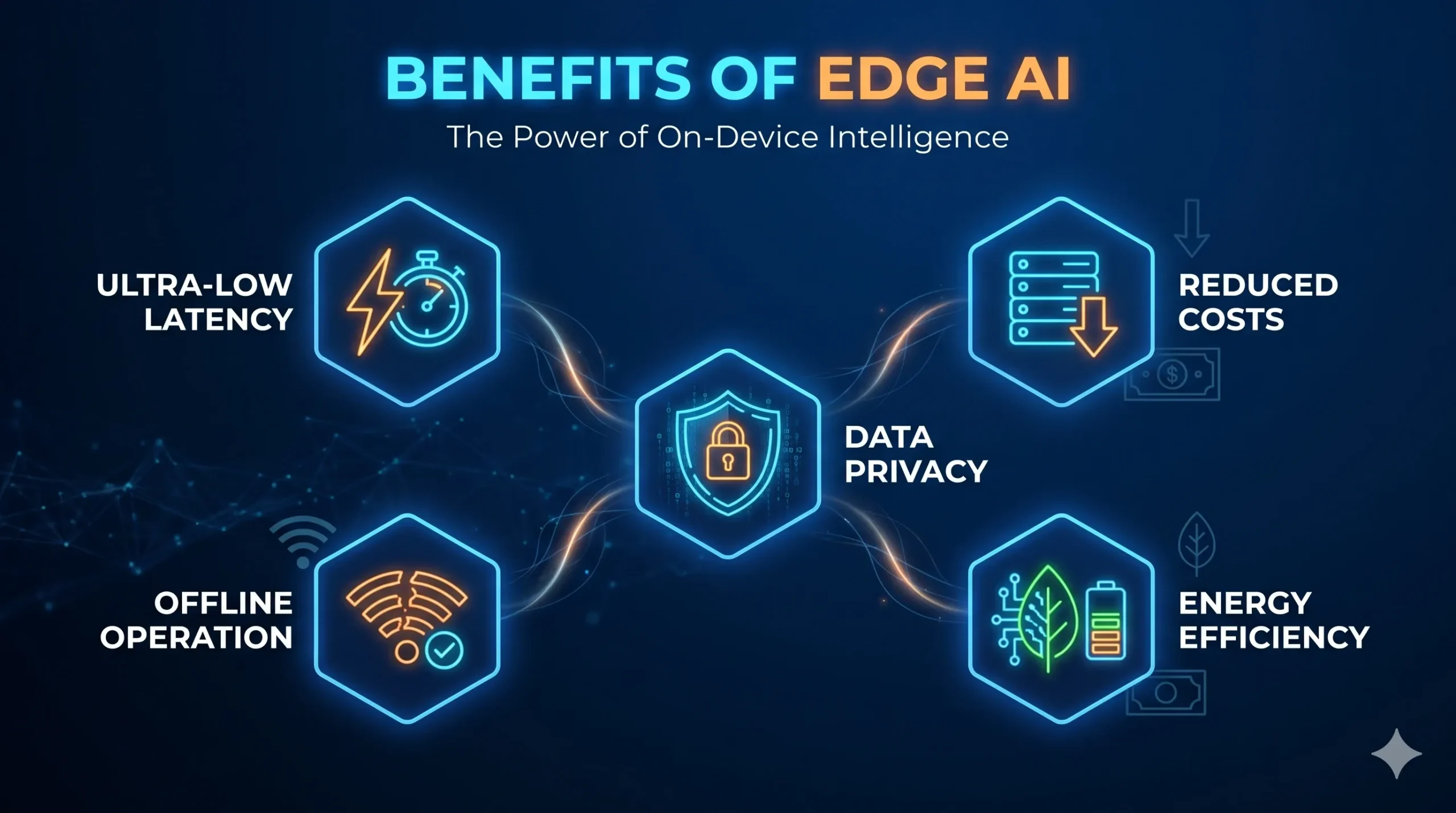
Edge AI offers benefits such as low latency, improved security, reduced bandwidth costs, reliable performance, energy efficiency, and scalability across industries.
In this blog, you'll learn what Edge AI is, how it works, its differences from cloud AI, key benefits, applications across industries, and its future in artificial intelligence.
Every time your phone unlocks with your face, your smartwatch flags an irregular heartbeat, or a car warns you about a pedestrian, artificial intelligence is making a decision in a split second. What many people do not realize is that much of this intelligence no longer travels to a faraway data center. It happens right on the device itself. This is the idea behind edge AI, and it is changing how businesses and everyday products use data.
As more organizations adopt this approach, the demand for professionals who understand both data and intelligent systems is growing quickly. Learners who want to build that foundation often explore structured options such as anonline M.Sc. in Data Science and AIto gain practical, career-ready skills. In this blog, we explain what edge AI is, how it works, and where it is being used today, in simple and easy-to-follow language.
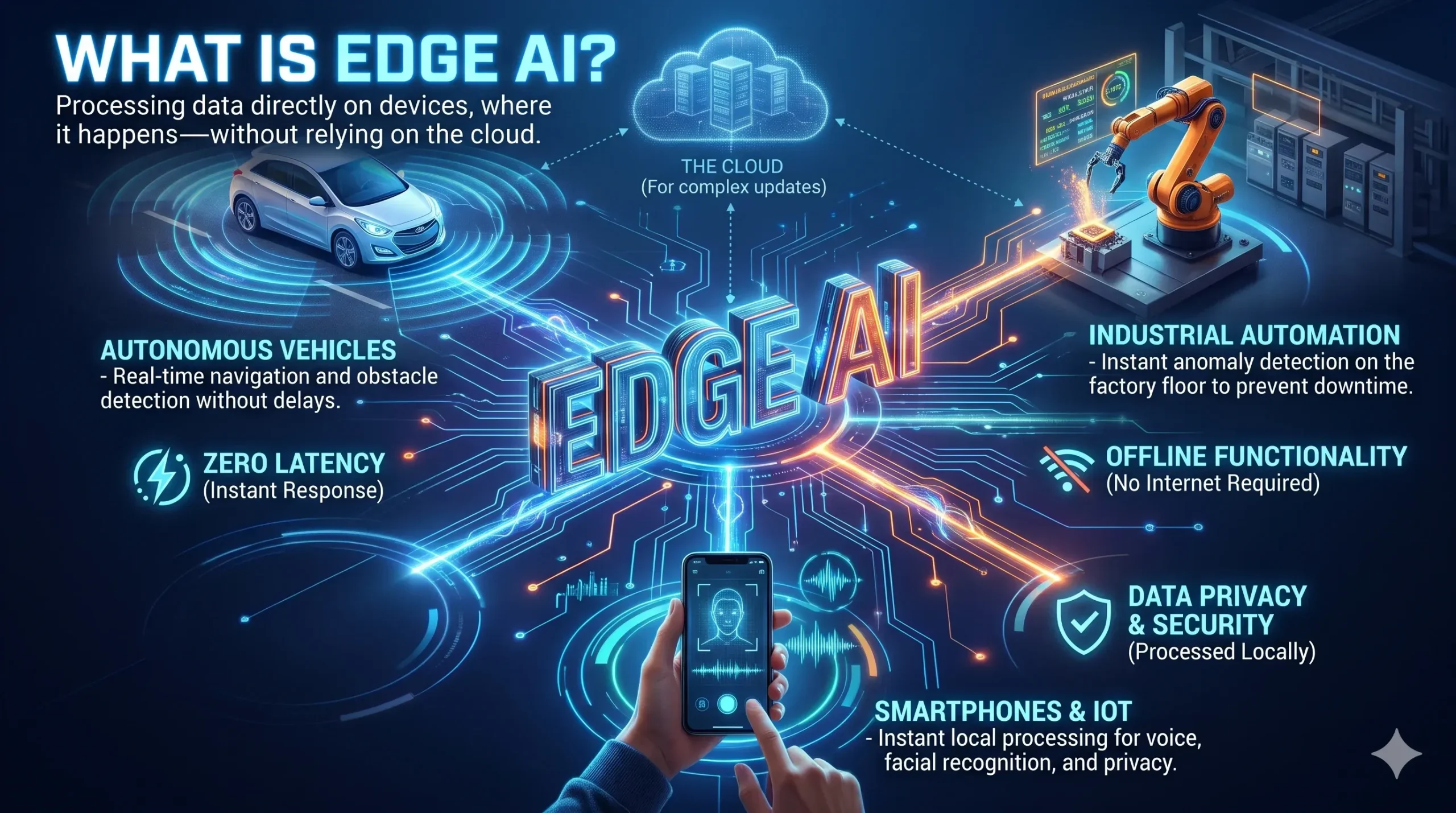
Edge AI refers to runningartificial intelligencealgorithms directly on local devices, close to where data is created. These devices can be smartphones, cameras, sensors, wearables, vehicles, factory machines, or small computers installed at a site. Instead of sending raw data to a remote cloud server for processing, the device analyzes the data on the spot and acts on it immediately.
The word “edge” simply means the outer boundary of a network, where physical devices meet the digital world. When AI lives at this boundary, decisions become faster, more private, and less dependent on internet connectivity.
A simple example helps here. Imagine a security camera in a warehouse. In a traditional setup, the camera streams video to the cloud, where an AI model checks for unusual activity. With edge AI, the camera has a small AI chip inside. It detects the activity itself and sends only an alert, not hours of footage. This saves bandwidth, reduces delay, and keeps sensitive video data local.
To understand edge AI clearly, it helps to compare it with cloud AI, which has been the more common approach for years.
Where processing happens. In cloud AI, data travels to powerful remote servers for analysis. In edge AI, processing happens on the device or a nearby local system.
Speed. Cloud AI depends on network travel time, which can add delay. Edge AI responds in milliseconds because the data does not need to leave the device.
Connectivity. Cloud AI needs a stable internet connection. Edge AI can keep working even when the connection is weak or completely offline.
Privacy. With cloud AI, personal or sensitive data moves across networks and is stored elsewhere. With edge AI, much of the data stays on the device.
Computing power. The cloud offers almost unlimited computing power, which is ideal for training large models. Edge devices have limited power, so the models must be small and efficient.
In practice, the two are not rivals. Most real-world systems use both. The cloud trains the models, and the edge runs them. This partnership is what makes modern intelligent systems so effective.
How Edge AI Works: A Look at AI Edge Computing
AI edge computing combines two ideas: artificial intelligence and edge computing. Edge computingmoves data processing closer to the source, and AI gives that processing the ability to understand, predict, and decide. Here is how the process usually works, step by step.
Step 1: Data Collection
Sensors, cameras, microphones, and other input devices collect data from the physical world. This could be temperature readings from a machine, images from a camera, or motion data from a wearable.
Step 2: Model Training in the Cloud
Training an AI model needs a large amount of data and heavy computing power. This work is usually done in the cloud or in a data center. Engineers feed the model thousands or millions of examples so it learns to recognize patterns, such as a defective product on an assembly line or a particular spoken command.
Step 3: Model Optimization
A trained model is often too large for a small device. So it is compressed and optimized using techniques such as quantization (reducing the precision of numbers), pruning (removing unnecessary parts of the model), and knowledge distillation (teaching a small model to mimic a large one). The result is a lightweight model that still performs well.
Step 4: Deployment to the Edge Device
The optimized model is installed on the edge device. Many modern devices include specialized hardware such as neural processing units (NPUs), graphics processing units (GPUs), or low-power AI chips designed for this exact job.
Step 5: Real-Time Inference
Now the device can perform inference, which means using the trained model to make predictions on new data. A camera identifies a face, a sensor predicts a machine failure, or a phone transcribes speech, all within milliseconds and without needing the cloud.
Step 6: Continuous Improvement
Edge devices can occasionally send selected data or performance summaries back to the cloud. Engineers use this information to retrain and improve the model, then push updates to the devices. This loop keeps the system accurate over time.
Understanding Edge Intelligence
You may also hear the term edge intelligence. It describes the ability of devices and local systems to learn from data, make decisions, and adapt without constant help from a central server. While edge AI focuses on running AI models at the edge, edge intelligence is a broader idea. It includes training, updating, and coordinating models across many connected devices.
One popular technique in this area is federated learning. Here, each device learns from its own local data and shares only the learning, not the raw data, with a central system. The central model improves by combining these lessons. For example, a keyboard app on your phone can learn your typing habits and help improve predictions for millions of users, without your private messages ever leaving your phone.
Edge intelligence is important because it makes systems smarter, more personal, and more respectful of privacy at the same time. As devices become more powerful, we can expect them to do more learning on their own.
Organizations are investing in edge AI for several practical reasons.
Low latency: Decisions happen almost instantly. This is critical in situations like autonomous driving or robotic surgery, where even a small delay can cause serious problems.
Better privacy and security: Keeping data on the device reduces the risk of exposure during transmission. This helps businesses meet data protection rules and builds user trust.
Reduced bandwidth costs: Sending video, audio, and sensor data to the cloud is expensive. Edge AI processes data locally and sends only what matters.
Reliable performance: Devices keep working in remote areas, on ships, in mines, or in places with poor internet access.
Energy efficiency: Efficient local processing can reduce the energy spent on moving large amounts of data across networks.
Scalability: Because each device handles its own processing, businesses can add thousands of devices without overloading a central server.
Edge AI Applications Across Industries
The real value of this technology becomes clear when we look at how it is used. Here are some of the most important edge AI applications today.
Healthcare
Wearable devices and bedside monitors use edge AI to track heart rate, oxygen levels, and sleep patterns in real time. They can detect irregular rhythms and alert patients or doctors immediately. In hospitals, AI-enabled imaging equipment can help flag possible issues in scans quickly, supporting faster care. Because health data is highly sensitive, processing it locally is also a strong privacy advantage.
Manufacturing and Industry 4.0
Factories use edge AI for predictive maintenance. Sensors on machines monitor vibration, temperature, and sound. The AI model spots early warning signs of failure, so teams can repair equipment before it breaks down. Cameras with built-in AI also inspect products on the assembly line and catch defects far faster than manual checks.
Automotive and Transportation
Self-driving and driver-assist systems depend on edge AI. A vehicle must recognize pedestrians, traffic signs, and obstacles instantly, and it cannot wait for a cloud server to respond. Edge AI also powers features like lane-keeping, automatic emergency braking, and driver drowsiness detection. In public transport and logistics, it helps optimize routes and monitor vehicle health.
Retail
Stores use smart cameras and sensors to track inventory on shelves, understand foot traffic, and reduce theft. Checkout-free stores rely on edge AI to detect which items a shopper picks up. Retailers can also personalize in-store experiences, such as digital signs that adapt to the audience, while keeping customer data local.
Smart Cities
Cities apply edge AI to manage traffic lights based on real-time congestion, monitor air quality, and improve public safety. Smart streetlights can adjust brightness depending on activity, saving energy. Local processing means these systems keep running even if the central network faces problems.
Agriculture
Farmers use drones, soil sensors, and smart cameras powered by edge AI to monitor crop health, detect pests, and manage irrigation. Since farms are often in remote locations with limited internet, on-device intelligence is especially useful.
Consumer Electronics
This is where most of us meet edge AI daily. Smartphones use it for face unlock, photo enhancement, and voice assistants. Smart speakers recognize wake words locally. Earbuds reduce noise, and smart TVs improve picture quality, all using on-device intelligence.
Energy and Utilities
Smart meters and grid sensors analyze usage patterns and detect faults quickly. Wind turbines and solar farms use edge AI to adjust performance and predict maintenance needs, which improves efficiency and reduces downtime.
The Future of Edge AI
The future looks promising. Chip makers are building more powerful and energy-efficient AI processors for small devices. Faster networks such as 5G make it easier for edge devices and the cloud to work together. Meanwhile, researchers are developing smaller language and vision models that can run on phones and sensors, bringing advanced AI features to everyday products.
We can also expect edge intelligence to grow through techniques like federated learning, which lets devices improve together while protecting privacy. As these developments mature, edge AI will likely become a standard part of almost every connected product, from home appliances to industrial robots.
For students and working professionals, this is an exciting space. Skills in data science, machine learning, and AI deployment will be valuable as organizations look for people who can design, build, and manage intelligent systems at the edge.
Edge AI brings intelligence to the place where data is born. By processing information locally, it delivers faster decisions, stronger privacy, lower costs, and dependable performance even without a strong internet connection. From healthcareand factories to cars, farms, and the phone in your pocket, its uses are already widespread and growing every year.
Understanding how AI edge computing works, and how edge intelligence continues to evolve, can help businesses make smarter technology choices and help individuals prepare for the careers of tomorrow. As the world becomes more connected, edge AI will play a central role in making technology more responsive, personal, and trustworthy.
Frequently Asked Questions
Edge AI means running artificial intelligence directly on a local device, such as a phone, camera, or sensor, instead of sending data to a faraway cloud server. The device analyzes information on its own and responds quickly.
Cloud AI processes data on remote servers, which offers huge computing power but depends on internet speed and connectivity. Edge AI processes data on or near the device, which gives faster responses, better privacy, and the ability to work offline. Many modern systems combine both, using the cloud for training and the edge for real-time decisions.
Common edge AI applications include face unlock on smartphones, predictive maintenance in factories, driver-assist features in cars, health monitoring on wearables, smart retail cameras, traffic management in smart cities, and crop monitoring in agriculture.
Edge AI is a major part of the future, but not the whole story. As devices become more powerful and models become more efficient, more intelligence will move to the edge. At the same time, the cloud will remain important for training large models and handling complex tasks. The most effective approach will be a smart balance of both.
Dr. Sanjay Kulkarni
Data & AI Transformation Leader
Dr. Sanjay Kulkarni is a Data & AI Transformation Leader with over 25 years of industry experience. He helps organizations adopt data-driven and responsible AI practices through strategic guidance and education. With experience across startups and global enterprises, he bridges the gap between theory and real-world application. His work empowers teams to innovate and thrive in AI-driven environments.

 November 26, 2026
 9 min read




 Key Insights
 ChatGPT
 Perplexity
 Claude
 Grok










 ROI Calculator