What Is Blue Ocean Strategy? Understanding the Basics
Blue Ocean Strategy Meaning: Red Oceans vs. Blue Oceans
Why Blue Ocean Strategy in Strategic Management Matters
Core Principles of Blue Ocean Strategy
Key Insights
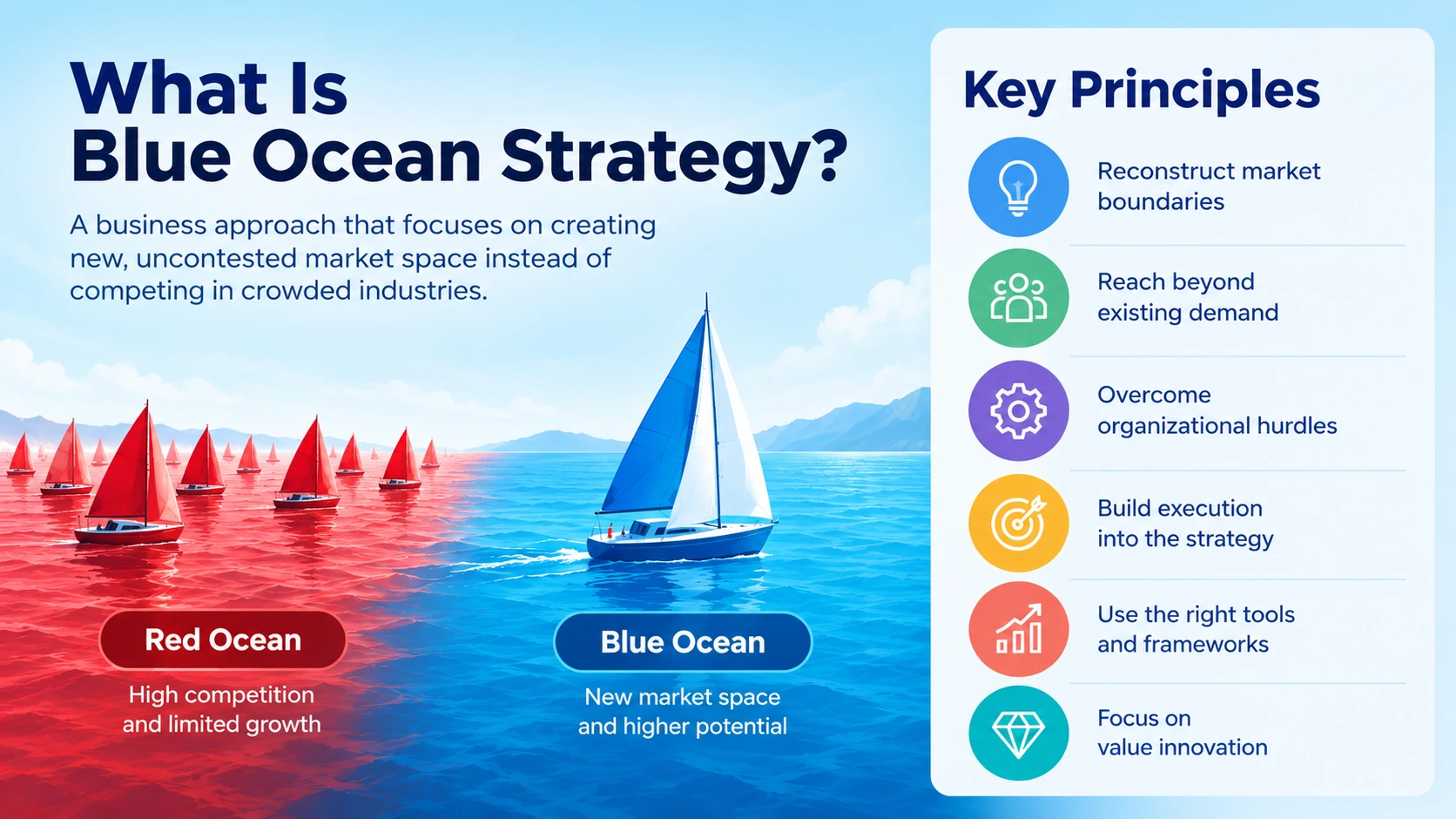
Blue Ocean Strategy focuses on creating new, uncontested market spaces instead of competing in crowded industries, helping businesses attract new customers and create fresh demand.
The strategy follows six core principles, including reconstructing market boundaries, reaching beyond existing demand, overcoming organizational hurdles, and building execution into the strategy.
Tools such as the Strategy Canvas, Four Actions Framework, and Eliminate-Reduce-Raise-Create Grid help businesses identify market gaps, reduce costs, and deliver greater customer value.
Real-world examples such as Cirque du Soleil, Nintendo Wii, Netflix, and Airbnb show how businesses can rethink customer needs and create new market opportunities.
In this blog, you'll learn the meaning of Blue Ocean Strategy, its difference from Red Ocean Strategy, its key principles and tools, real-world examples, and how to apply it in business and strategic management.
Most businesses spend their days fighting for the same customers, cutting prices, and copying each other's features. Over time, the competition becomes so intense that profits shrink and growth slows down. But some companies choose a different path. Instead of battling rivals in a crowded market, they create a new market where competition simply does not matter. This idea is known as blue ocean strategy.
In this blog, we explain the blue ocean strategy meaning in simple terms, how it differs from traditional competition, the key principles and tools behind it, and real-world examples that show how it works. We also look at how blue ocean strategy instrategic management helps leaders make smarter long-term decisions and how it fits into the wider strategic management process.
What Is Blue Ocean Strategy? Understanding the Basics
Blue ocean strategy is a business approach that focuses on creating new, uncontested market space rather than competing in existing, crowded industries. It was introduced by W. Chan Kim and Renée Mauborgne, professors at INSEAD, in their 2005 book Blue Ocean Strategy. Their research, which studied more than a hundred years of business moves across many industries, found that companies that created new markets often achieved stronger growth and profits than those that only tried to beat their competitors.
The central idea is simple. Rather than asking, “How can we beat our competition?” a company asks, “How can we make the competition irrelevant?” By offering something genuinely new and valuable, the business attracts customers who were not served before and opens up fresh demand.
Blue Ocean Strategy Meaning: Red Oceans vs. Blue Oceans
To understand the blue ocean strategy meaning fully, it helps to look at the two metaphors the authors use.
A red ocean represents all the industries that exist today. The boundaries are clear, the rules are known, and companies compete to grab a bigger share of the same demand. As more rivals enter, the water turns “bloody” with price wars and shrinking margins.
A blue ocean represents the unknown market space, the industries that do not yet exist. Here, there is no direct competition because the market has not been defined. Demand is created rather than fought over, and the opportunity for profitable growth is much greater.
Here is a quick comparison:
Competition: Red ocean companies compete in existing markets, while blue ocean companies create uncontested markets.
Demand: Red oceans fight over existing demand, while blue oceans create and capture new demand.
Focus: Red ocean strategy beats the competition, while blue ocean strategy makes the competition irrelevant.
Value and cost: Red oceans force a trade-off between value and cost, while blue oceans pursue differentiation and low cost together.
This last point is especially important. Traditional strategy suggests that a company must choose between offering higher value at a higher cost or lower value at a lower cost. Blue ocean strategy challenges this idea through what the authors call value innovation, which means delivering a leap in value for buyers while also reducing costs for the company.
Why Blue Ocean Strategy in Strategic Management Matters
Strategic management is the process of settinglong-term goals, choosing the right actions, and using resources wisely to achieve them. Traditionally, much of this field has focused on analyzing competitors, defending market share, and building advantages within existing industries.
Blue ocean strategy in strategic management shifts the focus. It encourages leaders to look beyond current industry boundaries and study the needs of buyers, non-customers, and related markets. Instead of treating the industry structure as fixed, it treats it as something that can be reshaped.
Here is why this approach is valuable for managers and business leaders:
It reduces dependence on price wars. Companies that create new demand are less exposed to constant discounting.
It supports sustainable growth. New markets can offer years of profitable expansion before competitors catch up.
It encourages innovation. Teams are pushed to rethink products, services, and business models rather than making small improvements.
It aligns strategy with customers. The approach starts with what buyers truly value, not what rivals are doing.
It provides practical tools. Frameworks andanalytical charts make the process systematic instead of relying on luck.
For students of management, blue ocean strategy is also a useful lens for understanding competitive advantage, market creation, and innovation.
Core Principles of Blue Ocean Strategy
The authors outline six principles that guide the creation and execution of a blue ocean. Four deal with formulating the strategy, and two deal with executing it.
Reconstruct market boundaries. Instead of working within the limits of a single industry, look across alternative industries, strategic groups, buyer groups, complementary products, and even time trends. New opportunities often hide at these edges.
Focus on the big picture, not the numbers. Many companies get lost in detailed planning documents. This principle encourages teams to visualize their strategy on a simple chart, so everyone can see where they stand and where they want to go.
Reach beyond existing demand. Rather than only chasing current customers and breaking them into smaller segments, look at non-customers. Understand why they avoid your industry and what would bring them in.
Get the strategic sequence right. A good idea must also be a good business. The sequence is to check for buyer utility first, then set a strategic price, then work out the target cost, and finally address adoption hurdles.
Overcome key organizational hurdles. Even the best strategy can fail if the team resists it. Leaders must deal with limited resources, low motivation, and internal politics by focusing on the points that make the biggest difference.
Build execution into strategy. People need to feel that the process is fair. The authors call this “fair process,” which includes engagement, explanation, and clarity of expectations. When employees understand and trust the plan, they commit to it more fully.
Key Tools and Frameworks Used in Blue Ocean Strategy
What makes this approach practical is its set of simple tools. Three of them stand out.
The Strategy Canvas. This is a graph that shows how a company and its competitors perform across the key factors an industry competes on, such as price, quality, or service. By plotting these factors, managers can see where everyone looks the same. If all curves overlap, the industry is likely stuck in a red ocean. A distinct curve signals a differentiated strategy.
The Four Actions Framework. To break away from the competition, a company asks four questions:
Eliminate: Which factors that the industry takes for granted should be removed?
Reduce: Which factors should be reduced well below the industry standard?
Raise: Which factors should be raised well above the industry standard?
Create: Which factors should be created that the industry has never offered?
This framework helps reduce costs by eliminating and reducing while lifting buyer value by raising and creating.
The Eliminate-Reduce-Raise-Create Grid. This simple grid records the answers to the four actions. It pushes teams to act on both the cost side and the value side at the same time, which is the heart of value innovation.
The authors also describe the Six Paths Framework, which gives managers six directions to explore when searching for new market space: looking across alternative industries, strategic groups, buyer chains, complementary products and services, functional or emotional appeal, and time.
Blue Ocean Strategy Examples from the Real World
Examples make the theory easier to grasp. Here are some well-known cases.
Cirque du Soleil. This is the classic example featured in the book. The circus industry was struggling, with rising costs and declining audiences. Cirque du Soleil did not try to be a better traditional circus. It eliminated expensive animal acts and star performers, and it raised the artistic quality, theme, and atmosphere by blending circus with theater. The result was a new entertainment category that attracted adults and corporate clients willing to pay higher ticket prices.
Nintendo Wii. While rivals competed on graphicsand processing power, Nintendo chose a different route. It created a console with simple motion controls that families and casual players could enjoy. This brought in non-gamers and opened a fresh customer base.
Netflix. The company started by offering DVD rentals by mail with no late fees, which removed a major customer frustration. It later moved to streaming and changed how people consume entertainment, creating new demand along the way.
Airbnb. Instead of building hotels, Airbnb created a platform where people rent out spare rooms and homes. It reached travelers who wanted local, flexible, and often lower-cost stays, and it expanded the overall travel market.
In each case, the company did not simply fight for the same customers. It rethought what buyers valued and built a new offering around that insight.
How to Apply Blue Ocean Strategy in Your Business
You do not need to be a global brand to use these ideas. Here is a simple way to start.
Map your industry. Draw a strategy canvas that lists the key factors your industry competes on and rate yourself and your rivals.
Study non-customers. Talk to people who do not use your product. Ask what stops them and what they would prefer.
Apply the four actions. Decide what to eliminate, reduce, raise, and create.
Test your idea. Build a small prototype or pilot, gather feedback, and refine it before a large launch.
Check the business logic. Confirm that the idea offers real buyer value, a fair price, a workable cost structure, and a plan to overcome adoption barriers.
Involve your team. Explain the thinking behind the plan and invite feedback so that people feel committed.
Who Can Benefit from Learning Blue Ocean Strategy?
Blue ocean strategy is not just for large corporations. Management students can use it to understand how companies create competitive advantage through innovation. Entrepreneurs can apply it to find gaps in the market before investing in a new idea. Managers and team leaders can use it to rethink products, services, and customer experiences. Marketing and product professionals can also gain from its focus on buyer value and non-customers.
Learning this approach builds valuable skills, such as strategic thinking, customer insight, and creative problem-solving. These skills are useful in almost every role, whether you are planning a new venture or guiding an established business through change.
Blue ocean strategy invites businesses to stop fighting over the same customers and start creating new space where they can grow. By understanding the blue ocean strategy meaning, studying its principles, and using tools such as the strategy canvas and the four actions framework, leaders can look at their industries from a fresh angle. Within the wider field of strategic management, it reminds us that competition is not the only path to success. Real growth often comes from creating value that no one else has offered. Whether you run a startup or manage a large team, asking where your own blue ocean might be is a worthwhile place to begin.
Frequently Asked Questions
Blue ocean strategy is a way of doing business in which a company creates a new market with little or no competition instead of fighting rivals in an existing, crowded market. It focuses on offering new value to customers, including those who were not buying before.
Blue ocean strategy was developed by W. Chan Kim and Renée Mauborgne, professors at INSEAD. They introduced the concept in their book Blue Ocean Strategy, published in 2005, after studying how successful companies created new markets.
A red ocean strategy focuses on beating competitors in an existing market, often leading to price wars and lower margins. A blue ocean strategy focuses on creating a new market where competition is not relevant, and it aims to deliver higher value at a lower cost at the same time.
Yes. Small businesses can apply the same ideas by studying non-customers, simplifying their offerings, and focusing on unmet needs in their niche. Tools such as the strategy canvas and the four actions framework work for businesses of any size.
Nuthana Reddy
Nuthana Reddy is a Senior Manager at Procter & Gamble, specializing in operations, digitization, and cross-functional leadership. She has driven multimillion-dollar impact through innovation, process optimization, and strategic execution across global markets.
Get Free Upskilling Guidance
Fill in the details for a free consultation
Related Courses
Explore our programs
Professional Certificate Programme in Strategic Management

 October 31, 2026
 8 min read





 Key Insights
 ChatGPT
 Perplexity
 Claude
 Grok












 ROI Calculator