
Executive Certificate Programme in Strategic AI Leadership and Organizational Transformation
Jointly Offered by IIM Mumbai and Cognitive AI Institute

- Duration
6 Months
- Mode of Engagement
Online with Campus Immersion
- Commencement Date
07th February, 2027
- Admission Closure Date
Closing Soon
Programme Overview
The Executive Certificate Programme in Strategic AI Leadership and Organizational Transformation, jointly offered by IIM Mumbai and the Cognitive AI Institute, equips senior leaders to translate AI into enterprise-wide value. The programme explores Generative AI, Large Language Models (LLMs), Agentic AI, Autonomous Systems, decision intelligence, and autonomous decision-making, enabling executives to drive innovation, strengthen strategic decisions, and lead AI-driven organizational transformation. Real-world cases, such as Deloitte’s adoption of AI to transform professional-services workflows, demonstrate how leaders can move from AI experimentation to scalable business impact while balancing governance, ethics, and responsible adoption.
Programme Details

Learning Hours:
- 60 Hours of learning, 13 modules and 1 Capstone Project
- 10 Hours Campus Immersion
Classes: 3 hours per week
- Classes are to be scheduled – preferred slot: Saturday evening or Sunday, anytime.
- Special sessions by academic and industry experts
Session Timings
- Saturday: 7:00–8:30 PM
- Sunday: 10:00–11:30 AM
– Special sessions by academic and industry experts
Mode of Engagement
Online with Campus Immersion
- The induction programme might be conducted in-campus, depending on the need
On-Campus Module
- Programme Induction: Blended format (On-Campus + Online)
- Campus Immersion: A 2-day on-campus immersion at the end of the programme.
- Travel & Accommodation: Expenses for travel and accommodation during the campus immersion will be borne by the participants.
Capstone Project
Mentored Business Transformation Project
Eligibility Criteria
- Graduates or Diploma Holders with a minimum of 50% marks from a recognized university or institution (UGC/AICTE/DEC/AIU/State Government/recognized international universities), in any discipline, with a minimum of 5 years of work experience after graduation or diploma.
This programme is designed for mid-to-senior-level professionals with a minimum of 5 years of work experience who are currently leading teams, functions, or strategic initiatives, including:
- Business Leaders and Functional Heads
- Senior Managers and Department Heads
- Digital Transformation and Innovation Leaders
- Strategy, Operations, HR, Finance, and Marketing Professionals
- Product, Technology, and Project Leaders
- Consultants and Business Advisors
- Entrepreneurs and Business Owners
- Professionals aspiring to transition into strategic leadership and AI-enabled decision-making roles
Evaluation Weightage
- Continuous Assessment (60%) – Assignments, case studies, quizzes, and capstone project presentations.
- Final Assessment (40%) – One-hour proctored examination.
To successfully complete the programme, participants must secure a minimum of 60% marks in each evaluation component.
About IIM Mumbai
IIM Mumbai, formerly known as NITIE, is one of India’s premier management institutions, consistently ranked among the nation’s best. Established in 1963, the institute is located in Mumbai, the country’s financial hub, offering students unique access to industry leaders and opportunities.
Renowned for its rigorous academic programmes and contemporary curriculum, IIM Mumbai blends theoretical insights with practical application to shape future business leaders. With a strong emphasis on Analytics, Management, and Sustainability, the institute develops versatile professionals equipped to excel across diverse functional areas.
Its commitment to excellence is reflected in its distinguished faculty, dynamic student exchange programmes, and strong industry linkages. Over the decades, IIM Mumbai has emerged as a destination for academic distinction, personal growth, and professional advancement, earning its reputation as one of India’s foremost management institutes and a trusted contributor to the nation’s top talent pool.
2nd Rank in THE Impact Rankings (India) 2022
6th Rank NIRF 2025: Top Management Institutions in India
Programme Objectives
Pedagogy
Learning Outcomes
Develop AI strategies aligned with business goals and growth
Evaluate AI investments using ROI and strategic impact frameworks
Lead AI-driven organizational transformation and change management
Build responsible AI governance and risk management frameworks
Design AI-Native operating models integrating human expertise and Agentic-AI Systems
Understand Generative and Agentic-AI capabilities for informed executive decision-making.
Admission Process
- 1
Eligibility of Applicant
- 2
Application Submission
- 3
Screening & Shortlisting
- 4
Admission & Fee Payment
- 5
Book your Seat
Unleash the benefits that await you with Jaro Value adds.
%
higher employee retention rate
%
increase in employee productivity
%
businesses achieved measurable growth
Companies that already trust us!



















Programme Curriculum
The AI-Transformed Business Landscape
- AI, digital transformation, and evolving competitive dynamics
- Fundamentals of data, analytics, AI, and LLM-driven systems
- From tools to systems to agents: how AI capabilities are evolving
- Understanding AI behavior: capabilities, limitations, and misconceptions
- Implications for managerial judgment and decision-making
- Case study and quiz included
AI-Driven Decision-Making for Managers
- Descriptive, predictive, and prescriptive analytics
- Translating data outputs into actionable business insights
- Limits of data-driven decision-making and role of human judgment
- Case study and quiz included
Generative AI, Prompt & Contextual Engineering
- Practical use of Generative AI tools (ChatGPT, Gemini, Copilot)
- Principles of prompt engineering and context design
- RCCR and ICE frameworks for structured interaction
- Improving output quality through context and workflow design
- Limitations: hallucinations, inconsistency, and misuse risks
- Applied demonstrations and exercises
- Quiz included
LLMs, Agentic AI & Autonomous Systems
- From single interactions to multi-step AI workflows
- Introduction to Agentic AI: task chaining, memory, and tool usage
- Degrees of autonomy: assistive, semi-autonomous, autonomous AI systems
- Single-agent vs multi-agent systems and orchestration concepts
- Building simple agentic workflows and semi-autonomous systems (demonstration)
- Strategic implications of agent-based and autonomous systems in organizations
- Case study and quiz included
Agentic AI in Operations, Supply Chain & Decision Systems
- Agentic AI and Digital Twins in supply chain: simulation, planning, coordination, and optimization.
- Multi-agent systems in semi-autonomous dynamic business environments.
- Predictive maintenance, logistics optimization, and demand forecasting.
- Demonstration of agent-based business workflow models.
- Case study and quiz included.
AI Agents in Internal Functions: HR & Finance
- Role of AI Agents in internal enterprise functions and decision environments
- AI Agents in Human Resources:
- Talent sourcing and screening workflows
- Workforce analytics and capability planning
- Employee lifecycle management using AI-assisted systems
- AI Agents in Finance:
- Forecasting, budgeting, and scenario analysis
- Anomaly detection and risk monitoring
- Financial decision support systems
- Designing agent-assisted workflows for internal decision-making processes
- Managing data sensitivity, confidentiality, and compliance risks in HR and Finance systems
- Challenges of over-reliance vs under-utilization of AI Agents in internal functions
- Integration of AI Agents into existing enterprise systems and processes
- Governance considerations in internal decision automation and support systems
- Case studies and quiz included
AI Agents in External Functions: Marketing & Customer Experience
- Role of AI Agents in customer-facing functions and engagement models
- AI Agents in Marketing: Campaign orchestration and automation
- Personalization and targeting strategies
- Content generation and optimization workflows
- AI Agents in Customer Experience (CX) and Support:Customer interaction agents (chat, voice, and service workflows)
- Service quality management and response optimization
- Customer retention and engagement systems
- Designing agent-driven customer journeys and interaction flows
- Managing consistency and brand alignment in AI-driven customer interactions
- Risks of automation at scale in customer-facing environments
- Coordination challenges between multiple AI systems across customer touchpoints
- Measuring effectiveness of AI-driven engagement systems
- Case studies and quiz included
AI Strategy & Competitive Positioning
- Strategic frameworks for AI-enabled competition
- Identifying AI opportunities aligned with business objectives
- AI as efficiency driver vs differentiation lever
- Linking AI initiatives to ROI, value creation, and competitive advantage
- Capstone ideation begins
- Case study and quiz included
Responsible AI & Governance for Leaders
- Ethical, regulatory, and governance considerations
- Data governance, privacy, bias, and explainability
- Accountability in AI and agent-assisted decision-making
- Governance frameworks: RARA, Human-in-the-Loop
- Leadership responsibility in AI oversight
- Case study and quiz included
The Future of AI, Agents & Executive Readiness
- Emerging trends in AI, LLMs, and agentic systems
- AI-driven shifts in organizational structures and roles
- Leadership readiness for continuous transformation
- Preparing for human–AI collaborative environments
- Capstone checkpoint and expert session
- Quiz included
AI Investment Decision Frameworks
- Framing AI initiatives as executive investment decisions
- ROI, TCO, and lifecycle cost analysis
- Scenario-based evaluation under uncertainty
- Investment prioritization across multiple AI initiatives
- Evaluating agent-based systems vs traditional automation
- Vendor evaluation and board-level justification
- Value realization and risk considerations
AI Operating Models for Agent-Based Decision Systems
- Scaling AI from pilots to enterprise systems
- Embedding AI and agents into decision workflows
- Human–AI and agent–human collaboration structures
- Centralized vs embedded AI operating models
- Orchestration of agentic systems within organizations
- Cross-functional alignment and decision flow integration
- Measuring decision effectiveness and system outcomes
AI Transformation, Adoption & Change Leadership
- Change management in AI-enabled organizations (Kotter, ADKAR)
- Adoption challenges: resistance, over-trust, and misuse.
- Understanding organizational transformation in AI-enabled environments
- Adoption challenges: Resistance to AI systems
- Over-reliance and blind trust in AI outputs
- Misalignment between human judgment and AI recommendations
- Managing trust in AI and agent-based systems: Calibration of trust (when to rely vs when to question)
- Behavioral responses to AI-driven decisions
- Designing human–AI and agent-assisted work environments
- Decision ownership and accountability in AI-assisted and semi-autonomous systems
- Human override, escalation mechanisms, and control frameworks
- Managing risks in AI systems: Model drift
- False confidence and misleading outputs
- Error propagation in agent-based workflows
- Aligning organizational incentives with decision quality, not just outcomes
- Leadership communication in AI-driven transformation initiatives
- Embedding governance into day-to-day operational decision-making
- Case study and quiz included
AI Strategy & Transformation Application
- Identify a real-world AI transformation opportunity
- Design AI-enabled or agent-based business workflows
- Develop investment rationale and prioritization
- Define governance, risk, and control mechanisms
- Build a transformation roadmap for implementation
- Faculty mentorship and structured checkpoints
Fee Structure

- Easy EMI Options Available*

Application Fee
INR 1,000 + GSTTotal Programme Fee
(Excluding application fee)
Instalment Pattern

Instalment 1
INR 90,000 + GST(As mentioned in the offer)
Instalment 2
INR 85,000 + GST(05th March, 2027)
Instalment 3
INR 85,000 + GST(05th May, 2027)
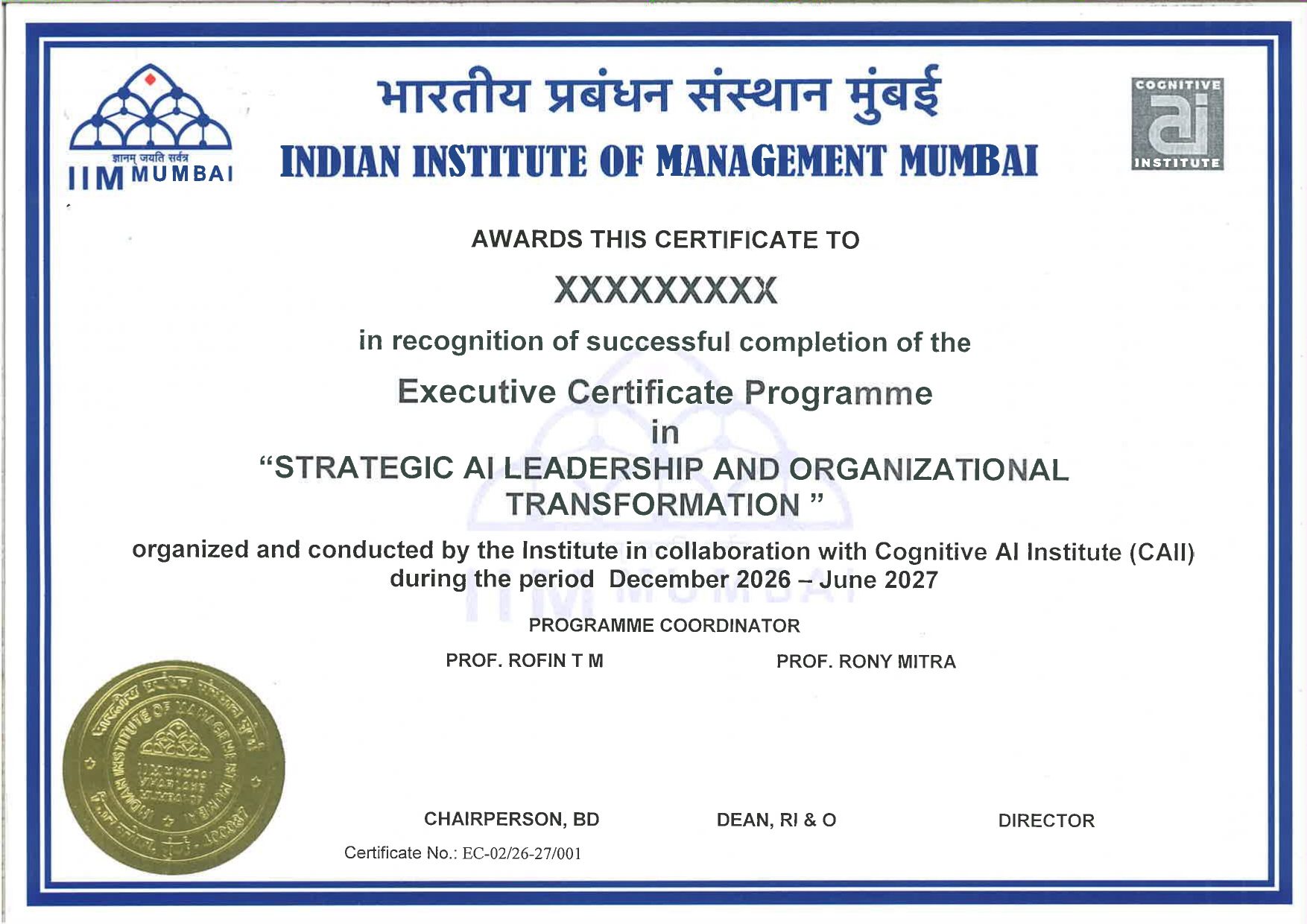
Earn Certificate
Participants who successfully meet the evaluation criteria and fulfil the requisite attendance requirements will receive a Certificate of Completion for the Executive Certificate Programme in Strategic AI Leadership and Organizational Transformation, jointly issued by IIM Mumbai and the Cognitive AI Institute, subject to:
- Securing a minimum of 60% marks in each evaluation component.
- Maintaining a minimum 75% attendance throughout the programme.
- Payment of all applicable programme fees.
Programme Coordinators




The Jaro Advantage

Personalized Learning Support
- Career Acceleration: Get unmatched career guidance, resume-building workshops, and 1:1 mentorship to fast-track your professional growth.
- 24/7 Student Support: Dedicated assistance at every step—from enrollment to graduation.
- Future-Ready Learning: Engage in immersive, industry-aligned programmes designed for lifelong career relevance.

Expert-Led Doubt Resolution
- Learn from the Best: Access mentorship from top-tier faculty and industry leaders.
- Collaborative Learning: Join dynamic discussion forums and peer-to-peer networks for deeper insights.
- Real-World Problem Solving: Apply knowledge through case studies and interactive sessions.

Powerful Global Networking
- Elite Alumni Community: Connect with 350,000+ professionals worldwide for career opportunities and collaborations.
- Exclusive Events: Attend global webinars, networking meetups, and industry talks.
- Lifelong Access: Stay updated with cutting-edge trends and alumni benefits long after graduation.
Unlock Your Path to Success
Unsure about which course to choose? We understand—selecting the right programme can feel overwhelming. That’s why our intuitive Course Finder is here to help you discover the perfect match based on your skills, goals, and interests. Let us guide you toward your next career milestone with confidence.
Find My Ideal Course Find My Ideal Course

Refer & Earn – Amazing Rewards Await!
Share the gift of education—refer your friends and colleagues now! Earn fantastic rewards for every successful referral and empower others to advance their careers while you benefit.
Start Referring Today! Start Referring Today!Frequently Asked Questions
You’ll develop the strategic skills to lead AI initiatives, evaluate emerging technologies, improve business performance, and confidently manage AI-driven transformation—capabilities that are increasingly sought after in leadership roles.
The programme combines live online classes, faculty-led discussions, real-world business case studies, AI demonstrations, industry expert sessions, a mentored capstone project, and a two-day campus immersion experience.
Upon successfully completing the programme and meeting the attendance and evaluation requirements, participants will receive a Joint Certificate of Completion from IIM Mumbai and the Cognitive AI Institute.