Google Search AI: How the World’s Largest Search Engine Is Changing
Key Insights
AI search uses technologies such as machine learning, natural language processing (NLP), and large language models (LLMs) to understand user intent and provide relevant, conversational answers.
An AI search engine works through five key stages: understanding queries, retrieving relevant information, ranking sources, generating answers, and learning from user feedback.
Unlike traditional search engines that display ranked links, AI search provides summarized answers, understands context, and supports natural follow-up questions.
Google Search AI features, including AI Overviews, AI Mode, and multimodal search, are transforming how users discover and interact with information.
AI search offers benefits such as time savings and better accessibility, but challenges like inaccurate answers, source bias, privacy concerns, and reduced exploration require users to verify important information.
In this blog, you'll learn what AI search is, how AI search engines work, how Google Search AI is evolving, how to choose the best AI search engine, its benefits and limitations, and what the future holds for AI-powered search.
Search has changed more in the last few years than in the two decades before. Instead of scrolling through a page of blue links, people now type a question and receive a clear, conversational answer in seconds. This shift is powered by AI search, a technology that understands meaning rather than just matching words. For professionals who want to lead this change instead of simply watching it, the IIM Indore AI Business Transformation & Deep Tech Strategy program is a strong place to begin. You can enroll in this program to build the strategic knowledge needed to apply AI across business functions. In this blog, we explain what AI search is, how an AI search engine works, how Google search AI features operate, and how to choose the best AI search engine for your needs.
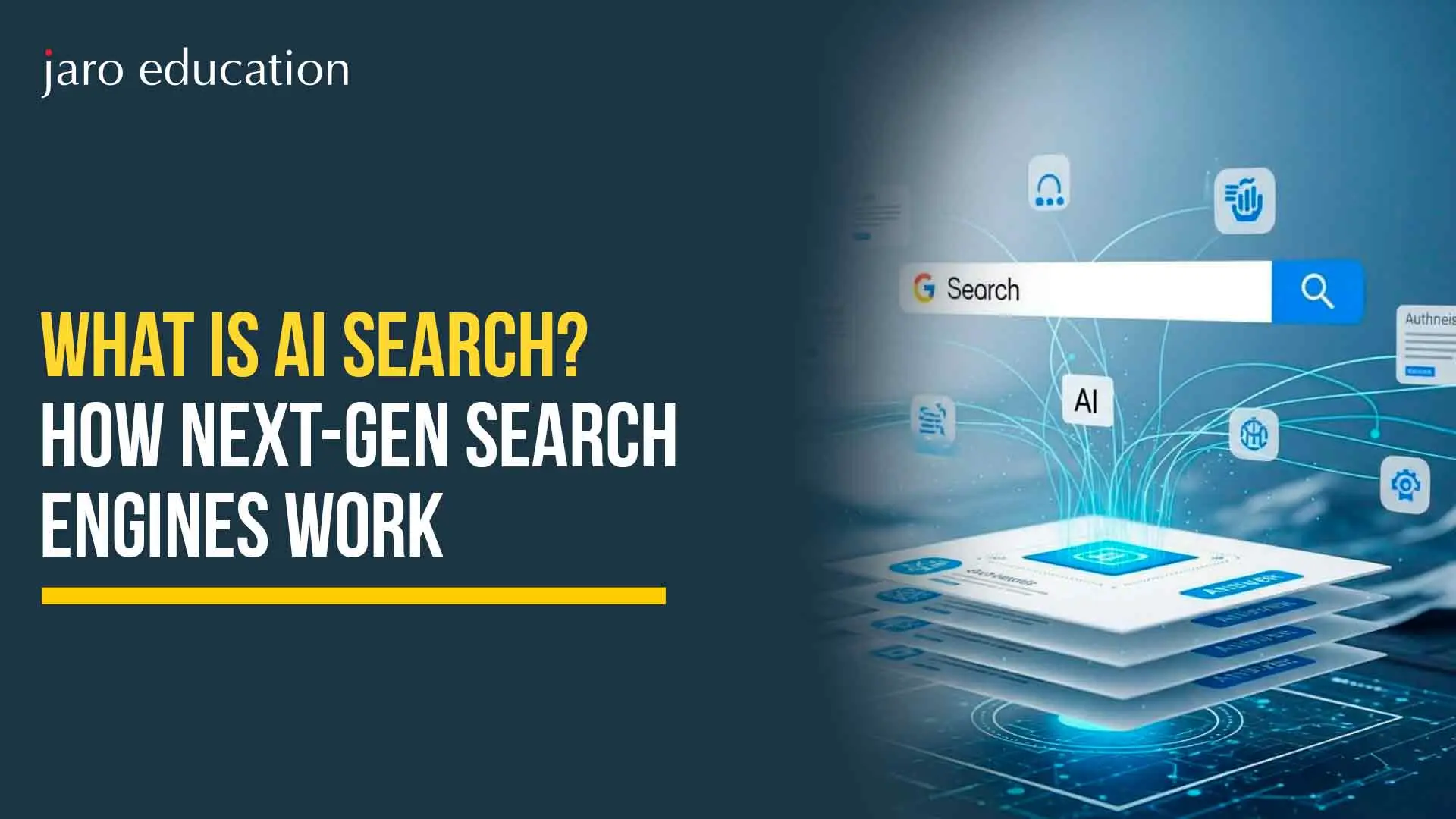
AI search is a method of finding information that uses artificial intelligence to understand what a person actually wants, not only the words they typed. Traditional search engines relied heavily on keyword matching. If your query contained certain words, the engine looked for pages containing those same words and ranked them by signals such as links and popularity.
AI search goes further. It uses technologies such as machine learning, natural language processing (NLP), and large language models (LLMs) to interpret the intent behind a query. It can handle long, conversational questions, understand context from earlier searches, and produce a summarized answer drawn from several sources.
For example, if you search “how do I prepare for a job interview in a new field,” a keyword-based engine may return pages with those exact terms. An AI search system recognizes that you need practical, step-by-step guidance, and it may combine advice from multiple trusted sources into one structured response.
In short, AI search shifts the experience from “finding pages” to “getting answers.”
An AI search engine may look simple on the surface, but several layers of technology work together behind it. Here is a clear breakdown of the process.
1. Understanding the Query
The first step is interpreting the question. Natural language processing breaks the query into parts, identifies the key topics, and determines the intent. The system asks itself: Is the user looking for facts, comparing options, seeking a how-to guide, or planning to buy something?
Modern systems can also handle spelling errors, slang, and incomplete phrases. This is why you can type a casual question and still get a relevant response.
2. Retrieving Relevant Information
Once the intent is clear, the engine searches its index of web pages, documents, and databases. Many next-generation systems use semantic search, which relies on “embeddings.” These are numerical representations of meaning. Two sentences that use different words but express the same idea will have similar embeddings, so the engine can match them.
This is the main reason an AI search engine can find useful content even when your exact words do not appear on the page.
3. Ranking the Results
After retrieval, the system ranks the candidate sources. Ranking models weigh factors such as relevance, freshness, authority, and quality. Machine learning helps the engine improve these decisions over time by learning from how people interact with results.
4. Generating an Answer
This is where AI search differs most from older systems. A large language model reads the top sources and writes a summarized response in natural language. Many systems use an approach called retrieval-augmented generation (RAG). In simple terms, the model does not rely only on what it learned during training. It first retrieves fresh information from trusted sources and then uses that information to write its answer.
This method helps make answers more current and accurate, and it allows the engine to show citations so users can verify the information.
5. Learning from Feedback
Finally, the system keeps learning. User behavior, such as which links people click, whether they ask a follow-up question, or whether they rephrase a query, helps developers refine the models. Over time, the engine becomes better at predicting what people need.
AI Search vs. Traditional Search: Key Differences
Understanding the difference helps explain why AI search is growing so quickly.
Query style: Traditional search works best with short keywords. AI search handles full sentences and complex, multi-part questions.
Results format: Traditional engines present a ranked list of links. AI search often presents a direct, summarized answer with supporting sources.
Context awareness: Traditional search treats each query separately. An AI search engine can remember the context of a conversation, so you can ask follow-up questions naturally.
Effort required: With traditional search, users often open several pages and combine the information themselves. AI search does much of that synthesis automatically.
Personalization: AI-driven systems can adjust responses based on context, location, and past interactions, where users permit it.
Neither approach is perfect. Traditional results still help when you want to browse many viewpoints or visit a specific website. AI search excels when you want a quick, clear answer or help with a complex task.
Google Search AI: How the World’s Largest Search Engine Is Changing
Google, the most widely used search engine, has been adding AI features steadily. Google search AI now includes tools that give summarized answers at the top of the results page, often called AI Overviews, as well as a more conversational experience known as AI Mode.
Here is how these features generally work:
AI Overviews provide a short summary with links to the sources used, so users can quickly understand a topic and then dig deeper.
AI Mode allows users to ask longer, more detailed questions and follow up in a conversation, similar to chatting with an assistant.
Multimodal search lets people search using text, images, or voice. For example, you can point your phone camera at an object and ask a question about it.
Behind these features, Google combines its massive web index with advanced language models. The goal is the same as other next-gen engines: understand intent, retrieve reliable information, and present it in a helpful format.
For website owners and marketers, Google search AI also changes how content gets discovered. Clear, well-structured, trustworthy content is more likely to be referenced in AI-generated summaries. Because Google’s features evolve often, it is wise to check official announcements for the latest details.
Many people ask which is the best AI search engine. The honest answer is that it depends on what you need. Several strong options exist, including Google with its AI features, Perplexity, Microsoft Copilot (with Bing), and ChatGPT’s search capabilities. Each has its own strengths.
Instead of searching for a single winner, evaluate any AI search engine using these practical criteria.
Accuracy and Source Transparency
The best AI search engine should show where its information comes from. Look for clear citations and links that let you verify claims. Answers without sources are harder to trust.
Freshness of Information
Some tools update their information in real time, while others rely on older training data. If you need current news, prices, or trends, choose a tool that retrieves live information.
Depth and Clarity of Answers
A good engine gives answers that are complete but easy to read. It should handle follow-up questions without losing context.
Privacy and Data Handling
Review how a platform stores and uses your queries. Professionals working with sensitive business information should be especially careful and read privacy policies closely.
Ease of Use and Features
Consider extras such as image search, voice input, file uploads, and integration with other tools you use daily.
Fit for Your Purpose
Students may prefer a tool that explains concepts simply. Researchers may want strong citations. Business teams may want integrations with workplace tools. Testing two or three platforms with the same question is often the best way to find your personal favorite.
Benefits of AI Search
AI search offers several clear advantages:
Saves time: Instead of opening ten tabs, users get a consolidated answer quickly.
Better understanding of intent: Natural language queries work well, even when phrased imperfectly.
Conversational experience: Follow-up questions feel natural and keep the context.
Support for complex tasks: Planning, comparing, and summarizing become easier.
Accessibility: Voice and image search help people who find typing difficult or prefer other input methods.
Limitations and Challenges to Keep in Mind
While AI search is powerful, users should remain thoughtful.
Possible inaccuracies: Language models can sometimes produce confident-sounding but incorrect statements. This is often called “hallucination.” Always verify important information, especially in areas such as health,finance, and law.
Source bias: AI answers reflect the sources they draw from. If those sources are biased or incomplete, the answer may be too.
Reduced exploration: Quick summaries may discourage people from reading original sources in full, which can limit deeper learning.
Privacy concerns: Personalized features depend on data, so users should understand what they are sharing.
Impact on publishers: When answers appear directly on the results page, websites may receive fewer clicks. This is prompting new conversations about fair use of content and sustainable business models.
Being aware of these challenges helps users benefit from AI search responsibly.
Why AI Search Matters for Business Leaders
AI search is not only a consumer convenience. It is reshaping how organizations find knowledge, serve customers, and make decisions. Internal enterprise search tools now let employees ask questions about company documents and receive instant answers. Customer-facing platforms use AI search to help shoppers find products using natural language. Marketing teams are rethinking content strategy so that their expertise appears in AI-generated responses.
Looking ahead, AI search will likely become even more personal, visual, and proactive. Here are a few trends to watch:
Agent-like assistants that not only answer questions but also complete tasks such as booking, comparing, and organizing.
Richer multimodal search, combining text, images, audio, and video in a single query.
Greater emphasis on trust, with improved citations, fact-checking layers, and clearer labeling of AI-generated content.
Specialized search tools built for industries such as healthcare, law, education, and finance.
Deeper workplace integration, where search becomes a built-in layer across email, documents, and business software.
As these systems mature, people who understand both the technology and its business impact will be in high demand.
Conclusion
AI search represents a major step forward in how people find and use information. By understanding intent, retrieving relevant sources, and generating clear answers, an AI search engine can save time and make complex topics easier to understand. Google search AI features show that even the biggest names in search are embracing this change, while a growing field of competitors gives users more choice than ever. When choosing the best AI search engine, focus on accuracy, transparency, freshness, privacy, and fit with your own goals, and always verify critical information.
For professionals and leaders, the opportunity is bigger than learning a new tool. It is about understanding how AI is transforming industries and preparing to lead that transformation. If that is your goal, consider the IIM Indore AI Business Transformation & Deep Tech Strategy program as your next step.
Frequently Asked Questions
AI search is a way of finding information using artificial intelligence. Instead of only matching keywords, it understands the meaning behind your question and often gives a summarized, conversational answer along with source links.
Traditional Google search was built around ranking web pages for keywords. A dedicated AI search engine focuses on generating direct answers through language models. However, the gap is narrowing, as Google search AI features such as AI Overviews and AI Mode now bring similar capabilities into Google itself.
There is no single best option for everyone. Google, Perplexity, Microsoft Copilot, and ChatGPT search each have different strengths. The best AI search engine for you depends on whether you value citations, real-time information, privacy, or integrations. Trying a few tools with the same question is a smart way to compare them.
No. AI search can make mistakes or present incomplete information. It is best to check the cited sources, especially for important decisions related to health, money, or legal matters.
Dr. Sanjay Kulkarni
Data & AI Transformation Leader
Dr. Sanjay Kulkarni is a Data & AI Transformation Leader with over 25 years of industry experience. He helps organizations adopt data-driven and responsible AI practices through strategic guidance and education. With experience across startups and global enterprises, he bridges the gap between theory and real-world application. His work empowers teams to innovate and thrive in AI-driven environments.
Get Free Upskilling Guidance
Fill in the details for a free consultation
Related Courses
Explore our programs
Executive Programme in AI Led Business Transformation & Deep Tech Strategy

 November 7, 2026
 9 min read




 Key Insights
 ChatGPT
 Perplexity
 Claude
 Grok










 ROI Calculator