HOME > BLOG > Marketing > Content Strategy Guide: Framework, Examples & Best Practices
Marketing
Content Strategy Guide: Framework, Examples & Best Practices
J
By Priya Sahu
May 11, 20269 min read
Published on May 11, 2026
SHARE THIS ARTICLE
Table Of Content
The ROI of Documentation: Why 64% of Top Marketers Write It Down
The IDEAL Content Strategy Framework for 2026
7 Steps to Build Your Results-Driven Strategy
Content Marketing Strategy Examples: From Zomato to B2B SaaS
Most content teams aren't losing because they're producing bad content. They're losing because they've confused motion with direction. A packed editorial calendar, a steady stream of blog posts, and a growing asset library can all coexist with zero meaningful lead generation — and that's the trap that quietly kills marketing ROI.
A genuine content strategy framework is far more than a publishing schedule. It's a deliberate system that connects every piece of content to a business outcome, a specific audience, and a measurable goal. Without that connective tissue, even the most prolific teams end up on what practitioners commonly call the 'content treadmill' — producing at full speed while standing still.
The content plan vs. content marketing strategy distinction matters enormously here. A content plan answers what you'll publish and when. A content strategy answers why it will work, who it serves, and how it drives revenue. One is a production schedule; the other is a competitive weapon.
A team without a documented strategy isn't executing a plan — it's making expensive guesses with its marketing budget.
The shift from production-first to strategy-first thinking requires acknowledging an uncomfortable truth: more content rarely solves the core problem. Value, precision, and alignment do.
That raises a critical question — and one that has a surprisingly clear answer when you look at what separates high-performing content teams from the rest. It starts with something as simple as writing things down.
The ROI of Documentation: Why 64% of Top Marketers Write It Down
Here’s a gap that should make every marketing leader uncomfortable: while roughly 90% of companies claim to have a content strategy, only about 40% have actually documented it. That’s not a minor discrepancy — that’s the difference between a plan and a wish.
Documentation isn’t just a formality. It’s the mechanism that transforms scattered ideas into repeatable, scalable systems. When a strategy lives only in someone’s head, every new hire, budget conversation, and campaign pivot starts from scratch. Written strategy creates alignment across teams, gives stakeholders a clear rationale for resource allocation, and makes it significantly easier to justify content budgets to leadership who want to see proof of direction before signing off.
The financial case for getting this right is hard to ignore. Content marketing consistently generates leads at a fraction of the cost of traditional outbound methods — and when teams operate from documented content strategy examples, they replicate what works instead of reinventing the wheel every quarter.
What does “guessing” actually cost? Consider this: every piece of content produced without a documented strategic rationale carries risk — wasted production hours, misaligned messaging, and content that serves no identifiable stage of the buyer journey. At scale, that waste compounds quickly. A mid-sized team producing 20 pieces of content per month, with even 30% of that output missing the mark, represents a significant drain on both budget and momentum.
A documented strategy doesn’t constrain creativity — it gives creativity a destination.
The good news is that documentation doesn’t require complexity. It requires clarity. And that clarity is exactly what a structured framework delivers — which is where the conversation gets genuinely useful.
So you’re convinced documentation matters. Now the real question is: what exactly should you be documenting? This is where most teams default to vague mission statements and audience personas that never leave the slide deck. The IDEAL framework gives that documentation actual teeth — turning abstract strategy into a repeatable, results-driven cycle.
I — Identify: Go Deeper Than Personas
Most teams know who their audience is. Far fewer understand what keeps them awake at 2 a.m. Moving beyond demographic personas to map genuine pain points is the critical first step. What decisions are your audience struggling to make? What information are they searching for but not finding? The difference between a persona and a pain point is the difference between knowing someone’s job title and knowing what’s standing between them and their next promotion.
D — Discover: Find the Gaps Before Your Competitors Do
Knowing your audience’s pain isn’t enough if you’re producing content that already saturates the market. The Discover phase uses data — search volume analysis, competitor gap audits, internal site search queries, and sales team feedback — to surface opportunities where demand exists but quality supply doesn’t. According to 7 Content Syndication Strategies to Drive 3x More B2B Leads: Targeting underserved content gaps is one of the highest-leverage moves for compounding lead generation over time.
E — Empower: Bring in Authentic Expert Voices
Here’s a pattern that separates high-performing content programs from average ones: subject matter experts are in the building but rarely in the content. Empowering internal experts — engineers, customer success managers, and product leads — to contribute real insight transforms generic articles into authoritative resources. This is especially critical as search algorithms and audiences alike become better at distinguishing genuine expertise from surface-level summaries.
A documented content strategy is only as strong as the real expertise it channels into every piece.
A — Activate: Distribute Strategically, Not Reflexively
Publishing is not a strategy. Activation means mapping each content asset to the right channels, formats, and timing based on where your audience actually spends their attention. A single well-researched article can fuel an email sequence, a LinkedIn carousel, a podcast talking point, and a sales enablement one-pager – but only if distribution is planned before the content is created, not as an afterthought.
L — Learn: Close the Loop and Feed the Next Cycle
The Learn phase transforms content from a one-way broadcast into an iterative engine. Performance analysis — focused on metrics that connect to business outcomes, not just page views — informs every stage of the next IDEAL cycle.
This full-cycle thinking is precisely what any practical content strategy guide needs to operationalize, and it maps directly into the step-by-step execution framework coming up next.
The IDEAL framework gives you the blueprint. Now it’s time to pour the foundation. Building a content structure framework that actually generates leads isn’t about producing more content — it’s about executing smarter across seven deliberate steps.
Step 1: Define SMART Goals Aligned with Business ROI
Vague goals produce vague results. Before writing a single word, anchor your strategy to Specific, Measurable, Achievable, Relevant, and Time-bound targets. “Get more traffic” isn’t a goal. “Increase organic leads by 30% within 90 days” is a goal. Tie every content objective directly to a business outcome — pipeline growth, customer acquisition cost, or revenue attribution.
Step 2: Conduct a Content Audit
Most teams are sitting on underperforming assets they don’t even know about. A thorough audit identifies what’s ranking, what’s converting, and what’s quietly wasting resources. Categorize existing content into three buckets: keep and optimize, consolidate, or retire. In practice, trimming low-quality pages often delivers faster ranking gains than publishing new ones.
Step 3: Map Content to the Buyer’s Journey
Every piece of content should serve a specific stage — Awareness, Consideration, or Decision. A common pattern is that teams over-invest in top-of-funnel blog posts while neglecting the comparison guides and case studies that convert mid-funnel prospects. Map your gaps before you fill them.
Step 4: Establish Your Brand Voice and Messaging Pillars
A documented brand voice does more than ensure consistency — it becomes a competitive differentiator that’s genuinely hard to replicate. Define three to five messaging pillars that reflect your brand’s unique positioning. Every content creator on your team should be able to answer: What do we sound like, and what do we stand for?
Step 5: Build a Content Calendar That Balances Consistency and Quality
Publishing frequency matters, but not at the expense of substance. A realistic calendar accounts for production capacity, seasonal trends, and campaign timelines. Aim for a cadence your team can actually sustain — two strong pieces per week consistently outperforms five rushed ones.
Step 6: Determine Your Distribution and Promotion Mix
Creating content is only half the equation. How you distribute it determines whether it gets seen. Your promotion mix should include owned channels (email and social), earned opportunities (guest posts and PR), and paid amplification where ROI justifies the spend. One practical approach is the 20/80 rule: spend 20% of your time creating and 80% promoting.
Step 7: Set Up a Measurement Framework Beyond Vanity Metrics
Pageviews feel good. Pipeline movement pays salaries. Build your reporting around metrics that connect content directly to revenue:lead quality, conversion rates by content type, and cost per acquisition. Tracking the right numbers makes it significantly easier to justify the budget and scale what’s working.
These seven steps form a repeatable system — not a one-time project. And as you’ll see next, the most successful brands in the world have put versions of this system to work in fascinating ways.
Free Courses
Stakeholder Communication & Negotiation Skill Sets
Content Marketing Strategy Examples: From Zomato to B2B SaaS
Frameworks and 7-step plans are only as convincing as the real-world results behind them. Studying content strategy samples from brands that have genuinely moved the needle reveals something important: the structure matters just as much as the content itself.
Zomato: Cultural Relevance as a Competitive Weapon
Zomato’s content approach is a masterclass in B2C engagement. Rather than flooding feeds with promotional posts, the brand leans into cultural moments, memes, and hyper-relevant humor that resonates deeply with its audience. The result? Consistently high organic reach without a proportionally high production budget.
What makes Zomato’s model replicable isn’t the wit — it’s the documented decision-making process behind it. Their team consistently asks, ‘Does this reflect how our audience actually talks and thinks right now?’ That single filter eliminates generic content before it ever gets created.
B2B SaaS: Turning a Blog Into a Lead Engine
A common pattern in B2B SaaS is the “publish and pray” blog strategy — dozens of posts with no measurable pipeline impact. What separates high-performing teams is documentation. In practice, companies that map every content piece to a specific buyer journey stage and a measurable conversion goal see their blog transition from a traffic asset to an actual lead engine.
One practical approach: assign each article a primary CTA aligned to the funnel stage, then track assisted conversions — not just page views. A documented content structure framework transforms your blog from a publishing calendar into a revenue-generating system.
The 70-20-10 Rule: Built-In Innovation
Industry leaders rarely go all-in on experimental content. Instead, they allocate roughly:
70% to proven, reliable content formats
20% to content that builds on what’s working
10% to genuinely experimental formats
This balance protects performance while creating room to discover your next top-performing asset.
However, the ratio only works when you’re honest about which bucket each piece belongs in, which brings up a critical challenge many teams quietly struggle with: producing more without necessarily producing better. That’s exactly the trap the next section addresses head-on.
Best Practices: Avoiding the 'Volume Trap' in 2026
More content isn’t always better content. In 2026, the brands winning on search and social are the ones publishing less while extracting more value from every asset they produce. Understanding how to create a content strategy that drives results means resisting the pull of constant new production.
Four practices separate disciplined teams from overwhelmed ones:
Update before you create. Refreshing high-performing existing pages consistently outperforms publishing new posts forSEO gains. Audit quarterly, not annually.
Optimize for Zero-Click. Structure content with clear answers, schema markup, and tweetable stats so it delivers value even before a user clicks through — building authority at every touchpoint.
Involve subject matter experts early. SME input isn’t optional — it’s what separates generic content from EEAT-compliant content that Google and readers actually trust.
Run the results-ready checklist. Before publishing, confirm a clear audience, a defined goal, a distribution plan, and a measurable success metric.
A results-driven strategy is selective by design. Each piece should earn its place. If it doesn’t serve a defined stage of the funnel or a specific keyword cluster, it probably doesn’t belong in your roadmap.
Conclusion
A strong content strategy is the foundation of successful digital marketing, helping businesses create, distribute, and manage content that aligns with their goals and audience needs. It provides a clear framework for planning topics, choosing the right channels, maintaining consistency, and measuring performance. Whether the objective is brand awareness, lead generation, customer engagement, or thought leadership, a well-defined strategy ensures every piece of content serves a purpose. By using practical frameworks, studying successful examples, and following proven best practices such as audience research, SEO optimization, and regular performance analysis, organizations can build a content strategy that drives long-term growth and meaningful results.
Frequently Asked Questions
Content strategy 101 begins with understanding your audience before you write a single word. Identify who you’re trying to reach, what problems they need solved, and which formats they actually consume. From there, map your content to business goals and build a publishing calendar that prioritizes quality over volume.
In practice, most brands begin seeing meaningful organic traction between three and six months after launching a focused strategy. Paid distribution and content syndication can accelerate that timeline significantly.
Less than you probably think. A common pattern among high-performing content programs is publishing fewer pieces at higher quality while repurposing each asset across multiple channels. One well-researched pillar post can fuel weeks of social content, email campaigns, and short-form video.
Chasing volume instead of relevance. Publishing 20 mediocre posts rarely outperforms five deeply useful ones. Specificity beats frequency — every time.
Absolutely. Even a one-page content plan with clear audience definitions, three core topics, and a simple repurposing workflow outperforms random publishing. Structure doesn’t require scale.
Priya Sahu
Sales & Digital Marketing Strategist
Sales and Marketing professional with 6+ years of experience in B2B and B2C growth, specializing in business development and digital marketing. Skilled in CRM systems, paid campaigns, and AI-driven strategies to drive revenue, optimize performance, and build lasting client relationships.

 May 11, 2026
 9 min read





 ChatGPT
 Perplexity
 Claude
 Grok
Grok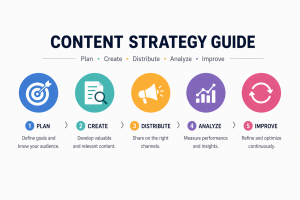





 Admission Open
 Admission Open
 Admission Open
 Admission Open
 ROI Calculator