AI Programming Languages: Which One Should You Learn?
What Can You Build with AI Programming?
Key Insights
AI programming means writing code that lets software learn from data and make predictions or decisions, instead of following only fixed rules.
Python is the most common starting language for AI, but R, Java, C++, JavaScript and Julia each have a place depending on the task.
You can start AI programming free using browser notebooks, open datasets and free learning resources, with no expensive hardware.
Maths, statistics and data handling matter as much as coding, so build those foundations alongside your programming skills.
Projects teach more than theory alone, so build small models early and grow from there.
In this blog, you'll learn what AI programming is, how it works, the key languages and libraries, a first example, free resources and how to choose an AI programming course.
Every time a streaming app suggests a show, a bank flags a suspicious transaction or a chatbot answers a question, there is code behind it. But that code looks different from the programs most beginners first learn to write. It does not just follow a list of instructions. It learns patterns from data.
That is the idea behind AI programming. This beginner's guide explains what it is, how it differs from traditional programming, which languages and tools to learn, how to start for free and how to choose a course if you want structured learning.
AI programming is the practice of writing software that can learn from data, recognise patterns and make predictions or decisions with minimal human instruction for each case. It spans several areas, including machine learning, deep learning, natural language processing and computer vision. If these terms are new, start with our overview of what artificial intelligence is.
AI Programming vs Traditional Programming
In traditional programming, you write explicit rules, feed in data and get answers. In AI programming, you feed in data along with examples of the right answers, and the algorithm works out the rules itself.
Aspect
Traditional programming
AI programming
Input
Rules and data
Data and expected outcomes
Output
Answers
A trained model that makes predictions
Improves with
Manual code changes
More and better data
Example
Tax calculator
Spam filter that learns from emails
How AI, Machine Learning and Deep Learning Fit Together
AI is the broad goal of making machines behave intelligently. Machine learning is a method within AI where systems learn from data, and deep learning is a subset that uses multi-layered neural networks. Our explainer on AI vs machine learning vs deep learning goes into more detail.
Define the problem: for example, predict whether a customer will cancel a subscription.
Collect and clean data: gather examples, remove errors and handle missing values.
Choose a model: pick an algorithm suited to the task, such as a decision tree or neural network.
Train the model: the algorithm learns patterns from the training data.
Evaluate it: test the model on data it has not seen to check accuracy and fairness.
Deploy and monitor: put it into an application and track performance, because data changes over time.
Beginners often spend most of their time on steps two and five. Good data and honest evaluation matter more than a clever algorithm.
AI Programming Languages: Which One Should You Learn?
There is no single language for AI. The right choice depends on what you want to build.
Language
Best for
Why it is used
Python
Machine learning, deep learning, NLP, prototyping
Simple syntax, huge library ecosystem
R
Statistics, data analysis, research
Strong statistical packages and visualisation
Java
Enterprise systems, large-scale deployment
Stability, performance, existing infrastructure
C++
Performance-critical systems, robotics, game AI
Speed and control over hardware
JavaScript / TypeScript
AI in web apps and browsers
Runs where users are, easy integration
Julia
Scientific and numerical computing
Speed with readable syntax
Python is the usual starting point. According to a summary of GitHub’s Octoverse 2025 report, TypeScript overtook Python as the most used language on GitHub by monthly contributors, but Python remains dominant in AI and data science. Our guide on why Python is good for AI and ML covers the reasons, and if you are weighing options, compare Java and Python.
AI programming is not one skill but a family of applications. Natural language processing powers chatbots, translation and text summarisation. Computer vision handles image classification, face detection and quality inspection in factories. Recommendation systems suggest products, videos and music. Predictive models forecast demand, churn or credit risk. Generative AI creates text, images and code from prompts. Each area uses a slightly different toolkit, so choosing a direction early helps you focus your learning.
PyTorch: a popular deep learning framework, widely used in research.
Hugging Face Transformers: pretrained models for language and vision tasks.
Skills You Need Before You Start
AI programming is part coding and part maths. You will need:
Programming basics: variables, loops, functions and data structures.
Mathematics: linear algebra, probability and basic calculus. Our guide to mathematics for machine learning lists what to focus on.
Statistics: distributions, sampling, hypothesis testing and evaluation metrics.
Data handling: cleaning, exploring and visualising datasets.
Problem framing: knowing which problems suit AI and which do not.
You do not need to master all of this before writing your first model. Learn alongside coding, using small examples.
AI Programming Free: How to Start at No Cost
You can start AI programming free with just a laptop and an internet connection.
Browser notebooks: services such as Google Colab and Kaggle Notebooks let you write and run Python code in the browser, and free tiers typically include limited access to GPUs. Availability and limits change, so check current terms.
Open datasets: Kaggle and public repositories offer datasets for practice.
Free courses: many universities and platforms publish free machine learning courses, lectures and tutorials.
Open-source libraries: scikit-learn, TensorFlow and PyTorch are all free to use.
For a curated roadmap, see our guide on how to learn AI for free. Free resources are excellent for learning, but they leave you to organise your own path and get your own feedback, which is where structured programmes help. Whichever route you choose, practise a little every day and keep every project in a public repository.
Your First AI Program in Python
This short example uses scikit-learn to train a model that classifies iris flowers from measurements. It shows the core steps: load data, split it, train and evaluate.
Example
from sklearn.datasets import load_iris from sklearn.model_selection import train_test_split from sklearn.ensemble import RandomForestClassifier from sklearn.metrics import accuracy_score
You split the data so the model is tested on examples it has never seen. Try changing the model or the split, and see how accuracy changes. That curiosity is how skills grow.
Beginner AI Project Ideas
Projects turn knowledge into skill. Good starting points include a spam classifier, a house price predictor, a movie recommender, a sentiment analyser for reviews or an image classifier. Browse our list of artificial intelligence projects for more ideas, and publish your work on GitHub so employers can see it.
How to Learn AI Programming Effectively
Consistency beats intensity. Study for a small block of time every day rather than cramming on weekends. Alternate between learning a concept and applying it, for example reading about decision trees and then training one on a real dataset. Keep a notes file of mistakes and fixes, because debugging is where much of the learning happens. Finally, explain what you have built in your own words, in a README or a short post, since teaching reveals gaps in understanding.
Skipping the basics: jumping into deep learning without understanding data and evaluation leads to confusion.
Ignoring data quality: a model trained on poor data produces poor results.
Overfitting: a model that memorises training data fails on new data, so always test on unseen examples.
Tutorial hopping: finishing many tutorials without building your own project does not build skill.
Ignoring ethics: bias, privacy and transparency matter in real systems.
AI Programming Course: When and How to Choose One
Self-study works, but a structured AI programming course can help if you want guided progression, expert feedback and a recognised qualification. Look for these features when comparing options:
A curriculum covering maths, statistics, machine learning, deep learning, NLP and deployment.
Hands-on projects and assessments, not only lectures.
Faculty with academic or industry experience.
Clear eligibility, duration and recognition details.
Career paths include machine learning engineer, data scientist, NLP engineer, MLOps engineer and AI product roles, and demand spans banking, healthcare, retail, manufacturing and technology services. Our guides on how to become an AI engineer and AI and ML subjects and syllabus explain what employers and programmes expect.
Conclusion
AI programming is about teaching software to learn from data rather than giving it every rule. Start with Python, build your maths and statistics foundation in parallel, use free notebooks and datasets to practise, and grow through projects.
If you want a structured route, consider the Online M.Sc. in AI and Machine Learning from CHRIST (Deemed to be University). It is a two-year online programme with live and recorded sessions that covers machine learning, deep learning, NLP, data structures and algorithms, Java programming and MLOps. Eligibility requires a qualifying undergraduate degree with at least 50% marks, and mathematics and statistics at the undergraduate level are mandatory, so check the programme page for current details.
Frequently Asked Questions
AI programming is writing software that learns from data to recognise patterns, make predictions or decisions, using techniques such as machine learning, deep learning and natural language processing.
Python is the most popular choice for beginners and professionals because of its simplicity and libraries. R, Java, C++, JavaScript and Julia are also used depending on the task.
Yes. Free tools such as browser notebooks, open datasets, open-source libraries and free online courses make it possible to start without spending money.
Yes. Linear algebra, probability, statistics and basic calculus are important, though you can learn them gradually alongside coding.
It depends on your background and time. Many learners need several months to become comfortable with Python and core machine learning, and longer for deep learning and deployment.
Machine learning is a major part of AI programming. AI programming also covers areas such as natural language processing, computer vision and rule-based systems.
Not necessarily. A course helps if you want structure, feedback and a recognised qualification, while self-study can work if you are disciplined.
Roles include machine learning engineer, data scientist, NLP engineer, computer vision engineer, MLOps engineer and AI product roles, depending on your skills and experience.
It can feel challenging at first because it combines coding, maths and data skills. Starting with small projects and learning one concept at a time makes it far more manageable, and most beginners find the first working model very motivating.
Dr. Sanjay Kulkarni
Data & AI Transformation Leader
Dr. Sanjay Kulkarni is a Data & AI Transformation Leader with over 25 years of industry experience. He helps organizations adopt data-driven and responsible AI practices through strategic guidance and education. With experience across startups and global enterprises, he bridges the gap between theory and real-world application. His work empowers teams to innovate and thrive in AI-driven environments.
Get Free Upskilling Guidance
Fill in the details for a free consultation
Related Courses
Explore our programs
Master of Science (Artificial Intelligence and Machine Learning)

 October 5, 2026
 7 min read




 Key Insights
 ChatGPT
 Perplexity
 Claude
 Grok
Grok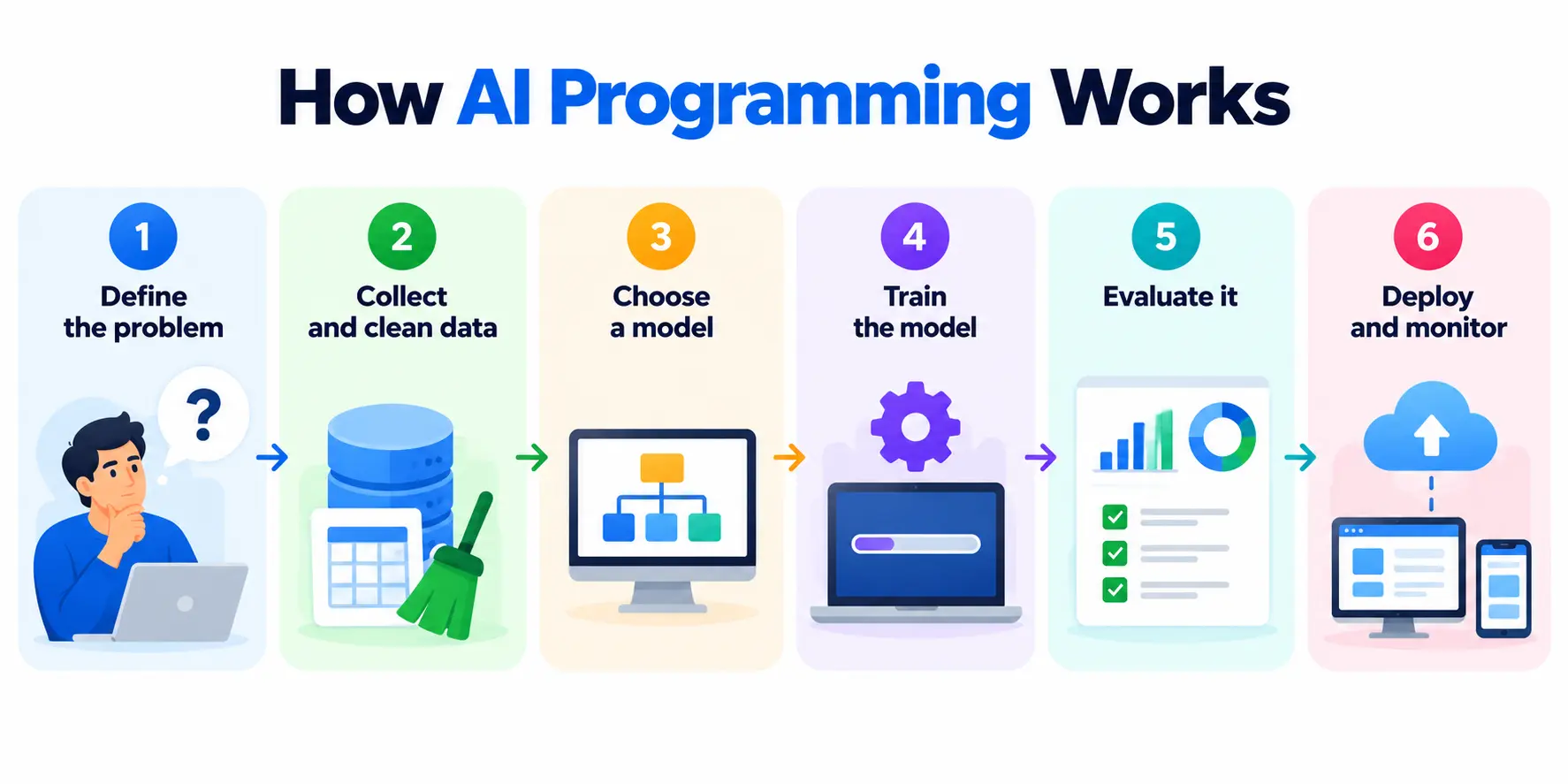









 ROI Calculator