
What Is ABC ID? Academic Bank of Credits Explained with Step-by-Step Guide (2026)
 October 4, 2026
 10 min read





Table Of Content
- What Is ABC ID (Academic Bank of Credits)?
- ABC ID vs APAAR ID vs DigiLocker
- How Does the Academic Bank of Credits Work?
- Multiple Entry and Multiple Exit Explained
 Key Insights
- ABC ID is your identifier in the Academic Bank of Credits, a digital system that stores, transfers and redeems academic credits under NEP 2020 and the UGC's 2021 regulations.
- The ABC ecosystem now runs on the APAAR ID, a permanent 12-digit learner ID, with DigiLocker as the login, so most students will create or access one identity rather than two.
- Credits are deposited by registered institutions, not by students, and they are valid for a maximum of seven years or the period set for the discipline.
- You can create your ID through DigiLocker in a few minutes using an Aadhaar-linked mobile number, plus your admission year, roll or registration number and institution.
- Most problems, such as name mismatches or a missing institution, have a simple fix, covered in the troubleshooting section below.
- In this blog, you'll learn what ABC ID is, ABC vs APAAR ID, how the credit system works, step-by-step creation, fixes for common errors and what it means for online learners.
If you are a college student in India, you have probably heard your university ask you to create an "ABC ID" or "APAAR ID", and you may not be sure whether these are the same thing. Add DigiLocker, credit transfer and multiple exit options to the mix and it can feel confusing.
This guide explains what ABC ID is, how it differs from APAAR ID, how the credit system works, and how to create and check your ID step by step. It also covers common errors and what the system means for online and distance learners.
 ChatGPT
 Perplexity
 Claude
 Grok
GrokWhat Is ABC ID (Academic Bank of Credits)?
The Academic Bank of Credits (ABC) is a digital platform run under the Ministry of Education and regulated by the UGC. It lets students store, transfer and redeem academic credits earned at recognised higher education institutions. Think of it as a passbook for your learning: instead of money, it holds the credits you earn from courses.
According to the ABC portal’s FAQ, credit transfer means registered institutions can receive or provide credits to a student’s account under UGC norms, and credit redemption means commuting those credits to meet the requirements for a degree, diploma, certificate or Ph.D. coursework. Your ABC ID is the identity linked to your Academic Bank Account, and it is how institutions find and update your credit record.
Where Did It Come From?
NEP 2020 recommended an Academic Bank of Credit so that credits earned from various recognised institutions could be stored digitally and used when awarding degrees. The UGC then framed the Academic Bank of Credits Regulations, 2021, notified on 28 July 2021, to set out how it operates.
ABC ID vs APAAR ID vs DigiLocker
This is the most common point of confusion, so here is the simple version.
| Term | What it is | Role for you |
|---|---|---|
| APAAR ID | Automated Permanent Academic Account Registry, a permanent 12-digit “One Nation, One Student ID” | Your lifelong academic identifier from school to university |
| ABC ID / Academic Bank Account | Your account in the Academic Bank of Credits | Where your verified credits are stored and redeemed |
| DigiLocker | Government digital document wallet | The login and document store you use to create and access the ID |
The official ABC portal now describes APAAR ID as the learner’s unique identity used inside ABC, though many students still say “ABC ID.” When a form asks for a number, use exactly the ID your institution names, and if in doubt, ask your college’s academic office.
How Does the Academic Bank of Credits Work?
The process has a few clear stages.
1. Institutions Register
Eligible colleges and universities register on the ABC platform under the UGC regulations. Only registered institutions can deposit credits, so your college’s status matters.
2. Credits Are Deposited
When you complete a course and pass, your institution uploads the credits to your account. Credits can only be shared by institutions, not directly by students.
3. Credits Can Be Transferred
If you move to another registered institution or programme, the credits can be shared with it under UGC norms, subject to its acceptance.
4. Credits Are Redeemed
When you are ready for a certificate, diploma or degree, the credits you have accumulated are redeemed and irrevocably debited for that award, so the same credits cannot be used twice. The regulations, as summarised in academic literature, also expect students to earn at least half their credits, including the core subject credits, from the awarding institution, so check your university’s specific rules.
5. Credits Have a Validity Period
Credits are valid for a maximum of seven years, or the duration specified for the discipline, as stated in the ABC FAQ. Plan your progression accordingly if you take a break.
A Simple Example of the Credit Journey
Suppose Riya joins a three-year undergraduate programme and completes the first year. Her institution uploads the credits she earned to her Academic Bank Account. Because of a job move, she pauses her studies. Within the validity window, she re-joins a registered institution that accepts those credits and continues from where she left off. When she finally completes the requirements, the credits used for the award are debited, so they cannot be counted again. This example is illustrative, and acceptance always depends on the receiving institution’s rules and the programme’s credit requirements.





Multiple Entry and Multiple Exit Explained
One of the main goals of ABC is to enable multiple entry and multiple exit. In principle, you can complete part of a programme, exit with a certificate or diploma, and return later to continue toward a degree using the credits you have already earned.
In practice, this depends on how your institution has implemented it, so ask about the exit and re-entry rules for your specific programme. To see how online and distance formats fit into this flexibility, read our guide on UGC’s equivalence of online and regular degrees.
Benefits of an ABC ID
- Academic mobility: move between registered institutions without losing earned credits.
- Flexible pathways: combine courses and take breaks without starting from scratch, and pair credits with practical skills, as discussed in degree vs skills.
- Digital records: credits are stored securely in a government system rather than on paper.
- Choice across disciplines: the regulations aim to give students flexibility and choice of disciplines
- Grievance support: the regulations provide grievance redressal at the central, UGC, ABC and institution levels.
Who Needs an ABC ID?
Students in higher education at institutions registered with ABC are the main users, and many universities now ask new and existing students to create the ID. Whether it is compulsory for you depends on your institution’s instructions, so follow the notice from your college or university.
Online and distance learners should check two things: whether their university is registered with ABC and whether the programme is UGC-recognised. Our guides to UGC-approved universities and how to choose an online university explain how to verify this.
Documents and Details You Need
Keep these ready before you start:
- An active DigiLocker account linked to your Aadhaar and mobile number
- A phone that can receive OTPs on the Aadhaar-linked number
- Your admission year
- Your roll number, registration number or enrolment number
- The exact name of your institution as listed in the portal
How to Create ABC ID: Step by Step
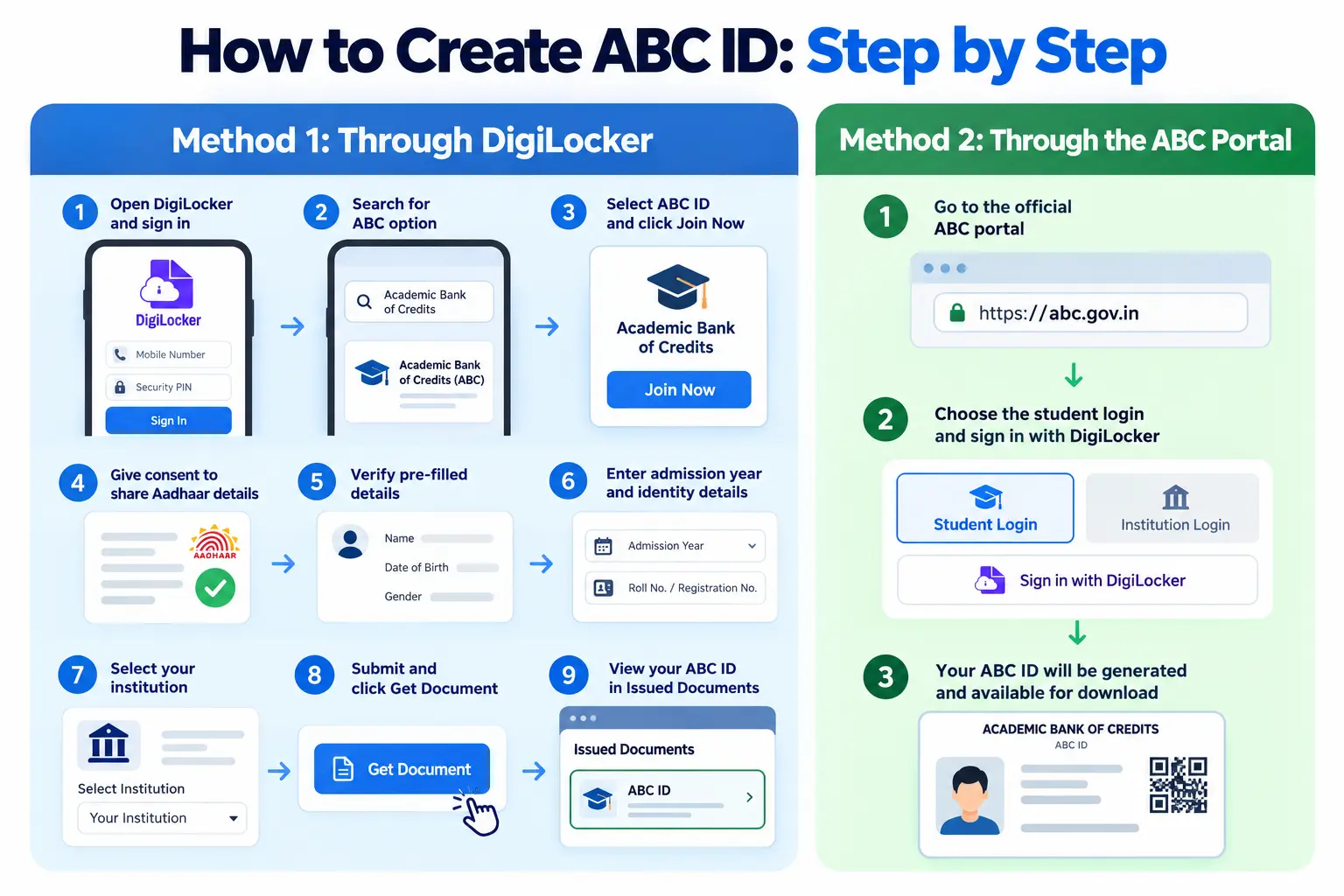
Method 1: Through DigiLocker
- Open DigiLocker on the web or in the app and sign in with your mobile number, security PIN and OTP. If you are new, sign up first.
- In the search bar, look for “Academic Bank of Credits” or the APAAR/ABC ID option.
- Select the ABC (APAAR) ID option and click the “Join Now” or create option.
- Give consent for DigiLocker to share your Aadhaar details with the Academic Bank of Credits.
- Check the pre-filled details: your name, date of birth and gender usually come from Aadhaar.
- Enter your admission year, choose the identity type such as roll number or registration number, and enter its value.
- Select your institution from the list
- Submit and click “Get Document.”
- Once matched, your ID card appears in the “Issued Documents” tab of your DigiLocker account.
Method 2: Through the ABC Portal
Go to the official ABC portal, choose the student login and sign in using your DigiLocker account. You cannot create the ID without DigiLocker, which is why the DigiLocker account comes first. Some guides also list the UMANG app as another entry point, but the DigiLocker route is the one documented on the ABC portal.
How to Check Your ABC ID and Credits
Open DigiLocker and go to Issued Documents to view or download your ID. To view credits, log in to the ABC portal through DigiLocker and open your student dashboard, where deposited credits appear once your institution has uploaded them. If nothing shows yet, the likely reason is that your college has not uploaded your credits, not that your ID is faulty.
Common ABC ID Problems and How to Fix Them
| Problem | Likely cause | What to do |
|---|---|---|
| Name or date of birth mismatch | Details differ between Aadhaar and college records | Update Aadhaar through the official channel, refresh Issued Documents in DigiLocker, then retry |
| Institution not listed | Your institution may not be registered | Ask your college whether it is registered with ABC |
| Roll or registration number rejected | Wrong number type or year | Confirm the exact number and admission year with your academic office |
| OTP not received | Mobile not linked to Aadhaar | Update your Aadhaar mobile number, then try again |
| Credits not visible | Institution has not uploaded them | Contact your college; use the grievance mechanism if needed |
Common Myths About ABC ID
Myth: ABC ID gives you a degree automatically. It does not. It stores credits. A qualification is awarded only when you meet the programme’s requirements at an awarding institution.
Myth: Students can upload their own credits. Only registered institutions can deposit credits.
Myth: Credits can be transferred anywhere in the world. The ABC FAQ defines credit transfer between registered higher education institutions within India, so do not assume overseas universities will accept them.
Myth: Credits never expire. They are valid for a maximum of seven years or the duration specified for the discipline.
Myth: Every institution automatically accepts your credits. Acceptance is subject to the receiving institution’s rules and the credit norms set by the UGC. The UGC regulations linked earlier are worth reading in full for the exact rules.
Mistakes to Avoid While Creating Your ABC ID
- Rushing through the details: a typo in your roll number or admission year is the most common reason for a failed match.
- Using the wrong number type: pick the identity type your college actually issued, whether that is a roll number, registration number or enrolment number.
- Ignoring Aadhaar errors: if your name or date of birth is wrong in Aadhaar, fix it first, because DigiLocker pulls those details from it.
- Creating duplicate accounts: if you already have an APAAR or ABC card, check Issued Documents before starting again.
- Trusting unofficial help: stick to the official portals and your institution’s helpdesk.
- Assuming every online programme is recognised: verify approval and accreditation first, as explained in our guide to the importance of accreditation.
What Institutions Must Do
Your ID is only half of the system. Your institution must be registered on the ABC platform, must verify your details and must upload credits after assessments. If you find that your credits are not showing months after completing a course, ask the academic or examination office whether the upload has happened. The regulations provide a grievance mechanism at the institution level, and further levels above it, so you have a route to escalate if the issue is not resolved.
Does Creating an ABC ID Cost Anything?
No fee is listed on the official portals for creating an ID through DigiLocker or the ABC portal. Be cautious of agents or websites that charge for it.
Many look-alike sites use “ABC ID” in their names. Use only the official government domains, abc.gov.in and digilocker.gov.in, and never share your Aadhaar OTP with anyone.
ABC ID for Online and Distance Learners
Online learners often ask whether credits from their programme count. The answer depends on whether your university is registered with ABC and whether the programme is UGC-approved. Before enrolling, check both, and understand the differences by reading online MBA vs distance MBAand online vs distance BBA.
Recognition also matters for jobs and exams. Before you commit, check whether an online degree is valid for government exams, and browse the list of UGC online degree courses to confirm your programme is on it.
Employers care about how your qualification is perceived, too. See whether an online MBA is recognised by employers before you enrol.
For working professionals, flexible credit-based learning fits alongside a job. Our guides on the benefits of online education for working professionals and all about online education explain how.
How ABC Fits Into India's Education Reform
ABC is part of the wider shift towards flexible, learner-centred education in India, alongside online learning platforms and skill-based programmes. Our overview of the evolution of the Indian education system shows how this fits together. If you plan to add skills alongside a degree, see upskilling strategies with online courses.
Conclusion
ABC ID is your key to the Academic Bank of Credits, the system that lets registered institutions store, transfer and redeem your credits. In practice, you create your ID through DigiLocker using your Aadhaar-linked mobile and your institution details, then rely on your college to upload credits.
Confirm that your institution is registered, follow the exact ID instructions your university gives, and stick to the official portals. If you are choosing a programme, verify UGC recognition first with our online MBA in India guide and explore Jaro Education’s online degrees.
Frequently Asked Questions
ABC stands for Academic Bank of Credits. The related APAAR ID stands for Automated Permanent Academic Account Registry.
They are closely linked. APAAR ID is the permanent learner ID, and the ABC portal uses it as the learner’s identity. Use whichever number your institution asks for.
Requirements depend on your institution. Many ask students to create it, so follow your college or university’s official notice.
Credits are valid for a maximum of seven years, or the duration specified for the discipline, according to the ABC FAQ.
No. Credits are deposited by registered institutions, not directly by students.
Sign in to DigiLocker and open the Issued Documents tab, where the ID appears after successful creation.
No fee is listed on the official portals. Avoid websites or agents that ask for payment.
Yes, if their institution is registered with ABC. Always check registration and UGC recognition of the university and programme before enrolling.

Related Courses
Explore our programs





Find a Program made just for YOU
We'll help you find the right fit for your solution. Let's get you connected with the perfect solution.

Is Your Upskilling Effort worth it?
 ROI Calculator

Are Your Skills Meeting Job Demands?
Try our Skill Gap tool
Experience Lifelong Learning and Connect with Like-minded Professionals
Explore Jaro Connect
