What Is Bandwidth? Meaning, Types, Uses & Examples
J
By Shubham Lal
September 25, 20269 min read
Published on September 25, 2026
SHARE THIS ARTICLE
Table Of Content
What Is Bandwidth?
Bandwidth Definition
How Does Bandwidth Work?
What Are the Types of Bandwidth?
Key Insights
Bandwidth refers to the capacity of a network connection to transfer data over a specific period and is commonly measured in bps, Mbps, or Gbps.
The blog explains different types of bandwidth, including network, digital, analog, and wireless bandwidth, along with their uses and common measurement units.
Bandwidth is different from internet speed, throughput, and latency. Understanding these differences can help when identifying and managing network performance issues.
Bandwidth supports activities such as video streaming, video conferencing, file transfers, cloud applications, online gaming, and website hosting.
In this blog, you'll learn the bandwidth meaning, bandwidth definition, types, uses, examples, common units, bandwidth meaning in work and bandwidth meaning in business.
Have you ever wondered why a video buffers when several people are using the same Wi-Fi connection, or why a large file takes longer to upload when the network is busy? Bandwidth is one of the key factors behind these everyday experiences.
In simple terms, bandwidth refers to the amount of data a network connection can carry over a given period. It is commonly measured in bits per second (bps), with units such as megabits per second (Mbps) and gigabits per second (Gbps).
However, bandwidth is not limited to internet connections. The term is also used in telecommunications, signal processing, cloud computing, and even workplace conversations. For example, someone may say, “I don't have the bandwidth for another project,” meaning they do not currently have enough time or capacity to take on more work.
This blog explains bandwidth, its definition, types, uses, examples, and how it differs from related terms such as speed, latency, and throughput.
Bandwidth is the capacity of a communication channel to transfer data during a specific period. In computer networking, it generally describes the maximum amount of data that can be transmitted through a network connection in a given amount of time.
Think of bandwidth as the width of a highway. A narrow highway can accommodate fewer vehicles at a time, while a wider highway can accommodate more vehicles. Similarly, a connection with greater bandwidth can carry more data at the same time.
For example, a network connection with 1 Gbps bandwidth has a higher data carrying capacity than a connection with 100 Mbps bandwidth.
It is important to remember that bandwidth represents capacity, not necessarily the actual amount of data being transferred at every moment.
Bandwidth Definition
The bandwidth definition can vary slightly depending on the context.
In computing, bandwidth is the measurement of how much information a network or internet connection can send within a specific period. It is generally measured in bits per second.
In telecommunications and signal processing, bandwidth can refer to the range of frequencies used by a signal orcommunication channel. This form of bandwidth is generally measured in hertz (Hz) rather than bits per second.
So, bandwidth has two commonly discussed meanings:
When you browse a website, watch a video, download a file, or join a video conference, data travels between your device and another computer or server.
The amount of data that can be transmitted through the connection during a particular period depends partly on its available bandwidth.
For example, imagine a home network with 100 Mbps bandwidth. If one person is downloading a large file while another is watching high quality video and a third person is attending a video meeting, all these activities are competing for network capacity.
This does not automatically mean each activity will receive an equal share. Network equipment, traffic management, application requirements, congestion, and other technical factors can affect actual performance.
What Are the Types of Bandwidth?
Bandwidth can be discussed in several ways depending on the technology and context.
1. Network Bandwidth
Network bandwidth refers to the data carrying capacity of a network connection. It is commonly expressed in Mbps or Gbps.
For example, an office network might have a connection with 1 Gbps bandwidth to support multiple employees using cloud applications, video meetings, file transfers, and other online services.
2. Digital Bandwidth
Digital bandwidth describes the capacity available for transmitting digital information. It is commonly associated with data transmission rates and is measured in bits per second.
Higher digital bandwidth allows a connection to carry more digital data within a given period.
3. Analog Bandwidth
Analog bandwidth refers to the range of frequencies that a system or communication channel can handle. It is measured in units such as Hz, kHz, or MHz.
This meaning is particularly relevant to telecommunications, electronics, and signal processing.
4. Wireless Bandwidth
Wireless bandwidth describes the capacity available for transmitting data over wireless connections such as Wi-Fi and cellular networks.
The actual experience can be influenced by factors such as signal strength, interference, network congestion, and the capabilities of the connected devices.
What Is the Difference Between Bandwidth and Internet Speed?
Bandwidth and internet speed are often used interchangeably, but they are not exactly the same concept.
Bandwidth describes how much data a connection can carry, while the actual rate at which data is transferred can be affected by several other factors.
A useful analogy is a highway. Bandwidth is similar to the number of lanes, while the rate at which vehicles actually move depends on traffic and road conditions.
For example, a network may have high bandwidth but still experience slow performance because of congestion, latency, packet loss, server limitations, or other network conditions.
This is why simply increasing bandwidth does not always solve every internet performance problem.
Bandwidth vs Throughput
Bandwidth and throughput are also related but different.
Bandwidth represents the maximum capacity of a connection under specified conditions. Throughput refers to the actual amount of data successfully transferred over the connection during a particular period.
For example, suppose a network connection has a theoretical bandwidth of 500 Mbps. If network congestion and other conditions result in an actual transfer rate of 350 Mbps, the 500 Mbps represents the available capacity while 350 Mbps represents the observed throughput.
This distinction is important when diagnosing network performance.
Bandwidth vs Latency
Latency refers to the time it takes for data to travel between two points or for a response to return. Bandwidth, on the other hand, is concerned with the capacity of the connection.
Consider a highway again. Bandwidth can be compared with the number of lanes, while latency is more closely related to how long it takes a vehicle to reach its destination.
A connection can therefore have high bandwidth and still have noticeable delays if latency is high.
Free Courses
Finance for All – Free Finance Certification Course
Bandwidth is usually expressed using bits per second.
Common units include:
Unit
Meaning
bps
Bits per second
Kbps
Kilobits per second
Mbps
Megabits per second
Gbps
Gigabits per second
Tbps
Terabits per second
For everyday internet connections, Mbps and Gbps are among the most common units you will encounter.
It is also important to distinguish bits from bytes. One byte consists of eight bits. Therefore, a measurement in Mbps should not be directly interpreted as the same numerical value in MB/s.
What Are the Uses of Bandwidth?
Bandwidth plays an important role in many digital activities.
Video Streaming
Streaming services send video and audio data to your device continuously. Higher quality video generally requires more data to be transmitted, so adequate bandwidth is important for a smooth viewing experience.
Video Conferencing
Applications used for online meetings need to send and receive audio and video data. When several people are using the same connection, available bandwidth can become an important consideration.
File Downloads and Uploads
Large files require the transfer of significant amounts of data. Available bandwidth can affect how quickly these transfers can take place, although actual transfer performance also depends on other factors.
Cloud Applications
Businesses increasingly use cloud based software for communication, storage, collaboration, and other activities. These applications rely on network connectivity to exchange data between users and cloud services.
Online Gaming
Online games communicate continuously with servers. While bandwidth matters, gaming performance also depends heavily on factors such as latency and connection stability.
Website Hosting
Bandwidth is also important for websites. Each time a website delivers pages, images, videos, scripts, or other files to visitors, data is transferred.
For hosting, bandwidth can sometimes be discussed as the amount of data transferred during a month rather than simply the maximum network rate.
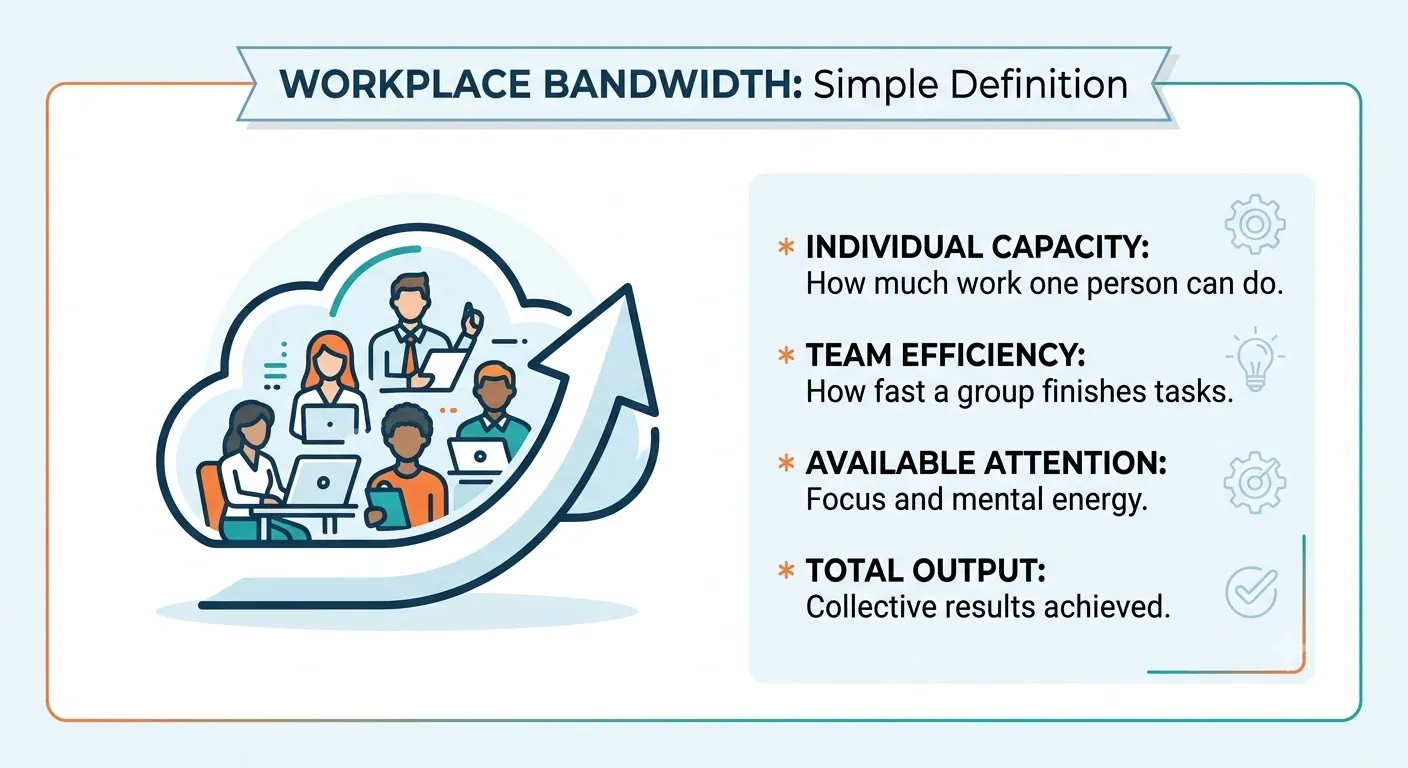
The bandwidth meaning in work is different from its technical networking meaning.
In workplace conversations, bandwidth is commonly used as a way to describe a person’s available time, energy, attention, or capacity to handle tasks.
For example, an employee might say:
“I don’t have the bandwidth to take on another project this week.”
Here, bandwidth does not refer to internet connectivity. It means the person currently has limited capacity because of existing responsibilities.
The business and workplace use of the term is widely recognized in English dictionaries. Oxford, for example, defines this usage as the energy or capacity needed to do something
What Is Bandwidth Meaning in Business?
The bandwidth meaning in business usually refers to the capacity available to handle work, projects, decisions, customers, or other responsibilities.
For example, a manager may say:
“Our team does not have the bandwidth to start another major project this quarter.”
This means the team may already have enough commitments and does not have sufficient capacity for additional work.
Bandwidth in business can therefore be discussed at both an individual and organizational level.
Individual bandwidth
This refers to how much work, responsibility, ordecision-makinga person can reasonably handle at a particular time.
Team bandwidth
This refers to the collective capacity of a team to complete its current and planned responsibilities.
Organizational bandwidth
This can refer to the broader capacity of an organization to manage new initiatives, changes, customers, or operational demands.
Using the term this way can make discussions about workload and resource planning more concise.
Examples of Bandwidth in Everyday Life
Here are some simple examples to understand the concept.
Example 1: Home Wi-Fi
A family has several devices connected to a home network. One person is streaming video, another is attending a video meeting, and another is downloading a large game. These activities share the available network capacity.
Example 2: Office Network
An office has dozens of employees using cloud applications, video calls, file sharing, and other services. A higher-capacity connection can support greater simultaneous demand, depending on the network design.
Example 3: Website
A website receives a large number of visitors. Every page request can involve transferring HTML, images, JavaScript, fonts, videos, and other resources. The amount of data transferred contributes to bandwidth usage in hosting environments.
Example 4: Workplace
A project manager is already responsible for several deadlines and meetings. When asked to lead another project, they might say they do not have enough bandwidth. Here, bandwidth means available capacity rather than network capacity.
Why Is Bandwidth Important?
Bandwidth matters because modern digital activities depend heavily on data transmission.
For individuals, sufficient bandwidth can support activities such as streaming, video calls, downloads, cloud backups, and multiple connected devices.
For businesses, bandwidth can influence the performance of cloud applications, communication tools, file sharing, websites, and other network dependent services.
However, bandwidth should not be viewed in isolation. Network performance can also be influenced by latency, congestion, packet loss, hardware, server capacity, wireless conditions, and other factors.
How Can You Manage Bandwidth More Effectively?
Organizations and individuals can take several approaches to manage network capacity.
Monitor usage: Understanding which applications and devices consume the most bandwidth can help identify potential bottlenecks.
Use caching and content delivery networks: Websites can reduce the amount of data repeatedly requested from an origin server by using caching and CDNs.
Optimize large files: Compressing images, videos, and other files can reduce the amount of data that needs to be transferred.
Prioritize important traffic: Organizations can use network management techniques to give appropriate priority to critical applications.
Plan for peak usage: Businesses should consider periods when many users or applications may need network capacity simultaneously.
Final Thoughts
Bandwidth is a fundamental concept in networking, telecommunications, and modern digital communication. In simple terms, the bandwidth meaning relates to the capacity available to transfer data over a connection within a given period.
The bandwidth definition becomes slightly different in technical contexts. In networking, it commonly refers to data carrying capacity and is measured in bits per second, while in telecommunications and signal processing it can refer to a frequency range measured in hertz.
The term also has a useful workplace meaning. Bandwidth meaning in work and bandwidth meaning in business generally refer to the time, energy, resources, or capacity available to handle additional responsibilities.
Understanding these different meanings makes it easier to interpret bandwidth whether you are troubleshooting a network, choosing an internet connection, managing a website, or discussing workload in a business environment.
Frequently Asked Questions
Bandwidth is the capacity of a network connection to carry data during a specific period. It is commonly measured in bits per second, such as Mbps or Gbps.
No. Bandwidth refers to data carrying capacity, while actual network performance can also depend on latency, congestion, packet loss, and other factors.
In the workplace, bandwidth refers to the amount of time, energy, attention, or capacity a person or team has available to handle additional tasks or responsibilities.
In business, bandwidth generally refers to the capacity an individual, team, or organization has to take on additional projects, decisions, customers, or responsibilities.
Network bandwidth is commonly measured in bits per second, including Kbps, Mbps, and Gbps. Bandwidth in signal processing is generally expressed in units such as Hz, kHz, or MHz.
Shubham Lal
Lead Software Developer
Shubham Lal joined Microsoft in 2017 and brings 8 years of experience across Windows, Office 365, and Teams. He has mentored 5,000+ students, supported 15+ ed-techs, delivered 60+ keynotes including TEDx, and founded AI Linc, transforming learning in colleges and companies.

 September 25, 2026
 9 min read





 Key Insights
 ChatGPT
 Perplexity
 Claude
 Grok
Grok










 ROI Calculator