Levels of Management: Types, Roles & Responsibilities
J
By Nuthana Reddy
September 28, 20267 min read
Published on September 28, 2026
SHARE THIS ARTICLE
Table Of Content
What Are the Levels of Management?
3 Level Management Structure
Different Managerial Levels and Their Key Differences
Key Functions Across the Levels of Management
Key Insights
The levels of management divide authority and responsibilities across top, middle, and lower-level management, helping organizations coordinate people, resources, and decisions.
Top level management focuses on long-term strategy and organizational direction, while middle managers turn strategies into departmental plans and lower-level managers oversee daily operations.
The 3 level management structure supports clear responsibilities, better communication, effective decision-making, improved coordination, and employee development.
The levels of change management can be considered at the individual, team, and organizational levels to help people and organizations understand and adapt to change.
In this blog, you'll learn about the levels of management, their types, roles and responsibilities, key differences, management functions, 3 level management, and levels of change management.
How does a large organization make decisions, manage employees, and achieve its business goals without everything becoming chaotic? The answer lies in having a clear management structure.
Every organization, whether it is a startup, a growing company, or a large multinational, needs managers at different positions to coordinate people and resources. These positions are commonly grouped into levels of management. Each level has different responsibilities, decision-making authority, and areas of focus.
Understanding the different managerial levels can help students, aspiring managers, and professionals understand how organizations function and how responsibilities are distributed.
In this blog, we will explore the levels of management, their types, roles, responsibilities, and how they differ from one another.
Levels of management refer to the different layers of authority and responsibility within an organization. They define who makes decisions, who implements them, and who manages day-to-day activities.
Managers at each level have a specific role. Senior managers generally focus on long-term organizational goals, middle managers convert those goals into actionable plans, and lower-level managers supervise employees and daily operations.
A traditional management structure is divided into three major levels:
Top-level management
Middle-level management
Lower-level management
This structure is often referred to as 3 level management.
The exact structure can vary depending on an organization’s size, industry, and business model. However, the basic purpose remains the same: to establish authority, improve coordination, and ensure that organizational goals are achieved efficiently.
The 3 level management structure provides a simple way to understand how authority flows through an organization.
Management Level
Main Focus
Common Roles
Top Level
Strategy and organizational direction
CEO, President, Managing Director
Middle Level
Planning and coordination
Department Manager, Regional Manager
Lower Level
Daily operations and supervision
Supervisor, Team Leader, Foreman
Although these levels have separate responsibilities, they are closely connected. Decisions made at the top influence middle management, while information from operational teams can help senior leaders make better decisions.
1. Top Level Management
Top level management represents the highest level of authority in an organization. These managers are responsible for determining the overall direction of the business.
Common positions at this level include CEOs, presidents, managing directors, executive directors, and other senior executives.
Roles of Top Level Management
The primary role of top level management is to establish the organization’s long-term vision and strategic direction.
Their responsibilities may include:
Setting organizational goals and objectives
Developing long-term strategies
Making major business decisions
Allocating important organizational resources
Establishing company policies
Managing relationships with major stakeholders
Monitoring overall organizational performance
Responding to major business opportunities and challenges
For example, if a company plans to expand into a new market, top-level managers may evaluate the opportunity, approve the expansion strategy, and allocate the necessary resources.
Skills Required at the Top Level
Managers at this level need strong strategic thinking and leadership abilities. They must understand the broader business environment and consider how decisions can affect the organization as a whole.
Middle-level management acts as a bridge between senior leadership and operational teams. Managers at this level take organizational strategies and convert them into practical plans.
Examples include department managers, branch managers, regional managers, and division managers.
Roles of Middle Level Management
Middle managers are responsible for translating broad organizational objectives into departmental goals.
Their responsibilities may include:
Implementing organizational policies
Preparing departmental plans
Allocating resources within departments
Monitoring team performance
Coordinating different teams
Reporting performance to senior management
Supporting employee development
Solving departmental issues
For example, if senior management decides to increase customer retention, a middle manager may create a departmental plan, assign responsibilities, monitor progress, and report results to senior leadership.
Middle management therefore plays an important role in maintaining communication between senior executives and operational employees.
3. Lower Level Management
Lower-level management, also known as supervisory management, focuses primarily on day-to-day activities.
This level is closest to employees who perform operational tasks. Common positions include supervisors, team leaders, shift managers, and foremen.
Roles of Lower Level Management
Lower-level managers ensure that employees understand their responsibilities and complete their work effectively.
Their responsibilities can include:
Assigning daily tasks
Supervising employees
Monitoring work quality
Maintaining schedules
Handling routine workplace problems
Providing feedback to employees
Maintaining workplace discipline
Reporting operational issues to middle management
For example, a customer service team leader may distribute daily tasks among team members, monitor service quality, resolve routine issues, and communicate important concerns to the department manager.
Different Managerial Levels and Their Key Differences
The different managerial levels can be distinguished based on their authority, responsibilities, decision-making, and time horizon.
Factor
Top Level
Middle Level
Lower Level
Main focus
Overall organization
Departments and functions
Daily operations
Planning
Long-term
Medium-term
Short-term
Decision-making
Strategic
Tactical
Operational
Main responsibility
Organizational direction
Strategy implementation
Employee supervision
Communication
Board, executives, stakeholders
Senior and lower management
Employees and middle managers
Time horizon
Long-term
Medium-term
Immediate or short-term
While the responsibilities differ, all three levels are essential for effective management.
Although each management level has different responsibilities, several management functions are common across the organization.
Planning
Planning involves determining what needs to be achieved and how it should be accomplished.
Top managers may create long-term business strategies, while middle managers develop departmental plans and lower-level managers prepare daily work schedules.
Organizing
Managers organize people, resources, and processes to accomplish organizational objectives.
This can involve assigning responsibilities, creating teams, allocating resources, and establishing workflows.
Staffing
Managers contribute to ensuring that the organization has the right people for different roles. Depending on their position, they may participate in recruitment, training, performance management, and employee development.
Directing
Directing involves guiding and motivating employees toward organizational objectives. Communication, leadership, supervision, and employee support are important parts of this function.
Controlling
Controlling involves comparing actual performance with planned objectives and taking corrective action when necessary.
For example, a manager may review sales performance against targets and identify areas that require improvement.
Importance of the Different Managerial Levels
Having clearly defined levels of management can help organizations operate more efficiently.
Clear Distribution of Responsibilities
A management structure helps employees understand who is responsible for different decisions and activities.
Better Communication
Information can move between senior management and operational employees through middle management and supervisory levels.
Effective Decision-Making
Different decisions can be handled at the appropriate management level. Strategic decisions may require senior leadership, while routine operational decisions can often be handled by supervisors.
Improved Coordination
Managers at different levels coordinate people, departments, and activities to support common organizational goals.
Employee Development
Management levels can also create opportunities for professionals to grow from supervisory positions into middle management and eventually senior leadership roles.
Levels of Change Management
The concept of management levels should not be confused with the levels of change management.
Change management focuses on helping individuals, teams, and organizations adapt to changes. These changes may involve new technologies, processes, organizational structures, or business strategies.
While there are different approaches to change management, change can generally be considered at several interconnected levels:
Individual Level
At the individual level, employees learn to understand and adopt a change. Training, communication, and support can help employees adjust to new systems or processes.
Team Level
At the team level, managers coordinate employees and help them work together during the transition. Teams may need revised responsibilities, new workflows, or additional training.
Organizational Level
At the organizational level, leaders focus on broader changes involving business strategy, structure, culture, technology, or processes.
The levels of change management therefore focus on managing transitions, while traditional management levels describe the hierarchy of authority within an organization.
How Managers at Different Levels Work Together
An organization cannot function effectively if each management level operates independently.
Consider a company launching a new product.
Top-level management may approve the product strategy and determine the overall business objectives. Middle management may create marketing, sales, operations, and production plans based on those objectives. Lower-level managers may then coordinate employees responsible for executing these plans.
Information also flows in the opposite direction. Operational managers can provide feedback about customer responses, employee challenges, production issues, and other practical concerns. Middle managers can analyze this information and communicate relevant insights to senior leadership.
This two-way flow of information helps connect strategic decisions with day-to-day execution.
Why Understanding Levels of Management Matters
Learning about the levels of management is useful for business students, management professionals, entrepreneurs, and people preparing for leadership roles.
It helps explain how organizations divide responsibilities and how decisions move from strategic leadership to operational execution.
For professionals, understanding the responsibilities of different managerial levels can also help identify potential career paths. Someone starting as a team leader may eventually move into a departmental management role and later progress toward senior leadership.
At the same time, management is not simply about having authority. Effective managers need to communicate clearly, solve problems, coordinate people, and contribute to organizational objectives.
The levels of management provide a framework for understanding how organizations divide authority, responsibility, and decision-making.
The three major levels, namely top-level, middle-level, and lower-level management, each serve a distinct purpose. Top level management focuses on strategy and organizational direction, middle management converts strategies into practical plans, and lower-level management supervises daily operations.
Understanding these different managerial levels can help aspiring professionals recognize how organizations function and how managers at various positions contribute to business objectives.
At the same time, 3 level management is only one way of structuring an organization. Modern organizations may use flatter structures, specialized roles, or different reporting systems depending on their needs. Similarly, the levels of change management focus on helping people, teams, and organizations adapt to change rather than describing organizational hierarchy.
Frequently Asked Questions
The three main levels of management are top-level management, middle-level management, and lower-level management. Each level has different responsibilities related to strategy, planning, coordination, and daily operations.
Top level management is responsible for setting organizational goals, developing strategies, making major decisions, allocating resources, and providing overall direction to the organization.
Middle managers focus on implementing organizational strategies and coordinating departments, while lower-level managers primarily supervise employees and manage day-to-day operations.
The levels of change management can be viewed at the individual, team, and organizational levels. They focus on helping people and organizations understand, adopt, and manage changes effectively.
Nuthana Reddy
Nuthana Reddy is a Senior Manager at Procter & Gamble, specializing in operations, digitization, and cross-functional leadership. She has driven multimillion-dollar impact through innovation, process optimization, and strategic execution across global markets.

 September 28, 2026
 7 min read




 Key Insights
 ChatGPT
 Perplexity
 Claude
 Grok
Grok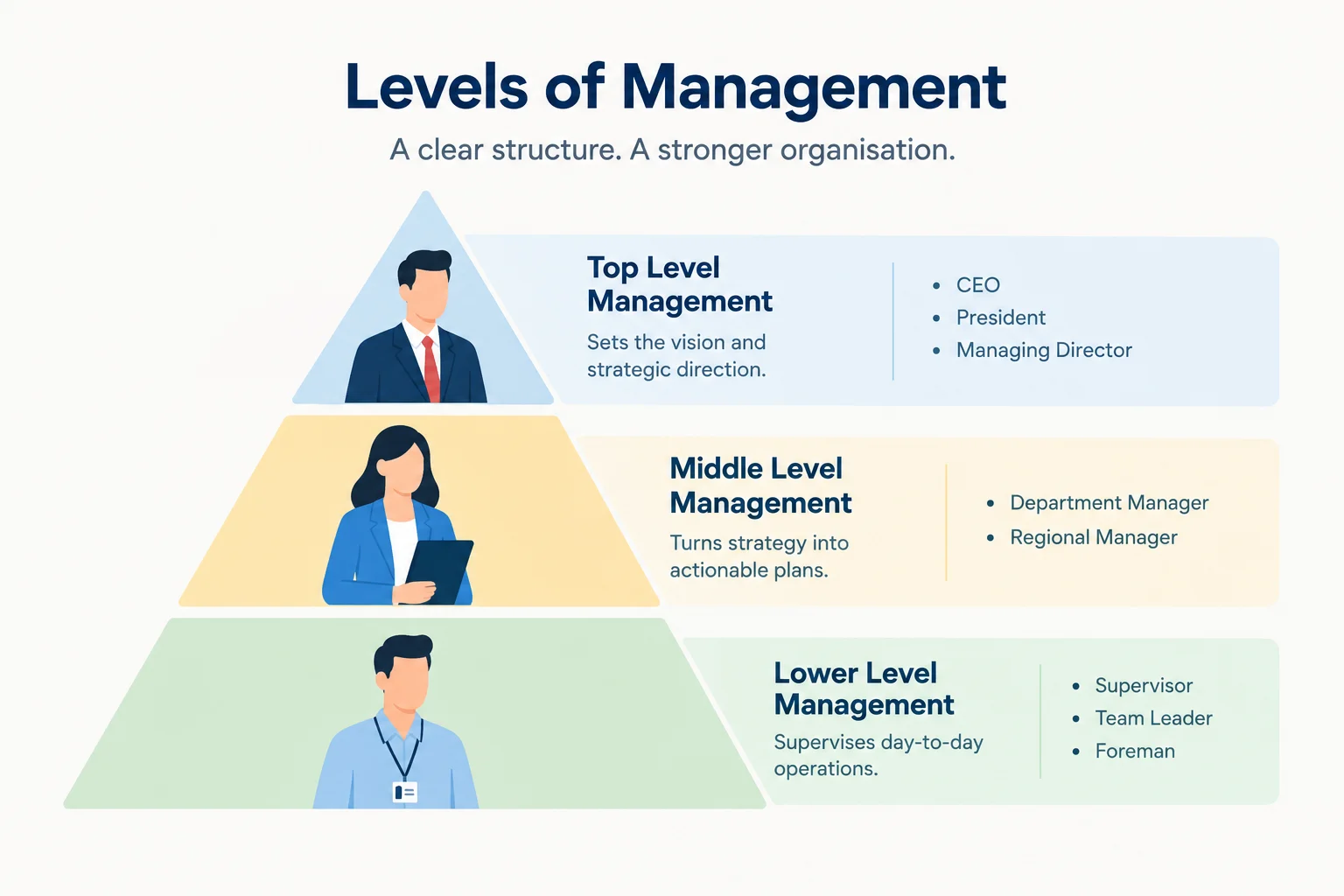










 ROI Calculator