Why Scenario Planning in Strategic Management Matters
Scenario Planning vs. Forecasting
The Scenario Planning Process: Step by Step
Key Insights
Scenario planning helps organizations prepare for multiple possible futures instead of relying on a single forecast. It allows leaders to anticipate uncertainties, assess risks, and make better strategic decisions.
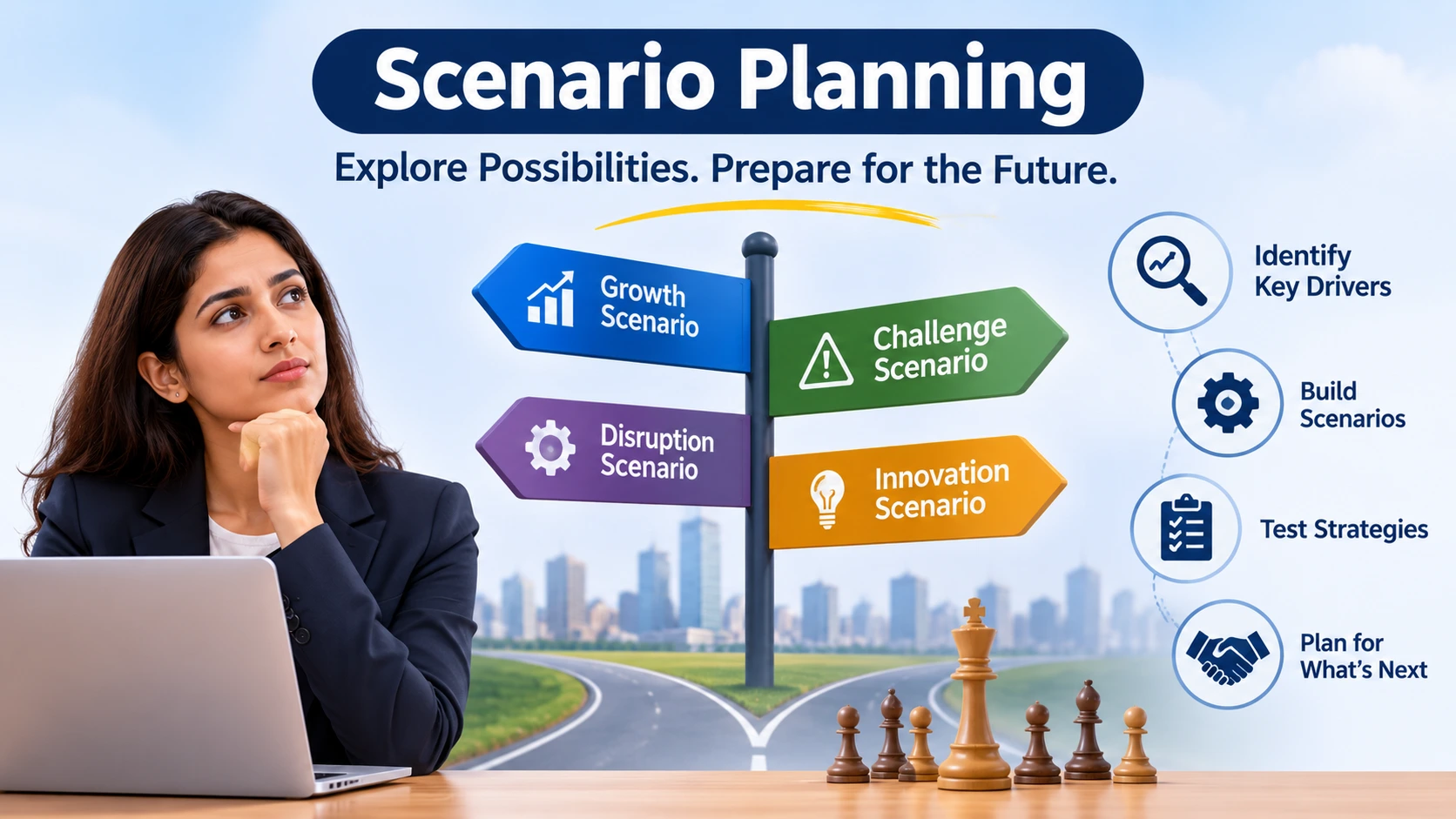
The scenario planning process involves defining objectives, identifying key drivers of change, evaluating critical uncertainties, building scenarios, testing strategies, and monitoring early warning signals.
Common scenario planning methodologies include intuitive logics, the two-by-two matrix, quantitative modeling, backcasting, and horizon scanning. Organizations can combine qualitative storytelling with quantitative analysis to evaluate potential outcomes.
Scenario planning tools such as PESTLE analysis, SWOT analysis, impact and uncertainty matrices, financial models, simulation software, and AI tools help businesses assess risks and explore different possibilities.
Effective scenario planning requires diverse perspectives, manageable scenarios, regular reviews, clear communication, and actionable strategies. Companies should avoid treating scenarios as predictions or creating plans without follow-up actions.
In this blog, you'll learn what scenario planning is, why it matters in strategic management, how the scenario planning process works, common methodologies and tools, real-world examples, and best practices for preparing businesses for uncertain outcomes.
No business can predict the future with certainty. A sudden policy change, a supply disruption, a new technology, or a shift in customer behavior can quickly alter the conditions in which a company operates. Leaders who plan around a single forecast often find themselves unprepared when reality takes a different path.
Scenario planning offers a better approach. Instead of guessing one outcome, it helps organizations explore several plausible futures and prepare for each of them. In this blog, we explain what scenario planning is, how the process works, which methods and tools are used, and how real companies apply it.
Scenario planning is a structured way of imagining and analyzing different possible futures so that an organization can make better decisions today. It is not about predicting what will happen. It is about understanding what could happen and how the business would respond.
Each scenario is a coherent story about the future, built from a set of assumptions about trends, events, and uncertainties. By comparing these stories, leaders can test whether their strategy would hold up under different conditions.
A useful way to think about it is as a rehearsal. A pilot practices emergency situations in a simulator so that the response becomes familiar before a real problem occurs. Scenario planning gives business leaders a similar opportunity.
Why Scenario Planning in Strategic Management Matters
Scenario planning in strategic management has become increasingly valuable because the business environment is more connected and unpredictable than before. Traditional strategic plans often rely on forecasts that assume the future will resemble the past. When conditions change quickly, such plans lose relevance.
Scenario planning helps in several ways:
Reduces surprise. Teams think through unlikely but possible events in advance, so they react faster when change arrives.
Challenges assumptions. It brings hidden beliefs into the open and invites leaders to question them.
Improves decision quality. Strategies can be stress-tested against multiple futures before resources are committed.
Encourages flexibility. Organizations learn to build options and adapt rather than depend on one fixed path.
Aligns leadership. Discussing scenarios gives executives a shared language for talking about risk and opportunity.
In short, it shifts the question from “What will happen?” to “What if this happens, and what will we do?”
People often confuse the two, but they serve different purposes.
Forecasting estimates a most likely outcome using historical data and trends. It works well when conditions are stable and the future resembles the past.
Scenario planning explores a range of possible outcomes, particularly when uncertainty is high and data from the past offers limited guidance.
The two approaches complement each other. A forecast can serve as one input into a scenario, but relying on a forecast alone can leave a company exposed to events it never considered.
The Scenario Planning Process: Step by Step
While approaches vary, the scenario planning process generally follows a clear sequence. Here is a practical outline.
Step 1: Define the Purpose and Time Horizon
Begin by deciding what question the exercise should answer. Examples include “How might our industry change in the next ten years?” or “What could affect our supply chain over the next three years?” A clear focus keeps the work relevant. The time horizon should be long enough for meaningful change but short enough to stay practical.
Step 2: Identify Key Drivers of Change
Next, list the forces that could shape the future. These often include economic conditions, technology, regulation, customer expectations, competition, demographics, environmental factors, and geopolitical events. Teams usually gather input from different departments and, where possible, from outside experts to reduce blind spots.
Step 3: Separate Predictable Trends from Critical Uncertainties
Not every driver is equally uncertain. Some trends, such as an aging population in many countries, are relatively predictable. Others, such as the speed of a new technology’s adoption, are highly uncertain. The team then identifies the uncertainties that are both highly important to the business and difficult to predict. These become the foundation of the scenarios.
Step 4: Build the Scenarios
Using the critical uncertainties, the team constructs a small number of distinct scenarios, commonly between two and four. Each one should be plausible, internally consistent, and different enough from the others to prompt useful discussion. Giving each scenario a memorable name makes it easier to remember and share.
Step 5: Develop Narratives and Implications
Each scenario is then described as a story that explains how events unfold. The team considers what the world looks like, how customers behave, and what challenges and opportunities emerge. Most importantly, it asks what the scenario means for the company’s business model, operations, finances, and people.
Step 6: Test Strategies and Identify Actions
Existing strategies are tested against every scenario. Some decisions will work well in all of them, and these are often called “no-regret moves.” Others will succeed in only one scenario and may need to be reconsidered or supported by contingency plans.
Step 7: Monitor Signals and Update
Finally, the team defines early warning indicators, such as changes in regulation, market prices, or consumer behavior. These signals show which scenario may be emerging. Scenario planning is not a one-time event, so scenarios should be reviewed and refreshed regularly.
Scenario Planning Methodology: Common Approaches
There is more than one scenario planning methodology, and organizations choose the approach that suits their needs.
The intuitive logics approach. This is the most widely used method. It relies on workshops where participants identify drivers, select key uncertainties, and develop narrative scenarios. It is qualitative, flexible, and encourages creative thinking.
The two-by-two matrix. A popular technique within intuitive logics. Teams select two critical uncertainties, place each on an axis and create four scenarios from the resulting quadrants. For example, a retailer might plot “pace of digital adoption” against “strength of consumer spending.”
Quantitative modeling. This approach uses data, simulations, and statistical models to estimate how variables such as demand, costs, or prices may change under different assumptions. It is common in finance, energy, and risk management.
Backcasting. Instead of moving forward from today, teams start with a desired or feared future and work backward to identify the steps that could lead there. It is useful for setting long-term goals, such as sustainability targets.
Horizon scanning. A supporting method in which organizations systematically watch for weak signals and emerging trends that may influence the scenarios.
Many companies combine qualitative storytelling with quantitative analysis. Stories make scenarios memorable, while numbers help leaders assess financial impact.
Scenario Planning Tools Used by Organizations
A range of scenario planning tools can support the work, from simple templates to advanced software.
Workshops and whiteboards. Structured sessions remain the foundation of most exercises, as they bring diverse perspectives together.
PESTLE analysis. A framework that examines political, economic, social, technological, legal and environmental factors to identify drivers of change.
SWOT analysis. Helps evaluate how strengths, weaknesses, opportunities, and threats differ across scenarios.
Impact and uncertainty matrix. Ranks drivers by their importance and unpredictability to select the critical uncertainties.
Spreadsheets and financial models. Allow teams to test how revenue, costs, and cash flow respond to different assumptions.
Simulation and analytics software. Platforms using Monte Carlo simulation, system dynamics, ordata visualization can model complex relationships and show a range of outcomes.
AI and data tools. Newer tools can scan large volumes of news and market data to identify emerging signals and help test assumptions. Their outputs still need careful human review.
The right tool depends on the size of the organization and the complexity of the question. A small business may do well with a workshop and a spreadsheet, while a multinational may use specialized modeling software.
Scenario Planning Examples from the Real World
Looking at scenario planning examples makes the concept easier to understand.
Energy industry. Royal Dutch Shell is widely cited as an early adopter. In the early 1970s, its planners explored the possibility of major disruptions in oil supply and prices. When the 1973 oil crisis occurred, Shell was reportedly better prepared to respond than many competitors. The case is often used to show how scenarios can improve readiness for shocks.
Retail and consumer goods. A retailer may build scenarios around how quickly customers shift to online shopping and how strongly the economy performs. In one scenario, online sales grow rapidly and stores shrink. In another, customers return to physical shopping. The company can then decide how flexibly to invest in stores, warehouses, and delivery networks.
Healthcare. Hospitals use scenarios to plan for rising demand, staff shortages, or disease outbreaks. By preparing for several levels of patient demand, they can arrange capacity, equipment, and staffing more effectively.
Manufacturing and supply chains. A manufacturer might examine scenarios involving trade restrictions, raw material shortages, or port disruptions. This helps it identify backup suppliers, hold strategic inventory, and design more resilient networks.
Public sector. Governments and city planners use scenarios to prepare for climate risks, population growth, and infrastructure needs.
Across all of these, the benefit is similar: leaders gain clarity about risks and options before they are forced to act under pressure.
Future Scenario Planning: Preparing for Long-Term Change
Future scenario planning extends the approach to longer horizons, often ten to thirty years. It is especially useful when organizations face large structural shifts, such as climate change, advances in artificial intelligence, changing workforce patterns, or shifts in global trade.
At this scale, accuracy matters less than imagination and discipline. Teams look for early signals, question assumptions, and consider developments that may seem unlikely today. The aim is to build strategic resilience, which means the ability to adjust and remain effective whatever the future brings.
Organizations that practice future scenario planning regularly tend to develop a culture of curiosity and adaptability. They become more comfortable discussing uncertainty openly, which can be a real competitive advantage.
Best Practices for Effective Scenario Planning
To get lasting value from the exercise, consider these practical guidelines.
Involve diverse voices. Include people from different functions, levels, and, if possible, outside the company. Diversity reduces groupthink.
Keep the number of scenarios manageable. Two to four well-developed scenarios are easier to use than a long list.
Make scenarios plausible, not predictive. Avoid labeling one scenario as “the real forecast.” Treat them all as serious possibilities.
Link scenarios to decisions. The exercise should lead to concrete actions, such as investments, partnerships, or contingency plans.
Define trigger points. Decide in advance which signals will prompt a change in course.
Communicate clearly. Use simple stories and visuals so that scenarios are understood across the organization.
Review regularly. Update scenarios as new information appears.
Uncertainty is a permanent feature of business, and companies cannot remove it. What they can do is prepare for it. Scenario planning gives organizations a disciplined way to explore multiple futures, test their strategies, and build flexibility into their decisions. By following a clear scenario planning process, choosing a suitable scenario planning methodology, and using practical tools, leaders can make more confident choices even when the road ahead is unclear. Whether applied to near-term risks or long-term future scenario planning, the value lies not in predicting correctly but in being ready.
Frequently Asked Questions
Scenario planning is a method that helps organizations imagine several possible futures and prepare for each one. Instead of relying on a single forecast, it asks “what if?” questions and tests whether current plans would still work if conditions changed.
Most organizations create between two and four scenarios. Fewer than two does not show real contrast, while too many can become confusing and difficult to act upon. The goal is to have a small set of distinct, plausible futures that spark meaningful discussion.
Risk management usually focuses on identifying and reducing specific threats. Scenario planning takes a broader view, exploring how multiple uncertainties may combine to create entirely different business environments. It covers opportunities as well as risks and supports long-term strategic choices.
Yes. Small businesses can use simple approaches, such as listing a few key uncertainties, building best-case, worst-case, and middle-case scenarios, and using a spreadsheet to test financial impact. The principles are the same, even if the tools are less advanced.
Nuthana Reddy
Nuthana Reddy is a Senior Manager at Procter & Gamble, specializing in operations, digitization, and cross-functional leadership. She has driven multimillion-dollar impact through innovation, process optimization, and strategic execution across global markets.
Get Free Upskilling Guidance
Fill in the details for a free consultation
Related Courses
Explore our programs
Professional Certificate Programme in Strategic Management

 November 8, 2026
 9 min read




 Key Insights
 ChatGPT
 Perplexity
 Claude
 Grok








 ROI Calculator