
Project Management Interview Questions and Answers
 September 4, 2026
 7 min read




Table Of Content
- Project Management Interview Questions and Answers
- Project Manager Scenario Based Interview Questions and Answers
- IT Project Manager Interview Questions and Answers
- Project Management Interview Prep
 Key Insights
- Project management interviews assess your ability to plan work, manage stakeholders, handle risks, resolve conflicts, make decisions, and keep projects aligned with objectives.
- Strong answers should focus on real project experience, with clear examples of your responsibilities, actions, challenges, and outcomes.
- Scenario-based questions can be approached by understanding the situation, assessing its impact, communicating with stakeholders, taking appropriate action, and monitoring the result.
- Effective risk and change management involves assessing impacts on scope, timelines, costs, resources, quality, and dependencies before making decisions and communicating approved changes.
- IT project manager interviews may place greater emphasis on technical projects, changing technology requirements, technical teams, dependencies, stakeholders, and technology-related project risks.
- In this blog, you'll learn about common project management interview questions, scenario-based questions and answers, IT project manager interview questions, project management interview preparation strategies, and tips for giving clear, structured, and relevant answers.
A project manager plays a crucial role in ensuring that projects are planned, organized, and delivered according to business objectives. From defining project requirements and coordinating teams to managing timelines, budgets, risks, and stakeholder expectations, project managers handle multiple responsibilities throughout the project lifecycle. Because of this, interviews for project management roles often go beyond basic definitions and test how candidates respond to real workplace situations.
If you are preparing for an upcoming interview, knowing the right project management interview questions can help you organize your preparation and approach the interview with greater confidence. Interviewers may ask about your experience, leadership style, project planning methods, risk management approach, and ability to handle conflicts or changing requirements. You may also encounter project manager scenario based interview questions and answers that assess your decision-making and problem-solving skills.
This guide covers common questions, scenario-based situations, IT project management questions, and practical project management interview prep tips to help you prepare effectively.
 ChatGPT
 Perplexity
 Claude
 Grok
GrokProject Management Interview Questions and Answers
A project management interview tests your project management knowledge. Interviewers want to understand how you plan work, manage stakeholders, handle risks, resolve conflicts, make decisions, and keep projects moving toward their objectives.
This guide covers project management interview questions, scenario-based project management questions and answers, IT project manager interview questions and answers, and project management interview prep tips.
1. Tell Me About Yourself
Keep your response focused on your professional background, project experience, relevant skills, and the type of projects you have handled. Connect your experience to the position rather than giving a complete personal history.
Mention experience coordinating teams, managing timelines, communicating with stakeholders, tracking progress, or solving project issues.
2. What Is Project Management?
Project management is the process of planning, organizing, executing, monitoring, and closing work to achieve defined project objectives. It involves coordinating people, resources, schedules, budgets, risks, communication, and stakeholder expectations.
Show that project management is not simply about completing tasks; it is about organizing work and people to achieve the intended outcome.
3. What Are the Key Responsibilities of a Project Manager?
A project manager coordinates a project from initiation through completion. Common responsibilities include defining objectives, creating plans, assigning responsibilities, managing schedules and budgets, managing risks, communicating with stakeholders, resolving issues, and tracking progress.
4. How Do You Start a New Project?
Begin by understanding the project’s objectives, expected outcomes, scope, stakeholders, constraints, and success criteria. Then identify resources, establish responsibilities, develop a schedule, identify risks, and create a communication approach.
5. How Do You Prioritize Tasks?
I prioritize tasks based on impact, urgency, dependencies, risks, and available resources. I identify activities that could affect critical milestones or block other work, communicate priorities to the team, and review them as conditions change.
6. How Do You Manage Project Risks?
Risk management starts with identifying potential risks early. I assess their likelihood and impact, determine appropriate responses, assign ownership when required, and monitor risks throughout the project.
Risk management should be an ongoing activity rather than something done only during planning.
7. How Do You Handle Scope Creep?
First, I determine whether the requested change is necessary and assess its impact on scope, timeline, cost, resources, and deliverables. I discuss the implications with relevant stakeholders before accepting or rejecting the change.
If approved, I update the project plan and communicate the impact to everyone affected.
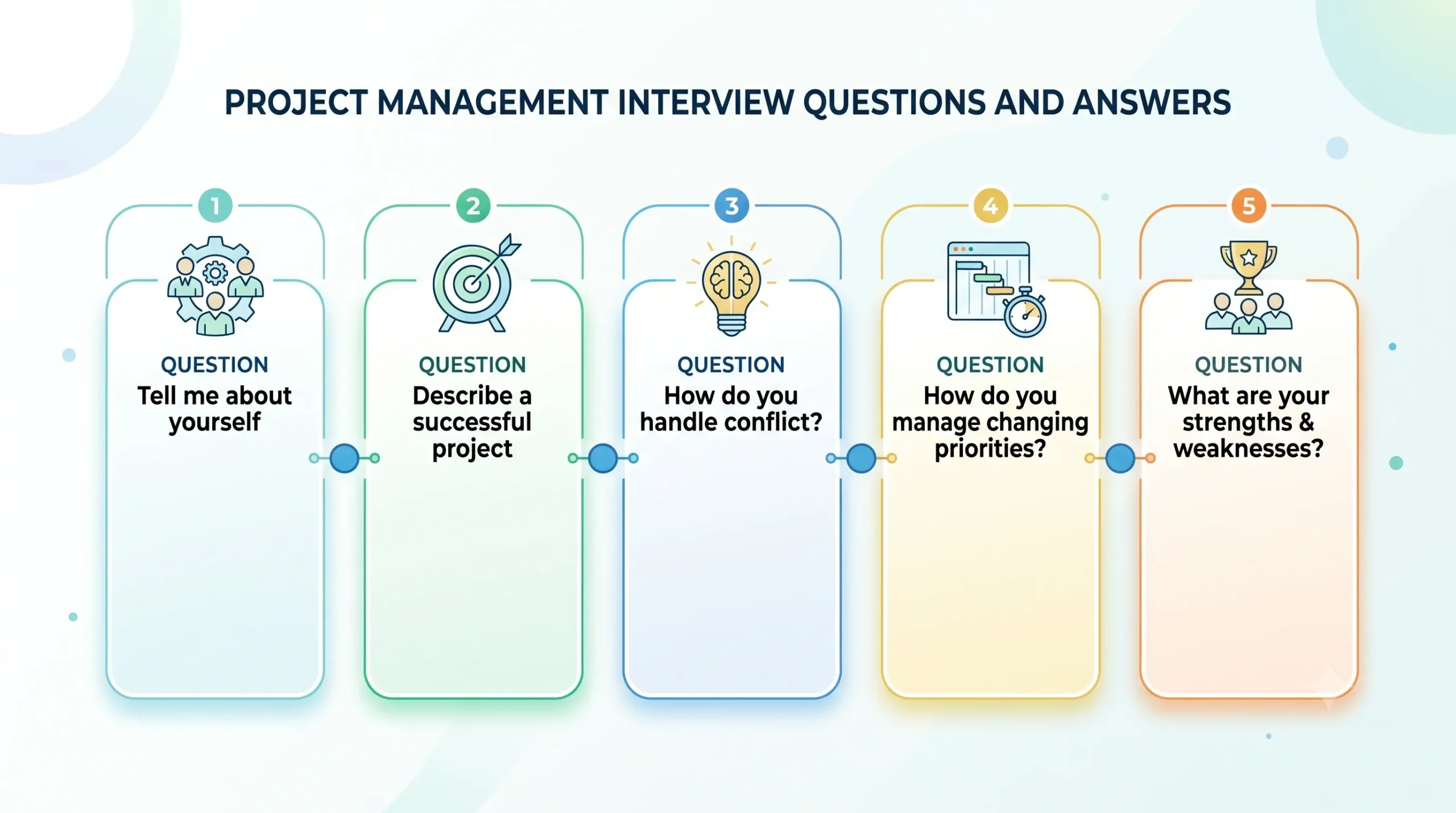
8. How Do You Handle a Missed Deadline?
I first identify why the deadline was missed rather than assigning blame. I review the cause, determine affected activities, assess the impact on milestones, and develop a recovery plan.
I then communicate the situation honestly to stakeholders, agree on realistic next steps, and monitor the revised plan.
9. How Do You Deal With a Difficult Stakeholder?
I start by understanding the stakeholder’s concerns, expectations, and priorities. I keep communication factual and focused on project objectives rather than personalities.
If there is disagreement, I use requirements, timelines, project data, and impacts to support the discussion.
10. How Do You Manage Conflicts Within a Team?
I address conflicts early and understand the perspectives of everyone involved. I focus on the issue and its impact on the project rather than allowing the discussion to become personal.
After reaching an agreement, I clarify responsibilities and follow up to ensure the conflict does not continue affecting the project.
11. What Project Management Methodologies Have You Used?
Explain the methodologies you have actually worked with, such as Agile, Scrum, Waterfall, or a hybrid approach. Explain why each approach was suitable.
Show that project characteristics, requirements, uncertainty, and stakeholder expectations can influence the methodology.
12. How Do You Track Project Progress?
Project progress can be tracked through milestones, schedules, task completion, deliverables, risks, issues, and metrics. I compare actual progress with the approved plan and identify deviations early.
Project Manager Scenario Based Interview Questions and Answers
Scenario-based questions show how you apply project management knowledge in practical situations. Explain the situation, problem, action, and outcome.
13. What Would You Do If a Key Requirement Changed Near the Deadline?
I would understand why the requirement changed and assess its impact on scope, schedule, resources, quality, and delivery. I would discuss the trade-offs with stakeholders and determine whether the change should be accepted, deferred, or handled through a revised plan.
If approved, I would update the project plan and communicate the revised expectations to the team.
14. What Would You Do If Two Stakeholders Had Conflicting Priorities?
I would bring the discussion back to the project’s objectives and success criteria. I would understand each stakeholder’s needs and evaluate the effect of each option on scope, schedule, resources, and outcomes.
The goal would be to reach a documented decision that supports the project and prevents competing priorities from delaying progress.
15. What Would You Do If Your Project Were Over Budget?
I would review the budget to identify where the variance occurred and determine whether it resulted from scope changes, resources, unexpected issues, or estimates.
I would evaluate available options, discuss the financial impact with stakeholders, and create a corrective plan. Approved changes would be documented and monitored.
16. What Would You Do If a Critical Team Member Left?
I would assess which responsibilities and deliverables are affected and identify immediate project risks. I would redistribute responsibilities where possible and determine whether replacement resources or additional support are needed.
I would also review the schedule and communicate material impacts to stakeholders.
17. What Would You Do If the Client Was Unhappy With the Project?
I would listen carefully to understand whether the concern involves scope, quality, communication, timelines, or expectations. I would compare the concern with agreed requirements and current results.
Based on the findings, I would propose corrective actions, agree on next steps, and maintain communication until the issue is resolved.



IT Project Manager Interview Questions and Answers
IT project manager interviews may focus more heavily on technology-related projects, changing requirements, technical teams, dependencies, and business outcomes.
18. How Do You Manage Technical and Non-Technical Stakeholders?
I adapt communication to the audience. Technical stakeholders may need information about dependencies, risks, systems, or implementation, while business stakeholders may need clearer information about outcomes, timelines, costs, and impacts.
19. How Do You Manage Changing Technology Requirements?
I document requirements clearly and establish a process for evaluating changes. When a requirement changes, I assess its impact on scope, timeline, resources, cost, quality, and dependencies before deciding how to proceed.
This keeps the project flexible without allowing uncontrolled changes to disrupt delivery.
Project Management Interview Prep
Effective project management interview prep combines knowledge, practice, and examples.
Start by reviewing project management fundamentals, including scope, schedules, risks, stakeholders, resources, communication, and methodologies. Then prepare examples from projects you have worked on. For each example, identify the challenge, your responsibility, the action you took, and the result.
Practice answering common project manager interview questions aloud. Avoid memorizing complete responses because interviews often include follow-up questions. Instead, understand the key points you want to communicate.
For scenario-based project management questions and answers, focus on your decision-making process. Explain how you gather information, assess impact, communicate with stakeholders, make decisions, and monitor outcomes.
Conclusion: Final Tips for a Project Management Interview
A strong answer should be specific, structured, and relevant. Avoid giving only theoretical definitions when the interviewer asks about your experience.
Use real examples whenever possible. When discussing a challenge, explain what happened, what you did, why you chose that approach, and what changed as a result.
For behavioral and scenario questions, demonstrate communication, accountability, organization, problem-solving, adaptability, and stakeholder management. Show that you can make practical decisions while keeping project objectives in focus.
Interviewers evaluate how you think, not only what you know. Clear reasoning, realistic actions, and confident communication can make your answers more effective.
Frequently Asked Questions
Explain how you would understand the situation, assess its impact, communicate with relevant people, take appropriate action, and monitor the result. Use real examples when possible.
Review project management fundamentals, prepare examples from your projects, practice common and scenario-based questions, and research the organization and role.
IT project manager interviews may place greater emphasis on technical projects, changing technology requirements, technical teams, dependencies, stakeholders, and technology-related project risks.





Find a Program made just for YOU
We'll help you find the right fit for your solution. Let's get you connected with the perfect solution.
Is Your Upskilling Effort worth it?
 ROI Calculator

Are Your Skills Meeting Job Demands?
Try our Skill Gap tool
Experience Lifelong Learning and Connect with Like-minded Professionals
Explore Jaro Connect
