
Performance Marketing: A Complete Guide for Modern Businesses
 August 27, 2026
 10 min read





Table Of Content
- What Is Performance Marketing?
- How Does Performance Marketing Work?
- Key Performance Marketing Channels
- Performance Marketing vs. Traditional Marketing
 Key Insights
- Performance Marketing focuses on measurable outcomes such as clicks, leads, purchases, sign-ups, and other defined conversions, helping businesses evaluate campaign effectiveness.
- An effective performance marketing strategy involves setting clear objectives, understanding the target audience, selecting suitable channels, tracking conversions, testing variables, and continuously optimizing campaigns.
- Businesses can use channels such as paid search, paid social media, affiliate marketing, display and programmatic advertising, and performance-oriented influencer partnerships.
- Key metrics including CTR, CPC, CPL, CPA, conversion rate, and ROAS help marketers evaluate campaign efficiency, while accurate tracking supports better budget allocation and data-driven decisions.
- In this blog, you'll learn what is performance marketing, how it works, its key channels and metrics, benefits and challenges, strategy-building techniques, required skills, and the role of a performance marketing course.
In today’s competitive digital landscape, businesses are under increasing pressure to make every marketing dollar count. Simply reaching a large audience is no longer enough. Businesses want to know which campaigns generate leads, which ads drive purchases, and which channels contribute to revenue. This is where Performance Marketing becomes important.
Performance marketing is a results-oriented approach that focuses on measurable actions such as clicks, leads, sign-ups, app installs, purchases, or other defined conversions. Instead of evaluating a campaign only by its reach or impressions, businesses can assess its effectiveness through measurable performance indicators.
For modern businesses, this approach can support better budget allocation, continuous campaign optimization, and more informed decision-making. However, successful performance marketing requires more than simply running paid advertisements. It involves setting clear objectives, understanding customers, selecting suitable channels, tracking conversions, analyzing data, and continuously improving campaigns.
This complete guide explains what is performance marketing, how it works, its major channels, important metrics, key benefits, common challenges, and how businesses can develop an effective performance marketing strategy.
 ChatGPT
 Perplexity
 Claude
 Grok
GrokWhat Is Performance Marketing?
What is performance marketing? In simple terms, it is a marketing approach in which campaigns are planned and evaluated around specific, measurable outcomes. These outcomes can include generating a qualified lead, completing a purchase, downloading an application, submitting a form, or booking a product demonstration.
The central idea is accountability. Instead of focusing only on how many people saw an advertisement, marketers can connect campaign activity with measurable actions.
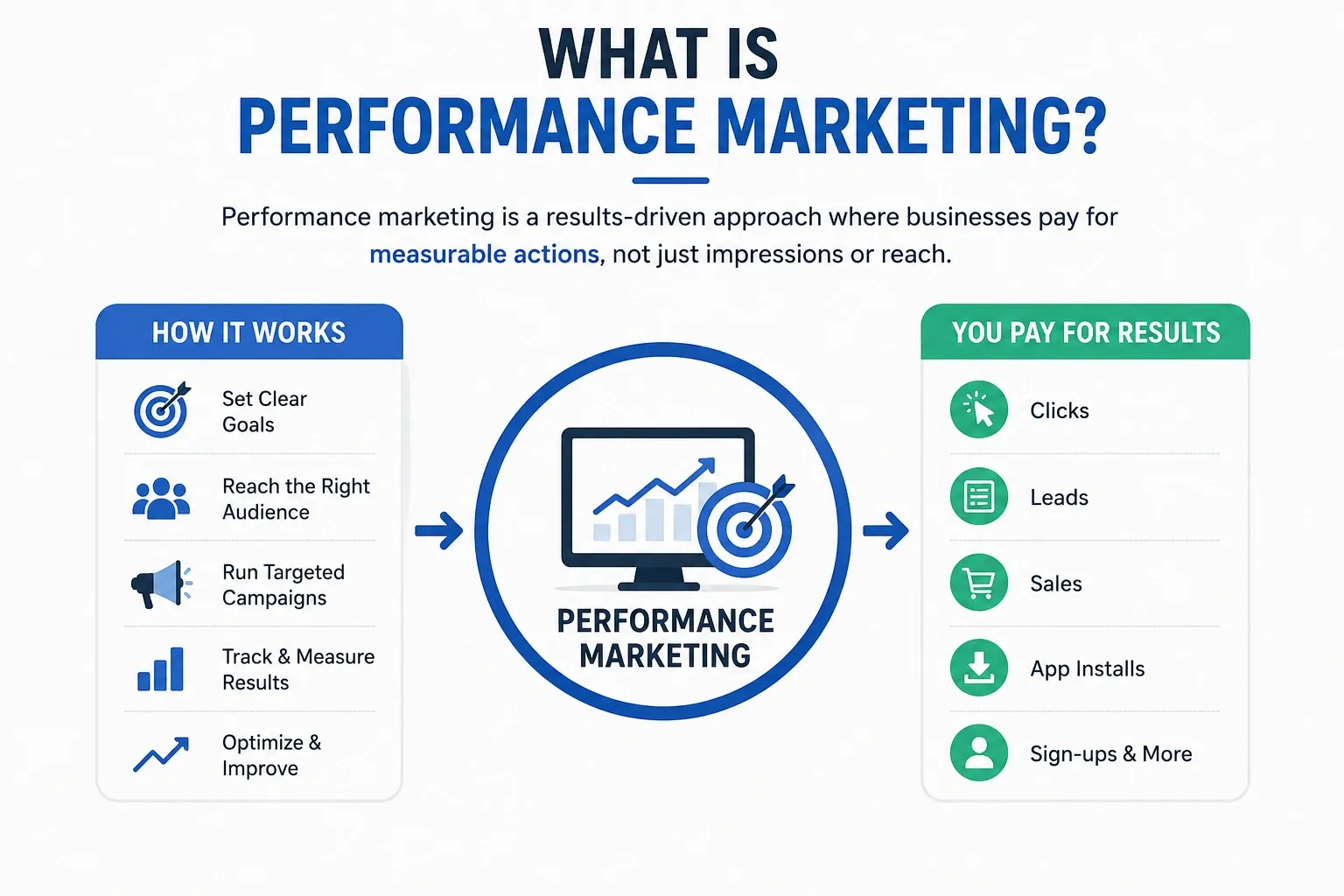
For example, an e-commerce company may launch a paid social campaign designed to generate purchases. The business can track impressions, clicks, conversions, cost per acquisition, and revenue generated. The campaign can then be adjusted based on the data.
This makes performance marketing different from advertising approaches that primarily focus on exposure. The difference is not necessarily the platform being used; the objective and measurement framework are equally important. The same advertising platform can support brand-focused or performance-focused campaigns depending on the campaign goal.
How Does Performance Marketing Work?
Performance marketing generally follows a continuous cycle:
Set objectives → Identify the audience → Select channels → Launch campaigns → Track results → Optimize → Scale
1. Define the Business Objective
The first step is deciding what the campaign needs to achieve. The objective could be increasing online sales, generating leads, acquiring new customers, increasing registrations, or driving app installations.
A clearly defined objective gives marketers a measurable target against which campaign performance can be evaluated.
2. Identify the Target Audience
Businesses need to understand who they want to reach. Audience research can include customer needs, demographics, behaviors, interests, purchase intent, and problems the product or service solves.
Understanding the audience helps businesses create more relevant messaging and select channels where potential customers are likely to engage.
3. Select the Right Marketing Channels
Different channels serve different purposes. Search advertising can help capture existing demand, while paid social can help businesses reach and engage specific audience groups. Affiliate marketing can introduce products through external partners, while retargeting can reconnect with users who have already interacted with a brand.
The right channel mix depends on the business model, audience, campaign objective, and available budget.
4. Launch and Track Campaigns
Tracking is one of the most important elements of performance marketing. Businesses need to establish conversion tracking and other measurement systems before campaigns begin.
Tracking helps marketers understand where conversions originate and which campaigns, advertisements, audiences, or landing pages contribute to results.
5. Optimize Continuously
Performance marketing is not a set-it-and-forget-it activity. Campaign data should be reviewed regularly to identify opportunities for improvement.
Marketers can test different advertisements, messaging, audiences, landing pages, bids, and budgets. Successful elements can receive greater investment, while underperforming campaigns can be modified or paused.
Key Performance Marketing Channels
Performance marketing can be implemented across multiple digital channels. The best choice depends on the audience and desired outcome.
Paid Search Marketing
Paid search allows businesses to display advertisements when users search for relevant products, services, or solutions. It can be particularly useful for capturing users who already demonstrate purchase or research intent.
For example, someone searching for a specific professional course may already be interested in enrolling. A relevant paid search campaign can place an offer in front of that user at an important stage of the decision-making process.
Paid Social Media Marketing
Social media advertising allows businesses to reach audiences using platforms where users spend time engaging with content. Campaigns can be optimized for objectives such as traffic, leads, conversions, or purchases.
Creative quality plays an important role in paid social performance. Businesses often test different headlines, visuals, offers, formats, and calls to action to identify combinations that generate stronger results.
Affiliate Marketing
Affiliate marketing involves partnerships in which external publishers or partners promote a business and receive compensation for qualifying actions generated through their efforts.
Because payment can be connected to specific outcomes, affiliate marketing fits naturally within the broader performance marketing ecosystem. Partners may use content, websites, promotional links, or other approved methods to generate conversions.
Display and Programmatic Advertising
Display advertising can be used to reach audiences across websites and digital properties. Programmatic advertising uses automated systems to purchase advertising inventory and can be optimized according to campaign objectives.
These channels can support different stages of the customer journey, including awareness, consideration, and conversion.
Influencer and Partner Marketing
Performance-oriented influencer campaigns can go beyond paying creators simply for exposure. Businesses can structure campaigns around trackable actions such as sales, sign-ups, or other conversions.
This approach allows brands to evaluate creator partnerships based on measurable business outcomes rather than audience size alone.
Performance Marketing vs. Traditional Marketing
Traditional marketing has often focused heavily on exposure, reach, and brand awareness. Television, print, outdoor advertising, and other traditional formats can be valuable for building recognition, but directly connecting every interaction to a conversion can be difficult.
Performance marketing places greater emphasis on measurable outcomes.
| Traditional Marketing | Performance Marketing |
| Focuses heavily on reach and exposure | Focuses on measurable actions |
| Measurement may be less direct | Conversion tracking is central |
| Campaign optimization can be slower | Campaigns can be optimized continuously |
| Results may be harder to attribute | Results can often be connected to specific campaigns |
| Budget decisions may rely on broader estimates | Data can inform budget allocation |
This does not mean businesses should completely replace brand marketing with performance marketing. A strong marketing ecosystem can combine brand building with measurable acquisition and conversion activities.
Important Performance Marketing Metrics
Metrics help marketers determine whether campaigns are moving toward their objectives. Some of the most commonly monitored metrics include:
Click-Through Rate (CTR)
CTR measures the percentage of users who click an advertisement after seeing it. It can provide insight into how effectively an advertisement attracts attention and encourages interaction.
Cost Per Click (CPC)
CPC represents the cost associated with generating a click. Monitoring CPC can help marketers understand how efficiently campaigns are generating traffic.
Cost Per Lead (CPL)
CPL measures how much a business spends to generate a lead. It can be particularly useful for businesses that rely on inquiries, registrations, or form submissions.
Cost Per Acquisition (CPA)
CPA measures the cost of acquiring a customer or completing a defined conversion. It is an important metric for evaluating campaign efficiency.
Conversion Rate
Conversion rate indicates the percentage of users who complete a desired action after interacting with a campaign. A higher conversion rate can indicate that the campaign and user experience are effectively encouraging the intended action.
Return on Ad Spend (ROAS)
ROAS compares revenue generated with advertising expenditure. It can help businesses understand how much revenue their advertising investment produces.
Metrics should not be evaluated independently. A campaign with a low CPC, for example, may still be unsuccessful if the resulting traffic does not generate meaningful conversions




How to Build an Effective Performance Marketing Strategy
A successful performance marketing strategy should connect business objectives with audience insights, campaign execution, measurement, and optimization.
Start With Clear Goals
Avoid vague objectives such as “increase online visibility.” Instead, establish measurable goals connected to business priorities, such as increasing qualified leads or generating a specific number of purchases.
Understand the Customer Journey
Map the customer journey from initial awareness to consideration, conversion, and retention. Different audiences may require different messages at different stages.
Someone discovering a brand for the first time may need educational content, while an existing website visitor may respond better to a product-focused offer.
Match Channels With Objectives
Do not select channels simply because they are popular. Consider where your audience spends time and which platforms are suitable for achieving your specific goal.
A business focused on capturing high-intent searches may prioritize paid search, while a visually driven consumer brand may place greater emphasis on paid social campaigns.
Create Relevant Campaign Assets
Advertisements and landing pages should work together. The message presented in an advertisement should align with the landing page experience.
Strong creative should communicate the value proposition clearly and provide a compelling reason for users to take the intended action.
Test Different Variables
Testing is essential for optimization. Businesses can experiment with headlines, visuals, offers, calls to action, audience segments, landing pages, and campaign structures.
Rather than making assumptions about what customers prefer, marketers can use campaign data to identify stronger-performing combinations.
Track the Entire Conversion Journey
Measuring only clicks can create an incomplete picture. Businesses should track meaningful conversion events and connect marketing activity with business outcomes whenever possible.
Good measurement also helps identify which campaigns generate valuable customers rather than simply inexpensive traffic.
Optimize and Scale Carefully
When a campaign performs well, businesses may increase investment. However, scaling should be approached carefully.
Rapidly increasing budgets without monitoring efficiency can affect campaign performance. Businesses should continue evaluating acquisition costs, conversion rates, revenue, and other relevant metrics as spending increases.
Benefits of Performance Marketing for Modern Businesses
Better Budget Visibility
Performance marketing provides businesses with data that can help them understand how advertising budgets are being used and what outcomes campaigns generate.
Data-Driven Decision-Making
Instead of relying entirely on assumptions, marketers can use campaign data to make decisions about audiences, messaging, channels, and budgets.
Continuous Optimization
Because campaign performance can be monitored regularly, marketers can identify underperforming areas and make changes during the campaign lifecycle.
Scalable Campaigns
Once businesses identify campaigns that generate acceptable results, they can explore opportunities to expand successful campaigns across audiences, channels, or geographic markets.
Greater Accountability
Performance marketing creates a stronger connection between marketing activity and measurable business outcomes. This can make it easier for marketing teams to communicate campaign performance to business stakeholders.
Skills Needed for Performance Marketing
As businesses increasingly rely on measurable digital acquisition, performance marketers need a combination of analytical, creative, and strategic skills.
Important skills include:
- Digital advertising fundamentals
- Data analysis and interpretation
- Conversion tracking
- Campaign optimization
- Audience research
- Copywriting and creative evaluation
- Landing page optimization
- Budget management
- A/B testing
- Marketing analytics
- Customer journey understanding
- Strategic decision-making
Professionals who want structured knowledge can consider a performance marketing course to develop their understanding of campaign planning, paid advertising, analytics, measurement, and optimization.
A good learning path should ideally combine concepts with practical application. Working with campaign examples, analyzing performance data, developing advertisements, and understanding conversion funnels can help learners connect theory with real-world marketing decisions.
The Future of Performance Marketing
Performance marketing continues to evolve as advertising platforms become more automated and customer journeys become increasingly complex. Marketers are now required to combine technology, creativity, analytics, and strategy.
Automation can assist with campaign management and optimization, but marketers still need to establish appropriate goals, provide effective creative assets, interpret performance data, and make strategic decisions.
Measurement is also becoming increasingly important. As users interact with brands across multiple channels and devices, understanding the customer journey requires more than looking at a single click or conversion.
The future of performance marketing is therefore likely to focus not simply on generating more conversions, but on generating better business outcomes. Marketers who understand both data and customer behavior will be better positioned to build sustainable campaigns.
Conclusion
Performance Marketing has become an important approach for modern businesses that want greater accountability from their digital advertising investments. By connecting campaigns with measurable actions, businesses can evaluate performance, identify opportunities, and continuously improve their marketing efforts.
However, successful performance marketing requires more than placing advertisements on digital platforms. Businesses need clear objectives, audience understanding, appropriate channel selection, accurate tracking, compelling creative, meaningful metrics, and continuous optimization.
Whether a company is generating leads, selling products, promoting applications, or acquiring new customers, a well-planned performance marketing strategy can create a structured framework for turning marketing activity into measurable outcomes.
For professionals, learning these principles through practical experience or a performance marketing course can also provide a strong foundation for understanding one of the most data-focused areas of modern marketing.
Frequently Asked Questions
Performance marketing is a results-focused marketing approach where campaigns are planned and evaluated around measurable actions such as clicks, leads, purchases, registrations, or app installs.
Digital marketing is a broad category covering multiple online marketing activities. Performance marketing is more specifically focused on measurable outcomes and campaign performance.
A performance marketing course can help beginners build structured knowledge of campaign planning, advertising channels, analytics, tracking, optimization, and performance measurement. Practical exercises can further help learners understand how these concepts are applied.





Find a Program made just for YOU
We'll help you find the right fit for your solution. Let's get you connected with the perfect solution.

Is Your Upskilling Effort worth it?
 ROI Calculator

Are Your Skills Meeting Job Demands?
Try our Skill Gap tool
Experience Lifelong Learning and Connect with Like-minded Professionals
Explore Jaro Connect

