12 Types of Organizational Skills You Should Focus On
How to Improve Organizational Skills in Daily Life
How Can Jaro Education Help You Build Strong Organizational Skills
Conclusion
In a professional setting, organizational skills affect almost everything. They influence how you handle deadlines, how you communicate with your team, and how efficiently you complete your work. Since organizational abilities are an important part of any social skill, professionals who focus on improving them often find they can accomplish more in less time by reducing distractions, managing priorities better, and avoiding last-minute chaos.
This guide breaks down the most important types of organizational skills and explains how they show up in real situations.
12 Types of Organizational Skills You Should Focus On
Different roles demand different strengths, but certain organizational skills are useful no matter what you do. These skills work together to create a system that supports your daily workflow.
1. Time Management
Time management tends to be the first thing that pops into everyone’s mind when it comes to organizational skills, and for a very good reason. A major source of stress among professionals is that they tend to feel that there simply is no time for anything. Usually, what this really comes down to is how the available time is being managed, rather than just the sheer number of things one needs to do. Proper time management involves knowing how much time any specific task will take.
2. Task Prioritization
Not all tasks require your immediate attention. Some tasks have urgency; others have importance; and some can wait for your attention. Prioritization is one of the most fundamental organizational skills that you need to develop to be more efficient. By doing so, you won’t end up spending too much time on insignificant work while letting crucial work go undone.
3. Goal Setting
Without having any goals, an individual might experience unproductiveness even on a hectic day. Goal-setting gives you a sense of direction regarding your endeavors. This skill will help you align yourself with your larger objectives in terms of organizational skills among all other skills. This involves not only goal setting but also making small steps in achieving your goals.
4. Planning and Scheduling
These organizational skills enable you to set your daily routine, whether on a weekly or monthly basis, such that everything seems much more organized. This allows you to avoid wasting too much time deliberating on what the next step should be. A properly planned schedule will save you from decision fatigue and allow you more freedom of choice.
5. Attention to Detail
Attention to detail is evident when you pay careful attention to what you are doing, adhere strictly to the instructions, and maintain consistency in your output. When you are engaged in the process of developing organizational skills, paying attention to detail guarantees that your efforts are not only prompt but also dependable.
6. Documentation and Record Keeping
Documentation is a skill that helps save time in the future. Information tracking can be done by keeping notes, storing documents, or documenting discussions. This enables one to be ready for future use of the information. It also reduces confusion among team members as everyone has access to the information.
7. Clear Communication
Communication will be more effective when your ideas are structured. It is for this reason that good communication is associated with organization. You can save a lot of time when you understand your message and the way you are going to communicate your message. Individuals who develop the skill of organization usually find that their messages, whether through writing or talking, are clearer.
8. Workflow Management
Workflow management refers to the concept of tracking how processes get from point A to point B. This particular organizational competency represents a rather sophisticated one, since it deals with seeing the big picture. It is no longer only about individual processes, but also about relationships between these processes. By improving this competency, it is possible to recognize inefficiencies, eliminate superfluous processes, and streamline the whole workflow.
9. Delegation
Attempting to handle all matters alone may lead to a reduction in efficiency. Delegation is an effective way to handle organizational matters through dividing responsibilities. This process involves trusting people and communicating clearly what you expect. Proper delegation enables you to concentrate on matters that require your undivided attention. Delegation forms one aspect of organizational skill development.
10. Adaptability
Even the best plans need adjustments sometimes. Adaptability helps you stay productive when things do not go as expected. This aspect of organizational skills ensures that you do not get stuck when plans change. Instead, you adjust your approach and keep moving forward. It also helps you handle unexpected challenges without feeling completely overwhelmed.
11. Decision Making
Every day involves making choices, both big and small. Strong decision making is one of the most useful organizational skills because it helps you move forward without constant hesitation. When your work is organized, you have better clarity, which leads to better decisions. This is another reason why understanding what are organizational skills is important for long term growth.
12. Stress Management
This is one of the basic components of your organizational skills because all other aspects are dependent upon it. By effectively managing your stress, you are able to reduce your chances of making any kind of mistake and remain consistent throughout. Those people who work hard on improving their organizational skills generally find themselves capable enough to handle greater amounts of work.
All the above mentioned twelve skills form a whole picture of how to improve your organizational skills. It is not necessary for you to learn them all at once; you only need to get started from somewhere and keep improving yourself.
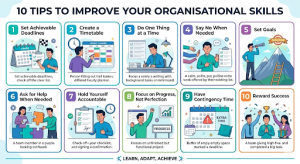
How to Improve Organizational Skills in Daily Life
Understanding the various kinds of organizational skills is helpful, but the true change occurs when you begin practising your organizational abilities in your daily activities. The following are some methods for improving organizational skills without turning your daily life into a strict schedule.
1. Start With a Clear Daily Plan
One of the easiest methods of boosting your organizational skills is by starting your day with a plan. Rather than responding to things as they happen throughout your day, spend some time determining what must be attended to. Create a list of three to five main items that will have to be accomplished during the day. This helps you to concentrate on the essentials without getting distracted.
2. Use Time Blocks Instead of To Do Lists Alone
Although list-making is a good habit, at times, everything on your list may seem equally important, leading to feeling overwhelmed. Time blocking will help you add structure to your list. Dedicate particular periods for each task that you have on your list. Time blocking makes you a better organiser because you follow a pattern in your schedule.
3. Declutter Your Workspace and Digital Files
There is an effect of your surroundings when you have to be organized. A cluttered desk or a desktop full of mess can hinder you more than you know. Developing your organizing skills begins with organizing yourself first. Only keep those things in sight that you require for immediate use and arrange documents for easy access.
4. Break Large Tasks Into Smaller Steps
Large goals tend to be intimidating for some people; hence, they postpone completing them. Splitting large goals into small parts enables them to become more manageable. This is among the most useful methods of improving organizational skills since it ensures that motivation is sustained throughout the process.
5. Set Realistic Deadlines
Overly high expectations can also interfere with good organizational skills, like too short a deadline means poor results, and too lengthy a deadline means delays. Learn to predict the amount of time needed for your assignments and give yourself adequate deadlines. With practice, you will develop better scheduling skills that allow you to be productive without becoming overwhelmed.
6. Review and Reset at the End of the Day
A fast recap at the end of each day will work wonders. Check what you have done for the day, what tasks need to be done tomorrow, and what still needs to be carried forward. Such a practice improves your organizational abilities while making you conscious of your accomplishments. This will help you start the next day on a clear note.
7. Learn to Say No When Needed
Taking on too many tasks can weaken your organizational skills. It creates unnecessary pressure and reduces your ability to focus. Understanding your limits is an important part of our organizational skills. Saying no to low-priority work allows you to protect your time and energy for tasks that truly matter.
8. Use Tools That Work for You
There is no shortage of apps and tools designed to improve organizational skills. From calendars to task managers, these tools can help you stay on track. The key is to choose something simple and stick with it. Overloading yourself with too many tools can have the opposite effect. Focus on what supports your workflow rather than complicates it.
9. Build Consistent Routines
Routines reduce the need for constant decision making. When certain tasks become part of your daily or weekly routine, they require less effort to complete. This is why routines are a powerful way of developing organizational skills. They create stability and make your workflow more predictable.
10. Reflect and Improve Regularly
Improvement in organizational skills is an ongoing process. What works today may need adjustment later. Take time to reflect on your habits and identify areas where you can improve. This mindset ensures that your systems continue to evolve with your needs.
Improving organizational skills is not about becoming perfect or rigid. It is about creating a structure that supports your goals while still allowing flexibility. When you consistently apply these practices, you begin to notice a shift. Tasks feel more manageable, your time feels more controlled, and your overall productivity improves in a way that feels sustainable.
How Can Jaro Education Help You Build Strong Organizational Skills
If you are serious about strengthening your organizational skills, the right learning ecosystem can make all the difference. Jaro Education connects working professionals with industry-relevant programs designed to sharpen decision-making, improve execution, and build structured thinking.
If your goal is to move from being task-driven to strategy-driven, these programs offer a clear pathway.
These programs serve as a broader pathway for professionals looking to strengthen their overall management capabilities. They focus on systems, processes, and operational efficiency, all of which are closely tied to organizational skills. By learning how to structure workflows and optimize processes, you build a more scalable approach to managing work.
Explore the program that aligns with your goals and take the next step toward building a more structured, high-impact career!
Building strong organizational skills is not about becoming overly structured or rigid. It is about creating a way of working that gives you clarity, control, and consistency. When you understand what organizational skills are and start applying them in small, practical ways, the impact shows up quickly in your daily routine.
You begin to manage time better, make clearer decisions, and handle responsibilities without constant pressure. Over time, developing organizational skills becomes less of a conscious effort and more of a natural part of how you work.
Frequently Asked Questions
The term organizational skills refers to those capabilities that help individuals manage their time and tasks well in a manner that is efficient and allows them to remain systematic and focused rather than disorganized.
Individuals who have organizational skills find it easier to do multiple things at once without missing out on any deadlines.
One can start working on organizational skills through something simple like planning one’s day, managing tasks, and organizing one’s workspace properly.
The most common mistake would be attempting to do everything at once. Organizational skills require very straightforward and easy-to-understand systems that don’t require much effort.
Bhargavi R
HR Professional
Bhargavi Reddy is an HR professional with over 6 years of experience in IT recruitment and talent acquisition. She specializes in hiring across technologies like Java, DevOps, Python, and Data Engineering. With strong expertise in full-cycle recruitment and stakeholder management, she focuses on building high-performing teams. Currently, she works as an HR Manager driving strategic hiring initiatives.

 June 1, 2026
 9 min read




 ChatGPT
 Perplexity
 Claude
 Grok
Grok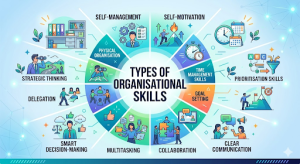






 Admission Open
 Admission Open
 Admission Open

 ROI Calculator