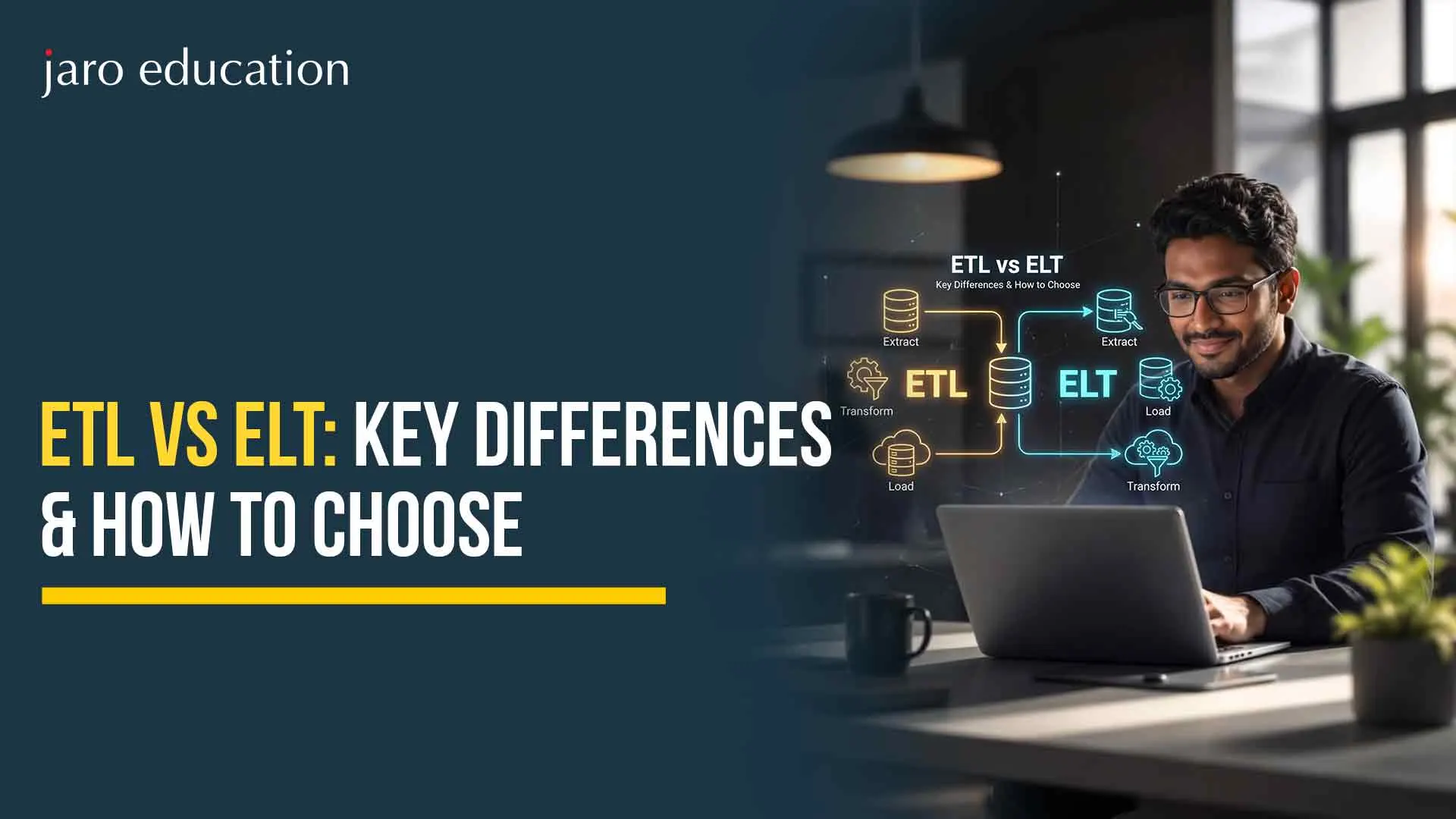
ETL transforms data before loading it into a data warehouse, while ELT loads raw data first and transforms it within the destination system.
ETL offers better control over data quality, consistency, security, and compliance, making it suitable for regulated industries and legacy systems.
ELT supports faster data ingestion, scalability, and flexibility, making it a strong fit for cloud analytics, big data, and machine learning.
A hybrid approach allows businesses to use ETL for sensitive data and ELT for large, varied datasets, balancing compliance, speed, and flexibility.
In this blog, you'll learn the key differences between ETL and ELT, their benefits and limitations, use cases, cost considerations, best practices, and how to choose the right data integration approach.
Data is at the center of almost every business decision today. Sales figures, customer behavior, app logs, and supply chain updates all flow in from different systems, and none of it is useful until it is collected, cleaned, and stored in one place. This is where data integration comes in, and two approaches dominate the conversation: ETL and ELT. It is also an important concept for anyone looking to build skills in data and AI. Programmes such as theOnline M.Sc. in AI and Machine Learning from Christ University help learners develop a strong understanding of the data fundamentals that support these fields.
If you are new to data engineering, the two terms can look almost identical. Yet the order of just two letters changes how data moves, where it is processed, how much it costs, and how fast your team gets answers. This blog explains ETL and ELT in plain language, covers the key differences, and helps you decide which approach fits your needs.
ETL is the older and more traditional method. It rose to prominence in the 1980s and 1990s, when storage and computing power were expensive and data warehouses had limited capacity. Teams could not afford to store messy, raw data, so they cleaned it first.
How ETL Works
Extract: Data is pulled from source systems such as CRM platforms, ERP software, or transactional databases.
Transform: The data moves to a separate staging server, where it is cleaned, validated, deduplicated, and converted into a consistent format. Business rules are applied here.
Load: Only the processed, structured data is loaded into the data warehouse.
Strengths of ETL
Data quality and consistency: Only clean, validated data reaches the warehouse.
Compliance and security: Sensitive information can be masked, encrypted, or removed before it lands in the destination. This matters for industries such ashealthcare and finance.
Smaller storage needs: Because raw data is not stored in the warehouse, storage costs can stay lower.
Mature ecosystem: Many proven tools and decades of best practices support ETL.
Limitations of ETL
Slower for large data volumes: Transformation happens on a separate server, which can become a bottleneck.
Less flexible: If business requirements change, the transformation logic often has to be rebuilt and the data reprocessed.
Higher maintenance: Pipelines can be rigid and need regular engineering attention.
Limited raw data access: Analysts cannot easily go back to the original data if it was not stored.
ELT flips the traditional order. It became popular with the rise of cloud data platforms such as Snowflake,Google BigQuery, Amazon Redshift, and Databricks. These platforms offer almost unlimited storage and powerful, scalable processing, so it makes sense to load everything first and transform it where the computing power already exists.
How ELT Works
Extract: Raw data is pulled from the source systems.
Load: The raw data is loaded directly into the data warehouse or data lake without major changes.
Transform: Transformations are run inside the destination system, usually with SQL or tools such as dbt, whenever they are needed.
Strengths of ELT
Speed of ingestion: Data lands in the destination quickly because there is no heavy processing before loading.
Scalability: Cloud platforms scale processing power up or down based on demand.
Flexibility: Raw data is always available, so teams can create new transformations later without re-extracting data.
Support for varied data types: ELT handles structured, semi-structured, and unstructured data well.
Better fit for modern analytics: Machine learning and advanced analytics often need access to raw, granular data.
Limitations of ELT
Data governance challenges: Raw data, including sensitive fields, sits in the destination, so strong access controls are essential.
Higher storage use: Storing everything can increase storage and compute costs if not managed carefully.
Dependency on powerful destinations: ELT works best with modern cloud platforms and may not suit older systems.
Risk of messy “data swamps”: Without good organization, a pile of raw data becomes hard to use.
Free Courses
Free FinTech Course – FinTech 101: Digital Banking & Payments
Now that you have the basics, let us look more closely at the difference between ETL and ELT across the areas that matter most in real projects.
1. Order of Operations and Architecture
In ETL, a dedicated transformation engine sits between the source and the destination. The data takes a detour through this engine before it is stored. In ELT, that middle layer largely disappears. The data goes straight into the destination, and the destination handles the transformation. This makes ELT architectures simpler to set up, with fewer moving parts.
2. Speed and Performance
ETL pipelines often take longer to deliver data because everything must be transformed before loading. ELT pipelines load data almost immediately, and transformations run in parallel using the warehouse’s processing power. For businesses that need near real-time insights, this speed advantage is significant.
3. Data Volume and Scalability
ETL works well for small to medium data volumes, but the transformation server can struggle as data grows. ELT is built for scale. Cloud warehouses can process terabytes or even petabytes of data by distributing the workload across many machines.
4. Flexibility and Data Availability
This is one of the most important points in any etl and elt difference discussion. With ETL, you decide how data should look before you load it. If your needs change, you may need to rebuild the pipeline. With ELT, the raw data is always there. Analysts and data scientists can revisit it, apply new logic, and answer questions nobody thought of when the pipeline was first designed.
5. Cost Considerations
Cost is not as simple as it seems. ETL may reduce storage costs, but it often requires separate infrastructure and more engineering time. ELT can cut infrastructure and maintenance effort, but it may raise storage and compute bills if queries are not optimized. The right answer depends on your data volume, usage patterns, and platform pricing.
6. Security and Compliance
ETL has a natural advantage here. Because sensitive data can be cleaned or masked before it reaches the warehouse, there is less risk of exposure. ELT can still be secure, but it requires well-planned access controls, encryption, and governance policies, since raw data is stored in the destination.
7. Skills and Tools
ETL tools such as Informatica, Talend, and SSIS are well known in enterprise settings. ELT commonly relies on cloud warehouses, SQL, and tools such as dbt, Fivetran, and Airbyte. The skill sets overlap, but ELT puts more emphasis on SQLand cloud platform knowledge.
ETL vs ELT: When Should You Choose Each?
There is no universal winner. The best choice depends on your data, your tools, and your goals. Here are practical guidelines.
Choose ETL When:
You work with legacy or on-premises systems that have limited processing power.
You must follow strict compliance rules, and sensitive data needs to be cleaned or masked before storage.
Your data volumes are small to moderate, and the structure is well defined.
You need highly curated, consistent data for regulated reporting.
Your team already has a stable, well-tested ETL setup that meets business needs.
Choose ELT When:
You use a modern cloud data warehouse or data lake.
You handle large volumes or a mix of structured and unstructured data.
Your analysts and data scientists need access to raw data for exploration and machine learning.
You want faster ingestion and the ability to change transformations without rebuilding pipelines.
Your business requirements change often, and agility matters.
A Quick Decision Checklist
Ask yourself these questions:
Where will the data be stored: on-premises or in the cloud?
How large and varied is the data?
Do we need to protect sensitive fields before storage?
Do our teams need raw data for advanced analytics?
How quickly do we need insights?
If most of your answers point to the cloud, large data, and flexibility, ELT is likely the better fit. If they point to compliance, legacy systems, and structured reporting, ETL may serve you better.
The Hybrid Approach: Using ETL and ELT Together
Many organizations do not choose just one. In practice, ETL and ELT often work side by side. For example, a company might use ETL to handle sensitive customer data, cleaning and masking it before storage, while using ELT for website logs, clickstream data, and IoT sensor data that benefit from raw, flexible access.
This hybrid model lets teams apply the right method to the right data. It also supports gradual modernization: a business with older ETL pipelines can adopt ELT for new projects without replacing everything at once.
Trends Shaping Data Integration Today
Data integration keeps evolving. A few trends are worth noting:
Cloud-first architectures: More companies are moving to cloud platforms, which naturally favors ELT.
Real-time and streaming data: Businesses want fresh data for instant decisions, pushing pipelines toward faster ingestion.
Rise of the modern data stack: Tools such as dbt, Fivetran, and Airbyte have made ELT easier to adopt.
Data governance and observability: As ELT stores more raw data, monitoring, lineage, and quality checks are becoming essential.
AI and machine learning demand: Advanced models need large, granular datasets, which ELT supports well.
Understanding the concepts behind ETL and ELT is a valuable foundation for anyone aiming to work in data engineering, analytics, or AI. These roles are in strong demand, and employers look for professionals who can design reliable pipelines, work with cloud platforms, and prepare data for machine learning models. For learners who want a structured path, programs such as theonline M.Sc. in AI and Machine Learning from Christ Universitycan help build the technical depth, from data handling to model development, that modern data roles require. Whichever route you take, hands-on practice with real datasets and cloud tools will strengthen your understanding far more than theory alone.
Best Practices for Either Approach
Whether you pick ETL, ELT, or a mix of both, these habits will improve your results:
Define your goals first. Know what questions the data must answer before designing pipelines.
Prioritize data quality. Add validation checks at every stage.
Document everything. Clear documentation helps teams maintain and update pipelines.
Monitor performance and cost. Track pipeline speed, failures, and cloud spending.
Plan for security. Use encryption, role-based access, and audit logs.
Start small and scale. Test with a limited dataset before expanding.
Conclusion
ETL and ELT solve the same basic problem, which is moving data from many sources into a place where it can be analyzed. The difference lies in when the transformation happens and where it runs. ETL transforms data before loading, offering control, cleanliness, and strong compliance. ELT loads first and transforms later, offering speed, scale, and flexibility.
When weighing ETL vs ELT, remember that neither is better in every situation. Look at your data volume, your infrastructure, your compliance needs, and your analytics goals. For many modern teams working in the cloud, ELT is a natural fit, while ETL remains valuable for regulated and legacy environments. And if neither fits perfectly, a hybrid approach can give you the best of both worlds.
Frequently Asked Questions
Not entirely. ELT has grown quickly because of cloud data platforms, but ETL remains widely used, especially in regulated industries and legacy systems. Most organizations choose based on their needs, and many use both.
The main difference is the order of steps. ETL transforms data before loading it into the destination, while ELT loads raw data first and transforms it inside the destination system. This affects speed, flexibility, scalability, and governance.
ELT is generally better suited for big data and machine learning. It stores raw, granular data and uses the scalable processing power of cloud platforms, which gives data scientists the flexibility to experiment and build models.
Yes. Many companies use a hybrid approach, applying ETL to sensitive or highly structured data and ELT to large, varied datasets such as logs and streaming data. This balances compliance, speed, and flexibility.
Shubham Lal
Lead Software Developer
Shubham Lal joined Microsoft in 2017 and brings 8 years of experience across Windows, Office 365, and Teams. He has mentored 5,000+ students, supported 15+ ed-techs, delivered 60+ keynotes including TEDx, and founded AI Linc, transforming learning in colleges and companies.
Get Free Upskilling Guidance
Fill in the details for a free consultation
Related Courses
Explore our programs
Master of Science (Artificial Intelligence and Machine Learning)

 November 15, 2026
 9 min read




 Key Insights
 ChatGPT
 Perplexity
 Claude
 Grok











 ROI Calculator