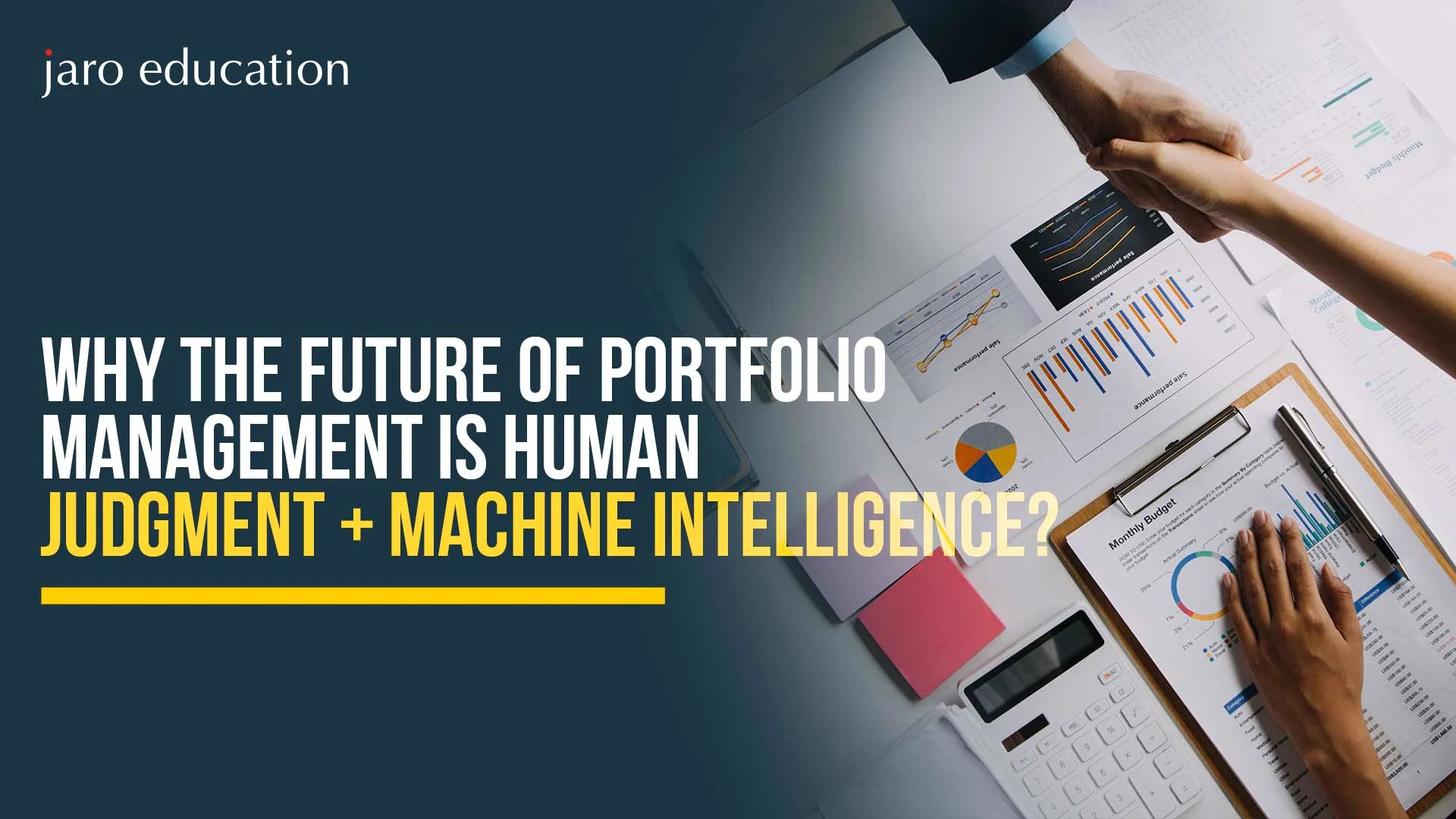
Why the Future of Portfolio Management Is Human Judgment + Machine Intelligence?
J
By Dr. Sanjay Kulkarni
March 16, 20264 min read
Last updated on April 14, 2026
SHARE THIS ARTICLE
Table Of Content
The Role of AI in Modern Portfolio Management
The Shift Toward Data-Driven Investing
Why Human Expertise Still Matters
Machine Intelligence as a Strategic Partner
The financial markets are changing rapidly, and this phenomenon can be attributed to technological disruption, the growth in data, and the changing expectations of the investors involved. The current conventional portfolio management techniques that are overly reliant on the expertise of human managers are no longer enough in a world where the lifecycle is dominated by the presence of machine algorithms, predictive models, and real-time financial reportingand insights. At the same time, the over-reliance on technology in investment is not enough since investment managers possess the strategic intuition and knowledge needed in the future of portfolio management.
In today’s financial markets, the role of artificial intelligence is significantly affecting the way investors manage and optimize their financial assets. The introduction of AI in portfolio management has enabled financial institutions and investors to analyze huge amounts of data and make informed investment decisions with greater accuracy and speed. Through machine learning in portfolio management, investors can analyze historical market trends and make predictions regarding possible risks and profits in the market. This has led to the introduction of data-driven investing, where investors make investment decisions based on data and analysis rather than intuition and instinctive decision-making. However, there is debate about the role of humans in geopolitical risks and economic shocks, which are difficult for machines to understand and process. Although machines can process huge amounts of data and identify patterns more easily, human professionals can provide critical thinking and ethical decision-making in the complex world of finance and markets. As a result, many financial institutions are now combining human and AI investment strategies to make more informed and balanced investments.
The Shift Toward Data-Driven Investing
The modern concept of portfolio management heavily relies on utilizing the tools and power of data analytics and other state-of-the-art technologies. With the tools of machine intelligence, it is possible to quickly and accurately process humongous amounts of data and determine the various patterns in the market, which in turn can result in the prediction of future investment possibilities.
However, data does not necessarily lead to successful investment strategies. There are various factors that influence financial markets, which may not be effectively understood by machines. This is where the role of humans is crucial. This is perhaps the area where the human mind must evaluate the situation and apply strategic thinking to the subject.
Despite all the advancements in technology, it can be safely stated that the art of portfolio management has as much to do with science as it does with art. Professionals, being human, can tap into their latent ability to assimilate information that extends beyond just statistical numbers and market fluctuations. They can respond to unprecedented market situations, incorporate ethical factors into their decision-making processes, and are able to manage the expectations of all parties involved, something which cannot be said of computer algorithms.
Additionally, human expertise is essential in managing risks and diversifying portfolios properly. Even as algorithms highlight statistical correlations, various professionals determine their relevance and alignment with overarchingbusiness strategiesand goals. The union of expertise and technology enables investment managers to construct portfolios that are robust and resistant to market volatility.
Machine Intelligence as a Strategic Partner
Rather than a replacement for a dedicated team of professionals, however, machine intelligence is most likely to serve as a strategic partner in the portfolio management process. With the analysis of data and the constant evaluation of performance and scenarios being carried out through a number of technologies involving predictive analysis, forecasting potential risks and opportunities can be achieved.
Moreover, artificial intelligence can reduce the need for human intervention through more efficient processes, enhance the monitoring of compliance, and improve the accuracy of reports. Overall, with the use of live dashboards, the portfolio managers are able to respond to market shifts to ensure maximum control over the assets, thus promoting an efficient partnership between technology and human expertise.
The future of portfolio management is a combination of intelligent systems and human professionals, which is known as the hybrid model. In the hybrid model, intelligent machines assist in data processing, predictions, and performance to provide portfolio management services, whereas human professionals facilitate the process through strategic management, ethical decisions, and vision.
This synergy enhances investment outcomes by combining the strengths of both approaches. Algorithms deliver speed, scalability, and analytical precision, while humans contribute creativity, contextual understanding, and adaptability. Working together, both enable a rich process of decision-making where risk and return are in balance and in concurrence with investor objectives.
Conclusion: Lead the Future of Portfolio Management with Advanced Expertise
Gaining in-depth knowledge of AI-driven investment strategies and portfolio management frameworks
Learn from distinguished faculty and industry experts with real-world insights
Practical skills are developed using case studies and market simulations
To comprehendrisk management, asset allocation, and data-driven decision-making
Develop your capacity to harness human instinct coupled with advanced analytics engines
Increase your professional credibility with a prestigious certification from IIT Bombay
Network with a diverse group of finance professionals and industry leaders
Be empowered with the knowledge and the strategic capabilities you need to succeed in the age of intelligent investing. Register today and secure your place at the forefront of next-generation portfolio management.
Yes, portfolio management is an exciting and rewarding profession in finance, with high growth prospects, high earnings, and opportunities to manage investments and financial assets.
The future of project portfolio management is looking bright, with technology playing a bigger role in the use of analytics, automation, and AI tools in portfolio management.
The seven key steps in portfolio management are generally accepted to be:
Investment objectives, financial condition analysis, asset allocation, security analysis, portfolio execution, portfolio monitoring, and portfolio rebalancing. These seven steps are designed to help investors achieve their long-term financial goals.
An MBA is not always a requirement to become a portfolio manager, but it can be very helpful in advancing one’s portfolio management career. Many professionals also acquire the CFA designation in conjunction with finance experience to become portfolio managers in investment management.
Dr. Sanjay Kulkarni
Data & AI Transformation Leader
Dr. Sanjay Kulkarni is a Data & AI Transformation Leader with over 25 years of industry experience. He helps organizations adopt data-driven and responsible AI practices through strategic guidance and education. With experience across startups and global enterprises, he bridges the gap between theory and real-world application. His work empowers teams to innovate and thrive in AI-driven environments.
 HOME > BLOG > AI and Machine Learning > Why the Future of Portfolio Management Is Human Judgment + Machine Intelligence?
 March 16, 2026
 4 min read




 ChatGPT
 Perplexity
 Claude
 Grok
Grok




 Admission Open
 Admission Closed

 Admission Closed
 ROI Calculator