Agile vs Traditional Project Management: A Practical Comparison
J
By Nuthana Reddy
September 13, 20266 min read
Published on September 13, 2026
SHARE THIS ARTICLE
Table Of Content
What Is Traditional Project Management?
What Is Agile Project Management?
Agile vs Traditional Project Management
Planning and Execution
Key Insights
Agile focuses on flexibility, collaboration, continuous improvement, and delivering work in smaller cycles, while Traditional Project Management follows a structured and sequential process.
Traditional Project Management works well for projects with stable requirements, while Agile is better suited to projects where requirements and priorities may change.
Agile uses short iterations, regular feedback, and continuous planning, whereas traditional approaches rely more on detailed upfront planning, defined milestones, and formal approvals.
Both approaches address project risks differently, with traditional methods focusing on planned risk management and Agile using frequent reviews and incremental delivery to identify issues earlier.
A hybrid project management approach can combine traditional planning and governance with Agile practices when different parts of a project have different requirements.
In this blog, you'll learn the key differences between Agile and Traditional Project Management, including planning, change management, stakeholder involvement, risk management, cost and schedule control, and when to use each approach.
Did you know that the same project can succeed or struggle simply because of the way it is managed? Two teams may have similar goals, budgets, and resources, yet follow very different paths to reach the finish line. This is where project management methodologies make a difference.
Agile and Traditional Project Management are two widely used approaches to managing projects. While traditional project management focuses on detailed planning and following a defined sequence, Agile focuses on flexibility, collaboration, and delivering work in smaller cycles.
But which approach is better? The answer is not as simple as choosing one over the other. The right methodology depends on the type of project, how clearly the requirements are defined, how often changes are expected, and how closely stakeholders need to be involved.
Let us understand the key differences between Agile and Traditional Project Management and explore when each approach works best.
Traditional Project Management, often associated with the Waterfall approach, follows a structured and sequential process. The project is generally divided into different phases such as planning, design, execution, testing, and delivery.
The team usually defines the project scope, requirements, timelines, resources, and budget at the beginning. Once the plan is approved, the project moves through each phase in sequence.
This approach works well when project requirements are clear and unlikely to change significantly. It is also useful when detailed documentation, defined milestones, and formal approvals are important.
For example, construction projects often require extensive planning before execution begins. Changing a major requirement after construction has started can be expensive and complicated. A traditional approach can therefore provide the structure and control required for such projects.
What Is Agile Project Management?
Agile Project Management takes a more flexible and iterative approach. Instead of planning everything in detail at the beginning, teams work on smaller portions of a project and improve the solution based on feedback.
Agile teams may divide work into short cycles called sprints or iterations. At the end of each cycle, the team reviews the progress, collects feedback, and decides what should happen next.
Agile became particularly popular in software development because technology projects can involve changing customer expectations and evolving requirements. However, Agile practices are now used in several other business environments as well.
The focus here is usually on collaboration, continuous improvement, frequent delivery, and responding to change.
The biggest difference between Agile and Traditional Project Management is how they respond to change.
Traditional Project Management generally starts with a detailed plan and aims to follow that plan throughout the project. Agile accepts that requirements may change and builds flexibility into the project process.
Here is a practical comparison below:
Factor
Agile Project Management
Traditional Project Management
Planning
Short term and iterative
Detailed and long term
Approach
Flexible and adaptive
Structured and sequential
Scope
Can evolve during the project
Usually defined at the beginning
Delivery
Frequent and incremental
Usually delivered after major phases
Customer involvement
Regular throughout the project
Often concentrated at key stages
Change management
Changes are expected
Changes can require formal approval
Team structure
Collaborative and cross functional
Clearly defined roles
Feedback
Continuous
Usually received at specific stages
Best suited for
Projects with changing requirements
Projects with stable requirements
Planning and Execution
Planning is one aspect where Agile and traditional approaches differ from each other.
Traditional project management invests significant effort in planning before execution begins. Project managers may create detailed schedules, budgets, milestones, resource plans, and documentation.
Agile takes a different route. The team plans enough to begin the next cycle and then uses feedback from each iteration to guide future work.
This does not mean Agile projects do not require planning. Instead, planning happens simultaneously as the project develops.
Managing Changes
Imagine that a client changes an important requirement halfway through a project.
In a traditional project, the change may affect the approved scope, budget, schedule, and resources. It may therefore require a formal change request and approval process.
In Agile, change is treated as a normal part of the project. The team can review the new requirement, prioritize it, and decide when it should be addressed in an upcoming iteration.
This makes Agile useful for projects where customer needs or market conditions are likely to change.
Stakeholder involvement can also look very different.
Traditional project management often defines specific points where stakeholders review progress, approve deliverables, or provide feedback. The customer may have limited involvement during certain phases of execution.
Agile encourages more regular interaction between the team, customers, product owners, and other stakeholders. Frequent feedback can help the team identify issues earlier and adjust the product as the project progresses.
This collaborative approach can be particularly useful when the final solution needs to evolve based on user feedback.
Risk Management
Both methodologies address project risks, but they approach them differently.
Traditional project management generally identifies risks during the planning stage and develops strategies to manage them throughout the project. A risk register and formal monitoring processes can help project managers track potential issues.
Agile reduces certain types of uncertainty by delivering work in smaller increments and reviewing progress frequently. Problems can become visible earlier because the team does not wait until the end of the project to evaluate the entire solution.
However, Agile does not eliminate risk. It requires continuous monitoring, communication, and disciplined execution.
Cost and Schedule Control
Traditional project management can make it easier to establish a defined budget and timeline when the scope is clearly understood from the beginning.
Agile usually works with shorter planning cycles. The team focuses on delivering value within each iteration while priorities can be adjusted as new information becomes available.
If the project has fixed requirements and strict deadlines, a traditional approach may provide greater predictability. If the project needs flexibility and priorities may change, Agile can offer more room to adapt.
Can Agile and Traditional Project Management Work Together?
Yes, agile and traditional project management can work together. In fact, many companies still use a combination of both.
A hybrid approach can bring the structure of traditional project management together with the flexibility of Agile practices. For example, a project may use traditional planning for budgeting, governance, and major milestones while using Agile sprints for product development.
This can be useful when different parts of the same project have different requirements.
The key is not to choose a methodology simply because it is popular. Project managers need to understand the project environment and select practices that support the desired outcome.
Take Your Project Management Skills Further
Effective project management requires more than knowing Agile and Traditional approaches. Skills in project analytics, risk management, leadership, stakeholder management, and data-driven decision-making are equally important.
The programme can help professionals strengthen their project management skills and prepare to manage complex projects more effectively.
Agile vs Traditional Project Management: Which is Better?
Agile and Traditional Project Management are not competing approaches where one must always replace the other. Each has its strengths and limitations.
Traditional project management provides structure, predictability, and detailed planning. Agile provides flexibility, continuous feedback, and the ability to respond to changing requirements.
The most effective project managers understand both approaches and know when to apply them. They can evaluate project complexity, stakeholder expectations, risk, scope, timelines, and business priorities before deciding how the project should be managed.
As businesses take on more complex projects, project managers also need skills beyond basic scheduling and task management. Data analysis,risk management, leadership, stakeholder management, and technology are becoming increasingly relevant to effective project delivery.
Frequently Asked Questions
Neither approach is universally better. Agile works well when requirements can change, while traditional project management is useful when the scope and requirements are clearly defined. The right choice depends on the project environment.
No. Agile may not be the best fit for projects that require extensive upfront planning, fixed requirements, strict documentation, or clearly defined sequential phases. Project managers should evaluate the nature of the project before selecting Agile.
The main difference is how each approach handles planning and change. Traditional project management follows a structured plan, while Agile uses shorter development cycles and allows requirements and priorities to evolve.
Yes. Organizations can use a hybrid approach that combines traditional planning and governance with Agile practices such as iterative delivery, regular reviews, and team collaboration.
No. Although Agile gained popularity through software development, its principles can be applied to other projects where flexibility, collaboration, frequent feedback, and changing requirements are important.
Nuthana Reddy
Nuthana Reddy is a Senior Manager at Procter & Gamble, specializing in operations, digitization, and cross-functional leadership. She has driven multimillion-dollar impact through innovation, process optimization, and strategic execution across global markets.
Get Free Upskilling Guidance
Fill in the details for a free consultation
Related Courses
Explore our programs
Executive Certificate Programme in Advanced Project Management and Analytics

 September 13, 2026
 6 min read




 Key Insights
 ChatGPT
 Perplexity
 Claude
 Grok
Grok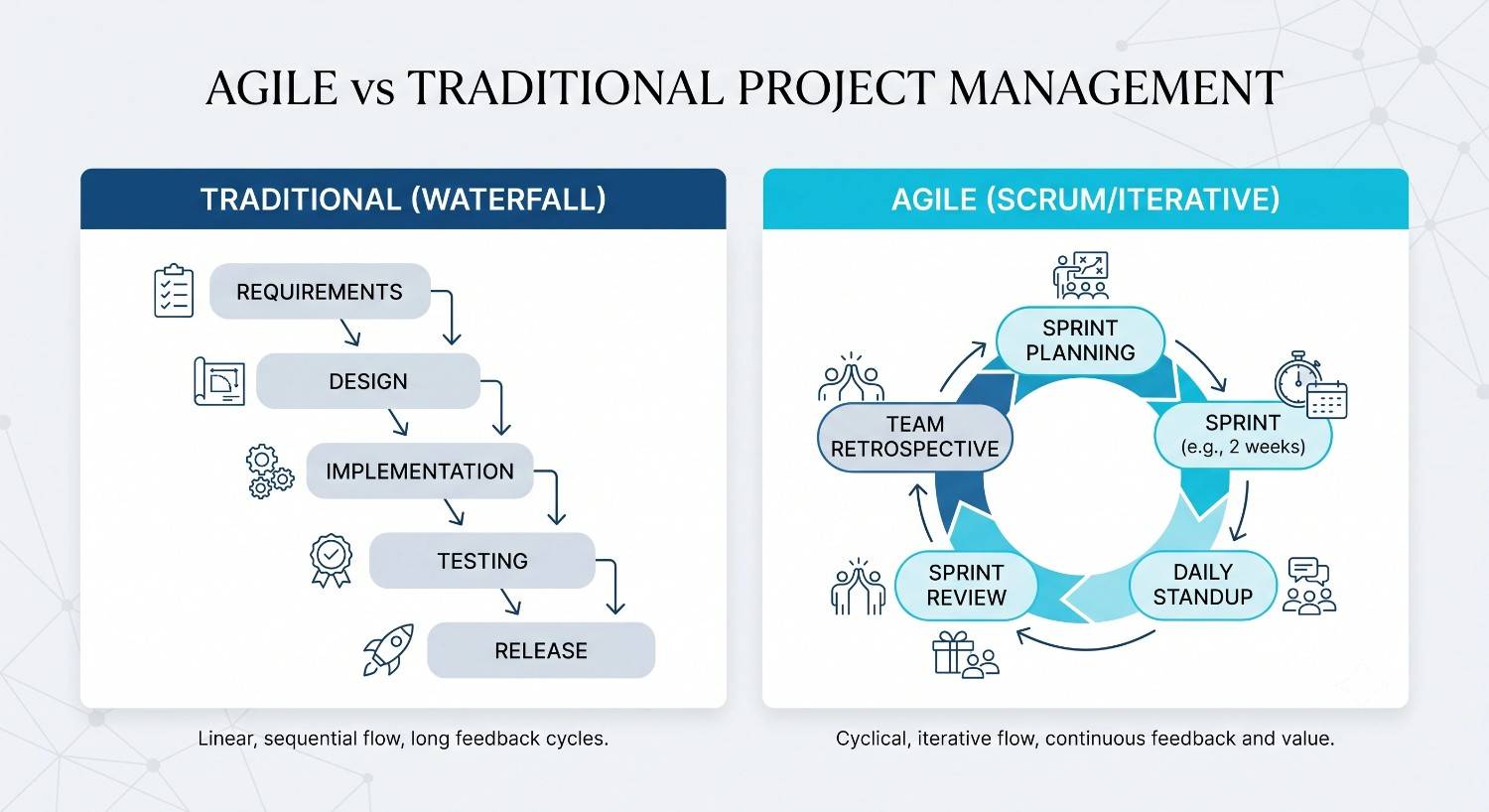








 ROI Calculator