Agentic AI in Procurement: From Manual Tasks to Smarter Sourcing
Replenishment: Keeping the Right Stock at the Right Time
Key Insights
Agentic AI in supply chains goes beyond traditional forecasting and recommendations by enabling AI agents to plan, make decisions, and take actions toward defined business goals with limited human input.
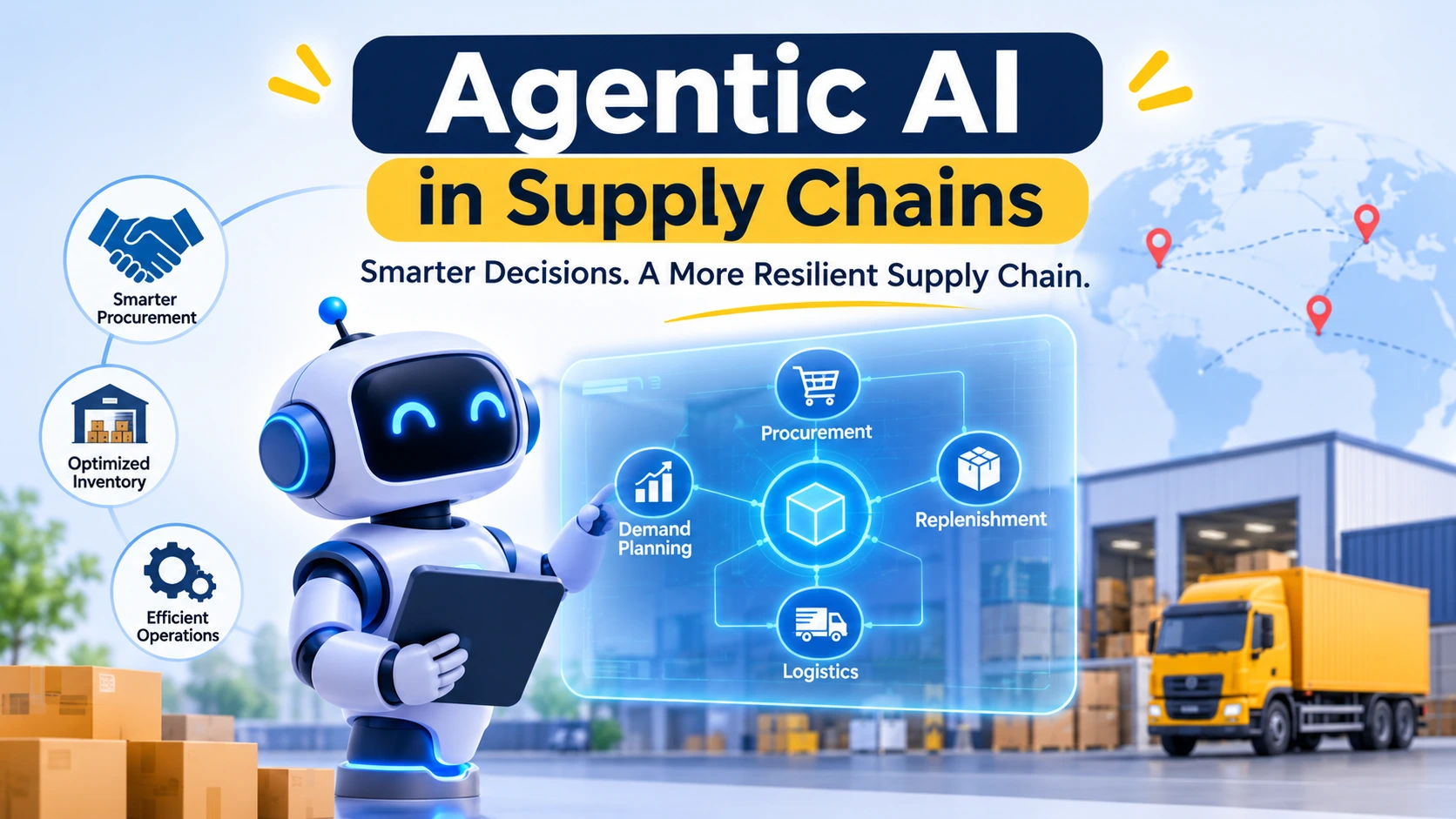
AI agents follow a continuous cycle of sensing, reasoning, acting, and learning to manage supply chain activities using data from inventory records, supplier updates, shipping information, and customer orders.
Agentic AI in procurement can streamline supplier evaluation, quotation management, contract reviews, purchase order processing, spend analysis, and supplier risk monitoring.
AI-powered replenishment enables continuous inventory monitoring, dynamic reorder points, automated order proposals, warehouse stock balancing, and faster responses to supply disruptions.
Human oversight remains essential for accountability, ethical decisions, error prevention, and managing unexpected situations. Clear boundaries, approval workflows, audit trails, and regular performance monitoring help ensure responsible adoption.
In this blog, you'll learn what agentic AI in supply chains is, how AI agents work, their applications in procurement, replenishment, logistics, and risk management, the different levels of autonomous supply chain management, and why human oversight is important.
Supply chains have always depended on timely decisions: which supplier to choose, how much stock to hold, when to reroute a shipment. For years, software helped by producing reports and forecasts, but people still had to act on them. That is now changing. Agentic AIin supply chain operations introduces software that can plan, decide, and act toward a goal with limited human input. In this blog, we explain what it is, where it fits in procurement and replenishment, which use cases matter most, and why human oversight remains essential.
Agentic AI refers to artificial intelligence systems that pursue a defined objective on their own. Unlike a traditional model that only predicts or recommends, an AI agent can break a goal into steps, gather data, use tools, take action, and review the result.
Consider a simple example. A conventionalforecastingtool might tell a planner that demand for a product will rise next month. An agent can go further. It can check current inventory, review supplier lead times, draft a purchase order within approved limits, and flag the plan for approval.
The key features of agentic AI in supply chain settings include:
Goal orientation: The agent works toward a target, such as reducing stockouts or lowering procurement costs.
Autonomy: It can take multiple steps without waiting for a prompt at each stage.
Tool use: It connects to enterprise systems such as ERP, warehouse management, and supplier portals.
Adaptability: It adjusts its plan when conditions change, such as a delayed shipment.
Memory and learning: It uses past outcomes to improve later decisions.
AI agents in supply chain management generally follow a repeating cycle of sensing, reasoning, acting, and learning.
Sensing – The agent collects information from sources such as inventory records, supplier updates, shipping data, market prices, weather alerts, and customer orders.
Reasoning – Using large language models, optimization methods, and business rules, the agent evaluates options. It weighs cost, speed, risk, and service levels against the goals it has been given.
Acting – The agent carries out approved tasks, such as sending a request for quotation, updating a reorder point, or booking alternative transport.
Learning – After each action, the agent compares results to expectations. Over time, this feedback helps it refine its decisions.
In many organizations, several specialized agents work together. One may monitor demand, another may manage supplier communication, and a third may track logistics. A coordinating layer helps them share information and avoid conflicting actions. This multi-agent design mirrors how human teams divide responsibilities.
Agentic AI in Procurement: From Manual Tasks to Smarter Sourcing
Procurement is one of the most promising areas for this technology. Buyers often spend significant time on repetitive work, such as comparing quotes, chasing approvals, and checking contract terms. Agentic AI in procurement can take over much of this routine effort so that professionals can focus on strategy and relationships.
Here is how it can help across the procurement cycle:
Supplier discovery and evaluation – An agent can scan approved vendor lists, review performance history, and compare offers against criteria such as price, quality, delivery record, and sustainability standards.
Request and quote management – Agents can prepare and send requests for quotation, collect responses, and summarize differences in a clear format for the buyer.
Contract review – Agents can read contracts and highlight unusual clauses, expiring terms, or deviations from company policy. A legal or procurement expert should still make the final call.
Purchase order processing – For low-value, repeat purchases, an agent can create and send orders automatically within preset spending limits.
Spend analysis – By reviewing purchasing data, agents can detect duplicate suppliers, off-contract buying, and savings opportunities.
Supplier risk monitoring – Agents can track news, financial signals, and delivery performance to alert teams when a supplier may be at risk.
The result is faster cycle times, better compliance, and more time for negotiation and relationship building, which are areas where human judgment matters most.
Replenishment: Keeping the Right Stock at the Right Time
Replenishment is where autonomous decision-making can deliver quick, visible value. The challenge is a balancing act. Too little inventory leads to lost sales, while too much ties up cash and increases storage and waste.
Traditional replenishment relies on fixed reorder points and periodic reviews. These methods struggle when demand swings or lead times change. AI agents in supply chain management can make replenishment more dynamic in several ways:
Continuous monitoring: Agents watch sales, stock levels, and incoming shipments in near real time.
Dynamic reorder points: Instead of fixed numbers, thresholds adjust based on demand patterns, seasonality, and supplier reliability.
Automated order proposals: When stock is forecast to run low, the agent drafts a replenishment order, often for approval or automatic release within limits.
Network balancing: If one warehouse has surplus stock and another faces shortages, the agent can recommend transfers rather than new purchases.
Exception handling: If a supplier delays a delivery, the agent can suggest expediting, switching suppliers, or reallocating stock.
For retailers, manufacturers, and distributors, this can reduce stockouts, lower holding costs, and improve customer service. The benefits depend heavily on data quality, so clean and connected data is a prerequisite.
Agentic AI Supply Chain Use Cases Beyond Procurement and Replenishment
While procurement and replenishment are common starting points, there are many other agentic AI supply chain use cases worth knowing.
Demand planning
Agents can combine sales history, promotions, market signals, and external events to refine forecasts and update them as new information arrives.
Logistics and transportation
Agents can compare carriers, optimize routes, track shipments, and propose alternatives when delays or disruptions occur.
Warehouse operations
Agents can help plan labor, sequence picking tasks, and coordinate with automated equipment.
Supply chain risk management
Agents can monitor geopolitical events, weather, port congestion, and supplier health, then recommend mitigation steps before problems escalate.
Order management and customer service
Agents can answer order status questions, update delivery promises, and resolve routine issues, escalating complex cases to human staff.
Sustainability tracking
Agents can gather emissions and compliance data from suppliers and highlight areas for improvement.
Each of these use cases follows a similar pattern: the agent handles data-heavy, repetitive work and surfaces decisions that need human attention.
Autonomous Supply Chain Management: How Far Can It Go?
The long-term vision of autonomous supply chain management is a network that largely runs itself. It senses changes, plans responses, and executes decisions with minimal human involvement. While that vision is attractive, most organizations are moving toward it in stages.
A helpful way to think about it is through levels of autonomy:
Assisted: The system provides insights and recommendations. Humans make all decisions.
Partially automated: The system acts on routine, low-risk tasks, while people handle everything else.
Conditionally autonomous: The system manages most decisions within defined rules and escalates exceptions to humans.
Highly autonomous: The system manages end-to-end processes with humans setting goals and monitoring performance.
Most companies today operate between the first and third levels. Reaching higher levels requires reliable data, strong integration across systems, clear governance, and, above all, trust built through proven results. Full autonomy is not necessary or even desirable in every area. High-value, high-risk decisions will likely keep a human in the loop for a long time.
Why Human Oversight Remains Essential
Agentic AI can act quickly, but speed without supervision creates risk. Human oversight is what makes autonomous systems safe, accountable, and aligned with business goals.
Accountability. An AI agent cannot take responsibility for a decision. Organizations need clear ownership so that someone is answerable for outcomes.
Handling the unexpected. Agents learn from data and rules, but unusual events, such as a sudden regulatory change or a political crisis, may fall outside their experience. People can apply context and common sense.
Ethics and fairness. Supplier selection, for example, should reflect company values, including fair treatment and responsible sourcing. Humans must ensure agents do not optimize cost at the expense of these principles.
Error prevention. Language-model-based systems can sometimes make mistakes or act on incorrect information. Review checkpoints reduce the chance of costly errors.
Building trust. Teams adopt new technology more willingly when they can see how decisions are made and can intervene when necessary.
Practical Ways to Keep Humans in the Loop
Set clear boundaries: Define spending limits, approved suppliers, and decision types the agent can handle alone.
Use approval workflows: Require human sign-off for high-value orders or unusual actions.
Maintain audit trails: Record what the agent did and why so decisions can be reviewed.
Monitor performance: Track accuracy, cost impact, and exceptions regularly.
Create escalation paths: Make sure the agent knows when and how to pass a case to a person.
Train your teams: Help employees understand how to work with agents rather than compete with them.
The goal is not to replace professionals but to give them better tools. As routine work shifts to agents, the human role moves toward supervision, strategy, and exception management.
Build the Skills to Lead Supply Chain Transformation
Technology alone does not transform a supply chain. Skilled professionals who understand both operations and emerging tools do. If you want to deepen your expertise in areas such as procurement, logistics, planning, and digital supply chain strategy, consider theGlobal Supply Chain Management Programme by IIT Bombay. Designed for working professionals, it can help you build the strategic and practical knowledge needed to manage modern, technology-enabled supply chains. We encourage you to explore the program details and enroll today to take the next step in your career.
Conclusion
Agentic AI is moving supply chains from reactive reporting toward proactive, goal-driven action. In procurement, it can streamline sourcing, contract checks, and routine purchasing. In replenishment, it can keep inventory aligned with real demand. Across the wider network, agentic AI supply chain use cases range from logistics to risk monitoring.
Yet the most successful organizations will not be those that hand over every decision to machines. They will be those that combine the speed of AI agents with the judgment of experienced professionals, supported by strong data, clear governance, and thoughtful oversight. By starting small, setting boundaries, and investing in people, businesses can move toward autonomous supply chain management with confidence and control.
Frequently Asked Questions
Agentic AI in supply chain management refers to AI systems that can set steps, make decisions, and take actions toward a goal, such as reducing stockouts or lowering procurement costs. They work within limits set by humans and connect to business systems to carry out tasks.
Traditional automation follows fixed rules and performs predefined tasks. Agentic AI is more flexible. It can interpret changing situations, plan multiple steps, use different tools, and adjust its approach when conditions change.
No. AI agents are well suited to repetitive, data-heavy tasks, but professionals are still needed for negotiation, strategy, ethical judgment, relationship management, and handling unusual situations. The most effective model combines AI efficiency with human oversight.
Nuthana Reddy
Nuthana Reddy is a Senior Manager at Procter & Gamble, specializing in operations, digitization, and cross-functional leadership. She has driven multimillion-dollar impact through innovation, process optimization, and strategic execution across global markets.
Get Free Upskilling Guidance
Fill in the details for a free consultation
Related Courses
Explore our programs
AI-Driven Global Supply Chain Management & Transformation
 HOME > BLOG > Supply Chain > Agentic AI in Supply Chains: Procurement, Replenishment and Human Oversight
 November 7, 2026
 8 min read




 Key Insights
 ChatGPT
 Perplexity
 Claude
 Grok










 ROI Calculator