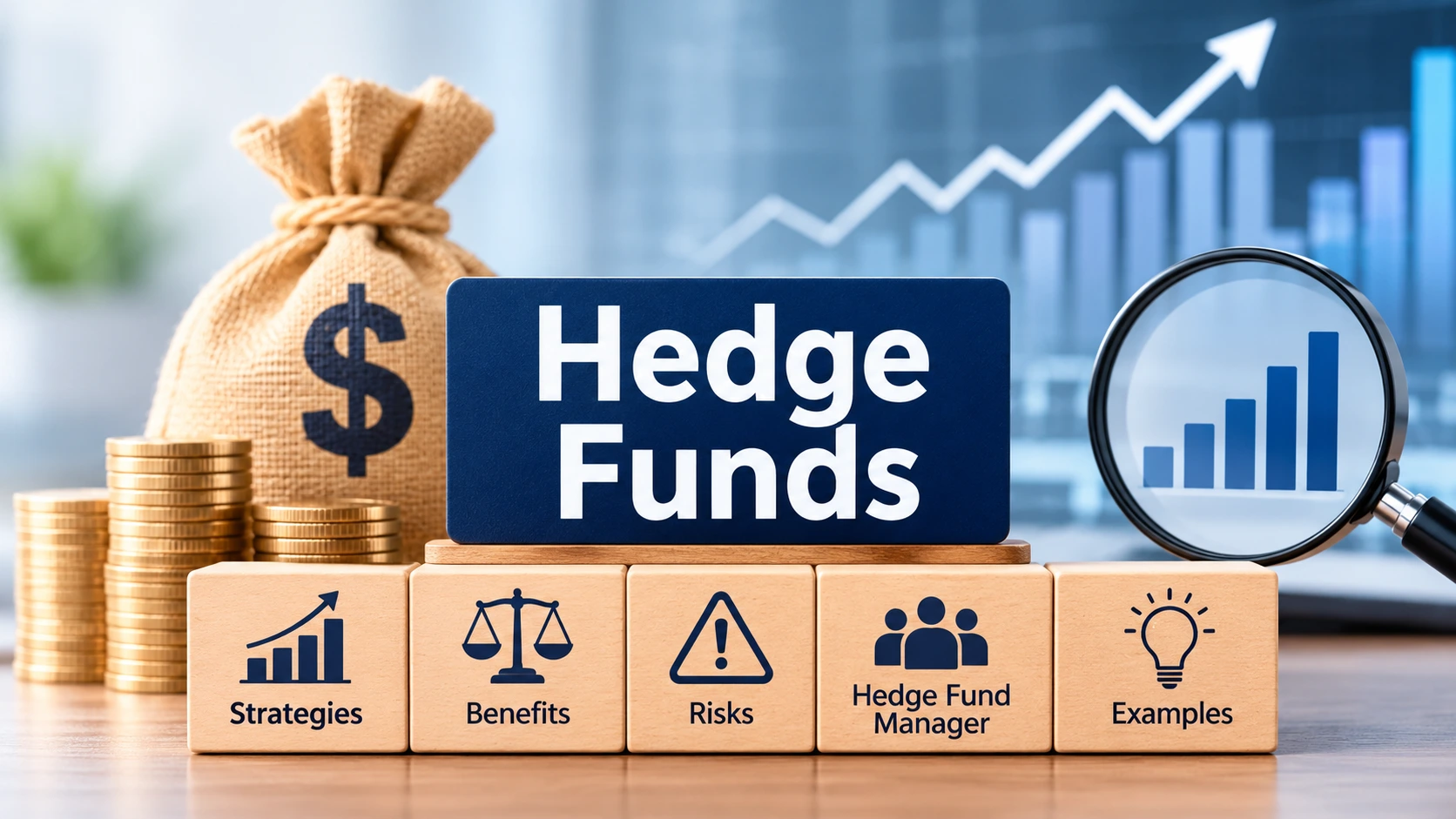
Hedge funds are private investment pools that use flexible strategies, including buying and selling stocks, short selling, and leverage, to generate returns for a limited group of investors.
Hedge funds commonly follow the 2 and 20 fee model, which includes a management fee and a performance-based fee. They may also have lock-up periods that restrict withdrawals.
Popular hedge fund strategies include long/short equity, global macro, event-driven, quantitative, distressed debt, and multi-strategy approaches.
Hedge funds offer potential benefits such as diversification, investment flexibility, and professional expertise, but they also involve risks like high fees, leverage, limited transparency, and liquidity constraints.
In this blog, you'll learn what hedge funds are, how they work, their strategies, famous real-world examples, benefits and risks, the role of a hedge fund manager, and career opportunities in the industry.
You have probably heard the term "hedge funds" in movies, news headlines, or finance podcasts, usually alongside words like billions, risky bets, and Wall Street. But what do these funds actually do, and why do they get so much attention? If you are curious about how modern finance works, or you are thinking about building a career in it, understanding hedge funds is a great place to start. Programs like theAmrita MBA in FinTech are designed to help learners build exactly this kind of finance and technology knowledge, which is increasingly valuable in today's investment world. In this blog, we will keep things simple and walk through the basics, real examples, and career paths in hedge funds.
If you are asking “what is hedge fund investing all about,” here is the short answer: a hedge fund is a pooled investment vehicle that collects money from a limited group of investors and uses a wide range of strategies to generate returns. Those strategies can include buying and selling stocks, bonds, currencies, commodities, and derivatives, and even borrowing money to boost results.
The word “hedge” comes from the idea of protecting yourself against losses. The first hedge fund is widely credited to Alfred Winslow Jones, who launched it in 1949. He bought stocks he expected to rise and sold short stocks he expected to fall, which helped reduce the impact of overall market swings. That “hedged” approach gave the industry its name.
Today, though, not every fund actually hedges in the traditional sense. Some take big, concentrated bets. What they share is flexibility. Unlike a regular mutual fund, a hedge fund can use almost any strategy that its legal documents allow.
Here is another important point: hedge funds are generally not open to everyone. In the United States, most funds are limited to “accredited investors,” such as individuals with a net worth over $1 million (excluding their primary home) or income above $200,000 a year($ 300,000 with a spouse). Pension funds, endowments, and wealthy families also invest heavily in them.
The basic structure is easy to understand. Investors put money into the fund and become partners. A professional team then invests that pool of money according to the fund’s strategy. If the fund earns profits, they are shared. If it loses money, investors bear the loss.
The “2 and 20” Fee Model
Hedge funds are known for their fee structure, often called “2 and 20.” This means:
A management fee of about 2% of the assets under management, charged every year no matter how the fund performs.
A performance fee of about 20% of the profits the fund generates.
For example, if you invest $1 million and the fund earns $100,000 in a year, you might pay $20,000 as a management fee and about $20,000 as a performance fee. In recent years, competition has pushed many funds to lower these fees, but the idea of paying for performance is still central.
Lock-Up Periods and Limited Access
Unlike a mutual fund, where you can usually sell your shares any day, hedge funds often have “lock-up” periods. This means your money may be tied up for a year or longer. Many funds also only allow withdrawals at set intervals, such as quarterly. This gives the manager time to carry out long-term strategies without worrying about sudden withdrawals.
Less Regulation, More Freedom
Because hedge funds serve sophisticated investors, they face lighter rules than public funds. They do not have to offer the same level of daily transparency, and they can use leverage (borrowed money), short selling, and complex instruments. This freedom is a big part of their appeal, but it is also a source of risk.
Free Courses
Free Finance Courses with Certificate – Finance for All
There is no single way to run a hedge fund. Here are some of the most popular approaches, explained simply:
Long/short equity. The manager buys stocks expected to go up (going long) and sells short stocks expected to go down. This is the classic strategy and the one closest to the original idea of hedging.
Global macro. These funds make big-picture bets based on economic trends, interest rates, politics, and currency movements. A manager might bet that a country’s currency will weaken or that interest rates will rise.
Event-driven. This strategy looks for opportunities around corporate events like mergers, acquisitions, bankruptcies, and restructurings. For example, a fund may buy shares of a company being acquired, expecting the deal to close.
Quantitative strategies. Here, computers do much of the work. Teams of mathematicians and data scientists build models that scan huge amounts of data to find patterns and trade automatically.
Distressed debt. Managers buy the debt of struggling companies at a steep discount, hoping to profit if the business recovers or is restructured.
Multi-strategy. Larger funds often combine several of these approaches under one roof to spread risk across different types of bets.
The right strategy depends on the fund’s goals, its team, and market conditions. This is why two hedge funds can look completely different even though they share the same label.
Who Is a Hedge Fund Manager?
A hedge fund manager is the person (or team) responsible for making investment decisions and running the fund. Think of them as the captain of the ship. They decide what to buy and sell, how much risk to take, and how to respond when markets move.
What Does a Hedge Fund Manager Do?
On a typical day, a hedge fund manager might:
Research companies, industries, and economic trends
Review reports from analysts and traders
Build and adjust the portfolio
Monitor risk and make sure positions stay within limits
Successful managers usually combine strong analytical thinking with emotional discipline. They need to understandfinancial statements, markets, and economics, but they also need the nerve to stay calm when markets get rocky. Good communication matters too, because managers must explain their ideas and results to investors who have trusted them with serious money.
How Do They Get Paid?
A hedge fund manager earns money from the fees described earlier. When a fund performs well and has lots of assets, the performance fee can be huge. That is why the best-known managers can earn millions or even billions. But when a fund performs poorly, the pay can shrink fast, and investors may pull their money out.
Hedge Fund Example: Real-World Cases
Nothing makes a concept clearer than a real story. Here are a few well-known examples that show both the upside and the downside of this industry.
Bridgewater Associates
Founded by Ray Dalio in 1975, Bridgewater is often described as one of the largest hedge funds in the world. It is known for its global macro approach and its unusual culture, which emphasizes radical transparency and data-driven decision-making.
Renaissance Technologies and the Medallion Fund
Renaissance Technologies, founded by mathematician Jim Simons, is famous for its Medallion Fund. The fund relied on mathematical models and data rather than traditional stock picking, and it reportedly delivered average annual returns of around 66% before fees over several decades. It is largely closed to outside investors today and mainly serves employees.
George Soros and the British Pound
In 1992, George Soros’s Quantum Fund made a giant bet against the British pound, which was under pressure within the European exchange rate system. When the UK was forced to withdraw, the fund reportedly earned over $1 billion. The episode became one of the most famous trades in history.
John Paulson and the Subprime Bet
Before the 2008 financial crisis, John Paulson’s fund bet that the U.S. housing market would collapse. When it did, his funds reportedly made billions of dollars in profit. It is a classic hedge fund example of contrarian thinking paying off.
Long-Term Capital Management (LTCM)
Not every story is a success. In 1998, LTCM, run by a team that included Nobel Prize-winning economists, collapsed after its highly leveraged bets went wrong. The losses were so large that major banks, encouraged by the Federal Reserve, stepped in to organize a rescue to prevent wider market damage. It remains a powerful lesson about leverage and risk.
Hedge Funds vs. Mutual Funds
Many beginners confuse these two, so here is a quick comparison:
Feature
Hedge Funds
Mutual Funds
Who can invest
Mostly accredited investors
Almost anyone
Regulation
Lighter
Heavily regulated
Strategies
Very flexible, including leverage and short selling
In short, mutual funds are built for the general public, while hedge funds are built for sophisticated investors who can handle more risk and less liquidity.
Benefits and Risks of Hedge Funds
Potential Benefits
Diversification. Hedge funds can behave differently from regular stocks and bonds, which may help balance a portfolio.
Flexibility. Managers can profit in rising and falling markets.
Access to expertise. Investors get skilled professionals and advanced research.
Key Risks
High fees. Costs can eat into returns, especially if performance is average.
Leverage. Borrowed money can magnify gains but also losses.
Limited transparency. It can be hard to see exactly what the fund holds.
Liquidity constraints. Your money may be locked up when you need it.
Manager risk. The results depend heavily on a small group of people.
A balanced view is important. Hedge funds are neither magic money machines nor reckless gambling. They are tools, and their value depends on the strategy, the manager, and the investor’s goals.
Hedge Fund Career: Roles, Skills, and How to Start
If all of this sounds exciting, you may be wondering about a hedge fund career. It is a competitive field, but it can be rewarding for people who love markets, data, and problem-solving.
Common Roles
Research analyst: studies companies and industries to find investment ideas.
Quantitative analyst (quant): builds mathematical and statistical models for trading.
Trader: executes buy and sell orders and manages market timing.
Risk analyst: tracks exposure and helps prevent large losses.
Portfolio manager: makes final investment decisions for a portfolio.
Operations, compliance, and investor relations: keep the fund running smoothly and legally, and communicate with clients.
Skills You Will Need
Strong skills in finance, accounting, and economics form the base. Increasingly, funds also look for people who can code inPython or R, work with large datasets, and understand machine learning. Soft skills matter just as much, including clear communication, curiosity, and the ability to make decisions under pressure.
How to Get Started
Build a strong foundation. A degree in finance, economics, mathematics, engineering, or computer science is a common starting point.
Consider advanced learning. An MBA or specialized program, especially one that combines finance with technology, can help you stand out as the industry becomes more data-driven.
Gain relevant experience. Many people begin in investment banking, equity research, asset management, or consulting before moving to a hedge fund.
Earn credentials. Certifications like the CFA can add credibility.
Network and stay curious. Follow markets daily, read widely, and connect with professionals in the industry.
Pay can be high, particularly at successful funds, but so can the pressure and the hours. It is a career for people who enjoy a fast pace and constant learning.
Final Thoughts
Hedge funds are private investment pools that use flexible strategies to try to earn strong returns, often for wealthy and institutional investors. They come with high fees, higher risk, and limited access, but they also play a major role in global markets. By understanding what a hedge fund is, how a hedge fund manager works, and the real stories behind famous funds, you get a clearer picture of how professional investing really works. And if you are drawn to the industry, building skills in finance and technology can open the door to a rewarding hedge fund career.
Frequently Asked Questions
Not usually. In the United States, most hedge funds are open only to accredited investors, such as people who meet certain income or net worth requirements, along with institutions like pension funds and endowments. Many funds also require large minimum investments, sometimes $100,000 or more.
It varies widely. A manager’s earnings come from management fees and performance fees, so pay depends on the fund’s size and results. Smaller funds may pay modestly, while top managers at large, successful funds can earn millions or even more in a strong year.
Often, yes. Many funds use leverage, short selling, and complex instruments, which can increase both gains and losses. Some funds are more conservative than others, but investors should always understand the strategy, fees, and lock-up terms before investing.
Hedge funds mostly trade liquid assets like stocks, bonds, and currencies, and they often hold positions for shorter periods. Private equity funds typically buy ownership stakes in private companies, work to improve them, and hold them for several years before selling. Both serve large investors, but their strategies and time horizons are different.
Arif Siddiqui
Head of Accounting and Treasury
Arif Siddiqui is a finance leader specializing in accounting, treasury, and financial strategy. As Head of Finance at Generali Employee Benefits, he brings extensive experience in managing global financial operations. He is known for driving financial efficiency and governance across organizations. His leadership supports sustainable business growth and financial excellence.
Get Free Upskilling Guidance
Fill in the details for a free consultation
Related Courses
Explore our programs
Online MBA in Fintech (In Collaboration with Grant Thornton)

 November 13, 2026
 9 min read





 Key Insights
 ChatGPT
 Perplexity
 Claude
 Grok









 ROI Calculator