HOME > BLOG > Online MBA > Union Budget 2026 Impact on Education & Upskilling: What Online MBA and Executive Learners Must Know
Online MBA
Union Budget 2026 Impact on Education & Upskilling: What Online MBA and Executive Learners Must Know
J
By Manya Tohani
July 12, 20268 min read
Last updated on July 16, 2026
SHARE THIS ARTICLE
Table Of Content
Union Budget 2026: Why It Matters for Education and Upskilling
Key Education and Skill Development Announcements
What the Budget Means for Online MBA Learners
Impact on Executive Education and Working Professionals
Every Union Budget influences India's economic priorities, but its impact extends beyond taxation, infrastructure, and industry. For students and working professionals, the education and skill development announcements often provide valuable insights into the country's long-term workforce strategy.
The Union Budget 2026-27 continues this trend by placing significant emphasis on education, employability, digital learning, innovation, research, and industry-ready skills. The government has increased education spending while highlighting initiatives that strengthen the connection between higher education and employment.
For professionals considering an Online MBA or an executive programme, these developments are particularly relevant. Organizations are increasingly looking for employees who possess practical business knowledge, leadership capabilities, analytical thinking, and digital skills that align with India's evolving economic priorities.
Rather than viewing education simply as a qualification, the Budget reinforces a broader message: continuous upskilling is becoming essential for long-term career growth.
This article examines what the Union Budget 2026 means specifically for Online MBA aspirants, executive learners, and professionals planning their next career move.
Union Budget 2026: Why It Matters for Education and Upskilling
The Union Budget is more than a financial statement—it signals the government’s long-term development priorities.
In recent years, education policy has shifted from focusing primarily on access to emphasizing employability, innovation, research, entrepreneurship, and future-ready skills. The Union Budget 2026 continues this direction by strengthening investments in education while encouraging stronger collaboration between academia and industry.
For working professionals, this shift carries an important message.
Organizations increasingly expect employees to update their skills throughout their careers rather than relying solely on qualifications earned years earlier.
As industries adopt Artificial Intelligence, automation, analytics, and digital technologies, professionals who continuously invest in learning are likely to remain more competitive in the job market.
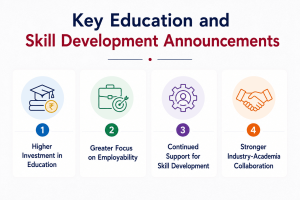
Key Education and Skill Development Announcements
The Union Budget 2026 introduces several initiatives aimed at strengthening India’s education ecosystem and preparing the workforce for emerging economic opportunities.
Some of the key themes include:
Higher Investment in Education
The government has announced another increase in education allocation, reinforcing its focus on improving educational quality, infrastructure, research, and access. Higher education funding for FY 2026–27 has increased compared with the previous year, reflecting continued policy support for the sector.
Greater Focus on Employability
A recurring theme throughout the Budget is the alignment of education with employment outcomes.
Rather than measuring success only by enrollment numbers, policymakers are increasingly emphasizing graduates who possess industry-relevant skills and are prepared for evolving workplace requirements.
Continued Support for Skill Development
The Budget highlights skill development as a national priority by encouraging practical learning, industry partnerships, innovation, and workforce readiness.
This reflects growing recognition that economic growth depends not only on academic qualifications but also on professional competencies that can be applied in real business environments.
Stronger Industry-Academia Collaboration
Several policy initiatives encourage closer collaboration between educational institutions and industry.
Such partnerships can improve curriculum relevance, increase practical learning opportunities, and help graduates develop skills that employers actively seek.
One of the biggest beneficiaries of the government’s increasing focus on employability and lifelong learning is online higher education.
Although the Budget does not specifically introduce an Online MBA policy, its emphasis on digital education, workforce development, and continuous learning strengthens the broader environment in which online professional education continues to grow.
For Online MBA learners, several implications stand out.
First, employers increasingly value professionals who continuously upgrade their skills while remaining active in the workforce. Online MBA programmes allow learners to do exactly that by combining professional experience with structured management education.
Second, the growing focus on industry-relevant curriculum aligns well with modern Online MBA programmes that increasingly incorporate business analytics, Artificial Intelligence, digital transformation, sustainability, leadership, and strategic decision-making.
Finally, the Budget’s emphasis on employability reinforces the importance of choosing programmes that focus not only on academic knowledge but also on practical business application.
Professionals considering management education may therefore find Online MBA programmes increasingly aligned with national workforce priorities.
Impact on Executive Education and Working Professionals
Executive education has experienced significant growth over the last decade, driven largely by professionals seeking specialized knowledge without taking a career break.
The Union Budget 2026 indirectly strengthens this trend by reinforcing the importance of continuous learning, digital capabilities, innovation, and workforce development.
Working professionals today operate in rapidly changing business environments.
New technologies, changing regulations, evolving customer expectations, and global competition require professionals to update their knowledge continuously.
Executive programmes offered by leading institutions increasingly focus on areas such as:
Artificial Intelligence
Business Analytics
Digital Transformation
Leadership
Finance
Supply Chain Management
Sustainability
Human Resource Analytics
These specialized programmes help professionals strengthen capabilities directly relevant to changing industry requirements.
Rather than replacing formal education, executive learning complements workplace experience by helping professionals remain competitive throughout their careers.
Why Upskilling Is Becoming India's New Career Strategy
Perhaps the most important message emerging from the Union Budget 2026 is that lifelong learning is becoming central to career success.
The nature of work continues to evolve rapidly.
Many professionals will change roles, industries, technologies, or responsibilities multiple times during their careers.
In this environment, employability increasingly depends on the ability to learn, adapt, and acquire new skills.
Several factors are contributing to this shift:
Artificial Intelligence is transforming business processes.
Automation is changing traditional job roles.
Digital transformation is affecting every industry.
For professionals, this means education is no longer a one-time milestone completed early in life.
Instead, continuous upskilling has become an ongoing professional strategy that supports long-term career resilience.
The Union Budget 2026 reinforces this broader shift by placing education, innovation, employability, and workforce development at the center of India’s growth agenda.
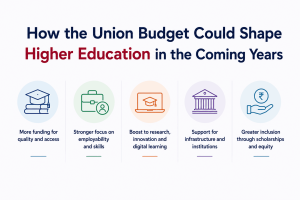
How the Union Budget Could Shape Higher Education in the Coming Years
The Union Budget 2026 reinforces a long-term vision for higher education that extends beyond increasing enrollment. The emphasis is increasingly on improving learning outcomes, strengthening employability, promoting innovation, and preparing graduates for the evolving demands of the global economy.
One noticeable trend is the growing integration of technology into education. Digital learning platforms, AI-enabled tools, virtual classrooms, and online assessments are becoming an integral part of modern education. This creates greater opportunities for learners to access quality education regardless of their location while allowing working professionals to pursue higher education without leaving their jobs.
The Budget also reflects a stronger focus on industry-academia collaboration. As businesses continue to influence workforce requirements, universities and educational institutions are expected to design programmes that better align with real-world business challenges.
For professionals considering an Online MBA or executive programme, this shift suggests that future learning experiences will increasingly combine academic knowledge with practical application, industry interaction, and technology-enabled learning.
Industries Likely to Benefit from the Upskilling Push
As India continues investing in digital transformation and workforce development, several industries are expected to experience increasing demand for skilled professionals.
Information Technology and Artificial Intelligence
The rapid adoption of AI, automation, cloud computing, and cybersecurity continues to create demand for professionals who can combine technical knowledge with business strategy.
Professionals with expertise in technology management, analytics, and digital transformation are likely to remain highly sought after.
Banking and Financial Services
Digital banking, fintech innovation, regulatory changes, and AI-powered financial services continue to reshape the financial sector.
Organizations increasingly require professionals who understand financial strategy, risk management, business analytics, and digital finance.
Healthcare
Technology is transforming healthcare through digital health platforms, hospital management systems, healthcare analytics, and AI-enabled diagnostics.
Healthcare managers with business and technology expertise are becoming increasingly valuable.
Manufacturing and Supply Chain
Modern manufacturing increasingly relies on automation, Industry 4.0 technologies, predictive analytics, and smart supply chains.
Professionals with operations management, analytics, and supply chain expertise are expected to play an important role in driving efficiency and innovation.
Consulting and Professional Services
Organizations undergoing digital transformation frequently seek consultants who understand strategy, technology, finance, and organizational change.
This creates opportunities for professionals who combine management education with specialized domain expertise.
Should You Invest in an Online MBA or Executive Programme in 2026?
The Union Budget reinforces the importance of continuous learning, but choosing the right educational pathway depends on your professional objectives.
An Online MBA May Be Suitable If You:
Want a recognized postgraduate management degree.
Plan to transition into managerial or leadership roles.
Need comprehensive business education.
Want to continue working while studying.
Intend to build long-term management capabilities.
An Online MBA provides exposure to multiple business disciplines, helping learners develop leadership, decision-making, communication, and strategic thinking skills.
An Executive Programme May Be Suitable If You:
Executive education is often a better fit for professionals who already have significant work experience and want to deepen expertise in a particular business domain.
These programmes are particularly valuable for professionals seeking specialization in areas such as:
Executive programmes generally focus on solving specific business challenges and helping professionals immediately apply new knowledge within their organizations.
The choice between an Online MBA and an executive programme depends less on which qualification is better and more on which aligns with your current career stage and future aspirations.
Practical Takeaways for Students and Working Professionals
The Union Budget 2026 sends several important signals for learners planning their professional development.
First, continuous learning is becoming increasingly important. Rapid technological change means professionals will need to update their knowledge throughout their careers rather than relying on a single qualification.
Second, industry-relevant skills matter more than ever. Employers increasingly seek professionals who can combine technical expertise with business understanding and leadership capabilities.
Third, flexibility has become an essential component of higher education. Online learning and executive education allow professionals to continue working while developing new competencies.
Finally, educational decisions should be guided by long-term career goals rather than short-term trends. Choosing programmes that align with future industry requirements is likely to generate stronger professional outcomes.
Final Verdict
The Union Budget 2026 reinforces an important reality: education is no longer viewed solely as a means of earning a degree—it is increasingly recognized as a continuous process of building skills that support employability, innovation, and long-term economic growth.
For Online MBA aspirants and working professionals, this shift presents significant opportunities. As businesses continue investing in digital transformation, AI, analytics, sustainability, and leadership development, professionals who actively upgrade their knowledge are likely to remain more competitive in the evolving job market.
However, the Budget also highlights that qualifications alone are no longer sufficient. Employers increasingly value professionals who can apply business knowledge, solve real-world problems, adapt to technological change, and contribute to organizational growth.
Whether you choose an Online MBA or an executive programme, the most valuable investment is one that aligns with your career aspirations and helps you develop skills that remain relevant in a rapidly changing economy.
Rather than viewing upskilling as a one-time activity, professionals should embrace lifelong learning as an essential strategy for career resilience and long-term success.
Frequently Asked Questions
The Budget places continued emphasis on education, digital learning, research, innovation, industry collaboration, and skill development, reflecting the government’s focus on improving employability and workforce readiness.
Rapid advances in Artificial Intelligence, automation, digital transformation, and changing business models require professionals to continuously update their knowledge and skills to remain competitive.
Yes. For working professionals seeking comprehensive management education with learning flexibility, an Online MBA remains a strong option for developing leadership and business capabilities.
Executive programmes are particularly valuable for experienced professionals who want to develop expertise in specialized areas such as leadership, finance, AI, healthcare management, or digital transformation.
Technology, banking and financial services, healthcare, manufacturing, consulting, logistics, and digital businesses are among the sectors expected to benefit from increased investment in education and workforce development.
Yes. The continued emphasis on digital education, technology adoption, and flexible learning environments supports the growing role of online and executive education in India’s higher education ecosystem.
The Budget reinforces that continuous learning, practical skills, and industry-relevant knowledge are becoming essential for long-term career growth. Professionals who invest in ongoing upskilling are likely to be better prepared for future opportunities.
Manya Tohani
Personal Growth Mentor
Manya Tohani is a Personal Growth Mentor and content strategist, helping individuals build strong personal brands and accelerate career growth. With 8M+ impressions and experience mentoring students, she empowers others through actionable guidance, resilience, and real-world insights.
 HOME > BLOG > Online MBA > Union Budget 2026 Impact on Education & Upskilling: What Online MBA and Executive Learners Must Know
 July 12, 2026
 8 min read









 Admission Open
 Admission Open
 Admission Open
 Admission Open
 ROI Calculator