The derivatives market deals with contracts whose value depends on underlying assets such as stocks, bonds, commodities, currencies, interest rates, and market indices.
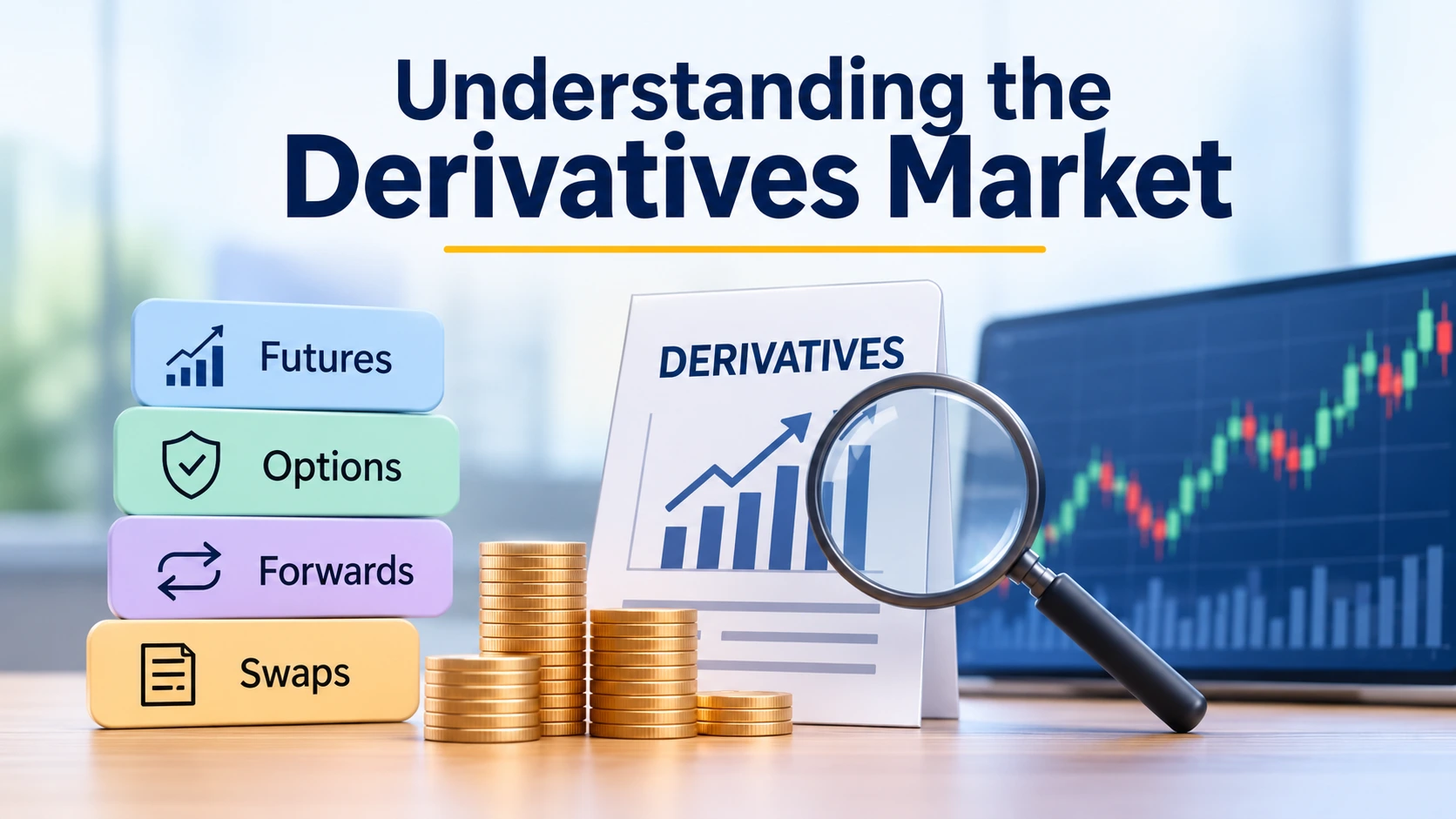
The four main types of financial derivatives are forwards, futures, options, and swaps, each serving different purposes based on contract terms, trading methods, and obligations.
Derivatives are primarily used for hedging, speculation, and arbitrage, helping businesses and investors manage financial uncertainty or benefit from price movements.
Derivative trading involves risks such as market volatility, leverage, counterparty exposure, liquidity, and operational errors. Risk management practices include using stop-loss limits, avoiding excessive leverage, diversifying, and understanding contracts before trading.
In this blog, you'll learn how the derivatives market works, its key types, exchange-traded and OTC markets, derivative trading mechanisms, major risks, risk management strategies, and their importance in finance careers.
Every business and investor faces uncertainty. A farmer does not know what price the harvest will fetch. An airline cannot be sure what fuel will cost next quarter. An importer worries about the exchange rate on the day the payment is due. The derivatives market exists to help manage this kind of uncertainty, and it has grown into one of the largest segments of global finance.
Understanding how it works is useful for investors, finance students, and working professionals alike. Many people build this knowledge through structured learning. For example, theExecutive Certificate Programme in Corporate & Strategic Finance from IIM Mumbai includes financial risk management in its syllabus. This guide explains the basics of financial derivatives in simple language, covers the main types of derivatives, and looks at the risks that come with derivative trading.
The derivatives market is a marketplace where contracts are bought and sold whose value is derived from something else. That “something else” is called the underlying asset. It can be a stock, a bond, a commodity such as gold or crude oil, a currency, an interest rate, or a market index.
The contract itself is not the asset. It is an agreement about the asset’s future price. If you hold a contract linked to crude oil, you do not receive barrels of oil in your account. Instead, you gain or lose money depending on how the oil price moves.
Financial derivatives are contracts between two or more parties whose value depends on the price of an underlying asset. Every contract has a few basic features:
Underlying asset: What the contract is based on, such as a stock or currency.
Expiry date: The date on which the contract ends or is settled.
Contract size: The quantity of the underlying asset covered by the contract.
Price terms: The agreed price, rate, or level at which the contract is set.
Why Does the Derivatives Market Exist?
Derivatives serve three main purposes.
Hedging. Hedging means reducing risk. A company that expects to receive foreign currencyin three months can lock in an exchange rate today, which protects it from sudden swings.
Speculation. Speculators take on risk deliberately, hoping to profit from price movements. They provide liquidity to the market, but they also face the possibility of large losses.
Arbitrage. Arbitrageurs look for small price differences between related markets and try to profit from them. Their activity helps keep prices consistent across markets.
A healthy derivatives market needs all three groups. Hedgers want protection, speculators accept risk, and arbitrageurs keep prices fair.
Types of Derivatives
There are four main types of derivatives: forwards, futures, options, and swaps. Each works a little differently.
1. Forward Contracts
A forward contract is a private agreement between two parties to buy or sell an asset at a fixed price on a future date. It is customized, which means the parties decide the quantity, price, and date.
Example: An exporter expects to receive $100,000 in three months. To avoid losing money if the dollar weakens, the exporter agrees with a bank to sell those dollars at today’s agreed rate. The deal is fixed no matter what happens in the market.
Forwards are flexible, but they trade over the counter (OTC), which means there is no exchange guaranteeing the deal. This creates counterparty risk, which we discuss later.
2. Futures Contracts
A futures contract is similar to a forward, but it is standardized and traded on an exchange. The exchange sets the contract size and expiry dates, and a clearing house stands between buyer and seller to reduce the chance of default.
Example: A trader buys a futures contract on a stock index, believing the market will rise. If the index goes up, the trader profits. If it falls, the trader loses. Futures are also marked to market daily, meaning gains and losses are settled in the trader’s account at the end of every tradingday.
3. Options Contracts
An option gives the buyer the right, but not the obligation, to buy or sell an asset at a set price (the strike price) on or before a certain date. The buyer pays a fee, called the premium, for this right.
A call option gives the right to buy.
A put option gives the right to sell.
Example: An investor buys a call option on a stock with a strike price of ₹500, paying a premium of ₹20 per share for a contract covering 100 shares. The total premium is ₹2,000. If the stock rises to ₹560, the option is worth ₹60 per share at expiry, giving a profit of ₹40 per share (₹4,000 in total) after the premium. If the stock stays below ₹500, the option expires worthless, and the investor loses only the ₹2,000 premium. The break-even price is ₹520.
This example shows why options are popular: the buyer’s maximum loss is limited to the premium. The seller of an option, however, takes on the obligation and can face much larger losses.
4. Swap Contracts
A swap is an agreement between two parties to exchange cash flows over a period of time. Swaps are usually traded OTC and are common among banks and large companies.
Example: A company has a loan with a floating interest rate but prefers predictable payments. It enters an interest rate swap in which it pays a fixed rate and receives a floating rate from the other party. This effectively converts its loan into a fixed-rate one.
Other swaps include currency swaps, commodity swaps, and credit default swaps.
A Quick Comparison
Feature
Forwards
Futures
Options
Swaps
Where traded
Over the counter
Exchange
Exchange or OTC
Over the counter
Standardized
No
Yes
Often yes
No
Obligation
Both parties
Both parties
Seller only
Both parties
Counterparty risk
High
Low
Low (exchange)
High
Upfront cost
Usually none
Margin
Premium
Usually none
Free Courses
Free Microsoft Excel course: : Beginner to Advanced
Exchange-traded derivatives are standardized contracts traded on recognized exchanges. Prices are transparent, trading is regulated, and a clearing house guarantees performance. Futures and many options fall into this group.
Over-the-counter derivatives are private contracts negotiated directly between parties. They can be tailored to specific needs, but they offer less transparency and carry a higher risk that the other side fails to pay.
For most individual investors, exchange-traded products are the more accessible and better-supervised option.
How Derivative Trading Works
Derivative trading involves buying or selling these contracts, either to hedge risk or to profit from price changes. A few basic ideas help beginners understand the process.
Margin. Instead of paying the full value of the contract, a trader deposits a fraction of it as margin. This is a good-faith deposit held by the broker or clearing house.
Leverage. Because margin is small compared to the contract’s value, a trader controls a large position with limited capital. If a trader deposits ₹10,000 to control a ₹1,00,000 position, a 5% price move changes the position’s value by ₹5,000. That is a 50% change relative to the trader’s deposit. Leverage magnifies profits, and it magnifies losses just as much.
Mark-to-market. Positions are revalued daily. If losses reduce your margin below the required level, you receive a margin call and must add funds, or your position may be closed.
Expiry. Derivatives have an end date. Unlike a stock, which you can hold for years, a contract’s time runs out, and time itself can affect its value, especially for options.
Settlement. Contracts are settled either in cash (the difference in value is paid) or by physical delivery of the underlying asset.
Regulators oversee derivative trading to protect investors and keep markets stable. In India, the Securities and Exchange Board of India (SEBI) regulates exchange-traded derivatives, and rules on margins and eligibility are updated from time to time. Anyone planning to trade should check the latest regulations.
Key Risks in the Derivatives Market
Derivatives are useful tools, but they are not risk-free. The same features that make them powerful also make them dangerous when misunderstood.
1. Market Risk
This is the risk that the price of the underlying asset moves against your position. Because derivative prices can change quickly, losses can build up fast.
2. Leverage Risk
Leverage can turn a small price movement into a large loss. In some cases, losses can exceed the amount you initially invested. This is one of the biggest dangers for beginners.
3. Counterparty Risk
This is the risk that the other party fails to meet its obligations. It is especially important in OTC contracts such as forwards and swaps, where no clearing house guarantees the deal.
4. Liquidity Risk
Some contracts are hard to sell quickly at a fair price because few buyers exist. A trader who needs to exit in a hurry may have to accept a poor price.
5. Operational Risk
Errors in processing trades, faulty systems, or weak internal controls can cause losses. History includes cases where poor oversight at financial firms led to heavy losses.
6. Basis Risk
Sometimes a hedge does not match the exposure perfectly. For example, a company may hedge with a contract on one commodity grade while its actual exposure is to another. Prices may not move together exactly, leaving a gap.
7. Model and Valuation Risk
Complex derivatives are priced using mathematical models. If the model’s assumptions are wrong, the price may be wrong too, and decisions based on it can lead to losses.
8. Legal and Regulatory Risk
Contract terms may be unclear, or rules may change. Poor documentation or sudden regulatory shifts can affect the value or enforceability of a contract.
It is worth knowing that studies by market regulators have reported that a large share of individual traders in derivatives lose money. This does not mean derivatives are unsuitable for everyone, but it does show why education and discipline matter.
Tips for Managing Risk in Derivative Trading
Whether you are a corporate financeprofessional or an individual investor, a few habits can help you protect yourself.
Learn before you trade. Understand how each contract works, including its costs and payoff.
Start small. Begin with limited capital while you gain experience.
Use stop-loss limits. Decide in advance how much loss you can accept and stick to it.
Avoid excessive leverage. Just because a broker allows a large position does not mean you should take it.
Hedge with a purpose. If you are hedging, make sure the contract matches the risk you want to cover.
Diversify. Do not put all your money into one position or one type of contract.
Stay informed. Keep track of market news, expiry dates, and regulatory changes.
Only risk what you can afford to lose. This simple rule prevents many serious problems.
Knowledge of financial derivatives is valuable beyond trading. Corporate treasurers use them to manage currency and interest rate exposure. Risk managers measure and control them. Analysts, auditors, and bankers all need to understand how these contracts affect balance sheets. As businesses become more global, the need for people who can use derivatives responsibly continues to grow.
Conclusion
The derivatives market plays an important role in the financial system by helping businesses and investors manage uncertainty. Forwards, futures, options, and swaps each serve a different purpose, from locking in prices to transferring risk. At the same time, derivative trading brings real dangers, including leverage, counterparty exposure, and market volatility.
The key lies in understanding what you are buying or selling, knowing how much you could lose, and using derivatives for a clear purpose. With sound knowledge, careful planning, and disciplinedrisk management, derivatives can be a useful part of a financial strategy. Without them, they can quickly become expensive lessons.
Frequently Asked Questions
The four main types of derivatives are forwards, futures, options, and swaps. Forwards and futures are agreements to buy or sell an asset at a fixed price on a future date, with futures being standardized and exchange-traded. Options give the buyer a right but not an obligation, and swaps involve exchanging cash flows between two parties.
It can be, mainly because of leverage. A small price movement can lead to large gains or losses, and in some cases losses can exceed your initial deposit. Beginners should learn the basics, start with small amounts, and use risk limits. Many new traders benefit from practicing with simulated accounts before using real money.
A futures contract obligates both parties to complete the trade at the agreed price on the expiry date. An options contract gives the buyer the right, but not the obligation, to buy or sell. This means an option buyer’s loss is limited to the premium paid, while a futures trader’s potential loss can be much larger.
Hedging means using derivatives to reduce an existing risk, such as protecting a business from currency swings. Speculation means taking on risk in the hope of profiting from price changes. The same contract can be used for either purpose, depending on the person’s goal.
Arif Siddiqui
Head of Accounting and Treasury
Arif Siddiqui is a finance leader specializing in accounting, treasury, and financial strategy. As Head of Finance at Generali Employee Benefits, he brings extensive experience in managing global financial operations. He is known for driving financial efficiency and governance across organizations. His leadership supports sustainable business growth and financial excellence.

 November 16, 2026
 9 min read




 Key Insights
 ChatGPT
 Perplexity
 Claude
 Grok








 ROI Calculator