Aptitude Questions and Answers (Detailed Solutions)
Quantitative aptitude forms a crucial part of most competitive exams and recruitment processes. Whether you are preparing for government exams, MBA entrance tests, or campus placements, aptitude questions play a vital role in evaluating your numerical ability, logical thinking, and problem-solving skills. These aptitude test questions are designed not just to test mathematical knowledge but also your speed, accuracy, and analytical mindset.
In today’s competitive landscape, employers and institutions rely heavily on aptitude test questions and answers to assess candidates objectively. These tests help measure how efficiently a candidate can interpret data, solve problems, and make decisions under pressure. According to insights from Jaro Education’s guide on aptitude preparation, aptitude assessments focus on skills like pattern recognition, time management, and strategic thinking, which are essential in real-world scenarios.
Practice is the key to mastering aptitude questions and answers. Unlike theoretical subjects, aptitude requires consistent problem-solving to build speed and familiarity with different question patterns. Regular practice helps candidates identify shortcuts, improve calculation speed, and reduce errors. Additionally, developing logical thinking skills—highlighted in this blog on logical thinking importance—enhances your ability to tackle complex problems efficiently.
To excel, aspirants must treat aptitude questions as skill-based challenges rather than rote-learning exercises. The more you practice, the more confident and accurate you become, ultimately improving your performance in exams and career opportunities.
Aptitude questions are structured problems designed to evaluate a person’s ability to think logically, solve numerical problems, and make quick decisions. These questions are commonly found in competitive exams, job interviews, and placement tests. In simple terms, aptitude test questions measure your capability to apply knowledge rather than just recall it.
There are several types of aptitude questions and answers, broadly categorized into quantitative aptitude, logical reasoning, verbal ability, and data interpretation. Each category tests a specific skill set. For example, quantitative aptitude focuses on numbers and calculations, while logical reasoning evaluates your ability to identify patterns and relationships.
In modern recruitment processes, companies widely use aptitude test questions and answers to assess candidates. As explained in this psychometric test guide, aptitude tests are a key part of hiring strategies because they provide insights into a candidate’s cognitive abilities, problem-solving skills, and adaptability. These tests often include numerical reasoning, verbal reasoning, and logical reasoning sections.
The role of aptitude questions in competitive exams is equally significant. Exams like MBA entrance tests and CETs include extensive sections on aptitude test questions to evaluate a candidate’s readiness. For instance, the XAT exam guide highlights how quantitative aptitude and data interpretation form a major part of the exam syllabus, testing both conceptual clarity and calculation speed.
Moreover, aptitude tests are not just about getting correct answers—they assess how you approach problems. Employers look for candidates who can manage time effectively, maintain accuracy, and think strategically under pressure. This is why practicing aptitude questions and answers regularly is essential for success.
In essence, aptitude questions serve as a bridge between academic knowledge and practical application, making them a critical component of both exams and professional growth.
Types of Quantitative Aptitude Questions
Quantitative aptitude includes a wide range of aptitude questions that test numerical ability and analytical thinking. Understanding the different types of aptitude test questions is essential for effective preparation.
1. Arithmetic
Arithmetic forms the foundation of most aptitude questions and answers. It includes topics such as percentages, profit and loss, ratio and proportion, time and work, and simple and compound interest. These aptitude test questions are commonly asked in exams and placements because they reflect real-life problem-solving scenarios.
2. Algebra
Algebra-based aptitude questions involve equations, inequalities, and sequences. These questions test your ability to work with variables and identify relationships between quantities. In many aptitude test questions and answers, algebra is used to simplify complex problems and derive quick solutions.
3. Geometry
Geometry focuses on shapes, sizes, and properties of figures such as triangles, circles, and polygons. These aptitude questions and answers often require knowledge of formulas and spatial reasoning. Geometry-based aptitude test questions are especially common in competitive exams, where conceptual clarity is essential.
4. Data Interpretation
Data interpretation (DI) is a crucial part of modern aptitude questions. It involves analyzing data presented in tables, graphs, or charts. According to the XAT exam syllabus overview, DI questions test your ability to extract insights quickly and make accurate calculations. These aptitude test questions and answers are highly relevant in business and management roles.
5. Number Systems
Number system questions are fundamental aptitude questions that include topics like divisibility rules, factors, multiples, and remainders. These aptitude test questions help build a strong mathematical base and are often used in combination with other topics.
Overall, mastering these categories of aptitude questions and answers is essential for performing well in exams and job assessments. A balanced preparation strategy that includes all these types ensures better accuracy, speed, and confidence.
Practicing a variety of aptitude questions is essential to strengthen your problem-solving skills and improve speed. Below is a curated set of aptitude test questions with mixed difficulty levels, covering arithmetic, algebra, data interpretation, and number systems. Try solving these before checking the solutions in the next section.
Practice Questions
Q1. A number is increased by 20% and then decreased by 20%. What is the overall percentage change?
This is one of the most common aptitude questions and answers types asked in exams.
Q2. If the ratio of ages of A and B is 4:5 and the sum of their ages is 45 years, what is A’s age?
Q3. A shopkeeper marks a product 25% above cost price and gives a discount of 10%. What is his profit percentage?
Q4. Solve for x: 2x + 5 = 17
Q5. The average of 5 numbers is 24. If one number is removed, the average becomes 20. What is the removed number?
Q6. A train travels 120 km in 2 hours. What is its average speed in km/h?
Q7. Find the next number in the series: 2, 6, 12, 20, ?
Q8. If 12 men can complete a task in 10 days, how many days will 8 men take to complete the same task?
Q9. In how many ways can the letters of the word “CAT” be arranged?
Q10. A dataset shows the sales of a company over 5 months: 100, 150, 200, 250, 300. Find the percentage increase from the first to the last month.
Data-based aptitude questions like this are important, as highlighted in the XAT exam preparation guide.
These aptitude test questions are designed to reflect real exam patterns and help you assess your preparation level. For a deeper understanding of concepts like logical reasoning and analytical thinking, you can also explore this blog on logical thinking skills, which complements your aptitude preparation.
Attempt all these aptitude questions and answers on your own before moving to the solutions. Regular practice like this builds confidence and improves accuracy over time.
Aptitude Questions and Answers (Detailed Solutions)
Now let’s go through the detailed solutions to the above aptitude questions and answers. Understanding the logic behind each solution is crucial for mastering aptitude test questions.
Q1. Percentage Change
Let the original number be 100. Increase by 20% → 100 + 20 = 120 Decrease by 20% → 120 – 24 = 96 Net change = 96 – 100 = –4%
Answer: 4% decrease This concept is widely used in aptitude test questions and answers, especially in profit and loss.
Q2. Ratio and Ages
Ratio = 4:5 → Total parts = 9 Sum = 45 1 part = 45 ÷ 9 = 5 A’s age = 4 × 5 = 20
Work is constant 12 men → 10 days 1 man → 120 days 8 men → 120 ÷ 8 = 15 days
Answer: 15 days Time and work problems are common aptitude test questions, also discussed in the psychometric test guide.
Q9. Permutations
Letters in “CAT” = 3 Arrangements = 3! = 6
Answer: 6
Q10. Percentage Increase
Initial value = 100 Final value = 300 Increase = 200 Percentage increase = (200 ÷ 100) × 100 = 200%
Answer: 200% Data interpretation-based aptitude questions and answers like this are essential for management exams, as highlighted in the XAT exam guide.
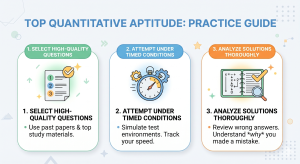
To excel in competitive exams, it is important to practice aptitude test questions that focus on speed and time management. The following set of aptitude questions is designed to simulate exam-level difficulty, helping you improve accuracy under time constraints. Attempt these aptitude test questions and answers within a limited time to build efficiency.
Practice Questions
Q1. A train 150 meters long crosses a pole in 15 seconds. What is its speed in km/h? Time-based aptitude questions like this are common in exams.
Q2. If 15 men can complete a work in 12 days, how many days will 20 men take to complete the same work?
Q3. A sum of money becomes ₹8,000 in 2 years at simple interest and ₹9,200 in 4 years. Find the principal.
Q4. Find the compound interest on ₹5,000 at 10% per annum for 2 years.
Q5. A person travels 60 km at 30 km/h and returns at 20 km/h. Find the average speed.
Q6. Find the missing number: 3, 9, 27, ?, 243
Q7. A boat travels 30 km downstream in 2 hours and returns upstream in 3 hours. Find the speed of the stream.
Q8. If a number is divided by 7, the remainder is 3. What will be the remainder when the same number is divided by 14?
Q9. A shopkeeper gives two successive discounts of 20% and 10%. Find the equivalent single discount.
Q10. A pie chart shows company revenue distribution: Product A (40%), Product B (35%), Product C (25%). If total revenue is ₹2,00,000, find revenue from Product B. Data-based aptitude questions like this are essential, as highlighted in the XAT exam guide.
These aptitude test questions are designed to enhance your ability to solve problems quickly. Practicing under timed conditions helps you identify shortcuts and improves decision-makingspeed. You can also strengthen your analytical skills by exploring this blog on logical thinking, which complements solving aptitude questions and answers effectively.
Attempt all these aptitude test questions and answers before checking the detailed solutions below.
Aptitude Test Questions and Answers (With Explanations)
Let’s now solve the above aptitude test questions and answers with step-by-step explanations and useful shortcuts to improve speed.
Q1. Train Speed
Speed = Distance ÷ Time = 150 ÷ 15 = 10 m/s Convert to km/h → 10 × 3.6 = 36 km/h
Answer: 36 km/h Shortcut: Multiply m/s by 3.6 to get km/h in aptitude questions.
Q2. Time and Work
Men × Days = Constant 15 × 12 = 180 Days for 20 men = 180 ÷ 20 = 9
Answer: 9 days
Q3. Simple Interest
Difference between amounts = 9200 – 8000 = 1200 (interest for 2 years) Interest per year = 600 Principal = (SI × 100) ÷ (Rate × Time) Using shortcut: Since SI is constant → Principal = 600 × 100 ÷ Rate From data → Rate = 7.5% Principal = 8000 – (600 × 2) = 6800
Answer: ₹6,800 Such aptitude test questions and answers are explained in detail in this aptitude blog.
Q4. Compound Interest
CI = P(1 + r/100)² – P = 5000(1.1)² – 5000 = 5000 × 1.21 – 5000 = 1050
Answer: ₹1,050 Shortcut: For 2 years → CI ≈ P × (r/100) × (2 + r/100)
When preparing for competitive exams, focusing on high-weightage aptitude questions is essential to maximize your score. Not all topics carry equal importance, so understanding which areas frequently appear in aptitude test questions can help you prioritize your preparation effectively.
High-Weightage Topics
Arithmetic is one of the most important areas in aptitude questions and answers, covering topics like percentages, profit and loss, ratio and proportion, time and work, and simple and compound interest. These concepts are widely used in exams and real-life problem-solving. As highlighted in this aptitude preparation guide, mastering arithmetic can significantly boost your overall performance.
Data interpretation is another crucial topic, especially in management entrance exams. Questions based on charts, graphs, and tables are common in aptitude test questions and answers, requiring both analytical and calculation skills. According to the XAT exam guide, DI forms a major portion of the exam syllabus.
Number systems and algebra also play a vital role in building a strong foundation for solving complex aptitude questions. These topics help improve logical reasoning and problem-solving speed.
Topic-Wise Importance
Arithmetic: High frequency, scoring, concept-based
Data Interpretation: Moderate to high difficulty, time-consuming
Number Systems: Fundamental, often combined with other topics
To strengthen your preparation, you can also explore this blog on logical thinking skills, which complements solving aptitude test questions effectively.
Focusing on these key areas ensures a balanced approach to solving aptitude questions and answers, improving both speed and accuracy.
Tips to Solve Aptitude Questions Faster
Solving aptitude questions quickly and accurately is crucial for success in competitive exams. Since most aptitude test questions are time-bound, improving speed without compromising accuracy should be your primary goal.
Time Management
One of the most effective strategies is proper time allocation. While solving aptitude test questions and answers, avoid spending too much time on a single problem. Instead, attempt easier questions first and return to difficult ones later. Practicing mock tests is of utmost importance to excel at time management.
Shortcut Techniques
Learning shortcuts is essential for solving aptitude questions and answers efficiently. Techniques like approximation, percentage-to-fraction conversion, and using formulas for average speed or successive discounts can save valuable time. These shortcuts are especially useful in high-pressure exam scenarios.
Practice Strategies
Consistent practice is the key to mastering aptitude test questions. Solve a variety of problems daily to become familiar with different patterns. Reviewing mistakes and understanding solutions is equally important. You can enhance your problem-solving ability further by referring to blogs on logical thinking, which explains how analytical skills improve performance in aptitude questions.
Common Mistakes to Avoid in Aptitude Tests
While solving aptitude questions, many candidates lose marks due to avoidable errors rather than lack of knowledge. One of the most common issues is calculation mistakes. Even when the approach is correct, small errors in multiplication, division, or percentages can lead to incorrect answers in aptitude test questions. This is why practicing regularly and double-checking calculations is essential.
Another major mistake is misinterpreting the question. Many aptitude test questions and answers are designed to test your attention to detail. Misreading conditions, skipping keywords, or misunderstanding what is being asked can lead to wrong answers. As highlighted in this aptitude preparation guide, careful reading and proper analysis are key to accuracy.
Time mismanagement is also a frequent challenge. Spending too long on a single question can reduce your chances of attempting easier ones. Improving logical thinking skills through this blog on logical reasoning can help you interpret aptitude questions and answers more effectively.
Avoiding these mistakes can significantly improve your performance in aptitude test questions.
Benefits of Practicing Aptitude Questions Regularly
Regular practice of aptitude questions offers numerous benefits, especially for students preparing for competitive exams and placements. One of the key advantages is improved speed and accuracy. The more aptitude test questions you solve, the better you become at recognizing patterns and applying the right formulas quickly.
Practicing aptitude questions and answers also enhances problem-solving skills. Over time, you develop the ability to approach complex questions with clarity and confidence. According to insights from this aptitude interview guide, consistent practice helps candidates perform better in real exam scenarios.
Another important benefit is increased confidence. When you regularly solve aptitude test questions and answers, you become familiar with different question types, reducing anxiety during exams.
Overall, consistent practice of aptitude questions is the key tomastering exams and achieving better results.
Conclusion
In today’s competitive environment, mastering aptitude questions is essential for success in exams and career opportunities. From understanding the basics to solving advanced aptitude test questions and answers, consistent practice plays a crucial role in improving performance.
Throughout this guide, we explored different types of aptitude questions and answers, important topics, and effective strategies to solve them faster. We also discussed common mistakes and how to avoid them, ensuring better accuracy in aptitude test questions. Resources like this XAT exam guide can further help you understand exam patterns and preparation strategies.
The key takeaway is simple—practice regularly, focus on concepts, and use smart techniques to save time.
Stay consistent, keep practicing aptitude questions, and you will steadily build the confidence and skills needed to excel in any aptitude test.
Frequently Asked Questions
Aptitude questions are problems designed to assess a candidate’s numerical ability, logical reasoning, and problem-solving skills. These aptitude test questions are commonly used in competitive exams and job placements to evaluate how efficiently a person can analyze and solve real-world problems. Practicing aptitude questions and answers helps in improving both speed and accuracy.
To prepare effectively for aptitude test questions and answers, start by understanding basic concepts like percentages, ratios, and averages. Create a study plan, practice daily, and take mock tests regularly. Referring to resources like this aptitude preparation guide can help you understand commonly asked aptitude questions and preparation strategies.
Some popular books include Quantitative Aptitude by R.S. Aggarwal and Fast Track Objective Arithmetic by Rajesh Verma. Along with books, online platforms and blogs like this XAT exam guide provide valuable insights into aptitude test questions and exam patterns.
Improving speed in aptitude questions and answers requires consistent practice and the use of shortcut techniques. Focus on learning formulas, approximation methods, and time-saving tricks
Prerna Singh
Talent Acquisition Manager - India
Prerna Singh is a results-driven Talent Acquisition Manager with expertise in end-to-end HR management. She has a strong background in recruitment, employee engagement, and HR operations across IT domains. Skilled in ATS/HRIS platforms and vendor management, she is passionate about building productive workplaces. She is committed to aligning talent strategies with business growth.

 April 17, 2026
 14 min read





 ChatGPT
 Perplexity
 Claude
 Grok
Grok






 Admission Open
 Admission Open
 Admission Open
 Admission Open

 ROI Calculator



