Understanding Competitive Exams in India After 12th
How Many Entrance Exams Are There in India After 12th?
Eligibility Criteria for Competitive Exams After 12th
Competitive Exams After 12th for Government Job
India’s education and employment system is heavily shaped by competitive exams. For students finishing their higher secondary education, these exams serve as entry points to top colleges, government jobs, and secure careers. Grasping the importance of competitive exams in India after 12th is essential for making smart career choices early on.
Thousands of candidates take entrance exams every year, leaving them with doubts such as how many entrance exams in India, what are the best entrance exams after 12th for government jobs, and to which they might already have answers.
This blog will give an entire spectrum of information related to Entrance Exams in India, right from 12th Govt Exams to Govt Entrance Exams for Science Students of 12th class, along with those for management programs, such as CAT, along with CAT Entrance Pattern & CAT Entrance Syllabus and so on.
Understanding Competitive Exams in India After 12th
Competitive exams are standardized tests that are used to assess the aptitude, knowledge, reasoning, and analytical skills of students. These exams are used to select students for professional courses or government jobs.
The range of competitive exams in India is quite wide and includes engineering, medical, law, defense, banking, railways, teaching, and management. Students from science, commerce, and arts streams can appear for different exams as per their eligibility. Competitive exams after 12th for a government job are considered a safe and prestigious career option for many.
According to recent estimates, students tend to ask how many entrance exams in India are there after Class 12, and the response to this question is quite complicated, as there are more than 100 entrance exams in India at the national and state levels, and more are being added from time to time.
How Many Entrance Exams Are There in India After 12th?
Aspirants are often curious about the number of entrance exams in India that are available after completing Class 12. Although there is no concrete number, entrance exams in India can be classified into various categories.
India has:
More than 30 national-level entrance exams
Over 50 state-level competitive exams
Many institution-specific and departmental recruitment tests
These are entrance exams for engineering and medical colleges, defence recruitment exams, and 12th-based government exams conducted by SSC, Railways, and State Public Service Commissions. For students seeking early career stability, competitive exams after 12th for a government job offer a range of options.
Eligibility Criteria for Competitive Exams After 12th
Eligibility criteria for competitive exams in India after 12th differ according to the type of exam, stream, and authority governing the exam. But there are some general eligibility criteria that are common to most exams.
Educational Qualification:
They should have passed Class 12 from an approved board.
Science stream students are eligible for technical and medical exams
Arts and Commerce students are eligible for Administrative and Clerical Exams
Age Criteria
Most of the 12th-based government exams have an age restriction of 17 to 25 years, with an age relaxation for reserved categories. In government competitive exams after 12th science, the age restriction for technical posts might be higher.
It is important to have clarity on the eligibility criteria before applying, as not meeting the eligibility criteria may lead to disqualification even after clearing the exam.
Competitive Exams After 12th for Government Job
Government jobs are among the most desired career options in India because of their job security, stable pay, and social respect. Many competitive exams after 12th for government jobs are held each year by central and state authorities.
Popular government exams include:
– SSC CHSL
– SSC GD Constable
– Indian Army, Navy, and Air Force exams
– Railway Group D and NTPC (limited posts)
– State Police and Forest Department exams
These competitive exams in India assess general knowledge, quantitative skills, reasoning, and language abilities. Passing these exams leads to clerical, defense, and technical government positions.
12th based government exams allow students to start working at a young age. These exams are perfect for students who want a job rather than extended academic studies.
Some well-known 12th based government exams include:
– SSC CHSL (Clerk, DEO, PA/SA)
– RRB Group D
– Indian Coast Guard Navik
– State-level police constable exams
For science students, government competitive exams after 12th science also include technical positions in defense and paramilitary forces. These exams are competitive and need disciplined preparation.
Government Competitive Exams After 12th Science
Students from the science stream have better access to both technical and non-technical jobs. Government competitive exams after 12th science are meant to check the analytical skills, knowledge, and physical fitness of the candidates.
Some of the popular exams include
NDA (National Defence Academy)
Indian Navy SSR/AA
Air Force Group X & Y
Technical railway exams
These competitive exams in India offer career opportunities in engineering services, defense forces, and public sector undertakings. Science students are also eligible for competitive exams after 12th for a government job offered by SSC and state boards.
Pattern of Competitive Exams in India
Knowledge about the pattern of the exam is an important aspect of preparation. In most competitive exams in India, the format is objective-based, but some have descriptive components or physical tests.
The common elements of the exam pattern are:
Multiple-choice questions (MCQ)
Reasoning, Quantitative Aptitude, and General Awareness sections
Language proficiency tests
Physical efficiency tests (for defense and police exams)
In the case of 12th-based government exams, the role of time management cannot be underestimated, as the exams are speed-intensive.
Career Horizon After Passing Competitive Exams
Passing competitive exams in India after 12th provides access to secure and respectable professions. Government sector jobs provide opportunities for promotions, pensions, and a work-life balance.
Career scope includes:
Clerical and administrative jobs
Defence and paramilitary forces
Technical and non-technical jobs in the public sector
Opportunities for departmental exams and promotions
For the aspirants interested in competitive exams after 12th for government jobs, long-term growth is facilitated by internal training and exams.
Free Courses
Stakeholder Communication & Negotiation Skill Sets
Transition from Competitive Exams to Management Exams
Though most of the management entrance exams are attempted after graduation, it is important to have an understanding of them right from the start. This helps in planning for the long term. Most students who prepare for competitive exams in India later on plan for MBA courses through CAT.
Though CAT is not a 12th based government exam, prior awareness of the CAT exam pattern and CAT syllabus helps the aspirants gain an edge.
CAT Exam Pattern: Overview for Aspirants
The CAT exam pattern tests analytical and decision-making skills. This exam takes place every year for admission into IIMs and top B-schools. CAT has three sections.
The CAT exam pattern includes:
– Verbal Ability and Reading Comprehension (VARC)
– Data Interpretation and Logical Reasoning (DILR)
– Quantitative Ability (QA)
Although candidates usually take CAT after graduation, those familiar with competitive exams in India find that logical reasoning and aptitude preparation are useful.
CAT Syllabus Explained
The CAT syllabus is not officially set but generally covers topics based on aptitude. Students who prepare for competitive exams after 12th often develop foundational skills that are relevant to CAT.
The CAT syllabus includes:
– Reading comprehension and grammar
– Data interpretation sets
– Arithmetic, algebra, geometry, and number systems
Early exposure to the CAT syllabus helps students make better choices in their undergraduate studies related to future MBA goals.
Preparation Strategy for Competitive Exams After 12th
Preparing for competitive exams in India after 12th requires discipline, consistency, and a clear plan. Candidates should match their preparation with the exam patterns and eligibility criteria.
Effective strategies include:
– Understanding the syllabus and exam format
– Practicing mock tests and previous-year papers
– Strengthening general knowledge and current events
– Improving time management and accuracy
For competitive exams after 12th for government jobs, regular revision is vital due to heavy competition.
Role of Coaching vs Self-Study
Students preparing for government exams based on the 12th often debate whether to choose coaching institutes or self-study. Both methods can work well based on individual learning styles.
Coaching offers:
– Structured guidance
– Regular assessments
– Peer competition
Self-study provides:
– Flexibility
– Cost savings
– Personalized learning pace
For government competitive exams after 12th in science, technical subjects may benefit from coaching.
Challenges Faced by Aspirants
Even with many opportunities, aspirants face challenges while preparing for competitive exams in India. High competition, limited seats, and uncertainty about exams can cause stress.
Common challenges include:
– Balancing board exams with entrance preparation
– Limited access to quality study material
– Pressure from repeated attempts
However, strategic planning and being aware of the number of entrance exams in India can help students explore different paths.
Future Outlook of Competitive Exams in India
The competitive exam landscape in India after 12th is changing due to digitization and exam reforms. Online testing, adaptive assessments, and centralized exams are becoming more common.
Government initiatives aim to simplify 12th-based government exams while ensuring transparency and fairness. This means more accessibility and standardized evaluations for students.
Conclusion
Competitive exams in India after 12th are important milestones in shaping academic and professional journeys. Whether targeting government jobs after 12th, looking into government competitive exams for science graduates, or planning for future management exams like CAT, making informed decisions is crucial.
Understanding eligibility, exam patterns, and career options helps students navigate this complex environment confidently. With hundreds of options addressing the question of how many entrance exams exist in India, success depends on choosing the right exam that matches individual strengths and long-term goals.
Early preparation, consistent effort, and clear purpose can turn competitive exams into stepping stones for a successful and rewarding career.
The best option among competitive exams in India after 12th grade depends on your stream and career goals. Popular choices include government exams based on 12th grade, defence exams, and competitive exams after 12th that offer long-term stability and growth.
Some of the toughest competitive exams in India include UPSC, IIT-JEE, NEET, CAT, GATE, NDA, and CA. The CAT exam pattern and syllabus are considered challenging due to high competition and analytical complexity.
After Class 12, students can take competitive exams for government jobs such as SSC CHSL, NDA, railway exams, and police recruitment. These are all classified under government exams based on 12th grade in India.
Courses in engineering, data analytics, management, and defence have great potential. Students preparing for competitive exams in India often choose degrees related to government competitive exams after 12th science or future exams like CAT.
Top future jobs include data scientist, AI engineer, business analyst, cybersecurity expert, and management professionals. Strong foundations built through competitive exams in India, along with understanding the CAT syllabus, support long-term career growth.
Shubham Lal
Lead Software Developer
Shubham Lal joined Microsoft in 2017 and brings 8 years of experience across Windows, Office 365, and Teams. He has mentored 5,000+ students, supported 15+ ed-techs, delivered 60+ keynotes including TEDx, and founded AI Linc, transforming learning in colleges and companies.
 HOME > BLOG > Exam Preparation > Competitive Exams in India After 12th: Eligibility, Pattern & Career Scope
 March 5, 2026
 7 min read





 ChatGPT
 Perplexity
 Claude
 Grok
Grok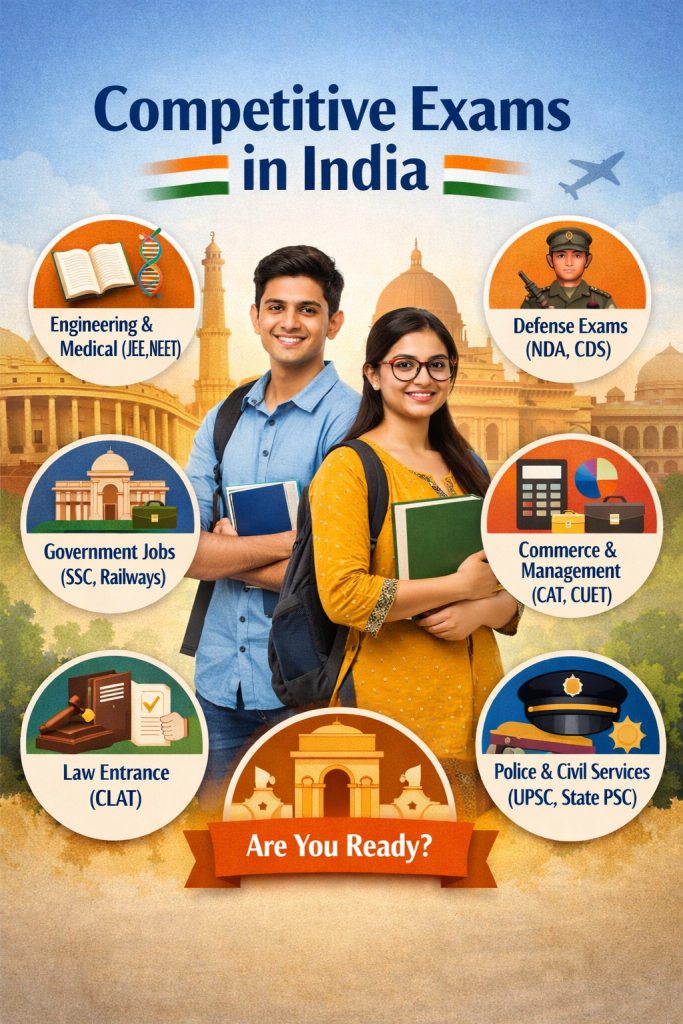







 ROI Calculator