 HOME > BLOG > Online MBA > MBA Colleges in India 2026: Top Government & Private B-Schools, Fees and Rankings
MBA Colleges in India 2026: Top Government & Private B-Schools, Fees and Rankings
 May 5, 2025
 5 min read





Table Of Content
- Before You Shortlist: Six Questions to Ask Yourself
- Top MBA Colleges in India
- Government MBA Colleges in India
- Best Private MBA Colleges in India
 Key Insights
- MBA colleges in India include government and private B-schools with different fees, admission criteria, specialisations and career opportunities.
- IIMs, IIT management schools, FMS Delhi, XLRI, MDI, SPJIMR and other institutes have different entrance exam requirements and selection processes.
- MBA fees can range from under ₹5 lakh to ₹40 lakh or more, while placement outcomes vary based on the institute, programme, specialisation and industry.
- Choosing an MBA college depends on factors such as entrance score, academic profile, budget, career goals, location, ROI and preferred mode of study.
Choosing from the many MBA colleges in India is less about chasing a rank and more about finding the right fit for your goals, budget and career stage. One institute may stand out for its campus and alumni network, another for its return on investment, and a third for placements in consulting, technology or finance.
This guide covers the best government and private B-schools, how MBA institutes in India are evaluated, which entrance exams you need, and answers to the questions aspirants ask most before applying.
 ChatGPT
 Perplexity
 Claude
 Grok
Before You Shortlist: Six Questions to Ask Yourself
Answer these first, and any list of top MBA colleges in India will shrink to a handful of realistic options:
- What matters most to you? Campus culture, alumni power or industry partnerships.
- Full-time or flexible? A residential programme, or a weekend, executive or online MBA that lets you keep working.
- Which city? Mumbai’s corporate buzz, Bengaluru’s tech ecosystem, Pune’s startup energy, or Delhi NCR’s industry access.
- Where do you stand academically? Your CAT, XAT or GMAT score and the time you can give to preparation.
- What is your budget? The total fee and the return you expect from it.
- What is your long-term goal? A CXO role, entrepreneurship or a niche field such as ESG consulting or analytics.
Top MBA Colleges in India
The table below highlights the top MBA colleges in India as per the NIRF Management Ranking, along with their respective NIRF scores and ranks.
| Rank | Institute | City | Score | Type |
| 1 | IIM Ahmedabad | Ahmedabad, Gujarat | 83.29 | Government |
| 2 | IIM Bangalore | Bengaluru, Karnataka | 81.56 | Government |
| 3 | IIM Kozhikode | Kozhikode, Kerala | 79.85 | Government |
| 4 | IIT Delhi | New Delhi, Delhi | 78.94 | Government |
| 5 | IIM Lucknow | Lucknow, Uttar Pradesh | 77.97 | Government |
| 6 | IIM Mumbai (NITIE) | Mumbai, Maharashtra | 77.58 | Government |
| 7 | IIM Calcutta | Kolkata, West Bengal | 74.43 | Government |
| 8 | IIM Indore | Indore, Madhya Pradesh | 75.68 | Government |
| 9 | Management Development Institute (MDI) | Gurugram, Haryana | 71.96 | Private |
| 10 | XLRI Xavier School of Management | Jamshedpur, Jharkhand | 70.63 | Private |
Government MBA Colleges in India
Government institutes are known for affordable fees, strong brand value and rigorous selection. Admission is mostly through the CAT, followed by a written ability test and personal interview. India now has 21 IIMs, and the older ones remain the most sought-after among MBA schools in India.
| Institute | Location | Exam | Known for |
| IIM Ahmedabad | Ahmedabad | CAT | Case-method teaching and a powerful alumni network |
| IIM Bangalore | Bengaluru | CAT | Closeness to India’s startup and technology ecosystem |
| IIM Calcutta | Kolkata | CAT | Finance, analytics and consulting roles |
| IIM Lucknow | Lucknow | CAT | Balanced general management curriculum and solid placements |
| IIM Indore | Indore | CAT | Wide programme range, including the five-year Integrated Programme in Management |
| FMS Delhi | New Delhi | CAT | Very low fees and high return on investment |
Best Private MBA Colleges in India
Private institutes offer industry-focused curricula, global exposure and a wide choice of specialisations, although their fees are higher. Most accept national-level exams such as CAT, XAT and GMAT, and some run their own tests.
| Institute | Location | Exam | Known for |
| XLRI | Jamshedpur | XAT / GMAT | Human resources and general management; one of India’s oldest B-schools |
| MDI Gurgaon | Gurugram | CAT | Strong corporate connect in Delhi NCR |
| SIBM Pune | Pune | SNAP | Finance and marketing, backed by the Symbiosis brand |
| SPJIMR | Mumbai | CAT / GMAT / XAT | Value-based learning and social impact projects |
| NMIMS | Mumbai | NMAT by GMAC | Industry network and varied specialisations |
| ISB | Hyderabad / Mohali | GMAT / GRE | One-year programme for experienced professionals |
Several autonomous institutes, such as XLRI, SPJIMR and ISB, award a PGDM or PGP rather than an MBA degree. Employers treat these as equivalent for hiring, but check the degree type if you plan to pursue a PhD later.
How MBA Institutes in India Are Ranked
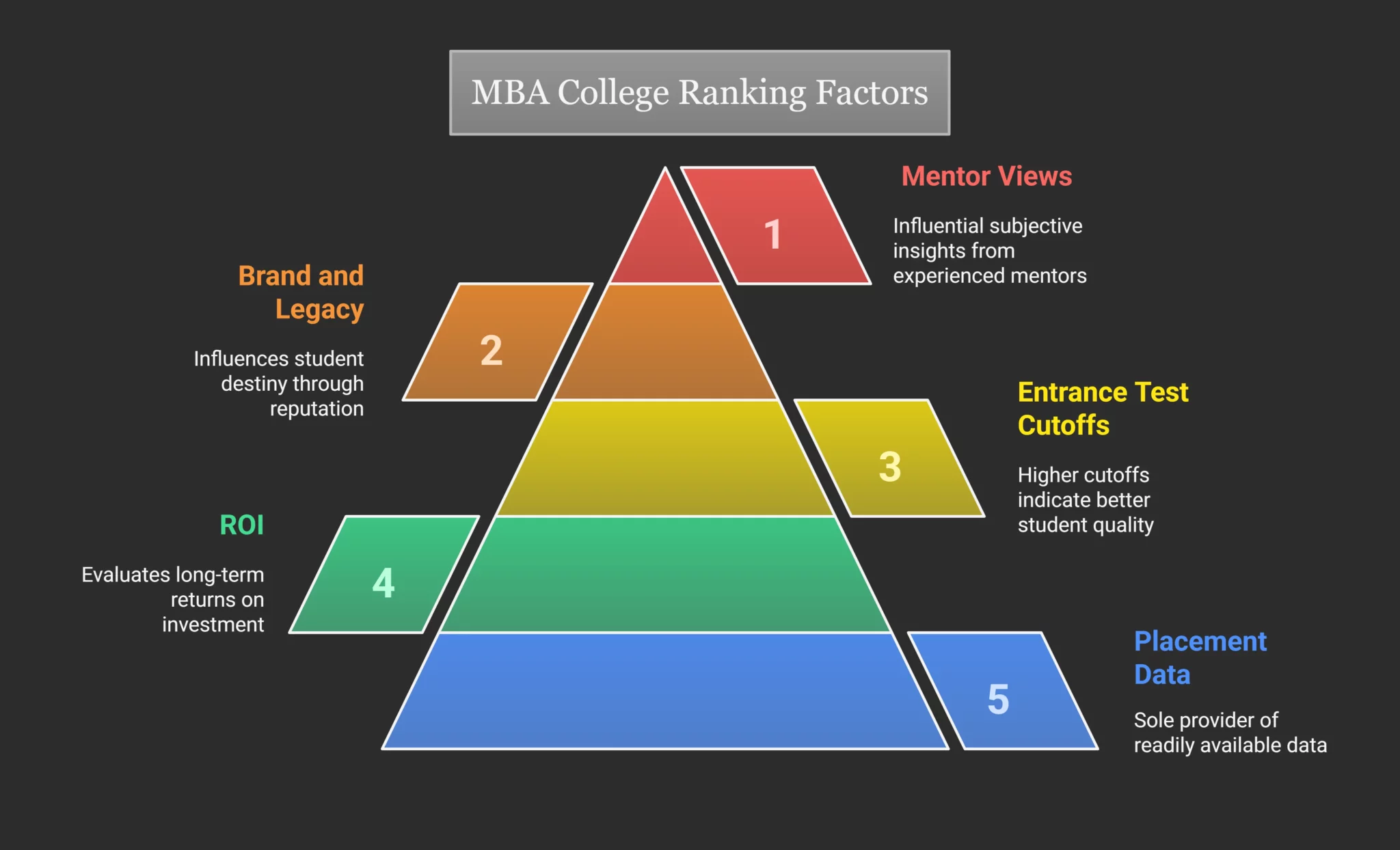
Rankings are a starting point, not the final verdict. When comparing MBA institutes in India, weigh these parameters:
- Placement data: average and median salary, top recruiters and the percentage of students placed.
- Return on investment (ROI): fees compared with salary growth and how quickly you can recover the cost.
- Entrance test cutoffs: higher cutoffs usually signal a stronger peer group.
- Brand and legacy: employer ratings, academic reputation and the strength of the alumni network.
- Faculty and curriculum: industry exposure, live projects and specialisation choices.
- Mentor and alumni feedback: firsthand views from those who have coached or studied at these schools.
Entrance Exams and Eligibility for MBA Admission
Most MBA colleges in India require a bachelor’s degree from a recognised university with at least 50% marks (45% for reserved categories) and a valid entrance score. The main exams are:
| Exam | Accepted by |
| CAT | IIMs, FMS Delhi, MDI Gurgaon, SPJIMR, IIT management departments and many other B-schools |
| XAT | XLRI and other XAT-accepting institutes |
| GMAT / GRE | ISB and several private and international programmes |
| NMAT by GMAC | NMIMS and other participating schools |
| SNAP | Symbiosis institutes, including SIBM Pune |
| CMAT / MAT | AICTE-approved institutes across the country |
For the top IIMs, general category candidates typically need a CAT percentile of 95 to 99 to be shortlisted, and cutoffs for reserved categories are lower. Final selection also depends on your academic profile, work experience, written ability test and interview.
MBA Fees and Placements at Leading MBA Schools in India
Fees vary widely by institute and programme. As a broad guide (approximate total programme fee, revised every year):
- Older IIMs and ISB: roughly ₹25 to ₹45 lakh for the full-time programme; newer IIMs are generally lower.
- XLRI, SPJIMR and MDI: roughly ₹20 to ₹30 lakh.
- FMS Delhi: a small fraction of private B-school fees, usually under ₹5 lakh.
- Average packages: top-tier schools generally report averages in the ₹25 to ₹35 lakh per annum range, varying by batch, specialisation and prior experience.
Many institutes also offer merit-based and need-based scholarships. Always verify fees, scholarships and placement figures in the latest official brochure or placement report.
Jaro Education: Shaping Careers for Future Success
With deep domain experience and leadership in executive education, Jaro Education has supported more than 350,000 professionals over 15 years through 23+ learning centres across India, Singapore and the USA. It offers over 150 management, technology and techno-functional programmes in association with reputed institutes.
Online and Executive MBA: An Option for Working Professionals
If a full-time programme is not practical, many reputed universities now offer online MBA programmes, and working professionals increasingly add them to their shortlist of MBA schools in India. Explore the fee structure and programme overview here:
Final Thoughts
Selecting the best MBA college in India is one of the most important decisions of your education and career. Whether you choose a government institute like IIM Ahmedabad or a private one like XLRI or ISB, check the curriculum, specialisations, placement history and industry tie-ups. Use the top MBA colleges in India listed above as your starting point, match them against your goals and budget, and apply with confidence.
Frequently Asked Questions
IIM Ahmedabad ranks first among MBA colleges in India in the NIRF Management Ranking, followed by IIM Bangalore and IIM Kozhikode. The right choice still depends on your budget, career goals, preferred specialisation and entrance exam score.
As per the NIRF Management Ranking , the leading institutes include IIM Ahmedabad, IIM Bangalore, IIM Kozhikode, IIT Delhi, IIM Calcutta, IIM Mumbai, IIM Lucknow, IIM Indore, XLRI Jamshedpur and IIT Bombay
The IIMs (Ahmedabad, Bangalore, Calcutta, Kozhikode, Lucknow, Indore and Mumbai), FMS Delhi, IIT Delhi and IIT Bombay are the best-known government options. Most admit students through CAT scores, followed by a written ability test and interview.
XLRI Jamshedpur, MDI Gurgaon, SIBM Pune, SPJIMR Mumbai, NMIMS Mumbai and ISB are among the most respected private B-schools. They accept exams such as XAT, CAT, SNAP, NMAT, GMAT and GRE, depending on the institute.
General category candidates usually need about 95 to 99 percentile to be shortlisted by the top IIMs. Cutoffs are lower for SC, ST and PwD categories and for many other institutes. Profile, work experience and interview performance also count.
Fees range from under ₹5 lakh at FMS Delhi to roughly ₹25 to ₹45 lakh at older IIMs and ISB, with many private institutes between ₹10 and ₹30 lakh. Fees change every year, so check official websites.
Yes. Many IIMs, ISB, XLRI and FMS Delhi offer merit-based or need-based scholarships and financial aid. Eligibility and amounts differ by institute, so review the scholarship section on each college’s official website.
Compare placement records, ROI, entrance cutoffs, faculty, curriculum, location and specialisation options against your own goals and budget. Use rankings only as a starting point, and speak to alumni where possible.

Related Courses
Explore our programs

 Admission Open


 Admission Open
 Admission Open
 Admission Open

Find a Program made just for YOU
We'll help you find the right fit for your solution. Let's get you connected with the perfect solution.
Is Your Upskilling Effort worth it?
 ROI Calculator


Are Your Skills Meeting Job Demands?
Try our Skill Gap tool
Experience Lifelong Learning and Connect with Like-minded Professionals
Explore Jaro Connect
