Team Leader vs Manager: Understanding the Difference
Why the Team Leader to Manager Transition Matters
Essential Managerial Skills You Need to Develop
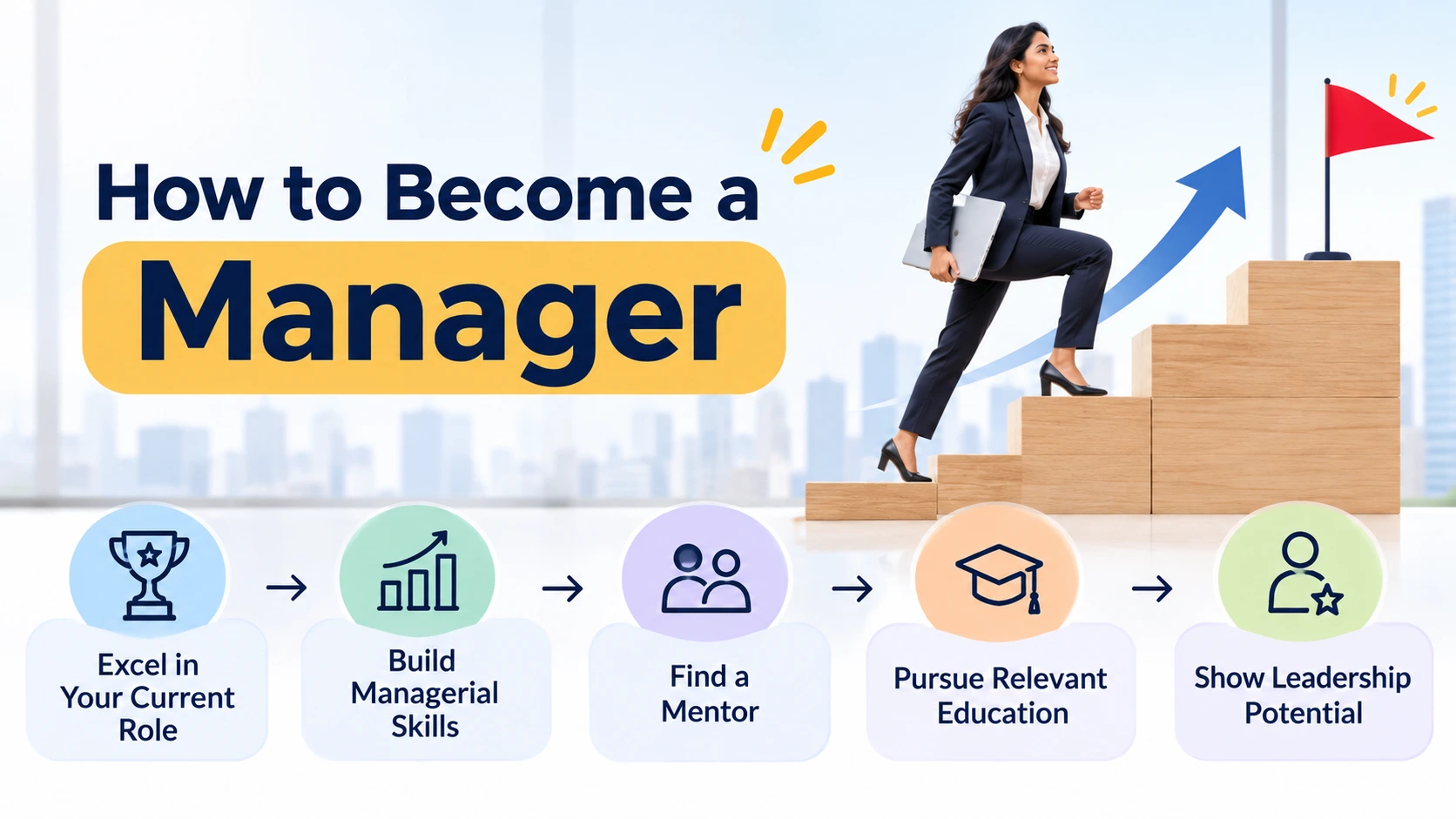
How to Become a Manager: A Step-by-Step Approach
Key Insights
The transition from team leader to manager involves shifting from daily task execution to strategic planning, broader responsibilities, and long-term business goals.
Developing essential managerial skills such as strategic thinking, communication, delegation, decision-making, emotional intelligence, and financial awareness is crucial for management success.
To become a manager, professionals should excel in their current roles, understand business operations, seek mentorship, invest in formal learning, and demonstrate leadership readiness.
Qualifications such as a bachelor's degree, MBA, postgraduate management certificates, and professional certifications can strengthen your profile, while practical experience remains equally important.
In this blog, you'll learn the key differences between team leaders and managers, essential managerial skills, qualifications required, practical steps to become a manager, and the different stages of the management career path.
Moving from a team leader role to a manager role is one of the most important steps in a professional journey. You have already shown that you can guide a small group, meet targets, and earn the trust of your colleagues. Now the question is how to take that success to the next level.
The Team Leader to Manager transition is not simply a promotion with a new title and a larger salary. It is a shift in mindset, responsibilities, and the way you create value for your organization. In this blog, we explain the key differences between the two roles, the managerial skills you need, how to become a manager, and what the management career path looks like in the long run.
Team Leader vs Manager: Understanding the Difference
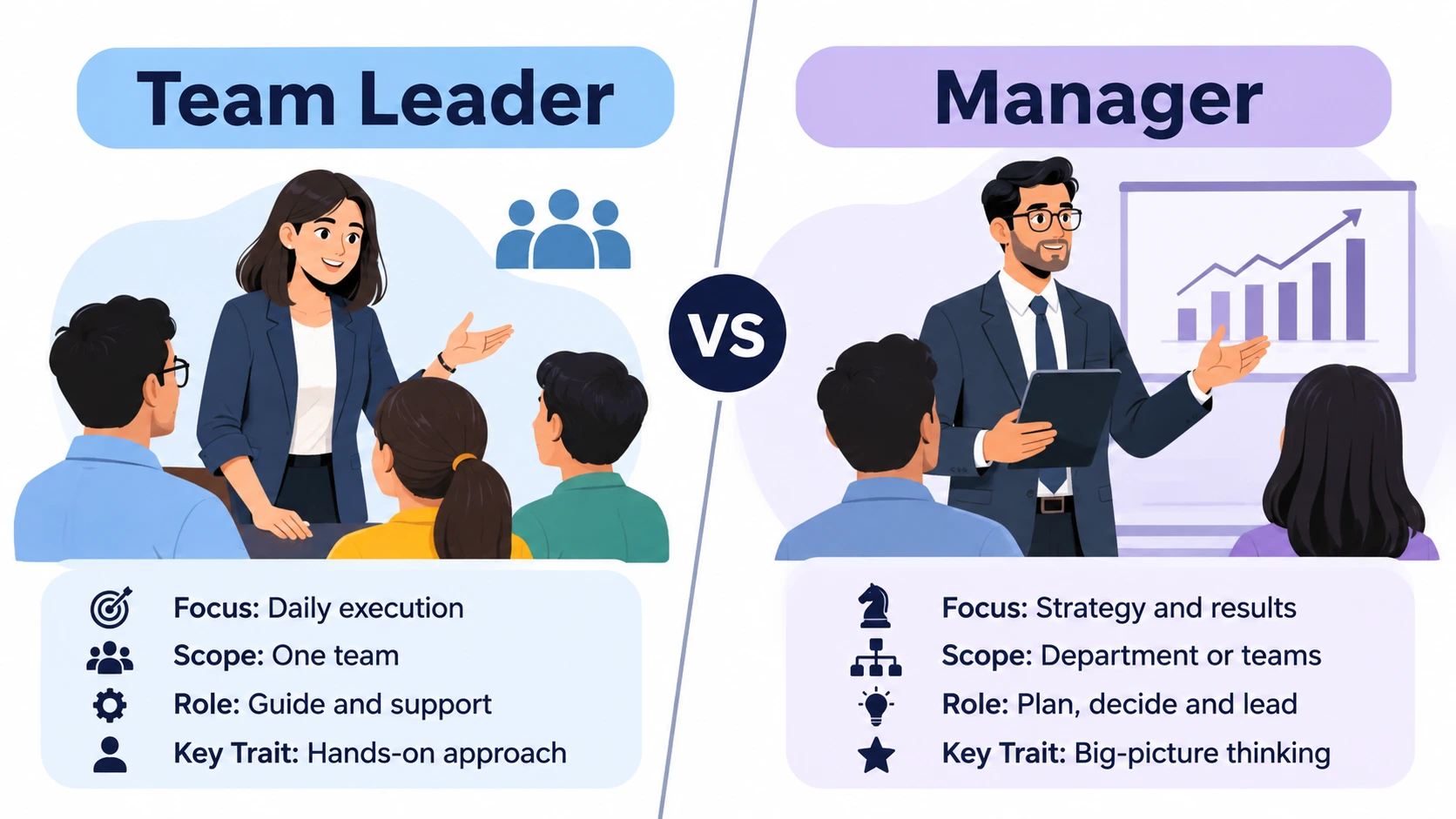
Many professionals use these two titles interchangeably, but the Team Leader vs Manager comparison shows clear differences in scope, focus, and accountability.
A team leader usually works close to the ground. They guide a small group of people, assign daily tasks, solve immediate problems, and often contribute to the work themselves. Their focus is on short-term goals, such as completing a project on time or hitting a weekly target. They are the first point of contact for team members who need help or direction.
A manager, on the other hand, operates at a broader level. Managers are responsible for planning, budgeting, resource allocation, performance reviews, and aligning team output with company strategy. They often oversee multiple teams or even multiple team leaders. Their focus shifts from “how do we finish this task” to “how do we achieve long-term business goals.”
Here is a simple way to look at the Team Leader vs Manager distinction:
Scope: A team leader handles one team; a manager handles a function, department, or several teams.
Focus: A team leader concentrates on daily execution; a manager concentrates on strategy and results.
Decision-making: A team leader makes operational decisions; a manager makes tactical and sometimes strategic decisions.
Accountability: A team leader answers for team output; a manager answers for budgets, outcomes, and overall business impact.
Work style: A team leader is often a hands-on contributor; a manager mainly guides, delegates, and reviews.
Understanding this difference early helps you prepare for what is expected of you and avoid the common trap of continuing to act like a team leader after being promoted.
The Team Leader to Manager transition is a turning point because success is measured differently. As a team leader, you are praised for your personal performance and your ability to support your team. As a manager, you are judged by what your team achieves without your direct involvement in every task.
This change can feel uncomfortable at first. You may miss the satisfaction of solving problems yourself. However, managers who learn to trust their teams, delegate effectively, and think strategically create far greater impact. They also open the door to senior leadership roles, higher compensation, and a more influential position within the organization.
For organizations, strong managers are essential. They turn company vision into action, keep employees engaged, and reduce costly turnover. That is why businesses actively look for team leaders who show potential for management roles.
Technical expertise may help you earn a team leader position, but managerial skills help you succeed as a manager. The good news is that these skills can be learned and improved with practice. Here are the most important ones.
1. Strategic Thinking
Managers must look beyond daily tasks and understand how their team’s work supports the company’s larger goals. This means analyzing market trends, setting priorities, and planning several months or even years ahead.
2. Communication
Clear communication is the foundation of good management. You will need to explain goals, give constructive feedback, present ideas to senior leaders, and listen carefully to your team. Strong communicators avoid confusion and build trust.
3. Delegation
Many new managers struggle to let go of tasks. Effective delegation means assigning work based on each person’s strengths, giving clear instructions, and trusting them to deliver. It frees your time for planning and also helps your team grow.
4. Decision-Making and Problem-Solving
Managers face complex decisions with limited information. The ability to gather data, weigh options, and make timely choices is a core part of managerial skills. It is equally important to take responsibility when a decision does not work out.
5. Emotional Intelligence
Understanding your own emotions and those of others helps you handle conflict, motivate people, and build a healthy workplace culture. Managers with high emotional intelligence tend to have more engaged and loyal teams.
6. Financial Awareness
Budgeting, forecasting, and cost control become part of your daily responsibilities. Even if you do not have a finance background, you should be comfortable reading financial reports and linking your team’s work to business results.
7. Coaching and Talent Development
Great managers build future leaders. This involves identifying skill gaps, offering mentorship, and creating growth opportunities for team members.
8. Adaptability
Business conditions change quickly. Managers who stay flexible, embrace new technology, and guide their teams through change are highly valued.
How to Become a Manager: A Step-by-Step Approach
If you are wondering how to become a manager, the path is easier when you break it into practical steps.
Step 1: Excel in your current role
Deliver consistent results as a team leader. Meet deadlines, support your team, and become someone your supervisors can rely on. Strong performance is the base of every promotion.
Step 2: Understand the business
Learn how your department contributes to company revenue and strategy. Managers are expected to think like business owners, so ask questions, attend planning meetings, and study your industry.
Step 3: Build your managerial skills
Identify the skills you lack and work on them deliberately. Take on stretch assignments, such as leading a cross-functional project or handling a budget, to practice in real situations.
Step 4: Seek feedback and mentorship
Ask your manager and senior colleagues for honest feedback. A mentor who has already made the Team Leader to Manager transition can offer valuable guidance and help you avoid common mistakes.
Step 5: Invest in formal learning
Structured programs, certifications, and degrees give you frameworks, credibility, and exposure to new ideas. They also show employers that you are serious about your growth.
Step 6: Make your ambition visible
Discuss your career goals openly with your manager or HR team. Many promotions happen because someone expressed interest and showed readiness at the right time.
Step 7: Develop your successor
One of the best ways to prove you are ready for a bigger role is to prepare someone to take over your current one. It shows that you can build capability in others.
Qualifications That Support Your Management Career Path
There is no single qualification that guarantees a managerial role, but certain credentials can strengthen your profile significantly.
A bachelor’s degree in business, commerce, or a related field is a common starting point. However, many professionals build on this with advanced learning, such as an MBA or a postgraduate certificate in management. These programs cover areas like operations, marketing, finance, human resources, and strategy, which together form a complete picture of how businesses run.
Professional certifications can also add value. Examples include project management certifications, leadership development courses, and domain-specific credentials in areas like supply chain, analytics, or human resources.
Experience remains equally important. Employers usually look for a mix of practical results, leadership exposure, and formal learning. Combining all three gives you a strong advantage when applying for management roles.
Understanding the Management Career Path
The management career path is not a single straight line. It offers multiple stages and directions depending on your strengths and interests. A typical progression looks like this:
Team Leader or Supervisor: You guide a small team and manage daily operations.
Assistant or Junior Manager: You begin handling planning, reporting, and larger responsibilities.
Manager: You lead a team or department, own targets, and manage budgets.
Senior Manager: You oversee multiple teams and contribute to departmental strategy.
Director: You shape strategy across a function and work closely with top leadership.
Vice President and C-Suite: You influence company-wide direction and long-term growth.
Along the way, you can choose to specialize in one function, such as operations, marketing, or finance, or move toward general management, which involves overseeing several functions together. General management is especially attractive for professionals who want to lead entire business units in the future.
Take the Next Step with PGCP in General Management from IIM Nagpur
If you are serious about moving ahead on the management career path, a structured program can accelerate your growth. The Post Graduate Certificate Program (PGCP) in General Management by IIM Nagpur, offered in collaboration with Jaro Education, is designed for working professionals who want to build strong managerial skills while continuing their careers.
The program helps you understand core business functions, strengthen leadership and decision-making abilities, and gain the confidence to take on bigger responsibilities. It also provides exposure to a reputed institute’s academic expertise and a network of peers from different industries.
The journey from team leader to manager is a rewarding one, but it requires preparation, patience, and a willingness to learn. By understanding the Team Leader vs Manager difference, developing key managerial skills, and following a clear plan for how to become a manager, you can move confidently along the management career path. With the right experience, qualifications, and mindset, your next big career milestone is well within reach.
Frequently Asked Questions
There is no fixed timeline. Most professionals take between two and five years, depending on their performance, industry, company size, and readiness. Building managerial skills and gaining formal qualifications can shorten this period.
An MBA is not mandatory, but it can help. Many professionals choose shorter postgraduate programs or certificates in general management to gain business knowledge without leaving their jobs.
The biggest difference is focus. Team leaders concentrate on daily execution and guiding a small team, while managers focus on strategy, planning, resources, and long-term results across a larger scope.
Employers currently value communication, emotional intelligence, strategic thinking, adaptability, data-driven decision-making, and the ability to lead remote or hybrid teams.
Bhargavi R
HR Professional
Bhargavi Reddy is an HR professional with over 6 years of experience in IT recruitment and talent acquisition. She specializes in hiring across technologies like Java, DevOps, Python, and Data Engineering. With strong expertise in full-cycle recruitment and stakeholder management, she focuses on building high-performing teams. Currently, she works as an HR Manager driving strategic hiring initiatives.
Get Free Upskilling Guidance
Fill in the details for a free consultation
Related Courses
Explore our programs
Post Graduate Certificate Programme in General Management (PGCPGM)
 HOME > BLOG > Career Development > From Team Leader to Manager: Skills, Qualifications & Career Growth
 November 24, 2026
 7 min read




 Key Insights
 ChatGPT
 Perplexity
 Claude
 Grok








 ROI Calculator