Quick Commerce Meaning: What Does It Actually Stand For?
How Does Quick Commerce Work Behind the Scenes?
Top Quick Commerce Apps in India
The Quick Commerce Business Model: How Do These Companies Make Money?
Key Insights
Quick commerce meaning: Quick commerce enables online shopping with deliveries typically within 10 to 30 minutes through local storage hubs called dark stores or micro fulfilment centres.
Popular quick commerce apps: Blinkit, Zepto, Swiggy Instamart, Amazon Now, Flipkart Minutes, and BigBasket's BB Now are among the key players in India's quick commerce market.
Business model and revenue streams: Quick commerce companies earn through product margins, commissions, delivery fees, advertising, private labels, subscriptions, and higher value product categories. Managing operational costs and achieving profitability remain major challenges.
Flipkart Quick Commerce Expansion: Flipkart Minutes is expanding across cities and product categories, including smaller towns, while using its existing supply chain, sellers, and technology to improve fulfilment efficiency.
Benefits, challenges, and future growth: Quick commerce offers convenience, saves time, reduces the need for stockpiling, and creates business opportunities. However, companies must address profitability, delivery partner safety, local retailer concerns, environmental impact, and product quality.
In this blog, you'll learn the meaning of quick commerce, how it works, the leading quick commerce apps in India, their business models and benefits, Flipkart's expansion strategy, the industry's key challenges, and its future growth prospects.
Not long ago, running out of milk at 9 PM meant a trip to the corner store, or waiting until morning. Today, you can open your phone, tap a few times, and a delivery partner is at your door before your tea has cooled. That small shift in how we shop has turned into one of the biggest retail stories in India.
This is quick commerce. It has changed how millions of people buy groceries, snacks, medicines, gadgets, and even gifts. In this blog, we'll walk through what it is, the apps leading the race, how the money works, why people love it, and where it's headed. We'll also look at Flipkart's big push into this space.
Quick Commerce Meaning: What Does It Actually Stand For?
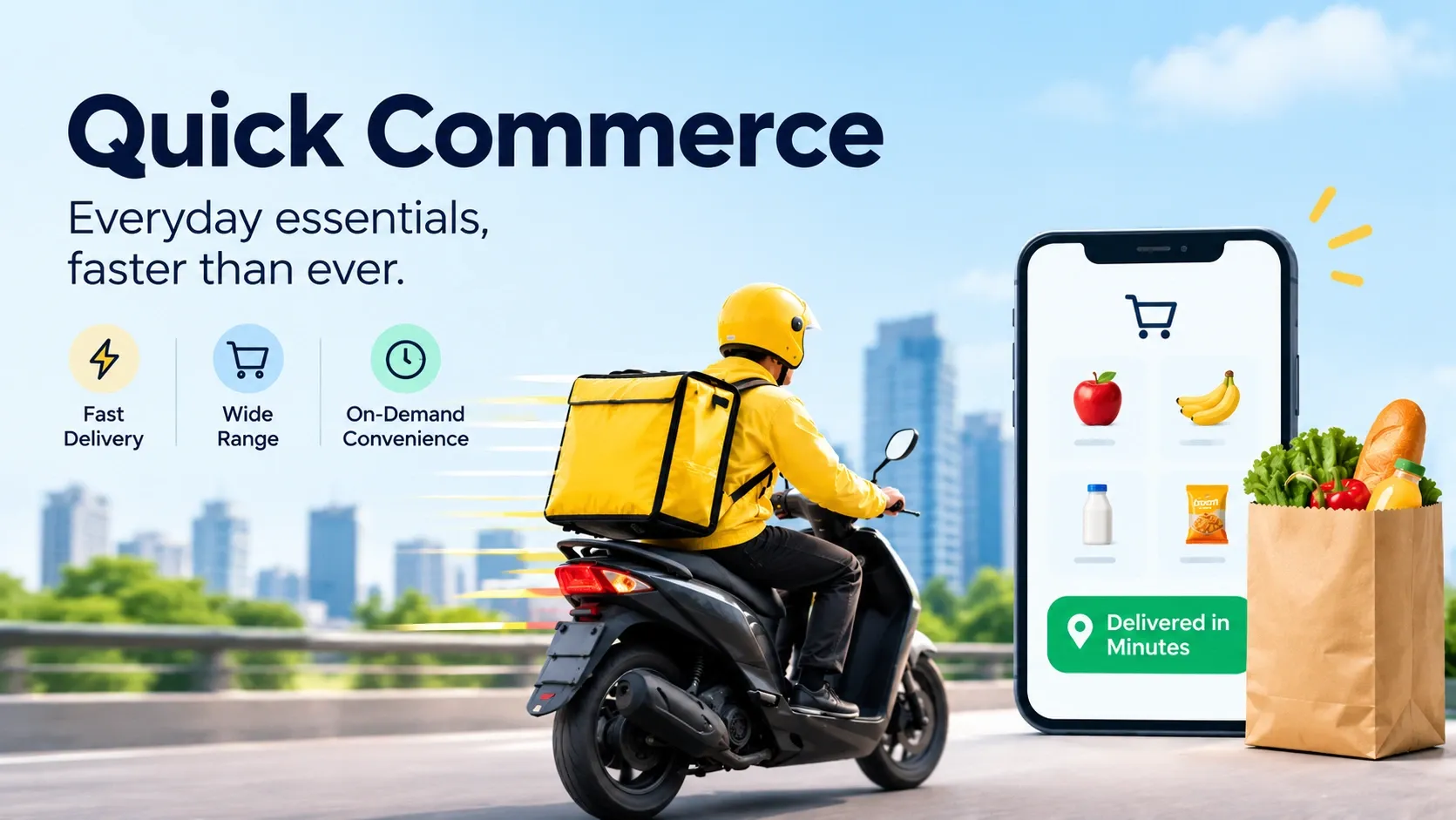
The quick commerce meaning is simple, i.e., it’s a style of online shopping where products are delivered within minutes, usually 10 to 30, instead of hours or days.
Traditional e-commerce works like this: you order something, it ships from a large warehouse far away, and it reaches you in a day or two, sometimes longer. Quick commerce flips that model. Instead of one giant warehouse, companies set up small, local storage hubs in your neighborhood. These hubs are often called dark stores or micro-fulfilment centres. They aren’t open to walk-in customers. They exist only to pack and dispatch online orders at lightning speed.
Because the products are stored just a couple of kilometres from you, delivery becomes incredibly fast. Think of it as having a supermarket in your pocket and a warehouse around the corner.
How Is It Different From Regular E-Commerce?
Take a look at a few differences that set regular e-commerce apart from quick commerce:
Speed: Minutes versus days.
Order size: Smaller, more frequent baskets, like a few vegetables, a packet of chips, or a phone charger.
Delivery radius: Usually 2 to 5 km around each dark store.
Product range: A carefully chosen set of fast-moving items rather than millions of listings.
Customer mindset: Shopping becomes an instant, on-demand habit rather than a planned purchase.
Quick commerce is sometimes called “q-commerce” or “instant commerce,” but the idea is the same everywhere: get what you need, right now.
It looks magical on your screen, but there’s a lot of planning behind that 10-minute delivery. Here’s a breakdown explained simply:
Dark stores are placed smartly: Companies study data on where people live, what they buy, and when they order. Then they open small stores in areas with high demand, typically dense residential neighborhoods.
Inventory is tightly managed: A dark store might hold only a few thousand products, compared to a regular supermarket. Technology predicts what will sell tomorrow, so shelves stay stocked with the right things.
You place an order: The app checks which dark store is closest to you and whether it has your items.
Pickers pack your order in under two minutes: Staff inside the store are guided by the app to find items quickly, often by shelf location, and bag them right away.
A delivery partner rides to your door: Routes are optimized so the rider reaches you in the shortest time possible.
The whole process is a blend of local real estate,data science, and well-trained people working in sync. If any piece slips, the 10-minute promise falls apart, which is why the companies that do this well invest so heavily in operations.
Top Quick Commerce Apps in India
Now for the part most people are curious about: which quick commerce apps are actually out there? India has become one of the most competitive markets in the world for this model, and new names keep entering. Here are the main players you should know.
Blinkit
Blinkit started as a grocery delivery startup and was later acquired by Zomato, now part of Eternal. It’s widely seen as the market leader, with a huge network of dark stores across the country. Besides groceries, it delivers electronics accessories, home items, beauty products, and more.
Zepto
Zepto burst onto the scene in 2021 with a bold 10-minute promise and grew at breathtaking speed. It built a loyal following among younger, urban shoppers and has raised large funding rounds to expand its store network and categories.
Swiggy Instamart
Swiggy took its food delivery strength and extended it to groceries and essentials through Instamart. Because many people already use Swiggy for meals, the cross-over is natural. It now sells everything from vegetables to toys and gadgets.
Amazon Now
Amazon entered the quick commerce race with its own fast-delivery offering, Amazon Now. With its logistics expertise and large customer base, Amazon is rolling it out across more cities and has announced plans to invest heavily to strengthen the service.
Flipkart Minutes
Flipkart, the Walmart-owned e-commerce major, launched Flipkart Minutes in August 2024. It was a late entrant, but it’s scaling rapidly. We’ll look at it in detail in the next sections.
BigBasket (BB Now) and Others
BigBasket, backed by the Tata Group, offers quick delivery through BB Now. There are also players like JioMart and a growing list of niche apps that focus on specific categories such as fashion, pharmacy, or fresh meat.
Which App Should You Use?
Honestly, it depends on where you live. Availability, delivery speed, pricing, and product range vary from city to city and even from one locality to another. Many people keep two or three apps installed and pick whichever offers the best price or fastest delivery at that moment. That kind of switching is exactly why these companies compete so hard on discounts, selection, and speed.
The Quick Commerce Business Model: How Do These Companies Make Money?
This is where things get interesting. Delivering a ₹150 order in 10 minutes sounds like it should lose money, and for a long time, it did. Let’s break down how the quick commerce business model is supposed to work.
1. Commission and Margins on Products
Quick commerce platforms either buy products from brands and sell them at a markup, or list products from sellers and charge a commission. Margins vary by category. Packaged foods, personal care, and electronics accessories usually offer better margins than fresh vegetables or milk.
2. Delivery and Handling Fees
Many apps charge a small delivery fee, a handling fee, or a surge fee during peak hours or bad weather. Some waive these above a minimum order value, which encourages customers to add more items to the cart.
3. Advertising Revenue
This one is a big deal. Brands pay quick commerce apps to appear at the top of search results, in banners, or in featured sections. Since shoppers on these apps are ready to buy right away, advertising here converts well. For many platforms, ad income is becoming a key route to profitability.
4. Private Labels
Some companies launch their own store brands for staples, snacks, or household products. These generally carry higher margins than third-party brands, which helps the overall economics.
5. Subscriptions and Memberships
Programs like paid memberships offer free delivery and special discounts for a monthly or annual fee. They bring in steady revenue and make customers more loyal.
6. Higher-Value Categories
To raise the average order value, apps keep adding bigger-ticket items like electronics, beauty, home décor, and gifts. A single phone accessory or skincare order adds far more margin than a bag of onions.
The Cost Side of the Story
Running a quick commerce operation is expensive. Costs include rent for dark stores, salaries for pickers and riders, packaging, technology, and heavy marketing. Because orders are small and delivery is fast, the cost per order can be high until a store reaches enough volume. That’s why most companies have been burning cash while chasing growth. The industry is now shifting its focus to unit economics, which means making each order profitable on its own, and to building enough density so each dark store is busy through the day.
Let’s talk about one of the most-discussed stories right now: the Flipkart quick commerce expansion.
Flipkart came to the party later than rivals like Blinkit, Zepto, and Instamart. But it has been moving fast. According to Flipkart’s own announcement, Flipkart Minutes has scaled to 1,000 micro fulfilment centers across 130+ cities and 8,000+ pincodes, a milestone achieved in under two years since its August 2024 launch. That’s a big leap for a service that started from scratch not long ago.
Growth Numbers That Stand Out
A few highlights from the rollout:
Reports say the division is adding about 100 stores per month, or three to four daily, up from 750 stores in March 2026.
Orders on the platform have grown 5X since the network expansion.
Flipkart has said it plans to expand the network to 1,500 micro-fulfillment centers by the end of 2026.
If it hits that target, analysts suggest Flipkart could emerge as India’s second-largest quick-commerce network by micro-fulfillment center count, behind Blinkit, though that’s based on current store counts and announced plans, so it’s worth watching how things unfold.
The “Bharat” Strategy: Going Beyond Big Cities
One of the most interesting parts of Flipkart’s approach is where it’s expanding. Instead of staying only in metros, it’s pushing into smaller cities. The company reports that Tier 2 and Tier 3 cities have recorded 42X scale compared to last year. It also entered 90+ new cities over the past year, including Ambala, Arrah, Bokaro, Darbhanga, Jorhat, Ongole, Purnia, Saharsa, and Tenali.
This matters because quick commerce was once seen as a luxuryfor big-city professionals. Flipkart’s numbers suggest it’s becoming a mainstream habit for a much wider set of Indians.
Gen Z and Beyond Groceries
Another notable trend is who’s using the service. Flipkart says Gen Z is its fastest-growing cohort, now making up 40%+ of the total customer base. These younger shoppers are using it for beauty, electronics, wellness, and lifestyle products, not just emergency groceries. The company has also said the platform now spans 250+ categories.
Flipkart’s Edge: Shared Infrastructure
Flipkart executives say one advantage is that shared infrastructure with Flipkart makes their cost of fulfillment a lot more effective than the rest of quick commerce. In simple terms, it can use its existing supply chain, sellers, and technology, instead of building everything from zero.
What’s Next?
There have also been reports that Flipkart has explored launching a dedicated app for Minutes and even exploring food delivery. Plans like these can change, so it’s best to treat them as developing stories rather than confirmed facts.
The bigger picture? Flipkart’s move shows that quick commerce has become too important for any major e-commerce player to ignore.
Benefits of Quick Commerce
Here are some of the benefits of quick commerce for customers, businesses, and the economy.
For Customers
Speed and convenience: The obvious one. Forgot an ingredient while cooking? Need a charger before a meeting? Need medicine late at night? Help arrives in minutes.
Less need for stockpiling: Since delivery is so quick, you don’t need to buy a month’s worth of supplies. You can order what you need, when you need it, which also reduces food waste at home.
Wide variety in one place: From milk and vegetables to skincare, stationery, and small electronics, one app covers a lot.
Time savings: Skipping the commute, parking, and checkout queue gives you hours back each month, especially in busy cities.
Support for emergencies: Sudden guests, a late-night craving, a missing school supply before a morning deadline: quick commerce handles last-minute needs well.
For Local Businesses and Brands
New sales channel: Brands, especially newer ones, can reach customers fast without needing a big retail presence.
Better visibility: Advertising on these apps puts products in front of people who are ready to buy.
Data insights: Platforms share trends that help brands understand what sells, where, and when.
For the Economy
Job creation: Quick commerce generates work in sourcing, warehousing, packing, operations, and last-mile delivery. Flipkart, for example, notes that its growth has created employment at scale across these areas.
Boost to small cities: As networks expand into tier-2 and tier-3 towns, these places gain access to better selection and services that used to be limited to metros.
Support for farmers and suppliers: Programs that source directly from farmer groups can improve incomes and reduce middlemen. Flipkart says its Samarth Krishi program empowers 3,000+ farmers in partnership with Farmer Produce Organizations.
No story is complete without the hurdles. Quick commerce has real challenges worth knowing about.
Profitability pressure: Heavy spending on discounts, stores, and marketing has kept many players in the red. Reports have noted that Indian quick commerce companies collectively burn well over a thousand crore rupees a month, which makes sustainable profit a major goal.
Rider welfare and safety: The 10-minute promise has drawn criticism for putting pressure on delivery partners. Companies and regulators are discussing better working conditions, insurance, and realistic delivery time promises.
Local retailer concerns: Small kirana stores worry about losing customers to dark stores, though some are also partnering with platforms.
Traffic and environment: More deliveries mean more vehicles and packaging. Many companies are shifting to electric vehicles and less wasteful packaging. Flipkart, for instance, says it scaled its electric vehicle fleet by 2X in the past year.
Quality control: Moving this fast means mistakes like wrong items, missing products, or near-expiry goods can slip through. Customers notice quickly, so reliability matters as much as speed.
The Future of Quick Commerce in India
Industry reports estimate India’s quick commerce market could grow into a $40 billion opportunity by 2030, though profitability remains a concern for investors.
Here’s what we’re likely to see:
More categories: Fashion, electronics, home appliances, pharmacy, and even gifting will keep growing on these apps.
Smaller cities, bigger reach: Expect more dark stores in towns that never had this convenience before.
Smarter technology:Artificial intelligencewill help predict demand, optimize routes, and personalize what you see on the home screen.
Greener delivery: Electric bikes and sustainable packaging will become the norm rather than the exception.
Healthier economics: Expect fewer deep discounts and more focus on ads, private labels, and higher-value orders.
Consolidation: With so many players, only the strongest operators are likely to survive in the long run.
Final Thoughts
Quick commerce has quietly rewired how we shop. What began as a way to get groceries faster is now a full-blown retail category covering everything from snacks to smartphones. The quick commerce meaning is simple, but the impact is huge: fast, local, on-demand shopping that fits our busy lives.
The quick commerce apps we use every day, from Blinkit and Zepto to Instamart, Amazon Now, and Flipkart Minutes, are all racing to be faster, wider, and more reliable. The quick commerce business model is still evolving, with advertising, private labels, and higher-value categories pointing the way to profits. And the Flipkart quick commerce expansion shows just how seriously the big e-commerce names are taking this shift, especially as it spreads to smaller cities and younger shoppers.
For customers, the benefits are clear. For companies, the challenge is to keep growth healthy and delivery partners treated fairly. If they get that balance right, quick commerce won’t be just a trend. It’ll be a regular part of everyday life.
Frequently Asked Questions
Quick commerce is a way of shopping online where your order arrives in about 10 to 30 minutes. Products are packed in small neighborhood warehouses called dark stores, so delivery is much faster than regular e-commerce.
Some of the best-known apps are Blinkit, Zepto, Swiggy Instamart, Amazon Now, Flipkart Minutes, and BigBasket’s BB Now. The best option depends on your city and what’s available in your area.
They earn through product margins and commissions, delivery and handling fees, advertising by brands, private label products, and paid memberships. Increasing the average order value by adding categories like electronics and beauty also helps.
It’s called Flipkart Minutes, launched in August 2024. According to Flipkart, it has scaled to 1,000 micro fulfilment centers across 130+ cities, and the company plans to reach 1,500 centers by the end of 2026.
Nuthana Reddy
Nuthana Reddy is a Senior Manager at Procter & Gamble, specializing in operations, digitization, and cross-functional leadership. She has driven multimillion-dollar impact through innovation, process optimization, and strategic execution across global markets.
Get Free Upskilling Guidance
Fill in the details for a free consultation
Related Courses
Explore our programs
Post Graduate Certificate Programme in Operations Management & Analytics

 October 23, 2026
 12 min read




 Key Insights
 ChatGPT
 Perplexity
 Claude
 Grok








 ROI Calculator