HOME > BLOG > Online MBA > Part-Time MBA vs Online MBA in India 2026: Which One Is Actually Worth Your Time and Money?
Online MBA
Part-Time MBA vs Online MBA in India 2026: Which One Is Actually Worth Your Time and Money?
J
By Manya Tohani
August 4, 20266 min read
Published on August 4, 2026
SHARE THIS ARTICLE
Table Of Content
Understanding a Part-Time MBA
Understanding an Online MBA
Why Flexible MBA Programmes Are Booming in India
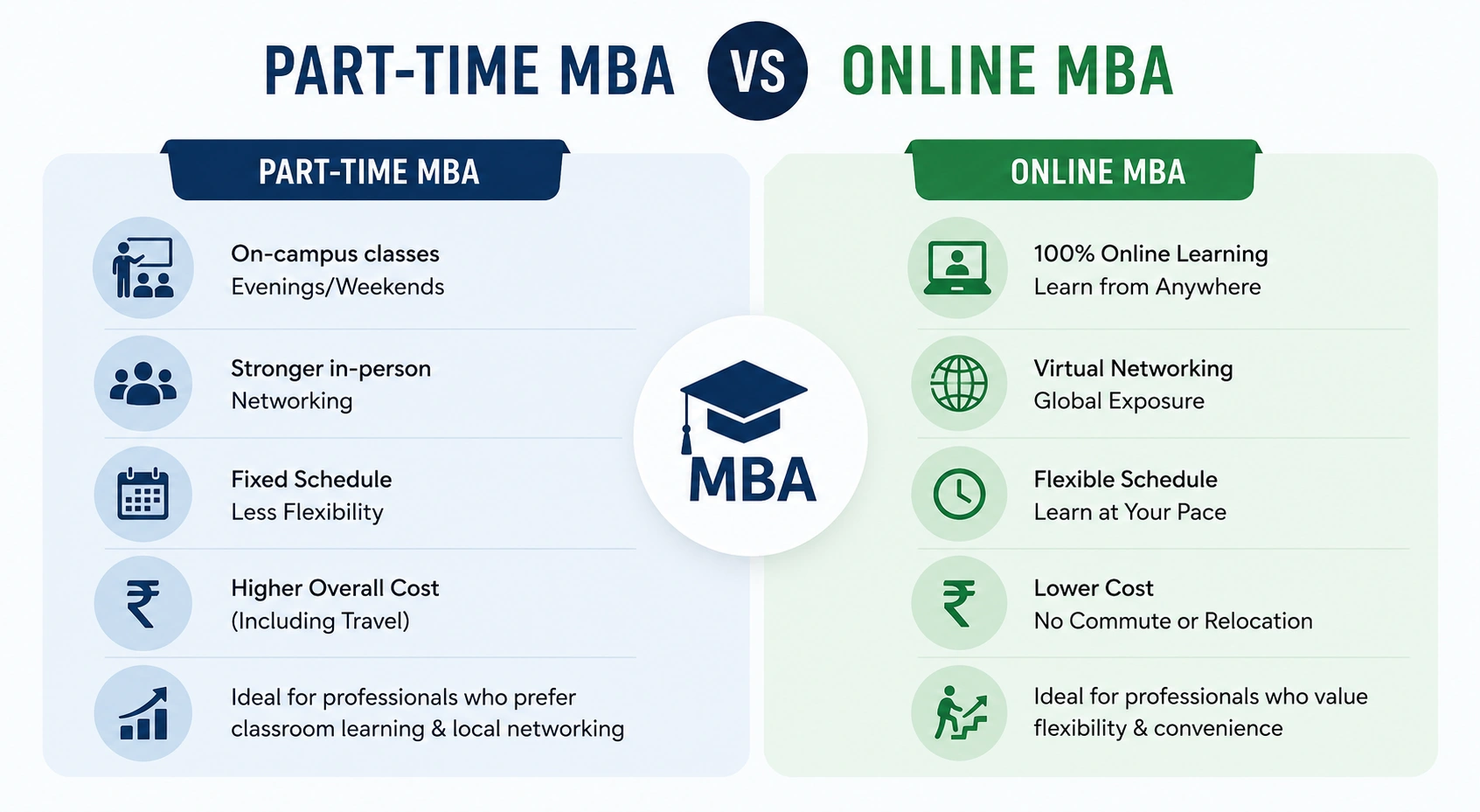
Part-Time MBA vs Online MBA: Quick Comparison
Blog Summary: Confused between a Part-Time MBA and an Online MBA? This blog compares both options across cost, flexibility, learning experience, career outcomes, and ROI to help working professionals choose the MBA that best fits their career goals in 2026.
The demand for flexible management education in India has grown significantly over the last few years. With professionals looking to upskill without putting their careers on hold, alternatives to the traditional full-time MBA have become increasingly popular. Among these, Part-Time MBA and Online MBA programmes are the two most sought-after options.
However, choosing between the two isn't always straightforward. While both allow learners to continue working, they differ in terms of learning experience, flexibility, networking opportunities, cost, curriculum delivery, employer perception, and return on investment (ROI).
In 2026, technological advancements, AI-powered learning platforms, and changing hiring practices have further blurred the gap between these two formats. Employers are now focusing more on skills, practical knowledge, andleadership capabilities rather than simply the mode of education.
So, which programme actually offers better value for your time and money?
This comprehensive guide compares Part-Time MBA and Online MBA across every important parameter to help you make an informed decision.
A Part-Time MBA is designed for working professionals who want to pursue management education while continuing their jobs. Classes are generally conducted during evenings, weekends, or on selected weekdays.
Unlike a full-time MBA, students continue earning while studying and attend physical sessions on campus.
Typical Features
Weekend or evening classes
Face-to-face classroom interaction
Continued employment
Two to three-year duration
Campus networking opportunities
Fixed class schedules
The programme suits professionals who can regularly commute to the institution and manage fixed academic commitments.
An Online MBA delivers the entire curriculum digitally through learning management systems (LMS), live virtual lectures, recorded sessions, discussion forums, and online assessments.
Students can attend classes from anywhere while balancing professional and personal commitments.
Key Characteristics
100% online learning
Live and recorded lectures
Flexible schedules
Digital assignments
Virtual networking
Lower overall cost
Accessible from any location
The online format has become increasingly sophisticated with AI-enabled learning platforms, virtual simulations, collaborative projects, and industry-led masterclasses.
Free Courses
Stakeholder Communication & Negotiation Skill Sets
Upskilling requirements in fast-changing industries
Professionals today are looking for education that fits their careers rather than interrupting them.
Part-Time MBA vs Online MBA: Quick Comparison
Parameter
Part-Time MBA
Online MBA
Learning Mode
Classroom
Fully Online
Flexibility
Moderate
High
Travel Requirement
Yes
No
Networking
Strong in-person
Virtual and global
Cost
Moderate to High
Usually Lower
Location Dependency
Yes
No
Working While Studying
Yes
Yes
Learning Pace
Fixed
Often Flexible
Accessibility
Limited by geography
Available nationwide
Course Flexibility
One of the biggest deciding factors is flexibility.
Part-Time MBA
Students must attend scheduled classes, usually on weekends or evenings. Missing sessions may impact learning since classroom participation is often mandatory.
This format works well for professionals with predictable work schedules.
Online MBA
Online programmes offer unmatched flexibility.
Students typically benefit from:
Recorded lectures
Self-paced learning modules
Weekend live sessions
Mobile learning
Digital resources available 24/7
This makes Online MBAs ideal for professionals with irregular work hours, travel commitments, or family responsibilities.
Learning Experience
Part-Time MBA
Traditional classroom interaction remains one of its biggest strengths.
Students benefit from:
Live faculty discussions
Group activities
Classroom debates
Campus infrastructure
Face-to-face mentoring
Many learners find physical interaction improves engagement and discipline.
These tools create engaging learning experiences comparable to many classroom settings.
Return on Investment (ROI)
ROI depends on:
Programme cost
Salary growth
Career opportunities
Skills acquired
Employer recognition
Part-Time MBA ROI
Advantages
Strong networking
Classroom experience
Faculty interaction
Limitations
Higher indirect costs
Less scheduling flexibility
Online MBA ROI
Advantages
Lower cost
Continued salary
Flexible learning
No relocation expenses
Wider accessibility
For many professionals, Online MBAs now offer stronger financial ROI due to lower investment and minimal career disruption.
Who Should Choose a Part-Time MBA?
A Part-Time MBA may be suitable if you:
Prefer classroom learning
Live near the institute
Want face-to-face networking
Learn better through direct interaction
Have predictable working hours
Who Should Choose an Online MBA?
An Online MBA is often ideal if you:
Travel frequently for work
Need maximum flexibility
Want to study from any city
Have family commitments
Prefer self-paced learning
Want lower overall costs
Already possess professional experience
Common Myths About Online MBA
Myth 1: Employers Don’t Value Online MBAs
Reality: Employer acceptance has increased significantly, particularly when the institution is recognized and the candidate demonstrates relevant skills.
Myth 2: Online Learning Is Easier
Reality: Online MBA programmes demand discipline, consistent participation, and effective time management.
Myth 3: There Is No Networking
Reality: Virtual communities, alumni groups, webinars, and collaborative projects provide meaningful networking opportunities.
Myth 4: Online Degrees Have Lower Quality
Reality: Many online programmes follow the same curriculum, faculty, and assessment standards as their campus counterparts.
Future Trends in MBA Education (2026 and Beyond)
Management education continues to evolve with advancements in technology and changing industry needs. In the coming years, MBA programmes are expected to place greater emphasis on AI, data-driven decision-making, sustainability, digital transformation, and leadership in hybrid workplaces. Personalized learning paths, immersive virtual classrooms, micro-credentials, and industry-integrated projects are becoming common features. Employers are increasingly valuing practical skills, continuous learning, and adaptability over traditional classroom formats, making flexible MBA programmes more relevant than ever.
Which MBA Is Actually Worth Your Time and Money?
There is no universal answer because the right choice depends on your goals, lifestyle, and career stage.
Choose a Part-Time MBA if your priority is classroom interaction, structured learning, and building strong in-person professional networks.
Choose an Online MBA if you value flexibility, affordability, location independence, and the ability to learn at your own pace while continuing your career.
For many working professionals in India in 2026, Online MBAs offer an excellent balance of convenience, affordability, and career relevance. However, those who thrive in face-to-face learning environments and can commit to fixed schedules may benefit more from a Part-Time MBA.
Conclusion
Both Part-Time MBA and Online MBA programmes provide valuable opportunities for professionals to enhance their managerial skills without leaving their jobs. The decision ultimately depends on your career aspirations, financial situation, preferred learning style, and personal commitments.
As organizations continue to embrace digital transformation and skills-based hiring, the distinction between these formats is becoming less significant. What matters most is the quality of the programme, the knowledge you gain, and how effectively you apply it in the workplace. Before enrolling, evaluate factors such as accreditation, curriculum, faculty expertise, alumni network, flexibility, and long-termcareer goals to ensure you make the best investment in your professional future.
Frequently Asked Questions
It depends on your goals. An Online MBA offers greater flexibility and affordability, while a Part-Time MBA provides structured classroom learning and stronger in-person networking opportunities.
Yes. Employer acceptance of Online MBAs has grown significantly, especially when the programme is offered by a recognized institution and candidates demonstrate relevant skills and work experience.
A 1-year MBA in India generally offers a faster ROI since professionals return to the workforce quicker, whereas a 2-year MBA may take longer to yield financial returns due to the extended duration and tuition costs.
Yes. Both formats are designed for working professionals, although an Online MBA generally provides more flexibility in managing work, studies, and personal commitments.
Consider your learning style, work schedule, budget, location, networking preferences, career goals, programme accreditation, curriculum quality, and the level of flexibility you require.
Manya Tohani
Personal Growth Mentor
Manya Tohani is a Personal Growth Mentor and content strategist, helping individuals build strong personal brands and accelerate career growth. With 8M+ impressions and experience mentoring students, she empowers others through actionable guidance, resilience, and real-world insights.
 HOME > BLOG > Online MBA > Part-Time MBA vs Online MBA in India 2026: Which One Is Actually Worth Your Time and Money?
 August 4, 2026
 6 min read





 ChatGPT
 Perplexity
 Claude
 Grok
Grok









 ROI Calculator