 HOME > BLOG > Online MBA > Online MBA ROI Calculator 2026: Is Your Program Worth the Investment? (Data for Indian Professionals)
Online MBA ROI Calculator 2026: Is Your Program Worth the Investment? (Data for Indian Professionals)
 July 7, 2026
 10 min read





Table Of Content
- What Is Online MBA ROI?
- Why ROI Matters More Than Rankings in 2026
- Key Factors That Influence MBA ROI
- How to Calculate Online MBA ROI
The popularity of Online MBA programmes has grown significantly over the past few years. Flexible learning formats, industry-relevant specializations, and increasing employer acceptance have made online management education an attractive option for working professionals across India.
However, one question continues to dominate MBA decision-making:
"Will the programme generate a worthwhile return on investment?"
In 2026, professionals are becoming more outcome-focused than ever before. Instead of evaluating programmes solely on university rankings or brand reputation, learners are increasingly analyzing salary growth, career progression, leadership opportunities, and long-term earning potential.
This shift has made MBA ROI (Return on Investment) one of the most important factors when choosing a programme. For many professionals, the objective is not simply to earn a degree but to create measurable career value through better opportunities, stronger skills, and improved earning capacity.
The good news is that Online MBA programmes often offer unique ROI advantages. Because learners can continue working while studying, they avoid the income loss associated with full-time education, which can significantly improve overall returns.
This guide explores how Online MBA ROI works, how Indian professionals can evaluate it realistically, and whether pursuing an Online MBA remains a smart investment in 2026.
 ChatGPT
 Perplexity
 Claude
 Grok
GrokWhat Is Online MBA ROI?
MBA ROI refers to the value generated from an MBA programme relative to the cost of pursuing it.
In simple terms, ROI measures whether the benefits gained after completing the programme justify the money, time, and effort invested.
For management education, ROI is typically evaluated through several factors:
- Salary growth
- Career advancement
- Promotions
- Leadership opportunities
- Career transitions
- Professional networking
- Long-term earning potential
While salary increases are often the easiest metric to measure, true MBA ROI extends beyond immediate compensation changes. Many professionals experience benefits over several years as they move into higher-responsibility roles and leadership positions.
This is why a comprehensive ROI evaluation should include both financial and non-financial outcomes.
Why ROI Matters More Than Rankings in 2026
For decades, MBA applicants primarily relied on rankings when comparing programmes. While rankings still provide useful information about academic reputation and institutional quality, they do not always reflect individual career outcomes.
A highly ranked programme may not necessarily deliver the strongest ROI for every learner. Similarly, a more affordable programme with strong career alignment may generate better long-term value for a specific professional.
Today’s learners are evaluating programmes based on questions such as:
- Will this programme help me secure a promotion?
- Can it support a career transition?
- Will it improve my leadership capabilities?
- How quickly can I recover my investment?
- Does the specialization align with industry demand?
This outcome-driven approach explains why ROI has become one of the most important decision-making criteria in management education.
Key Factors That Influence MBA ROI
MBA ROI is influenced by multiple variables, and understanding them can help professionals make more informed decisions.
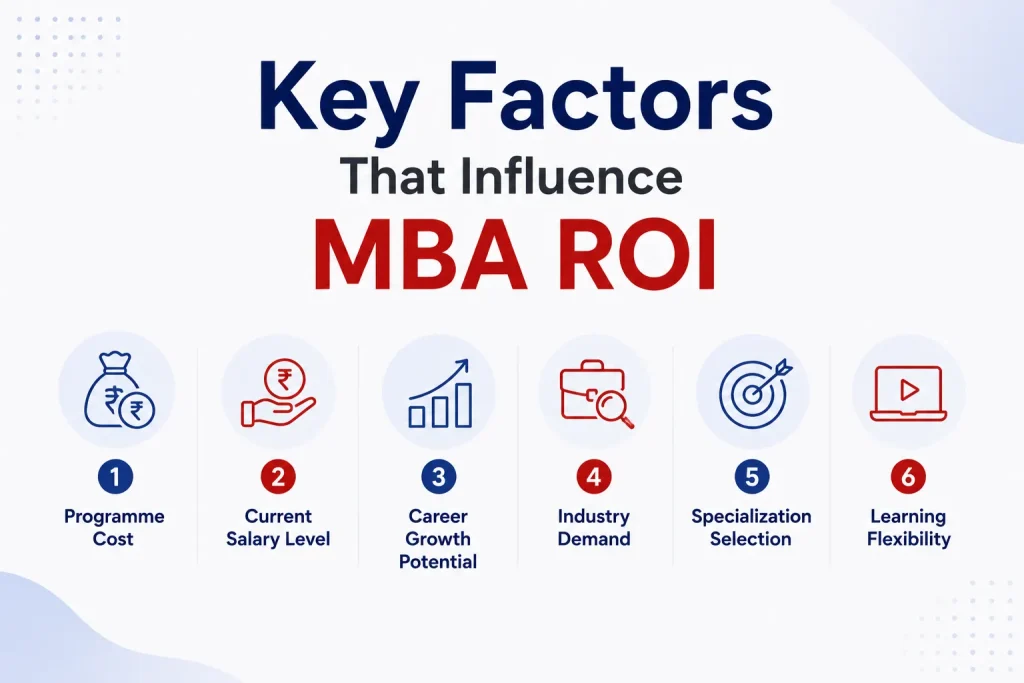
Programme Cost
The total investment remains one of the most important considerations. Tuition fees, examination fees, learning resources, and other associated expenses all contribute to the overall cost of the programme.
Lower programme costs often improve ROI, but only if the programme continues to deliver strong career outcomes.
Current Salary Level
Professionals at different career stages experience ROI differently.
For example, an early-career professional earning ₹4 lakh annually may experience significant percentage-based salary growth after completing an MBA. A senior professional earning ₹15 lakh annually may experience lower percentage growth but gain access to leadership opportunities with greater long-term value.
Career Growth Potential
Promotions, expanded responsibilities, and leadership roles frequently contribute more to ROI than salary increases alone.
Many professionals pursue MBAs not because they expect immediate compensation gains but because they want access to higher-growth career pathways.
Industry Demand
Certain industries offer stronger growth opportunities than others.
Technology, consulting, analytics, financial services, healthcare management, product management, and digital transformation roles continue to generate strong demand for management professionals.
Specialization Selection
The specialization chosen can significantly influence ROI outcomes.
Areas experiencing strong market demand often generate higher salary growth and faster career progression.
Learning Flexibility
One of the biggest advantages of Online MBA programmes is that learners can continue earning while studying.
Unlike full-time programmes, Online MBAs generally eliminate income disruption, which can dramatically improve overall return on investment.
How to Calculate Online MBA ROI
The basic formula for ROI is straightforward:
ROI (%) = [(Financial Gain – MBA Cost) ÷ MBA Cost] × 100
However, professionals should use this formula as a starting point rather than the final measure of programme value.
Consider the following example:
Suppose:
- MBA Cost = ₹2,00,000
- Current Salary = ₹6,00,000 per year
- Salary After MBA = ₹9,00,000 per year
Annual Salary Increase = ₹3,00,000
ROI Calculation:
ROI = (₹3,00,000 – ₹2,00,000) ÷ ₹2,00,000 × 100
ROI = 50%
In this scenario, the professional recovers the MBA investment within approximately one year after achieving the salary increase.
When salary growth continues over multiple years, the long-term ROI becomes even stronger.
Online MBA ROI Calculator Framework for Indian Professionals
Rather than relying solely on a formula, professionals should evaluate ROI through a structured framework.
Step 1: Calculate Your Total Investment
Start by calculating all programme-related costs.
This may include tuition fees, examination charges, technology expenses, study materials, and any additional learning costs.
Step 2: Estimate Potential Salary Growth
Research salary trends within your industry and specialization.
Consider:
- Promotion potential
- Leadership opportunities
- Industry demand
- Employer expectations
- Typical MBA salary growth
Step 3: Calculate the Payback Period
The payback period measures how quickly you can recover your educational investment through increased earnings.
A shorter payback period generally indicates stronger financial ROI.
Step 4: Evaluate Long-Term Career Benefits
Beyond salary growth, consider:
- Leadership readiness
- Career flexibility
- Industry credibility
- Professional network expansion
- Strategic business knowledge
These benefits often create value long after the programme has been completed.
Sample ROI Calculations by Salary Level
Early-Career Professional
Consider a professional earning ₹4 lakh annually before enrolling in an Online MBA.
If the programme costs ₹2 lakh and helps increase annual compensation to ₹6 lakh, the professional generates an additional ₹2 lakh per year. In this case, the investment may be recovered within approximately one year after achieving the salary increase.
Mid-Career Professional
A professional earning ₹8 lakh annually may pursue an MBA to prepare for managerial responsibilities.
If compensation increases to ₹12 lakh after programme completion, the annual gain becomes ₹4 lakh. Even with a programme investment of ₹2.5 lakh, the payback period remains relatively short.
Senior Professional
For professionals already earning ₹15 lakh or more, salary growth may be less dramatic in percentage terms.
However, the value often comes from leadership opportunities, strategic responsibilities, and executive career progression. In such cases, ROI should be evaluated beyond immediate compensation changes.
Common Mistakes Professionals Make When Calculating MBA ROI
One of the biggest mistakes professionals make is focusing exclusively on salary growth.
While compensation remains important, many MBA benefits emerge over a longer time horizon. Leadership opportunities, business knowledge, industry exposure, and professional credibility often contribute significantly to career advancement.
Another common mistake is ignoring opportunity costs and career timing. Enrolling in a programme without clear career objectives can reduce the effectiveness of the investment.
Professionals also sometimes choose programmes based solely on cost. The cheapest MBA is not always the best value, just as the most expensive programme does not automatically guarantee superior outcomes.
A more effective approach is to evaluate how well a programme aligns with long-term career goals and industry opportunities.





Online MBA ROI Across Different Career Stages
One of the most important aspects of MBA ROI is that it varies significantly depending on where a professional is in their career journey. The same programme can generate very different outcomes for early-career professionals, mid-career managers, and senior leaders.
Early-Career Professionals
For professionals with one to five years of experience, an Online MBA often serves as a career accelerator. At this stage, learners typically focus on building business knowledge, improving employability, and qualifying for higher-paying roles.
The ROI for early-career professionals is often driven by:
- Faster promotions
- Expanded job opportunities
- Higher starting salaries
- Improved managerial capabilities
Because salary growth percentages tend to be higher during the early stages of a career, ROI can often be realized relatively quickly.
Mid-Career Professionals
Professionals with five to fifteen years of experience usually pursue an MBA to transition into leadership roles or increase strategic responsibilities.
At this stage, ROI is influenced by:
- Management promotions
- Team leadership opportunities
- Cross-functional career movement
- Increased compensation packages
Many mid-career professionals experience some of the strongest MBA returns because they can immediately apply newly acquired skills within their existing organizations.
Senior Professionals
For senior leaders, ROI extends beyond salary increases.
Executive-level professionals often pursue management education to strengthen strategic thinking, expand professional networks, and prepare for larger leadership responsibilities.
In these cases, ROI is often reflected through:
- Executive leadership opportunities
- Board-level visibility
- Organizational influence
- Long-term career sustainability
The financial return may take longer to measure, but the strategic career value can be substantial.
Which MBA Specializations Deliver Strong ROI?
While ROI depends on individual circumstances, some MBA specializations consistently demonstrate strong market demand and career growth potential.
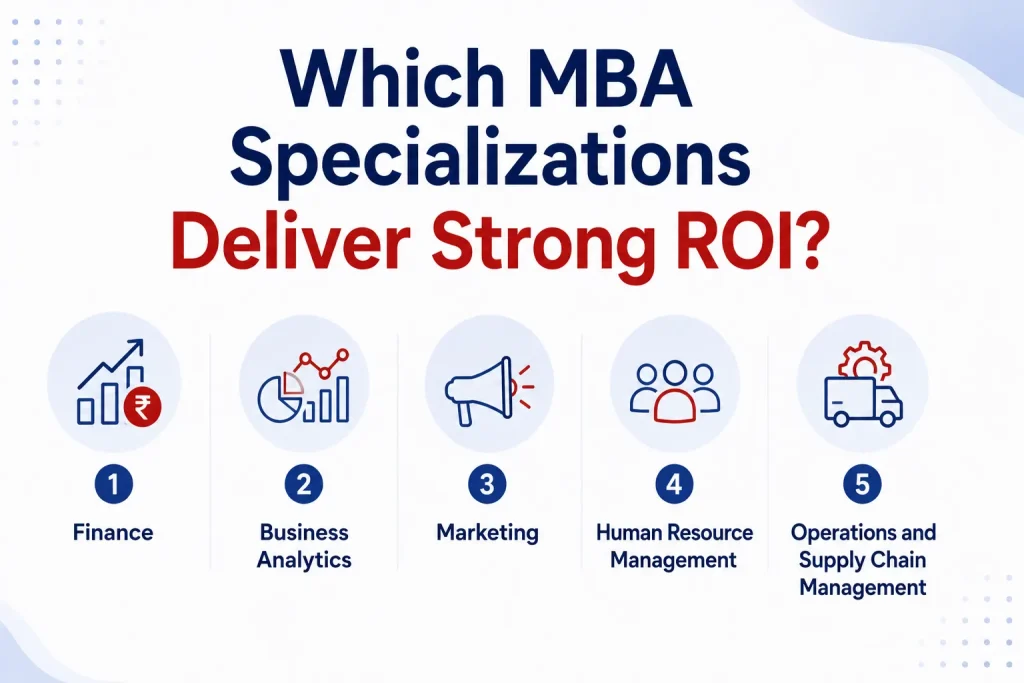
Finance
Finance remains one of the most sought-after MBA specializations because of its applicability across industries. Professionals often find opportunities in corporate finance, investment management, financial planning, consulting, and banking.
Business Analytics
Organizations increasingly rely on data-driven decision-making, making analytics one of the fastest-growing management domains. Professionals with analytical skills often benefit from strong demand and attractive compensation growth.
Marketing
Modern marketing combines business strategy, consumer insights, digital platforms, and performance analytics. Marketing professionals continue to play a central role in business growth initiatives.
Human Resource Management
As workforce management becomes increasingly strategic, HR professionals are gaining greater influence within organizations. Areas such as talent management, workforce analytics, and leadership development continue to create opportunities.
Operations and Supply Chain Management
Global supply chain disruptions and digital transformation initiatives have increased demand for professionals who can optimize business operations and improve efficiency.
Ultimately, the strongest ROI often comes from selecting a specialization that aligns with both market demand and individual career goals.
Beyond Salary: Hidden Benefits of MBA ROI
Many professionals underestimate the long-term benefits generated by an MBA because they focus exclusively on salary increases.
In reality, some of the most valuable outcomes may not be immediately visible on a compensation statement.
Stronger Professional Credibility
An MBA often enhances professional credibility and demonstrates a commitment to continuous learning and leadership development.
Expanded Business Knowledge
Professionals gain exposure to finance, marketing, strategy, operations, and leadership concepts that improve overall business understanding.
Leadership Development
Many professionals discover that management education helps them become more effective leaders, communicators, and decision-makers.
Career Flexibility
An MBA can create opportunities across industries, functions, and organizational levels, increasing long-term career resilience.
Professional Network
Interactions with faculty, peers, industry experts, and alumni often create valuable networking opportunities that contribute to future career growth.
These benefits may not generate immediate financial returns, but they often create significant value throughout a professional’s career.
How to Maximize Your MBA ROI
While programme selection matters, individual actions often determine whether professionals achieve strong returns from their investment.
One of the most effective strategies is to define clear career objectives before enrolling. Professionals who understand how the MBA fits into their career plans are typically better positioned to leverage the programme effectively.
Actively applying concepts learned during the programme can also improve outcomes. Learners who implement business frameworks, leadership techniques, and strategic thinking skills in their workplaces often experience stronger professional growth.
Networking is another important factor. Building relationships with peers, faculty members, and industry professionals can create opportunities that extend far beyond the classroom.
Professionals should also continuously update their skills in areas such as digital transformation, analytics, AI, leadership, and emerging business trends. Combining an MBA with ongoing skill development often strengthens long-term ROI.
Finally, choosing a programme aligned with career aspirations remains critical. A programme that supports professional goals will typically generate stronger outcomes than one selected solely based on cost or rankings.
Is an Online MBA Worth It in 2026?
For many Indian professionals, the answer is yes—but with an important qualification.
An Online MBA is most valuable when it is pursued with clear career objectives and realistic expectations.
The strongest ROI typically occurs when:
- The programme aligns with career goals
- The learner actively applies new knowledge
- Industry demand supports skill development
- Leadership opportunities follow programme completion
One of the biggest advantages of Online MBA programmes is flexibility. Learners can continue earning while studying, reducing opportunity costs and improving financial returns.
Additionally, employer acceptance of online management education has increased significantly, particularly when programmes are offered by recognized institutions and focus on practical business skills.
For professionals seeking career advancement, leadership readiness, business knowledge, and long-term earning potential, an Online MBA remains a strong educational investment in 2026.
Final Thoughts
The value of an MBA should not be measured solely by tuition costs or rankings. The true measure of ROI lies in how effectively the programme contributes to professional growth, career advancement, leadership opportunities, and long-term earning potential.
For Indian professionals, Online MBA programmes offer a compelling combination of flexibility, affordability, and career relevance. By allowing learners to continue working while studying, they often provide a stronger financial return than traditional full-time alternatives.
However, successful ROI depends on making informed decisions. Professionals should evaluate programme quality, specialization relevance, career goals, and long-term outcomes rather than focusing solely on cost.
Ultimately, the best MBA investment is one that helps you achieve meaningful career progress while delivering sustainable value over the course of your professional journey.
Frequently Asked Questions
The payback period depends on programme fees, salary growth, industry demand, and career progression. Many professionals recover their investment within one to three years after completing the programme.
For professionals seeking career growth, management expertise, and leadership opportunities while continuing to work, an Online MBA can be a valuable long-term investment.

Related Courses
Explore our programs





Find a Program made just for YOU
We'll help you find the right fit for your solution. Let's get you connected with the perfect solution.

Is Your Upskilling Effort worth it?
 ROI Calculator

Are Your Skills Meeting Job Demands?
Try our Skill Gap tool
Experience Lifelong Learning and Connect with Like-minded Professionals
Explore Jaro Connect
