Why Understanding Job Opportunities Matters Before You Choose a Degree
BCA Job Opportunities: Tech Careers You Can Start Right After Graduation
BBA Job Opportunities: Building a Strong Business Foundation
MBA Job Opportunities: Leadership, Specialization, and Higher Pay
Key Insights
BCA, BBA, and MBA offer different career paths, with BCA focusing on technology, BBA on business and management, and MBA on advanced management, leadership, and specialization.
BCA graduates can explore diverse tech roles such as software developer, web developer, data analyst, cybersecurity analyst, UI/UX designer, and software tester, with
BBA provides broad career opportunities across marketing, finance, HR, sales, operations, management training, and entrepreneurship, allowing graduates to specialize as they gain experience.
MBA can support leadership and specialized career paths in finance, marketing, HR, operations, business analytics, IT, international business, and entrepreneurship, with opportunities for senior management roles.
Practical skills can strengthen job prospects after any degree. Communication, problem-solving, digital literacy, teamwork, adaptability, internships, projects, networking, and interview preparation are highlighted as important career-building factors.
In this blog, you'll learn about job opportunities after BCA, BBA, and MBA, popular roles, salary expectations, career scope, degree combinations, essential skills, and practical tips for landing your first job.
You have finished (or are about to finish) your degree, and now comes the big question: what next? Should you apply for a job right away, pursue higher studies, or start something of your own? If you are holding a BCA, BBA, or MBA, the good news is that you have more options than you might think.
In this blog, we break down the job opportunities available after each of these three popular degrees. You will find real roles, realistic salary ranges, growth paths, and practical tips, all in plain language. Whether you are exploring BCA job opportunities, comparing BBA job opportunities, or aiming for the best MBA job opportunities, this guide will help you plan with clarity.
A quick note: salaries mentioned here are approximate annual figures for India and vary b
Why Understanding Job Opportunities Matters Before You Choose a Degree
Many students pick a course because friends or family suggested it. Later, they realize the career they imagined does not match the job opportunities the degree actually opens up. A little research now saves a lot of confusion later.
Here is the simple difference:
BCA (Bachelor of Computer Applications) builds your foundation in programming, databases, and software. It leads mainly to technology roles.
BBA (Bachelor of Business Administration) builds your foundation in management, marketing, finance, and people skills. It leads to business and corporate roles.
MBA (Master of Business Administration) is a postgraduate degree that sharpens leadership and specialization. It leads to mid-level and senior management roles.
The three are not rivals. In fact, many people combine them: BCA followed by MBA, or BBA followed by MBA. We will look at those combinations later.
BCA Job Opportunities: Tech Careers You Can Start Right After Graduation
If you enjoy solving problems with code, BCA job opportunities will feel exciting. The IT sector keeps growing, and companies are constantly hunting for people who can build, test, secure, and maintain digital products.
Popular Roles After BCA
Software Developer / Programmer: This is the most common starting point. You write, test, and improve code for websites, apps, and software systems. Knowing Java, Python, JavaScript, or C++ gives you a real edge.
Web Developer: From front-end design to back-end logic, web developers build the websites and web apps we use every day. Skills in HTML, CSS,JavaScript, React, and Node.js are in strong demand.
Mobile App Developer: With millions of Android and iOS users, app developers are always needed. Learning Kotlin, Flutter or Swift can open doors quickly.
Data Analyst: Companies drown in data and need people to make sense of it. If you like numbers and patterns, learn SQL, Excel, Power BI, and Python.
Software Tester / QA Engineer: Testers make sure products work smoothly before reaching users. It is a great entry route into the tech world.
System Administrator / Network Support Engineer: These professionals keep servers, networks, and company systems running without hiccups.
Cybersecurity Analyst (Entry Level): With rising online threats, security is a booming field. Certifications like CEH or CompTIA Security+ add strong value.
UI/UX Designer: If creativity meets technology for you, designing user-friendly interfaces is a rewarding path.
BCA Salary Expectations
Experience Level
Approximate Annual Salary
Fresher (0 to 2 years)
₹2.5 to ₹5 lakh
Mid-level (3 to 6 years)
₹6 to ₹12 lakh
Senior (7+ years)
₹12 to ₹25 lakh or more
Freshers from reputed colleges or those with strong project portfolios can secure packages above these averages, especially in product companies and startups.
Career Scope for BCA Graduates
The scope of BCA job opportunities goes beyond a first job. Many graduates move into roles like Technical Lead, Solution Architect, Product Manager or even start their own tech ventures. Others pursue an MCA or an MBA to move into management. Remote work and freelancing have also opened global income possibilities for skilled developers.
Pro tip: A degree gets you shortlisted, but a GitHub profile with real projects gets you hired.
BBA Job Opportunities: Building a Strong Business Foundation
A BBA does not lock you into one profession. Instead, it gives you a broad understanding of how businesses operate, which makes BBA job opportunities wonderfully diverse. You can start in marketing, finance, HR, sales, or operations and later specialize.
Popular Roles After BBA
Marketing Executive: You plan campaigns, handle brand communication, and understand customer behaviour. It is creative, fast-paced, and people-oriented.
Digital Marketing Specialist: SEO, social media, email marketing, and paid ads are in huge demand. Many BBA graduates build a strong career here with just a few certifications.
Sales and Business Development Executive: If you are a good communicator and love targets, this role offers fast growth and attractive incentives.
Human Resources Executive: From recruitment to employee engagement, HR professionals shape company culture and talent.
Financial Analyst / Accounts Executive: You work with budgets, reports, and financial planning. Adding certifications such as CFA, CMA, or tax-related courses boosts your profile.
Operations Executive: You keep processes, supply chains, and daily business activities running efficiently.
Management Trainee: Many large companies hire BBA graduates into trainee programmes where you rotate across departments and grow into leadership.
Entrepreneur / Startup Founder: BBA teaches you how to build a business plan, manage finances, and market a product, which is a solid base for starting something of your own.
BBA Salary Expectations
Experience Level
Approximate Annual Salary
Fresher (0 to 2 years)
₹2.2 to ₹4.5 lakh
Mid-level (3 to 6 years)
₹5 to ₹10 lakh
Senior (7+ years)
₹10 to ₹20 lakh or more
Salary growth in business roles often depends on performance, communication skills, and specialization. Sales and digital marketing roles may also include incentives that raise your total earnings.
Career Scope for BBA Graduates
The long-term scope is wide. A BBA graduate with a few years of experience can move into team leadership, brand management, or business strategy. Many also choose to pursue an MBA to access senior positions. If you enjoy variety and want to keep your options open, BBA job opportunities are a smart choice.
MBA Job Opportunities: Leadership, Specialization, and Higher Pay
An MBA is often the career accelerator people are looking for. It adds management skills, industry exposure, networking, and, in many cases, a significant salary jump. The range of MBA job opportunities is broad because you can specialize in a particular domain.
Why it works: E-commerce and manufacturing growth have made this a high-demand field.
MBA in Business Analytics / Data Science
Roles: Business Analyst,Data ScienceManager, Analytics Consultant
Why it works: Data-driven decision-making is now the norm, not the exception.
MBA in Information Technology
Roles: IT Project Manager, Technology Consultant, Product Owner, IT Strategy Manager
Why it works: It blends tech knowledge with management skills, which is a rare and valuable mix.
MBA in International Business and Entrepreneurship
Roles: Export-Import Manager, Global Business Consultant, Startup Founder
Why it works: Globalization and the startup boom keep creating new opportunities.
MBA Salary Expectations
College Tier
Approximate Fresher Salary
Top IIMs and elite B-schools
₹20 to ₹35 lakh+
Good tier-2 B-schools
₹7 to ₹14 lakh
Average or tier-3 colleges
₹3.5 to ₹6 lakh
With 8 to 10 years of experience, MBA professionals in management roles commonly earn ₹20 to ₹50 lakh or more, and senior leaders can go well beyond that.
Career Scope for MBA Graduates
MBA graduates often rise into roles such as General Manager, Vice President, Chief Marketing Officer, Chief Financial Officer, or even CEO. Consulting firms, banks, FMCG companies, tech giants, and startups all recruit MBAs actively. Entrepreneurship is another strong route, since you learn how to manage teams, money, and strategy.
The key point: the MBA job opportunities you receive depend heavily on your college brand, specialization, internships, and communication skills, not only on the degree itself.
BCA vs BBA vs MBA: Quick Comparison
Factor
BCA
BBA
MBA
Focus
Technology and software
Business and management basics
Advanced management and leadership
Duration
3 years
3 years
2 years
Typical First Job
Developer, Tester, Analyst
Executive, Trainee, Sales
Manager, Consultant, Analyst
Fresher Salary Range
₹2.5 to ₹5 lakh
₹2.2 to ₹4.5 lakh
₹3.5 to ₹35 lakh+ (varies widely)
Best For
Coding and problem-solving lovers
People-oriented, business-minded students
Those aiming for leadership roles
Further Study
MCA, MBA, certifications
MBA, professional courses
PhD, executive programmes
Smart Career Combinations That Work
You do not have to choose just one path. Some of the most successful combinations include:
BCA + MBA (IT or Analytics): Perfect for becoming a tech manager, product manager, or consultant.
BBA + MBA (any specialization): The classic route to corporate leadership.
BCA + Certifications (Cloud, AI, Cybersecurity): A quick way to boost your earnings without another degree.
BBA + Digital Marketing or Finance Certifications: A fast track to specialized, well-paying roles.
Skills That Improve Your Job Opportunities After Any Degree
Whatever you study, employers look for more than marks. These skills can make a real difference:
Communication: Speaking and writing clearly sets you apart instantly.
Problem-solving: Companies pay for people who can fix problems, not just identify them.
Digital literacy: Excel, data tools, and basic AI awareness are useful in almost every role now.
Teamwork and leadership: Group projects and club activities count more than you think.
Adaptability: Industries change fast, and learners survive.
Internships and projects: Real experience beats theory every single time.
Build a strong resume: Keep it to one page, highlight projects and measurable results.
Create an online presence: An updated LinkedIn profile gets noticed by recruiters. BCA graduates should also maintain a GitHub portfolio.
Network genuinely: Talk to seniors, alumni, and professionals. Many opportunities come through referrals.
Practice interviews: Mock interviews help you control nerves and sharpen answers.
Apply widely: Use job portals, company career pages, and campus placements together.
Never stop learning: Free and paid courses on Coursera, NPTEL, Google, and LinkedIn Learning can strengthen your profile.
Final Thoughts
There is no single “best” degree. BCA job opportunities suit those who love technology and building things. BBA job opportunities suit those who enjoy people, business, and variety. MBA job opportunities suit those ready to step into leadershipand specialization. The right choice depends on your interests, strengths, and long-term goals.
What matters most is combining your degree with practical skills, internships, and a learning mindset. Do that, and the doors will keep opening, no matter which path you start on.
Frequently Asked Questions
It depends on your interests. BCA offers strong demand in IT and tech roles with slightly higher starting salaries, while BBA offers broader opportunities across marketing, finance, HR, and sales. If you like coding, choose BCA. If you prefer business and people-facing roles, BBA is a better fit.
Not always. Many BCA and BBA graduates build excellent careers with skills and certifications alone. However, an MBA helps if you want to move into management, switch industries, or access higher salary brackets, especially from a reputed college.
Business Analytics, Finance, Marketing (especially digital), IT, and Operations/Supply Chain are currently among the most in-demand specializations. Roles connected to data, AI, and e-commerce are growing particularly fast.
Yes. BCA graduates can enter these fields by learning Python, SQL, machine learning basics or cloud platforms like AWS, Azure, and Google Cloud. Certifications and hands-on projects are often more important than the degree alone.
Most BBA freshers earn roughly ₹2.2 to ₹4.5 lakh per year. Those with strong internships, digital marketing skills, or sales experience can start higher, and salaries rise quickly with performance and specialization.
Manya Tohani
Personal Growth Mentor
Manya Tohani is a Personal Growth Mentor and content strategist, helping individuals build strong personal brands and accelerate career growth. With 8M+ impressions and experience mentoring students, she empowers others through actionable guidance, resilience, and real-world insights.
 HOME > BLOG > Career Guidance > Job Opportunities After BCA, BBA & MBA: Roles, Salary & Career Scope
 October 9, 2026
 8 min read





 Key Insights
 ChatGPT
 Perplexity
 Claude
 Grok
Grok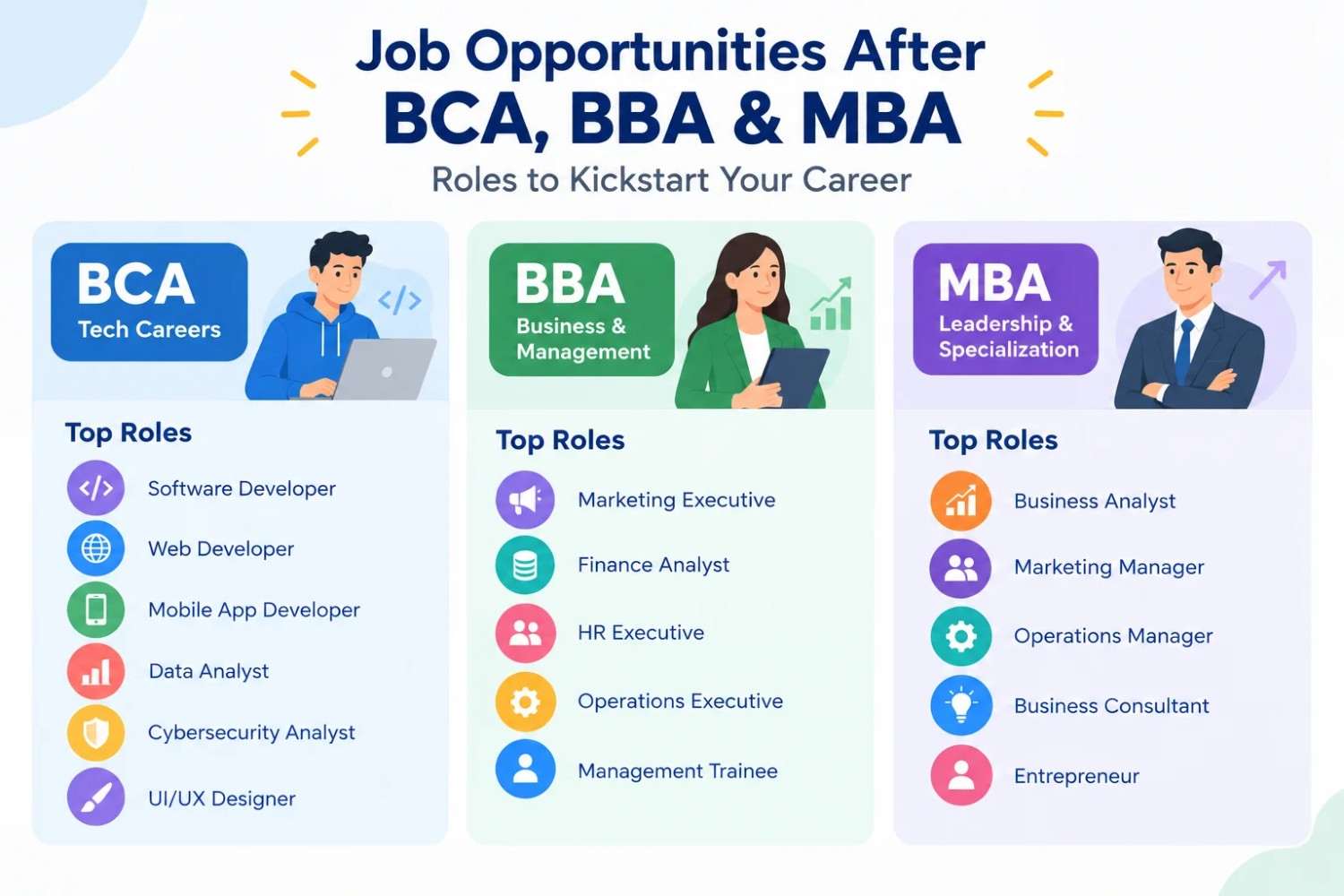










 ROI Calculator



