MECE Full Form: Mutually Exclusive, Collectively Exhaustive
Why the MECE Framework Matters in Problem-Solving
How to Apply the MECE Framework: Step by Step
Key Insights
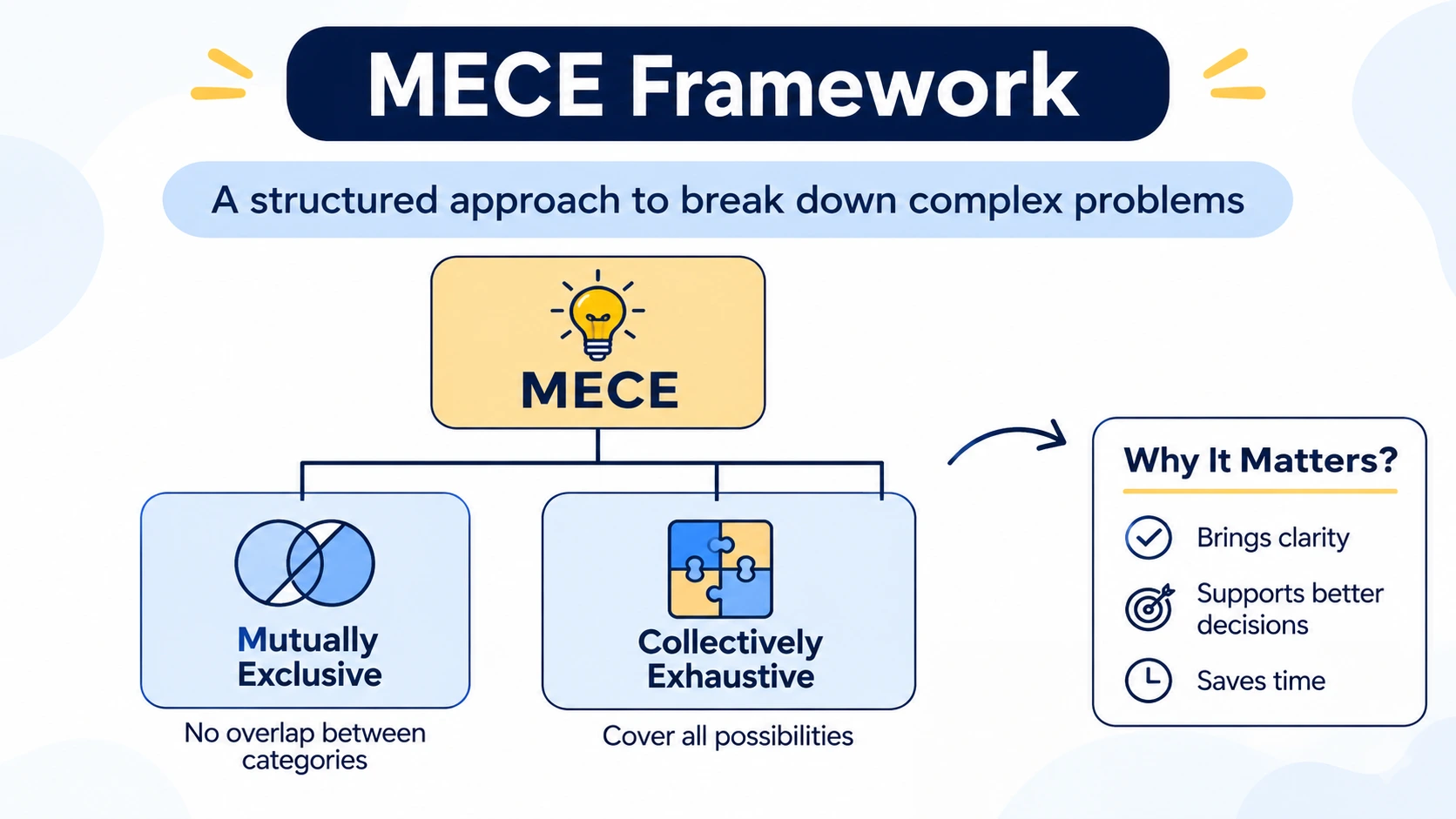
The MECE framework stands for Mutually Exclusive, Collectively Exhaustive, ensuring that categories do not overlap and cover all relevant possibilities.
It brings structure to complex problems, reduces confusion, prevents blind spots, saves time, and supports better decision-making.
Applying MECE involves defining the problem, choosing a logical structure, creating categories, checking for overlaps and gaps, and prioritising actions.
Common MECE structures include formulas, processes, time periods, segments, binary choices, and internal versus external factors.
In this blog, you'll learn the MECE meaning and full form, its importance in problem-solving, practical examples, application steps, common structures, benefits, limitations, and everyday uses.
Every workplace faces problems that look messy at first: falling sales, rising costs, slow delivery, unhappy customers. The real challenge is rarely a lack of effort. It is a lack of structure. When a problem is broken down clearly, solutions become easier to find. This is where the MECE framework helps. Managers, consultants, analysts, and students use it to organize their thinking and avoid confusion. Professionals who want to build this kind of structured thinking, such as those exploring theCertificate in Strategic Management from IIM Kozhikode, often meet MECE early in their learning. This blog explains what it is, how it works, and how you can use it with confidence.
To understand the MECE meaning, think of sorting a pile of papers. If you create folders, each paper should fit into exactly one folder, and no paper should be left without a home. That is the core idea.
MECE is a way of dividing a problem, topic, or set of ideas into groups that do not overlap and do not leave anything out. It is pronounced “mee-see.” The approach was popularized by Barbara Minto, a former consultant at McKinsey & Company, and it has since become a standard tool in consulting, business analysis, and strategic planning.
In simple terms, MECE gives you two checks:
No overlap. Each item belongs to only one group.
No gaps. Together, the groups cover everything that matters.
When both checks are met, your structure is clean, complete, and easy to explain.
MECE Full Form: Mutually Exclusive, Collectively Exhaustive
The MECE full form is “Mutually Exclusive, Collectively Exhaustive.” The two parts can sound technical, but each is easy to grasp.
Mutually Exclusive
Mutually exclusive means the categories do not overlap. If one item fits in one category, it cannot also fit in another. For example, if you divide customers by age group (under 25, 25 to 40, over 40), a 30-year-old belongs only to the middle group. There is no double counting.
Collectively Exhaustive
Collectively exhaustive means the categories together cover every possibility. Nothing is missing. In the same example, every customer, whatever their age, falls into one of the three groups. If you had left out the “over 40” group, the structure would be incomplete, because some customers would have no place.
A structure needs both qualities to be truly MECE. Having only one is a common source of weak analysis.
Why the MECE Framework Matters in Problem-Solving
The MECE framework is valued because it brings order to complexity. Here is why it matters.
It prevents confusion. When groups overlap, teams argue about where a point belongs. When groups are clearly separate, discussions stay focused.
It reduces blind spots. Because the groups must cover everything, you are pushed to ask what you might be missing. This leads to more complete analysis.
It saves time. A clean structure shows you where to dig deeper. You can test one branch at a time instead of chasing scattered ideas.
It improves communication. Leaders and clients appreciate answers that are organized and logical. A MECE structure makes your reasoning easy to follow.
It supports better decisions. When every factor is visible and no factor is counted twice, comparisons are fairer and conclusions are stronger.
How to Apply the MECE Framework: Step by Step
Using the MECE framework does not require special software. A pen, paper, and a clear mind are enough. Follow these steps.
Step 1: Define the Problem Clearly
Start with a precise question. “How do we fix our business?” is too broad. “Why did our monthly revenue fall by 15 percent?” is specific and measurable. A clear problem statement makes the next steps easier.
Step 2: Choose a Logical Way to Divide the Problem
Pick a principle for splitting the problem. You might divide by time, location, product, customer type, process stage, or a formula. Use one principle at a time. Mixing principles within the same level is the most common reason structures fail.
Step 3: Break the Problem into Main Categories
List the main branches. Check that each one is separate from the others and that, together, they cover the whole problem.
Step 4: Test for Overlap and Gaps
Ask two questions. First, “Can any item fit in more than one category?” If yes, redefine the categories. Second, “Is there anything that fits in none of them?” If yes, add a category or widen one.
Step 5: Go Deeper Where Needed
Break each main category into smaller parts, again checking for overlap and gaps. Stop when the pieces are small enough to analyze or act on.
Step 6: Prioritize and Act
Once the structure is ready, gather data, find which branches matter most, and focus your effort there. The structure guides the work; it does not replace it.
MECE Framework Examples You Can Relate To
Examples make the idea clearer. Here are three simple ones.
Example 1: Falling Profits
A company sees profits drop. Using a formula-based approach, you can divide the problem like this:
Profit = Revenue − Costs
Revenue splits into price and volume.
Costs split into fixed costs and variable costs.
This structure is MECE because profit is fully explained by revenue and costs, and each of those is split without overlap. You can now test each branch with data.
Example 2: Low Website Traffic
A team wants to understand why visitors are declining. They can divide the causes by traffic source:organic search, paid advertising, social media, email, and direct visits. A final category, “other sources,” can be added so that the structure is collectively exhaustive. Each visitor arrives from only one primary source, so categories do not overlap.
Example 3: Employee Turnover
To study why people leave, a manager might group reasons into compensation, career growth, work environment, management quality, and personal or external reasons. If a reason such as “workload” could belong to both work environment and management quality, the manager should define the categories more sharply so each reason sits in one place.
Common MECE Structures and Where to Use Them
You do not need to invent a new structure every time. Several proven patterns are widely used. The table below shows some of them.
Structure
How It Divides the Problem
Best Used For
Formula or equation
Breaks a result into mathematical parts, such as profit = revenue − costs
Financial and performance problems
Process or value chain
Follows steps in order, such as plan, build, sell, deliver
Operational and efficiency problems
Time
Splits by past, present, and future, or by months or quarters
Trend analysis and planning
Segments
Divides by customer type, region, product, or channel
Market and sales analysis
Yes or no (binary)
Splits into two opposite options
Quick decisions and diagnostics
Internal and external
Separates factors inside the organization from those outside
Strategy and risk assessment
Choosing the right structure depends on your problem. When one pattern does not fit, try another until the split feels natural and complete.
Seeing a bad example helps. Suppose you want to categorize reasons for missed deadlines.
A non-MECE list might read: “Poor planning, team issues, too much work, lack of resources, and delays.” The items overlap, since “too much work” and “lack of resources” are closely linked, and “delays” is the problem itself, not a cause.
A MECE list might read: “Planning issues, people issues, process issues, tools and resources issues, and external factors.” Each cause fits one group, and together they cover the main possibilities.
The second list is cleaner, easier to investigate, and easier to explain to others.
Tips to Use the MECE Framework in Daily Work
The MECE framework is not only for consultants. You can use it in everyday tasks.
Planning projects. Break the project into phases or workstreams that do not overlap.
Writing reports. Organize sections so each covers a distinct point, and together they answer the full question.
Making presentations. Use MECE groups to keep slides logical and easy to follow.
Solving team issues. List causes in clear categories before deciding on action.
Preparing for interviews. Case interviews, in particular, reward candidates who structure their answers in a MECE way.
A good habit is to pause before listing ideas and ask, “Are these groups separate, and have I covered everything?” With practice, this becomes second nature.
Benefits and Limitations of the MECE Framework
The framework has clear strengths, but it is not perfect.
Problem-solvingbecomes easier when thinking is structured. The MECE framework offers a simple way to do this: divide the problem into parts that do not overlap and that together cover everything. By learning the MECE meaning and its full form, and by practicing the steps outlined above, you can bring order to even the most tangled challenges.
Start small. Take a problem from your own work, choose a logical way to divide it, and test your groups for overlaps and gaps. Over time, you will find that your reports, decisions, and conversations become clearer and more convincing. That clarity is what makes MECE one of the most trusted tools in business problem-solving.
Frequently Asked Questions
The MECE full form is Mutually Exclusive, Collectively Exhaustive. It means that categories should not overlap with each other and, together, should cover every possible item or cause.
The MECE principle is widely credited to Barbara Minto, who developed it while working at McKinsey & Company. It later became a standard approach in management consulting and business analysis.
Yes. MECE is useful anywhere clear thinking is needed, including academic writing, project planning, research, personal decision-making, and exam preparation. Its logic of “no overlap, no gaps” applies to almost any structured task.
Not always. In real situations, information may be incomplete or categories may be linked. The goal is to get as close to MECE as possible and to make the structure useful. Adding an “other” category often helps keep the list complete.
Nuthana Reddy
Nuthana Reddy is a Senior Manager at Procter & Gamble, specializing in operations, digitization, and cross-functional leadership. She has driven multimillion-dollar impact through innovation, process optimization, and strategic execution across global markets.
Get Free Upskilling Guidance
Fill in the details for a free consultation
Related Courses
Explore our programs
Professional Certificate Programme in Strategic Management

 November 18, 2026
 7 min read





 Key Insights
 ChatGPT
 Perplexity
 Claude
 Grok











 ROI Calculator