 HOME > BLOG > Business Analytics > Difference Between Correlation and Regression: Key Differences & Examples
Difference Between Correlation and Regression: Key Differences & Examples
 September 23, 2026
 7 min read





Table Of Content
- What is Correlation?
- What is Regression?
- Difference Between Correlation and Regression: The Core Idea
- Difference Between Correlation Analysis and Regression Analysis
 Key Insights
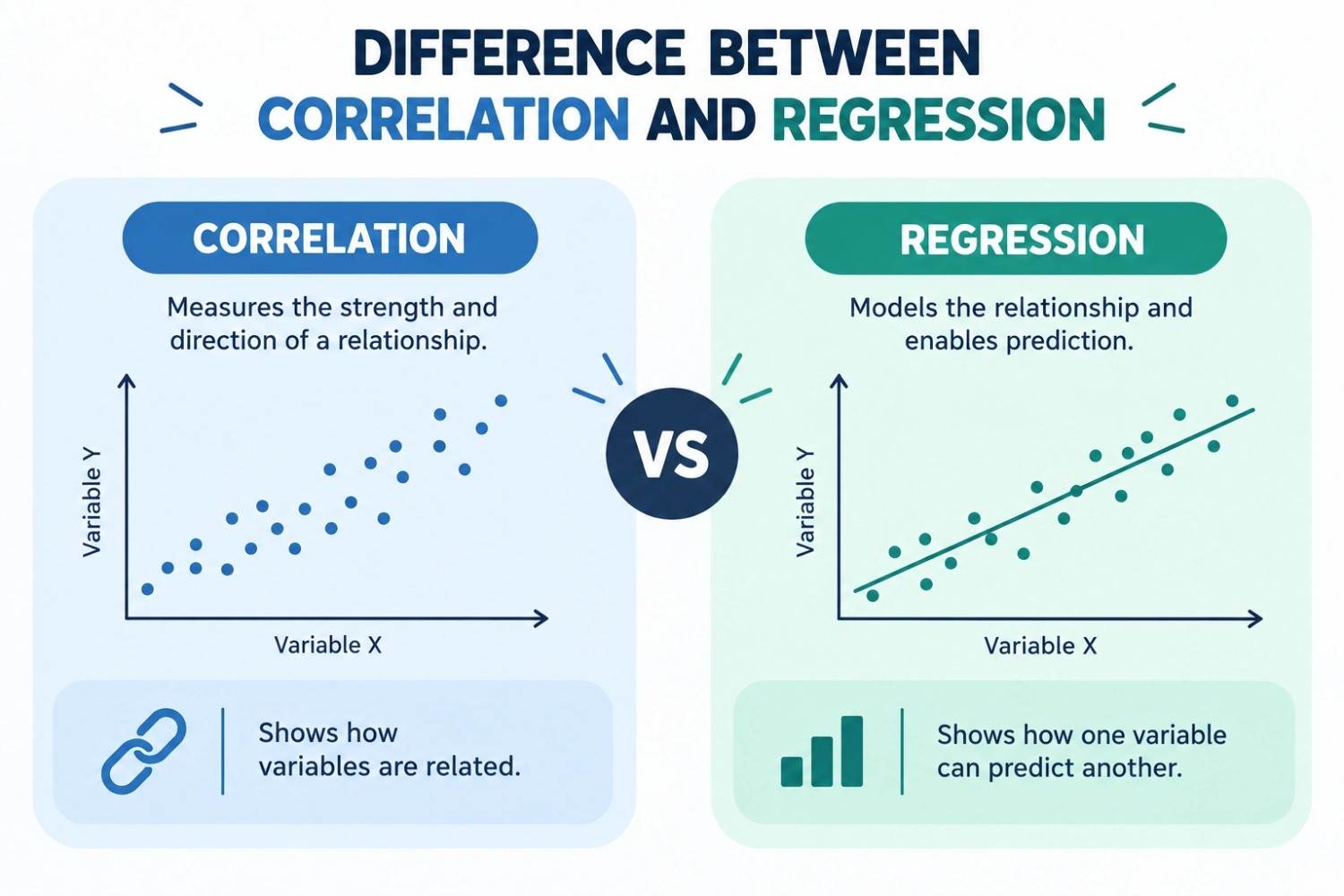
- Correlation measures the strength and direction of the relationship between two variables, while regression models how one variable changes in response to another and enables prediction.
- Correlation analysis is primarily exploratory and treats variables symmetrically, whereas regression analysis identifies dependent and independent variables and produces an equation that can be used for forecasting.
- Correlation and regression both examine relationships using quantitative data, are sensitive to outliers, and, in their basic forms, work best when relationships are approximately linear.
- Correlation often supports regression analysis by helping analysts first assess whether a meaningful relationship exists before developing a predictive model.
- Confusing correlation with regression can lead to misleading assumptions about prediction or causation, as an observed relationship between variables does not necessarily mean that one causes the other.
- In this blog, you'll learn the key differences and similarities between correlation and regression, how the two methods are related, their analytical purposes, and how they can be applied through practical examples.
Correlation and regression are two widely used statistical techniques that help us understand relationships between variables. While they may seem similar at first, they answer different questions. The difference between correlation and regression mainly lies in their purpose: correlation measures the strength and direction of a relationship, while regression examines how one variable can help explain or predict another. Understanding the difference between correlation analysis and regression analysis is especially useful when working with business, research, finance, marketing, or data analytics.
At the same time, there are important similarities between correlation and regression, as both involve studying relationships between variables and identifying patterns in data. To clearly distinguish between correlation and regression, it helps to understand how each technique works and when it should be applied.
This blog explores the relationship between correlation and regression, their key differences, similarities, and practical examples in a simple and easy-to-understand way.
 ChatGPT
 Perplexity
 Claude
 Grok
GrokWhat is Correlation?
Correlation is a statistical measure that describes the extent to which two variables move in relation to one another. It indicates whether a relationship exists between variables, and if so, the strength and direction of that relationship.
For instance, consider the relationship between temperature and ice cream sales. As temperature increases, ice cream sales tend to rise as well; this is referred to as a positive correlation. Conversely, when temperature decreases, sales of items such as hot beverages may increase, reflecting a negative correlation.
Correlation is quantified using the correlation coefficient (r), which ranges from -1 to +1:
- +1 indicates a perfect positive relationship
- -1 indicates a perfect negative relationship
- 0 indicates no relationship at all
It is important to note that correlation only identifies the existence and strength of a relationship. It does not explain the underlying cause, nor does it allow for precise prediction of future values.
What is Regression?
Regression extends beyond correlation by modelling the relationship between variables in a way that allows for prediction. In regression analysis, one variable is designated as the dependent variable (the outcome being studied), while the other is treated as the independent variable (the factor believed to influence the outcome).
Returning to the earlier example, if the objective is to predict the exact number of ice creams likely to be sold at a temperature of 35°C, regression analysis would be the appropriate method. Regression produces a mathematical equation, commonly referred to as the line of best fit, expressed as:
Sales = a + b(Temperature)
This equation enables analysts to input a specific temperature value and obtain a corresponding predicted sales figure. The defining feature of regression, therefore, is its predictive capability, as opposed to mere observation.





Difference Between Correlation and Regression: The Core Idea
At its core, the difference between correlation and regression can be summarized as follows:
- Correlation determines whether two variables are related and the strength of that relationship.
- Regression determines how one variable changes in response to another and enables prediction of future outcomes.
Correlation may be understood as identifying a pattern. For example, observing that delays consistently occur during periods of rainfall. Regression, by contrast, quantifies this relationship precisely, such as determining that for every 10mm of rainfall, a delay of approximately eight minutes can be expected, thereby allowing for a specific prediction in future instances.
Difference Between Correlation Analysis and Regression Analysis
When examined as complete analytical processes rather than isolated statistical values, the difference between correlation analysis and regression analysis becomes more apparent.
Correlation analysis is primarily exploratory. It is typically the initial step undertaken to determine whether variables warrant further investigation. It does not assume that one variable causes changes in another; both variables are treated symmetrically, without designation as dependent or independent.
Regression analysis, in contrast, is more structured and objective-driven. It assumes a directional relationship between variables (while acknowledging that correlation does not imply causation) and constructs a model to quantify this relationship. It requires the explicit identification of dependent and independent variables, and its output is a usable equation for forecasting purposes.
In essence, correlation analysis addresses the question of whether a relationship exists, while regression analysis addresses how that relationship functions and what can be predicted from it.
How to Distinguish Between Correlation and Regression
To further distinguish between correlation and regression, the following comparison outlines the key distinctions:
| Aspect | Correlation | Regression |
| Purpose | Measures strength and direction of relationship | Predicts the value of one variable based on another |
| Variables | No distinction between dependent and independent | Clearly defines dependent and independent variables |
| Output | A single coefficient value | A mathematical equation (regression line) |
| Causation | Does not imply causation | Often used to estimate directional impact |
| Range | Between -1 and +1 | No fixed range; dependent on the data |
| Symmetry | Symmetric (correlation of X,Y equals Y,X) | Not symmetric (regression of Y on X differs from X on Y) |
| Application | Identifying whether a relationship exists | Forecasting and estimating outcomes |
This comparison provides a practical framework for understanding how to distinguish between correlation and regression in applied contexts. While one identifies the presence of a relationship, the other models and applies it.
Similarities Between Correlation and Regression
Despite their distinct purposes, there are notable similarities between correlation and regression that account for their frequent association.
- Both measure relationships: Each method is fundamentally concerned with understanding how variables relate to one another.
- Both require quantitative data: Correlation and regression both depend on numerical, measurable data for accurate analysis.
- Both are mathematically connected: In simple linear regression, the square of the correlation coefficient (r²), known as the coefficient of determination, indicates the proportion of variation in the dependent variable that is explained by the independent variable.
- Both are sensitive to outliers: Extreme data points can significantly distort both the correlation coefficient and the regression line, potentially leading to inaccurate conclusions.
- Both assume linearity in their basic forms: Simple correlation and simple linear regression are most effective when the relationship between variables approximates a straight line. More complex relationships require advanced statistical techniques.
Relation Between Correlation and Regression
There is a well-established relation between correlation and regression that connects the two methods mathematically and procedurally.
Regression analysis often begins with an assessment of correlation. Before constructing a regression model, analysts typically evaluate the correlation coefficient to determine whether a predictive model is warranted. If two variables exhibit minimal correlation, constructing a regression model is unlikely to yield reliable predictions.
Mathematically, the slope of a regression line is derived using the correlation coefficient in conjunction with the standard deviations of the two variables. Correlation therefore serves as a foundational component that informs and supports regression analysis.
In this sense, correlation identifies the presence of a relationship, while regression develops and applies that relationship in a structured, predictive framework.
Illustrative Example
Consider a company seeking to understand the relationship between advertising expenditure and sales revenue.
- Step 1 (Correlation): The correlation coefficient is calculated and found to be r = 0.85, indicating a strong positive relationship between advertising spend and sales.
- Step 2 (Regression): A regression model is then developed: Sales = 5000 + 12(Ad Spend). This equation indicates that for every additional unit of currency spent on advertising, sales are expected to increase by approximately 12 units, starting from a baseline of 5000.
This example demonstrates the logical progression from correlation to regression within a practical business context.
Significance of the Distinction
Understanding this distinction carries practical importance beyond theoretical interest. Mistaking correlation for regression may lead to erroneous assumptions about predictive capability when only an observed pattern actually exists. This underscores the well-known principle that correlation does not imply causation. For example, the simultaneous rise in ice cream sales and shark attacks during summer months does not indicate a causal relationship between the two; both are influenced by a third factor, namely seasonal temperature. Regression models built on such coincidental correlations, without appropriate scrutiny, may produce misleading predictions.
Conclusion
Correlation and regression are closely connected statistical concepts, but they serve different purposes. Understanding the difference between correlation and regression can help you choose the right technique for a particular data analysis problem. Correlation focuses on identifying the strength and direction of association between variables, whereas regression studies the relationship in a way that can support explanation and prediction. This is also the fundamental difference between correlation analysis and regression analysis. Despite these differences, the similarities between correlation and regression make them useful together when exploring patterns and relationships within data.
Learning to distinguish between correlation and regression becomes easier when you look at their objectives, variables, outputs, and practical applications side by side. Ultimately, understanding the relation between correlation and regression provides a stronger foundation for statistical analysis and can help learners interpret data more confidently and apply these techniques appropriately in academic, business, and real-world situations.
Frequently Asked Questions
No, they are not the same. Correlation measures the strength and direction of a relationship between two variables, whereas regression models that relationship through an equation to enable prediction.
Neither method holds greater significance in isolation, as each serves a different analytical purpose. Correlation is useful for preliminary assessment of relationships, while regression is essential for forecasting and quantifying the specific impact of one variable on another.

Related Courses
Explore our programs




Find a Program made just for YOU
We'll help you find the right fit for your solution. Let's get you connected with the perfect solution.
Is Your Upskilling Effort worth it?
 ROI Calculator

Are Your Skills Meeting Job Demands?
Try our Skill Gap tool
Experience Lifelong Learning and Connect with Like-minded Professionals
Explore Jaro Connect

