HOME > BLOG > Online MBA > MBA at 40 in India: What Actually Makes Sense for Mid-Career Professionals (2026)
Online MBA
MBA at 40 in India: What Actually Makes Sense for Mid-Career Professionals (2026)
J
By Manya Tohani
August 8, 20267 min read
Published on August 8, 2026
SHARE THIS ARTICLE
Table Of Content
Is an MBA After 40 Worth It?
Why More Indian Professionals Are Pursuing an MBA After 40
What Makes an MBA Different at 40?
Common Career Goals Behind an MBA After 40
For many professionals, turning 40 brings a new phase of career reflection. After spending nearly two decades building technical expertise, managing teams, and delivering business results, the next question often becomes: What's the next step? For some, it's moving into senior leadership. For others, it's launching a business, switching industries, or preparing for executive roles.
This is where the idea of pursuing an MBA after 40 comes into the picture. Contrary to the common misconception that an MBA is only for young professionals, many experienced executives in India are enrolling in MBA programmes to sharpen their strategic thinking, strengthen leadership skills, and stay competitive in a rapidly changing business environment.
In 2026, flexible learning formats such as Online MBAs, Executive MBAs, and blended programmes have made higher education more accessible than ever. Rather than being a career restart, an MBA after 40 is often a strategic investment that builds upon years of professional experience.
This guide explores whether pursuing an MBA after 40 is worthwhile, which programme formats make the most sense, the career benefits you can expect, and how to choose the right option.
The short answer is yes—but only if you have a clear objective.
An MBA should not be pursued simply because it is another qualification. At this stage of your career, the focus should be on solving a specific challenge or achieving a long-term professional goal.
Many professionals over 40 pursue an MBA to:
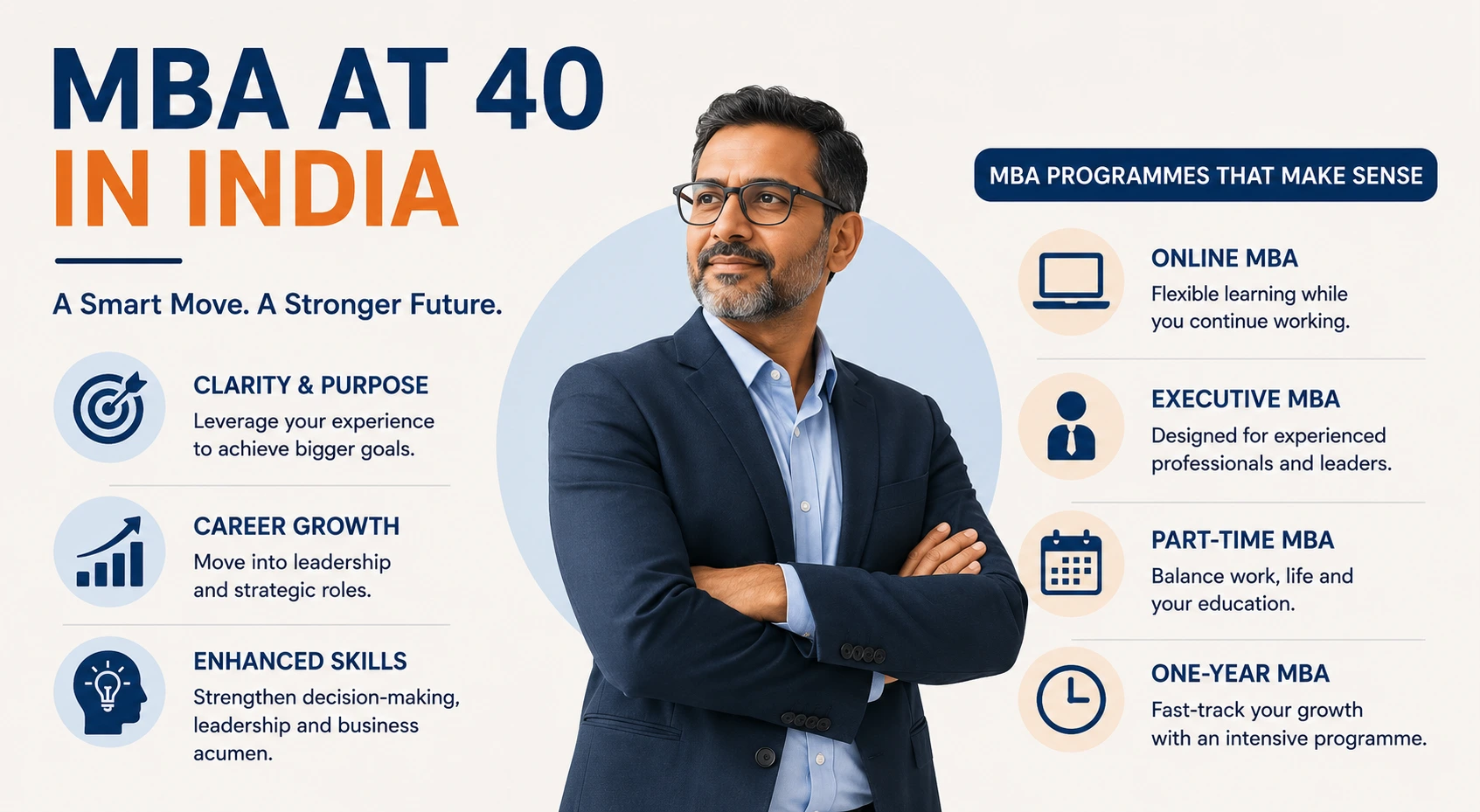
Move into senior leadership or executive management
Gain expertise in emerging business areas such as digital transformation and business analytics
Stay relevant in an increasingly competitive job market
Unlike younger students, mid-career professionals bring years of practical experience into the classroom. They understand organisational dynamics, business challenges, customer expectations, and team leadership, making MBA learning more practical and immediately applicable.
Why More Indian Professionals Are Pursuing an MBA After 40
The Indian workplace has evolved significantly over the last decade. Promotions are no longer based solely on experience. Organisations increasingly expect leaders to possess strong business acumen, financial understanding, digital awareness, and cross-functional management skills.
Professionals who have spent years in engineering, IT, healthcare, manufacturing, banking, telecom, logistics, or government often realise that technical expertise alone may not be enough for executive-level responsibilities.
An MBA after 40 helps bridge this gap by introducing structured learning in areas such as strategic management, finance, marketing, operations, innovation, leadership, and organisational behaviour.
Additionally, India’s growing startup ecosystem and digital economy have encouraged many experienced professionals to explore entrepreneurship, making business education even more relevant.
What Makes an MBA Different at 40?
Pursuing an MBA at 40 is very different from pursuing one in your twenties.
Professionals at this stage usually have a deeper understanding of workplace realities. Instead of learning business concepts theoretically, they relate every topic to real-life experiences, making classroom discussions richer and more insightful.
For example, a manufacturing manager studying supply chain strategy has already dealt with procurement challenges and vendor negotiations. A healthcare administrator understands operational bottlenecks, while an IT delivery manager can immediately apply lessons on project management and digital transformation.
Learning becomes less about memorising frameworks and more about solving complex business problems.
Career priorities often shift significantly after two decades of professional experience.
Instead of searching for entry-level management roles, professionals are generally focused on expanding their leadership responsibilities.
Many pursue an MBA to prepare for positions such as:
Business Head
General Manager
Director
Vice President
Chief Operating Officer
Chief Executive Officer
Others choose an MBA to diversify into consulting or start their own ventures, using their industry expertise combined with structured business knowledge.
For professionals nearing senior leadership, an MBA can also improve confidence when participating in board-level discussions involving budgeting, strategy, mergers, digital transformation, and long-term business planning.
Which MBA Programme Makes the Most Sense After 40?
Choosing the right programme matters more than choosing the most famous institution. The ideal option depends on your career stage, schedule, and learning objectives.
Online MBA
The Online MBA has become one of the most practical choices for mid-career professionals.
It allows learners to continue working while attending live online classes, accessing recorded lectures, completing assignments digitally, and interacting with faculty and peers remotely.
This flexibility makes it particularly suitable for professionals managing work responsibilities, family commitments, and travel schedules.
Executive MBA
Executive MBAprogrammes are specifically designed for experienced professionals with substantial work experience.
The curriculum focuses heavily on leadership, strategic decision-making, innovation, business transformation, and executive communication.
Participants often learn alongside senior managers, entrepreneurs, and business leaders, creating valuable networking opportunities.
For professionals aiming to accelerate into executive leadership, this remains one of the strongest options.
Part-Time MBA
Professionals who prefer classroom interaction without leaving their jobs may considerpart-time MBAprogrammes.
Weekend or evening classes allow working professionals to continue earning while pursuing higher education.
Although these programmes require greater time commitment, they offer face-to-face learning and peer interaction.
One-Year MBA
For professionals who can afford to take a career break, one-year MBA programmes offer an accelerated learning experience.
These intensive programmes are designed to compress management education into a shorter duration while maintaining academic rigor.
They are ideal for professionals seeking rapid career transitions.
Selecting an appropriate specialisation becomes especially important when pursuing an MBA after 40.
The programme should complement your future ambitions rather than simply reflecting your previous experience.
Some of the most valuable specialisations in 2026 include:
Business Analytics
Businesses increasingly rely on data-driven decision-making. This specialisation is useful for professionals leading digital initiatives or managing business intelligence functions.
Finance
Suitable for professionals moving into financial leadership, investment management, corporate finance, or strategic planning.
Marketing
An excellent choice for professionals interested in customer strategy, brand management, product marketing, and digital growth.
Operations and Supply Chain
Highly relevant for manufacturing, logistics, infrastructure, healthcare, and e-commerce professionals.
One of the biggest advantages of pursuing an MBA later in your career is that every concept has immediate workplace relevance.
Throughout the programme, professionals typically strengthen skills such as strategic thinking, financial planning, organisational leadership, business communication, negotiation, innovation management, risk assessment, and digital transformation.
These competencies become increasingly important for professionals overseeing larger teams, managing budgets, driving organisational change, and participating in long-term business planning.
An MBA also enhances confidence in interacting with senior stakeholders, investors, clients, and board members.
Balancing Work, Family, and Studies
One of the biggest concerns surrounding an MBA after 40 is managing multiple responsibilities.
At this stage of life, professionals are often balancing demanding careers, family obligations, children’s education, financial commitments, and personal responsibilities.
Flexible schedules, weekend sessions, recorded lectures, mobile learning platforms, and digital assessments allow professionals to study without taking extended career breaks.
Success depends largely on consistency rather than long study hours.
Creating a realistic weekly study plan, involving family members in scheduling, and maintaining discipline can make the learning journey manageable.
Can an MBA After 40 Increase Your Salary?
Salary growth is one of the most common reasons professionals consider an MBA, but expectations should remain realistic.
An MBA does not automatically guarantee a promotion or immediate salary increase.
Instead, it enhances your ability to qualify for higher-value roles requiring strategic leadership and business management expertise.
Professionals who transition into leadership positions often experience improved compensation over time because they become responsible for larger teams, broader business functions, and organisational strategy.
In many cases, the greatest return comes not from the degree itself but from the opportunities it unlocks.
The Importance of Networking
Networking becomes even more valuable during mid-career.
MBA classrooms typically include professionals from industries such as information technology, banking, healthcare, manufacturing, consulting, retail, logistics, energy, and government.
These diverse interactions expose learners to new perspectives, industry best practices, leadership styles, and business opportunities.
Many professionals discover consulting assignments, startup partnerships, mentoring relationships, and senior-level career opportunities through their MBA network.
The relationships developed often continue to deliver value long after graduation.
Challenges to Consider Before Enrolling
While an MBA after 40 offers numerous advantages, professionals should also evaluate the challenges honestly.
Time management remains one of the biggest obstacles. Work deadlines, business travel, family responsibilities, and academic commitments can create pressure if not planned carefully.
Another consideration is return on investment. Programme fees should be weighed against career goals rather than prestige alone. Choosing a curriculum that aligns with your ambitions is generally more valuable than selecting a programme based solely on rankings.
Finally, professionals should be prepared to embrace continuous learning. Today’s MBA curriculum increasingly includes emerging topics such as artificial intelligence, sustainability, digital transformation, business analytics, and innovation management.
How to Choose the Right MBA After 40
Before applying, evaluate every programme thoroughly.
Consider factors such as accreditation, curriculum relevance, faculty expertise, flexibility, industry exposure, alumni network, learning technology, peer profile, and overall value for money.
It is also helpful to speak with alumni who pursued the programme while working full-time. Their experiences can provide practical insights into workload, networking opportunities, and career outcomes.
Most importantly, ensure that the MBA supports your long-term objectives rather than becoming just another qualification on your résumé.
Final Thoughts
Pursuing an MBA after 40 is no longer an unconventional decision—it is an increasingly strategic move for professionals who want to remain relevant, competitive, and prepared for leadership in a rapidly changing business landscape. With nearly two decades of work experience behind them, mid-career professionals are well-positioned to extract maximum value from management education by connecting classroom learning with real-world challenges.
Whether your goal is to step into senior management, transition into a new industry, launch your own business, or strengthen your leadership capabilities, the right MBA programme can help you achieve it. The key lies in choosing a format that fits your lifestyle, selecting a specialisation aligned with your aspirations, and approaching the programme as a long-term investment in your career rather than a short-term credential. In 2026, an MBA after 40 is less about changing your career and more about elevating it.
Frequently Asked Questions
Yes. An MBA after 40 can be highly beneficial if your goal is to move into senior leadership, switch careers, start a business, or develop strategic management skills. The value depends on selecting the right programme aligned with your career objectives.
Online MBA and Executive MBA programmes are generally the most suitable because they offer flexibility for working professionals while focusing on leadership, strategy, and business management.
Absolutely. Many universities offer flexible Online and Executive MBA programmes with weekend classes, live sessions, recorded lectures, and digital learning platforms, allowing professionals to balance work and studies effectively.
An MBA does not guarantee an immediate salary increase, but it can improve your chances of moving into higher-paying managerial and leadership roles. Salary growth depends on your experience, industry, skills, employer, and the role you transition into after completing the programme.
Popular choices include Business Analytics, Strategy, Finance, Marketing, Operations & Supply Chain, Human Resource Management, and Digital Transformation. The ideal specialisation should align with your future career goals rather than your current role.
Manya Tohani
Personal Growth Mentor
Manya Tohani is a Personal Growth Mentor and content strategist, helping individuals build strong personal brands and accelerate career growth. With 8M+ impressions and experience mentoring students, she empowers others through actionable guidance, resilience, and real-world insights.
 HOME > BLOG > Online MBA > MBA at 40 in India: What Actually Makes Sense for Mid-Career Professionals (2026)
 August 8, 2026
 7 min read





 ChatGPT
 Perplexity
 Claude
 Grok
Grok








 ROI Calculator