Organisations frequently operate under constraints such as limited budgets, restricted time, and finite resources. The real challenge lies in selecting the best possible course of action while balancing these limitations. Whether the aim is to increase revenue, lower expenses, improve operational efficiency, or make better use of available capacity, structured decision-making becomes essential.
Linear programming offers a systematic way to tackle such optimisation challenges. It enables decision-makers to evaluate multiple variables and constraints simultaneously, making it easier to identify the most effective allocation of resources. Businesses often use linear programming to streamline production planning, optimise logistics networks, manage workforce schedules, and support data-driven strategic planning.
If you are exploring what is linear programming, looking to understand how the linear programming simplex method operates, or wanting clarity on how linear programming problems are solved in real-world contexts, this guide provides a clear and practical explanation in an easy conversational tone.
Linear programming is a mathematical technique used to identify the optimal solution within a model that contains linear relationships. It helps maximise or minimise a specific objective, such as profit, cost, or output, while considering various constraints like time, budget, or resource availability.
In simple terms, linear programming helps answer questions like:
How can a company maximise profit using limited resources?
What is the most cost-effective way to manufacture products?
How should a business allocate budget across different channels?
What combination of variables produces the best result?
Linear programming focuses on optimising an objective function while satisfying a set of constraints.
Key Idea
Linear programming solves problems where:
The objective is linear (for example, maximise profit)
Constraints are linear equations or inequalities
Decision variables are continuous values
For instance, a manufacturer may want to determine how many units of product A and product B to produce to maximise profits while considering labour and material constraints.
To understand what is linear programming, it is important to break down its key components.
1. Decision Variables
Decision variables represent the quantities we want to determine.
Example: Let: x = number of units of product A y = number of units of product B
These variables help define the solution.
2. Objective Function
The objective function defines what needs to be optimised — either maximised or minimised.
Example:
Maximise: Z = 40x + 30y
Here, Z represents the total profit. This means each unit of product A contributes ₹40 towards profit, while each unit of product B contributes ₹30. The goal of linear programming is to determine the values of x and y that maximise the value of Z, while satisfying all given constraints.
3. Constraints
Constraints represent limitations such as budget, labour, raw materials, or time.
Example:
2x + y ≤ 100 (labour constraint) x + 3y ≤ 90 (material constraint)
Constraints ensure the solution is realistic and feasible.
4. Non-negativity Restriction
Decision variables cannot be negative.
x ≥ 0 y ≥ 0
Negative production quantities do not make practical sense.
Why is Linear Programming Important?
Linear programming is widely used because it helps organisations make optimal decisions using limited resources.
Benefits of Linear Programming
Improves efficiency in resource allocation
Helps maximise profit or minimise cost
Supports strategic planning
Enables data-driven decision making
Simplifies complex decision problems
Provides clear quantitative solutions
Professionals in operations, supply chain, finance, analytics, and engineering frequently rely on linear programming problems to optimise performance.
Assumptions of Linear Programming
Linear programming models operate under certain assumptions:
1. Proportionality
The contribution of each decision variable is directly proportional to its value.
2. Additivity
The total value of the objective function equals the sum of individual contributions.
3. Divisibility
Decision variables can take fractional values.
4. Certainty
All coefficients are known with certainty and remain constant.
Formulation of Linear Programming Problems
Formulating linear programming problems involves converting real-life scenarios into mathematical expressions.
Example Problem
A company produces two products: A and B.
Profit per unit:
Product A = ₹50 Product B = ₹70
Constraints:
Product A requires 2 hours of labour Product B requires 3 hours of labour
Total available labour = 120 hours
Material constraint:
Product A requires 4 units of material Product B requires 2 units of material
Total material available = 160 units
Step 1: Define Decision Variables
Let:
x = units of product A y = units of product B
Step 2: Objective Function
Maximise Profit:
Z = 50x + 70y
Step 3: Constraints
Labour constraint:
2x + 3y ≤ 120
Material constraint:
4x + 2y ≤ 160
Non-negativity constraint:
x ≥ 0 y ≥ 0
Methods to Solve Linear Programming Problems
There are different approaches used to solve linear programming problems depending on complexity.
1. Graphical Method
The graphical method is one of the simplest ways to solve linear programming problems involving two variables.
*Calcworkshop.com
Steps:
Plot constraints on a graph
Identify the feasible region
Find corner points
Evaluate the objective function
Select optimal value
The feasible region represents all possible solutions satisfying constraints.
The optimal solution lies at one of the vertices (corner points).
Advantages
Easy to understand
Visual representation
Suitable for small problems
Limitation
Cannot be used for more than two variables.
2. Simplex Method
The linear programming simplex method is a mathematical procedure used to solve complex problems involving multiple variables.
Developed by George Dantzig in 1947, the simplex method systematically evaluates feasible solutions until the optimal solution is found.
How the Simplex Method Works
The simplex method:
Converts inequalities into equations
Uses iterative calculations
Moves from one feasible solution to another
Improves the objective function value at each step
Stops when the optimal solution is reached
The simplex method is widely used in:
Logistics optimisation
Production planning
Financial modelling
Portfolio optimisation
3. Interior Point Method
The interior point method is another approach used to solve large-scale linear programming problems efficiently.
Unlike the simplex method, which moves along edges of the feasible region, the interior point method moves through interior points.
This method is often used in machine learning optimisation models.
Types of Linear Programming Problems
Understanding various types of linear programming problems helps in applying appropriate methods.
Linear programming is widely applied across industries.
1. Business and Finance
Companies use linear programming to:
Maximise profits
Minimise operational costs
Optimise investment portfolios
Allocate budgets
Example: Determining the best combination of products to maximise revenue.
2. Supply Chain Management
Logistics companies use linear programming to:
Optimise transportation routes
Minimise delivery time
Reduce fuel costs
Manage warehouse inventory
3. Manufacturing Industry
Manufacturers use linear programming to:
Optimise production schedules
Allocate labour efficiently
Reduce waste
Maximise output
4. Marketing Optimisation
Marketing teams use linear programming to:
Allocate advertising budget
Optimise campaign performance
Maximise ROI
5. Healthcare Industry
Hospitals use linear programming to:
Schedule staff shifts
Allocate medical resources
Optimise patient care systems
6. Agriculture Planning
Farmers use linear programming to:
Determine crop combinations
Maximise yield
Optimise fertiliser usage
Manage irrigation planning
Example of Linear Programming Problem
Let us consider a simple linear programming problem.
A company manufactures chairs and tables.
Profit:
Chair = ₹20 Table = ₹30
Constraints:
A chair requires 3 units of wood A table requires 5 units of wood
Total wood available = 90 units
Labour:
Chair requires 2 hours The table requires 4 hours
Total labour hours = 80
Step 1: Define variables
x = number of chairs y = number of tables
Step 2: Objective function
Maximise:
Z = 20x + 30y
Step 3: Constraints
3x + 5y ≤ 90 2x + 4y ≤ 80
x ≥ 0 y ≥ 0
Solving the above constraints using the graphical or simplex method gives the optimal solution at:
x = 20 chairs y = 6 tables
Maximum Profit:
Z = 20(20) + 30(6) Z = 400 + 180 Z = ₹580
Therefore, the company should produce 20 chairs and 6 tables to achieve the maximum profit of ₹580, while satisfying both wood and labour constraints.
Advantages of Linear Programming
Linear programming provides several advantages:
Helps with optimal decision-making
Improves resource utilisation
Reduces operational cost
Provides a structured mathematical approach
Useful in solving complex problems
Widely applicable across industries
Limitations of Linear Programming
Despite its advantages, linear programming has certain limitations.
1. Assumes Linear Relationships
Real-world relationships may not always be linear.
2. Requires Accurate Data
Incorrect data leads to incorrect results.
3. Ignores Qualitative Factors
Human behaviour and market uncertainty cannot always be quantified.
4. Complexity in Large Models
Large problems require advanced computational tools.
Linear Programming and Career Opportunities
Knowledge of linear programming is highly valuable for professionals working in:
Data analytics
Business analytics
Operations research
Supply chain management
Financial modelling
Artificial intelligence
Machine learning
As organisations increasingly rely on optimisation techniques, professionals with strong analytical and problem-solving skills are in high demand.
Many advanced management programmes now include optimisation techniques such as the linear programming simplex method to build decision-making expertise.
Tools Used for Solving Linear Programming Problems
Several software tools help solve linear programming problems efficiently.
Popular Tools & Libraries
Microsoft Excel Solver: Best for beginners and small-scale business problems.
Python (SciPy, PuLP, Pyomo): The standard for data scientists and developers.
MATLAB: Preferred in engineering and academic research for complex matrix calculations.
Gurobi/CPLEX: High-performance industrial solvers used for massive, multi-variable datasets.
R Programming (lpSolve): Frequently used for statistical optimization.
LINDO & SAS: Specialized tools for operations research and advanced analytics
These tools automate calculations and help solve large-scale problems quickly.
Difference Between Linear Programming and Non-Linear Programming
Here’s the difference between linear programming and non-linear programming
With the increasing use of AI, big data, and analytics, optimisation techniques such as linear programming continue to evolve.
Future applications include:
Smart cities optimisation
AI decision models
Energy optimisation
Automated logistics
Predictive resource allocation
As industries embrace digital transformation, understanding what is linear programming becomes increasingly important for professionals aiming to stay competitive.
Conclusion
Linear programming is one of the most powerful mathematical tools used for optimisation and decision-making. From business operations to artificial intelligence, its applications span multiple industries.
Understanding linear programming problems, learning the linear programming simplex method, and applying optimisation techniques can significantly improve strategic planning and operational efficiency.
Whether you are a student, analyst, or business professional, mastering linear programming can enhance your ability to solve complex problems and make smarter, data-driven decisions.
As organisations continue to rely on analytics-driven insights, linear programming remains a foundational concept that supports innovation, efficiency, and competitive advantage.
Frequently Asked Questions
Linear programming is a mathematical technique used to determine the best possible outcome, such as maximum profit or minimum cost, within given constraints. It helps individuals and organisations make optimal decisions by representing relationships through linear equations and inequalities.
Linear programming is widely used across industries, including finance, manufacturing, logistics, healthcare, agriculture, and marketing. Organisations use it to optimise resource allocation, reduce costs, improve operational efficiency, and make strategic decisions based on quantitative analysis.
Linear programming problems involve finding the optimal value of an objective function while satisfying a set of linear constraints. These problems typically aim to maximise or minimise a value such as profit, cost, or time, while considering limitations related to resources, labour, budget, or production capacity.
The linear programming simplex method is a commonly used mathematical procedure for solving optimisation problems that involve multiple variables and constraints. It works by evaluating different feasible solutions step-by-step and improving the result iteratively until the optimal solution is achieved.
The main components of linear programming include decision variables, which represent the unknown values to be determined; an objective function, which needs to be maximised or minimised; constraints, which define limitations; and non-negativity restrictions, which ensure that variable values remain positive or zero.
Shubham Lal
Lead Software Developer
Shubham Lal joined Microsoft in 2017 and brings 8 years of experience across Windows, Office 365, and Teams. He has mentored 5,000+ students, supported 15+ ed-techs, delivered 60+ keynotes including TEDx, and founded AI Linc, transforming learning in colleges and companies.
Get Free Upskilling Guidance
Fill in the details for a free consultation
Related Courses
Explore our programs
Admission Open
Post Graduate Certification Programme in Business Analytics & Artificial Intelligence (AI) Applications

 April 7, 2026
 7 min read





 ChatGPT
 Perplexity
 Claude
 Grok
Grok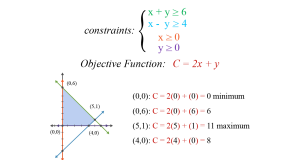






 Admission Open
 Admission Closed
 Admission Closed
 Admission Open
 ROI Calculator