 HOME > BLOG > Data Science and BI Analytics > Competitive Programming: What It Is, Courses, and Practice Questions
Competitive Programming: What It Is, Courses, and Practice Questions
 March 20, 2026
 9 min read





Table Of Content
- Understanding Competitive Programming
- The Challenges and Reality of Competitive Programming
- How to Get Started with Competitive Programming?
- Top Courses to Learn Competitive Programming
 ChatGPT
 Perplexity
 Claude
 Grok
GrokUnderstanding Competitive Programming
Competitive programming is a coding practice where programmers solve algorithm-based problems under time constraints to improve problem-solving and coding efficiency.
Imagine tackling intricate puzzles under pressure while competing against brilliant minds globally—that’s the essence of competitive programming. It’s a sport where programmers vie against time and each other to solve algorithmic challenges using code. Think of it as the Olympics for programmers: participants are presented with a set of complex problems, typically involving data structures, algorithms, and mathematical logic, and must devise efficient solutions within stringent time limits.
Competitive programming transforms coding from a solitary activity into a high-energy competition. Platforms like Codeforces, TopCoder, and LeetCode host contests ranging from hour-long sprints to multi-day marathons. What distinguishes this from regular programming? It’s the unique blend of speed, accuracy, and algorithmic thinking required. You’re not creating user interfaces or debugging production systems—you’re showcasing pure problem-solving skills. The appeal of competitive programming lies in its accessibility and meritocracy. Whether you’re a student exploring foundational programming concepts or a seasoned developer honing your skills, competitions welcome all levels. Success hinges on a deep understanding of fundamental concepts, quick pattern recognition, and efficient solution implementation—skills that translate remarkably well into software engineering careers and technical interviews.
The Challenges and Reality of Competitive Programming
While competitive coding offers incredible opportunities, it’s vital to understand what you’re committing to. The path isn’t always smooth—according to Wikipedia, most contests involve solving 5-8 algorithmic problems within a strict 2-5 hour timeframe, demanding intense focus and rapid problem-solving under pressure.
The learning curve is notably steep. Many beginners struggle with the transition from basic programming to optimizing solutions that can handle millions of inputs efficiently. You’ll face problems where a solution that works perfectly for small test cases crashes when scaling up—a frustrating reality that tests patience and persistence.
Time commitment presents another significant hurdle. Consistent practice requires dedicating 10-15 hours weekly minimum to see meaningful progress, which can feel overwhelming alongside academic or work responsibilities. Some problems might take days to solve, and plateaus in improvement are common, especially when advancing from beginner to intermediate levels.
However, understanding these challenges upfront helps you prepare mentally. On the other hand, thousands of programmers successfully navigate these obstacles by setting realistic expectations and maintaining steady practice habits. The key is recognizing that difficulty is part of the journey—not a sign to quit. With the right resources and technical courses focused on algorithms, you can systematically build the skills needed to overcome these challenges.
How to Get Started with Competitive Programming?
Embarking on online competitive programming doesn’t require a computer science degree—just curiosity and commitment. The foundation begins with mastering a single programming language; C++ remains the most popular choice due to its speed and extensive library support, though Python and Java work equally well for beginners.
Start by solidifying your data structures and algorithms knowledge—arrays, linked lists, stacks, queues, and basic sorting techniques form the bedrock. According to GeeksforGeeks’ comprehensive guide, understanding time complexity and space complexity analysis is non-negotiable; you’ll need to recognize when your solution will time out before even writing code.
Create accounts on beginner-friendly platforms like HackerRank, CodeChef, Codeforces, and tackle easy problems daily. Consistency beats intensity—solving two problems every day builds pattern recognition faster than marathon weekend sessions. Track your progress and don’t skip the editorial solutions; understanding why your approach failed teaches more than any tutorial. Consider exploring structured programming courses to accelerate your learning curve, especially if you’re transitioning from traditional development work. The journey feels overwhelming initially, but every accepted solution builds both skill and confidence toward competitive mastery.
Top Courses to Learn Competitive Programming
Structured learning accelerates your journey into coding competitions far faster than piecing together random tutorials. The right competitive programming course transforms scattered algorithm knowledge into a systematic competitive programming framework you can apply under pressure.
Foundational courses should cover data structures and algorithms comprehensively—topics like dynamic programming, graph theory, and advanced searching techniques. Platforms like Coursera and edX offer university-backed programs from institutions like Stanford and MIT that ground you in theoretical fundamentals while incorporating practical problem-solving. For hands-on preparation, contest-focused bootcamps deserve attention. These programs simulate real competition environments, teaching you time management strategies alongside algorithmic solutions. Many successful competitors credit dedicated training programs with helping them recognize pattern variations quickly—a skill that separates top performers from the rest.
Language-specific tracks matter too. If you’re committed to C++ or Java for competitions, specialized programming courses that emphasize performance optimization and standard library mastery prove invaluable. According to GeeksforGeeks’ competitive programming guide, understanding your chosen language’s nuances can shave precious seconds off execution time.
The investment pays dividends—structured courses provide mentor feedback, peer comparison, and progressive difficulty scaling that self-study often lacks.
Competitive Programming Questions and Resources
Mastering competitive programming demands consistent practice across diverse problem types and difficulty levels. The most effective approach involves a structured progression—starting with foundational challenges on platforms like Codeforces before advancing to complex algorithmic puzzles. A solid CP course provides the framework, but daily problem-solving builds the muscle memory needed for timed competitions.
Platform selection matters tremendously. GeeksforGeeks recommends LeetCode for interview-focused preparation, HackerRank for domain-specific contests, and Codeforces for pure algorithmic challenges. Each platform emphasizes different problem styles—what works for Google interviews won’t necessarily prepare you for IOI-level competitions.
The key is deliberate practice: solve problems slightly beyond your current capability, analyze editorial solutions when stuck, and revisit challenging problems after a week. Track your progress through rating systems and contest participation frequency. However, quantity without quality leads nowhere—solving 100 easy problems teaches less than deeply understanding 20 medium-difficulty challenges. The transition from beginner to intermediate typically requires 150-200 solved problems across fundamental data structures and algorithms.
Benefits of Learning Competitive Programming
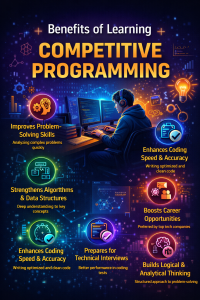
There are many benefits of learning competitive programming which are as follows:
1. Improves Problem-Solving Skills: Competitive programming trains you to quickly analyze complex problems and design efficient solutions using algorithms and logic.
2. Strengthens Data Structures and Algorithms Knowledge: Regular practice deepens your understanding of key concepts like arrays, graphs, dynamic programming, and recursion.
3. Enhances Coding Speed and Accuracy: Solving timed challenges helps programmers write clean and efficient code more quickly.
4. Boosts Career Opportunities: Many top tech companies look for candidates with strong competitive programming experience.
5. Builds Logical and Analytical Thinking: It encourages structured thinking and improves decision-making when facing technical challenges.
6. Prepares for Technical Interviews: Practicing competitive programming questions helps candidates perform better in coding interviews and assessments.





Future Opportunities After Learning Competitive Programming
There are multiple opportunities which one can pursue after learning competitive programming.
Software Developer
Competitive programming builds a strong foundation in algorithms, data structures, and problem-solving skills that are essential for becoming a successful software developer. By regularly solving coding challenges, programmers learn to write optimized and efficient code for large-scale applications. Many tech companies prefer candidates with competitive programming experience because it shows strong logical thinking and coding skills. Taking a structured competitive programming course can deepen your understanding of algorithms and programming concepts, making you more prepared for real-world development projects and software engineering roles in top tech organizations.
Algorithm Engineer
An algorithm engineer focuses on creating efficient algorithms to solve complex computational problems. Competitive programming is excellent training for this career as it emphasizes algorithm design, optimization, and performance analysis. Programmers learn techniques like dynamic programming, graph algorithms, and greedy strategies while tackling tough problems. A well-designed competitive programming course helps learners grasp these concepts thoroughly and apply them in real-world situations. With solid algorithmic thinking and coding skills, professionals can pursue jobs in research labs, tech companies, and organizations that need advanced computational solutions.
Data Scientist
Competitive programming is highly beneficial for aspiring data scientists as it fosters strong analytical thinking and programming skills. Data science involves handling large datasets, building models, and solving complex analytical problems efficiently. The algorithmic thinking gained from competitive coding helps data scientists write optimized code and manage computational tasks effectively. Completing a competitive programming course can enhance your understanding of algorithms, which are commonly used in data analysis, machine learning, and statistical computing. These skills allow professionals to create scalable data-driven solutions and make informed business decisions based on data insights.
Machine Learning Engineer
Machine learning engineers create intelligent systems that learn from data and improve over time. Competitive programming develops the algorithmic mindset needed to build efficient machine learning models and manage complex datasets. It boosts coding skills and enhances the ability to optimize performance, both crucial in AI development. Many machine learning tasks demand a strong knowledge of algorithms and data structures, which competitive programming emphasizes. A structured competitive programming course can help learners master these basics, preparing them to work with machine learning frameworks, implement advanced algorithms, and develop AI-driven solutions for practical applications.
Technical Interview Preparation
Competitive programming is widely considered one of the best ways to prepare for technical interviews in the tech industry. Numerous companies, including leading global tech firms, assess candidates through coding challenges focused on algorithms, data structures, and logical reasoning. Regular practice with competitive programming questions improves problem-solving speed and accuracy under time constraints. Joining a competitive programming course can offer structured learning, practice exercises, and expert guidance to help candidates master important concepts. This preparation significantly boosts the chances of performing well in coding interviews and landing roles in top tech companies.
Common Pitfalls and How to Overcome Them
Even dedicated programmers stumble over predictable obstacles during their competitive journey. Rushing into contests without mastering fundamentals creates a shaky foundation—attempting dynamic programming problems before understanding basic recursion guarantees frustration. According to GeeksforGeeks, beginners frequently skip data structure practice, jumping straight to complex algorithms that require precisely those foundations.
Time management failures plague competitors at every level. Spending forty minutes debugging a single problem while neglecting easier questions costs critical points. A practical approach involves allocating specific time blocks per question based on difficulty, moving forward when stuck rather than fixating.
Neglecting code readability under pressure leads to self-inflicted errors—variable names like “x1” or “tmp2” become incomprehensible mid-contest. Clean, commented code actually saves time during debugging sessions. However, over-optimization presents the opposite trap: perfecting solutions that already pass test cases wastes precious minutes better spent elsewhere.
Breaking these patterns requires honest self-assessment after each contest, identifying which mistakes cost the most points and deliberately practicing those weak areas.
Key Takeaways
Competitive programming transforms theoretical computer science into practical problem-solving prowess. Mastering fundamental data structures like arrays, trees, graphs forms the foundation—without them, and even brilliant algorithmic thinking remains limited. Platforms ranging from Codeforces to TopCoder offer graduated difficulty levels that systematically build skills. Consistency trumps intensity in this domain. Solving two problems daily yields better results than marathon weekend sessions, as pattern recognition develops through repeated exposure. Time complexity analysis isn’t optional—it’s the difference between solutions that scale and those that crash under real-world constraints.
The competitive journey reshapes how programmers approach uncertainty. Every contest deadline, every Time Limit Exceeded error, builds resilience that translates directly to software development roles. Understanding when to optimize versus when to submit a working solution mirrors production engineering decisions.
Start small, practice deliberately, and embrace failure as feedback. The path from beginner to expert isn’t mysterious—it’s paved with consistent practice, strategic learning, and community engagement through platforms that make improvement measurable.
Frequently Asked Questions

Related Courses
Explore our programs




Find a Program made just for YOU
We'll help you find the right fit for your solution. Let's get you connected with the perfect solution.

Is Your Upskilling Effort worth it?
 ROI Calculator

Are Your Skills Meeting Job Demands?
Try our Skill Gap tool
Experience Lifelong Learning and Connect with Like-minded Professionals
Explore Jaro Connect
