HOME > BLOG > Finance > Ind AS vs IFRS: Key Differences Every CFO, CA and Finance Manager Must Understand
Finance
Ind AS vs IFRS: Key Differences Every CFO, CA and Finance Manager Must Understand
J
By Arif Siddiqui
July 30, 202612 min read
Published on July 30, 2026
SHARE THIS ARTICLE
Table Of Content
What is Ind AS?
What is IFRS?
Why Were Ind AS and IFRS Introduced?
Objectives of Ind AS and IFRS
Understand the fundamental differences between Ind AS and IFRS, two widely followed accounting frameworks that shape financial reporting across India and the world. This blog explores their objectives, major differences in recognition, measurement, and presentation, along with their impact on CFOs, Chartered Accountants, and Finance Managers. It also discusses practical implementation challenges, compliance requirements, and best practices to help finance professionals navigate global accounting standards with confidence.
Financial reporting has evolved significantly over the past few decades as businesses have expanded beyond domestic markets and become increasingly global. Investors, regulators, lenders, and other stakeholders now expect financial statements to be transparent, comparable, and prepared using internationally accepted accounting principles. This demand has led many countries to align their accounting frameworks with global standards, making financial reportingmore consistent across borders.
Two accounting frameworks frequently discussed in this context are Indian Accounting Standards (Ind AS) and the International Financial Reporting Standards (IFRS). Although these standards share many similarities, they are not identical. India has adopted a converged version of IFRS known as Ind AS rather than implementing IFRS directly. This means that while Ind AS follows the overall philosophy of IFRS, it includes certain modifications to suit India's regulatory, legal, taxation, and economic environment.
For finance professionals, understanding these differences is no longer optional. Whether you are a Chief Financial Officer (CFO), Chartered Accountant (CA), Finance Controller, Internal Auditor, Investment Analyst, or Finance Manager, the ability to interpret financial statements prepared under both frameworks is increasingly becoming a core professional competency.
This article explains the relationship between Ind AS and IFRS, explores their major differences, examines why those differences exist, and discusses how they impact financial reporting, business decisions, compliance, and corporate governance.
Indian Accounting Standards (Ind AS) are accounting standards notified by the Ministry of Corporate Affairs (MCA) under the Companies Act, 2013. They were developed after considering IFRS while incorporating modifications that address India’s unique legal, regulatory, and economic environment.
Before the introduction of Ind AS, Indian companies followed Accounting Standards (AS) issued by the Institute of Chartered Accountants of India (ICAI). As globalization increased and Indian companies sought international investments and overseas listings, there was a growing need for accounting standards that aligned with global practices.
To address this need, India adopted a phased implementation approach. Instead of adopting IFRS exactly as issued by the International Accounting Standards Board (IASB), India introduced Ind AS as IFRS-converged standards.
Today, Ind AS is mandatory for specified classes of companies based on their net worth and listing status. Banks, insurance companies, and non-banking financial companies (NBFCs) also follow specific implementation timelines prescribed by regulators.
The primary objective of Ind AS is to improve the quality, comparability, and transparency of financial reporting while ensuring compatibility with India’s legal and regulatory framework.
What is IFRS?
International Financial Reporting Standards (IFRS) are globally recognized accounting standards developed and maintained by the International Accounting Standards Board (IASB).
IFRS aims to create a common accounting language that allows investors, regulators, multinational corporations, and financial institutions to comparefinancial statements across different countries without significant adjustments.
More than 140 countries either require or permit IFRS for listed companies. Countries across Europe, Australia, Canada, South Korea, South Africa, and several Middle Eastern nations have adopted IFRS in varying forms.
One of the defining characteristics of IFRS is its principles-based approach. Instead of prescribing rigid accounting rules for every possible situation, IFRS focuses on broad accounting principles, allowing professional judgment to determine the most appropriate accounting treatment.
This flexibility enables businesses operating in different industries and jurisdictions to apply standards that best reflect the economic substance of transactions rather than merely following legal form.
Accounting standards have always played a crucial role in ensuring consistency in financial reporting. However, as businesses became global, differences between national accounting systems created significant challenges.
Investors struggled to compare companies operating in different countries.
Multinational corporations had to prepare multiple versions of financial statements.
Cross-border mergers and acquisitions became more complicated.
Regulators found it difficult to evaluate companies using different accounting frameworks.
To solve these issues, IFRS was developed as a globally accepted accounting language.
India recognized the benefits of adopting internationally accepted reporting practices but also understood that complete adoption might conflict with domestic laws and taxation policies. Therefore, instead of directly adopting IFRS, India introduced Ind AS with carefully designed carve-outs and modifications.
This approach allowed Indian companies to benefit from global accounting practices while ensuring compatibility with local regulations.
Objectives of Ind AS and IFRS
Although they differ in certain areas, both frameworks pursue similar goals.
Their primary objectives include:
Improving transparency in financial reporting
Enhancing comparability across organizations
Increasing investor confidence
Supporting informed decision-making
Promoting accountability and corporate governance
Facilitating access to international capital markets
Ultimately, both standards seek to ensure that financial statements accurately represent an organization’s financial position and performance.
Why Should Finance Professionals Understand Both?
In today’s interconnected economy, finance professionals rarely work within purely domestic environments.
A CFO may oversee subsidiaries in multiple countries.
A Chartered Accountant may audit multinational clients.
A Finance Manager may prepare consolidation reports involving companies reporting under different standards.
Investment professionals frequently compare Indian companies with international competitors.
Private equity firms, venture capital investors, and global lenders also rely heavily on financial statements prepared under both frameworks.
Without understanding the differences between Ind AS and IFRS, professionals may face challenges in:
Financial statement analysis
Consolidation of overseas subsidiaries
Cross-border acquisitions
Fundraising activities
Regulatory reporting
Due diligence assignments
External audits
Consequently, expertise in both standards has become a valuable professional skill.
Ind AS vs IFRS: Understanding the Relationship
One common misconception is that Ind AS and IFRS are identical.
This is not true.
Ind AS is based on IFRS but is not an exact replica.
The Indian government introduced several carve-outs and carve-ins to align accounting standards with domestic business realities.
These modifications were necessary because India has unique requirements related to:
Taxation laws
Company law
Banking regulations
Insurance regulations
Foreign exchange management
Government policies
As a result, while most accounting treatments remain similar, certain recognition, measurement, disclosure, and presentation requirements differ.
These differences may appear minor but can significantly affect reported profits, asset values, liabilities, earnings per share, and financial ratios.
Major Differences Between Ind AS and IFRS
1. Regulatory Authority
One of the most fundamental differences lies in who governs the standards.
IFRS is developed and periodically updated by the International Accounting Standards Board (IASB), an independent global accounting body.
Ind AS, on the other hand, is notified by the Ministry of Corporate Affairs (MCA) after recommendations from the Accounting Standards Board of ICAI and consultations with regulators such as SEBI, RBI, and IRDAI.
As a result, revisions to Ind AS generally occur after IFRS amendments have been evaluated for suitability in the Indian context.
2. Adoption Approach
Perhaps the biggest distinction is that IFRS represents full international standards, whereas Ind AS represents converged standards.
India deliberately chose convergence instead of direct adoption.
This allows regulators to retain certain accounting treatments that better align with Indian laws and economic conditions.
Consequently, companies reporting under Ind AS may prepare financial statements that differ from those prepared under IFRS, even when reporting identical business transactions.
3. Presentation of Financial Statements
Both standards prescribe similar financial statements, including:
Balance Sheet
Statement of Profit and Loss
Cash Flow Statement
Statement of Changes in Equity
Notes to Accounts
However, Ind AS includes additional presentation requirements that align with Schedule III of the Companies Act, 2013.
Indian companies must therefore ensure compliance with both accounting standards and statutory presentation formats.
This dual compliance requirement often results in differences in classifications and disclosures compared to IFRS-based financial statements.
4. Treatment of Other Comprehensive Income (OCI)
Both Ind AS and IFRS require companies to present Other Comprehensive Income separately from profit or loss.
However, certain classifications, terminology, and recycling requirements differ under specific standards.
For finance professionals, understanding these differences is important because OCI affects:
Shareholders’ equity
Net worth
Return on Equity (ROE)
Comprehensive income reporting
Misinterpreting OCI components may lead to incorrect financial analysis.
5. Property, Plant and Equipment (PPE)
Under IFRS, companies may choose either:
Cost Model
Revaluation Model
Ind AS also permits these approaches in principle, but practical implementation often differs due to regulatory considerations and historical transition provisions introduced during Ind AS adoption.
For example, several companies adopted deemed cost exemptions while transitioning to Ind AS, creating differences that continue to influence financial reporting years after adoption.
Understanding these transition adjustments is particularly important during mergers, acquisitions, and valuation exercises.
6. Revenue Recognition
Revenue recognition has undergone significant changes globally following the introduction of IFRS 15 and its corresponding Ind AS 115.
Both standards now follow a five-step revenue recognition model that focuses on identifying performance obligations and recognizing revenue as those obligations are satisfied.
Although the overall framework is substantially aligned, certain implementation guidance and practical considerations differ in India due to legal and regulatory requirements.
For industries such as construction, software, telecommunications, infrastructure, and real estate, even small differences in interpretation can materially affect revenue timing and reported profitability.
7. Lease Accounting
The introduction of IFRS 16 and its Indian equivalent, Ind AS 116, transformed lease accounting by requiring lessees to recognize most leases on the balance sheet. Earlier, many operating leases were treated as off-balance-sheet items, but the revised standards significantly improved transparency by recognizing a Right-of-Use (ROU) Asset and a corresponding lease liability.
While Ind AS 116 is largely aligned with IFRS 16, practical differences arise due to India’s regulatory framework and transitional provisions. Companies operating in sectors such as aviation, retail, logistics, infrastructure, and manufacturing often encounter challenges when implementing these standards because lease agreements vary significantly in terms of tenure, renewal clauses, and embedded lease components.
For CFOs and Finance Managers, lease accounting has a direct impact on financial ratios such as debt-to-equity, EBITDA, and return on assets. As a result, understanding the nuances of lease accounting under both frameworks is essential for accurate financial reporting and business planning.
8. Financial Instruments
Financial instruments are among the most technically demanding areas of accounting. Both IFRS 9 and Ind AS 109 classify financial assets based on an entity’s business model and the contractual cash flow characteristics of the asset.
Assets are generally measured at:
Amortized Cost
Fair Value Through Other Comprehensive Income (FVOCI)
Fair Value Through Profit or Loss (FVTPL)
Although Ind AS is substantially aligned with IFRS in this area, there are certain carve-outs and implementation differences related to regulatory requirements in India. Financial institutions, NBFCs, banks, andinvestment companies must pay particular attention to these variations while preparing financial statements.
For finance professionals, errors in financial instrument classification can significantly affect earnings, reserves, taxation, and regulatory compliance.
9. Business Combinations
Business combinations involve accounting for mergers, acquisitions, and corporate restructurings. Both IFRS 3 and Ind AS 103 require companies to identify the acquirer, determine the acquisition date, measure identifiable assets and liabilities at fair value, and recognize goodwill or gain from bargain purchases.
However, one notable difference relates to bargain purchase gains. Under IFRS, such gains are generally recognized immediately in profit or loss after reassessing the acquisition accounting.
Under Ind AS, bargain purchase gains are usually recognized in Other Comprehensive Income (OCI) and accumulated in equity as Capital Reserve, unless there is clear evidence supporting recognition in profit or loss under applicable regulations.
This distinction can materially impact reported earnings, making it particularly important during mergers and acquisitions involving Indian entities.
10. Foreign Currency Translation
Global businesses frequently engage in cross-border transactions involving multiple currencies. Both IFRS and Ind AS prescribe similar principles for translating foreign currency transactions and financial statements of foreign operations.
Exchange differences arising from foreign currency transactions are generally recognized in profit or loss unless they relate to qualifying exceptions such as net investments in foreign operations.
Although the overall principles are aligned, Indian regulations governing foreign exchange transactions may influence practical application under Ind AS.
Finance professionals working with multinational corporations must therefore understand both accounting standards and local regulatory requirements while preparing consolidated financial statements.
11. First-Time Adoption
When an organization adopts IFRS or Ind AS for the first time, special transition standards apply.
IFRS follows IFRS 1 – First-time Adoption of International Financial Reporting Standards, while India follows Ind AS 101 – First-time Adoption of Indian Accounting Standards.
Both standards provide optional exemptions and mandatory exceptions to facilitate transition. However, India introduced several additional exemptions during the initial implementation phase to reduce the burden on companies transitioning from previous Indian GAAP.
These transition provisions continue to influence financial statements even years after adoption, especially in areas such as property valuation, foreign currency items, and business combinations.
Practical Implications for CFOs, CAs and Finance Managers
Understanding the differences between Ind AS and IFRS goes beyond compliance—it directly influences financial decision-making and business strategy.
For CFOs, the choice of accounting treatment can affect key financial metrics, debt covenants, investor confidence, and valuation. Since many multinational organizations report under IFRS while their Indian subsidiaries prepare financial statements under Ind AS, finance leaders often need to reconcile differences during consolidation.
Chartered Accountants benefit from a thorough understanding of both standards because they frequently advise clients on statutory audits, tax planning, mergers and acquisitions, due diligence, and financial reporting. As businesses increasingly expand internationally, clients expect advisors who can navigate both domestic and international accounting frameworks.
Finance Managers are responsible for preparing accurate financial reports, managing month-end closures, ensuring regulatory compliance, and supporting management decisions. Familiarity with Ind AS and IFRS enables them to reduce reporting errors, improve internal controls, and communicate financial information more effectively to stakeholders.
Challenges in Transitioning Between Ind AS and IFRS
Despite their similarities, organizations often face several challenges while transitioning between the two frameworks.
One of the primary difficulties is interpreting technical guidance correctly. Accounting standards frequently require significant professional judgment, particularly in areas such as revenue recognition, fair value measurement, impairment testing, and lease accounting.
Another challenge is updating financial systems and ERP platforms. Companies may need to redesign reporting processes, modify chart of accounts, and implement new internal controls to comply with revised accounting requirements.
Training employees is equally important. Finance teams accustomed to previous accounting standards often require extensive learning before they can confidently prepare financial statements under Ind AS or IFRS.
Organizations also face increased disclosure requirements. Modern accounting standards emphasize transparency, requiring companies to provide detailed notes explaining assumptions, judgments, risks, and accounting policies. Preparing these disclosures demands considerable effort and coordination across departments.
Keeping pace with evolving accounting standards requires continuous learning and professional development. Finance professionals should regularly review amendments issued by standard-setting bodies and understand their practical implications.
Participation in technical workshops, webinars, certification programmes, and accounting conferences helps professionals remain updated with regulatory changes and industry best practices.
Organizations should also invest in accounting technology capable of handling complex reporting requirements under multiple frameworks. Automation not only improves efficiency but also minimizes manual errors and enhances data accuracy.
Strong collaboration between finance, taxation, legal, compliance, and information technology teams is equally important. Since accounting changes often affect multiple business functions, a coordinated approach ensures smoother implementation and better governance.
The Future of Financial Reporting
Financial reporting continues to evolve in response to globalization, digital transformation, and growing stakeholder expectations. Emerging areas such as sustainability reporting, environmental disclosures, climate-related financial risks, and integrated reporting are reshaping corporate reporting practices worldwide.
Both IFRS and Ind AS are expected to continue evolving to address these developments. The International Sustainability Standards Board (ISSB) has already introduced sustainability disclosure standards that complement traditional financial reporting. As India strengthens its sustainability reporting framework, finance professionals will increasingly need to integrate financial and non-financial reporting into a unified reporting strategy.
Artificial intelligence, data analytics, robotic process automation, and cloud-based accounting systems are also changing how financial information is generated and analyzed. Future finance leaders will need expertise not only in accounting standards but also in digital technologies that support modern finance functions.
Conclusion
Ind AS and IFRS share the common objective of enhancing transparency, consistency, and comparability in financial reporting. However, they are not identical. India’s approach of converging with IFRS while incorporating country-specific modifications has resulted in several important differences that influence financial reporting, compliance, and business decision-making.
For CFOs, Chartered Accountants, Finance Managers, auditors, and financial analysts, understanding these differences is essential in today’s interconnected business environment. Whether preparing financial statements, managing cross-border transactions, conducting due diligence, or supporting strategic decisions, professionals who possess expertise in both frameworks are better equipped to navigate complex reporting requirements and add value to their organizations.
As accounting standards continue to evolve alongside global business practices, continuous learning and staying updated with regulatory developments will remain critical for every finance professional.
Frequently Asked Questions
No. Ind AS is a converged version of IFRS with certain modifications to suit India’s legal, regulatory, and economic environment.
India chose convergence instead of full adoption to ensure compatibility with domestic laws, taxation policies, and regulatory requirements while aligning with global accounting practices.
Specified companies based on net worth, listed entities, and certain financial institutions are required to comply with Ind AS as prescribed by the Ministry of Corporate Affairs (MCA).
Many Indian companies have international operations, overseas investors, or foreign subsidiaries. Knowledge of IFRS helps professionals work effectively in multinational environments and supports global financial reporting requirements.
Arif Siddiqui
Head of Accounting and Treasury
Arif Siddiqui is a finance leader specializing in accounting, treasury, and financial strategy. As Head of Finance at Generali Employee Benefits, he brings extensive experience in managing global financial operations. He is known for driving financial efficiency and governance across organizations. His leadership supports sustainable business growth and financial excellence.

 July 30, 2026
 12 min read





 ChatGPT
 Perplexity
 Claude
 Grok
Grok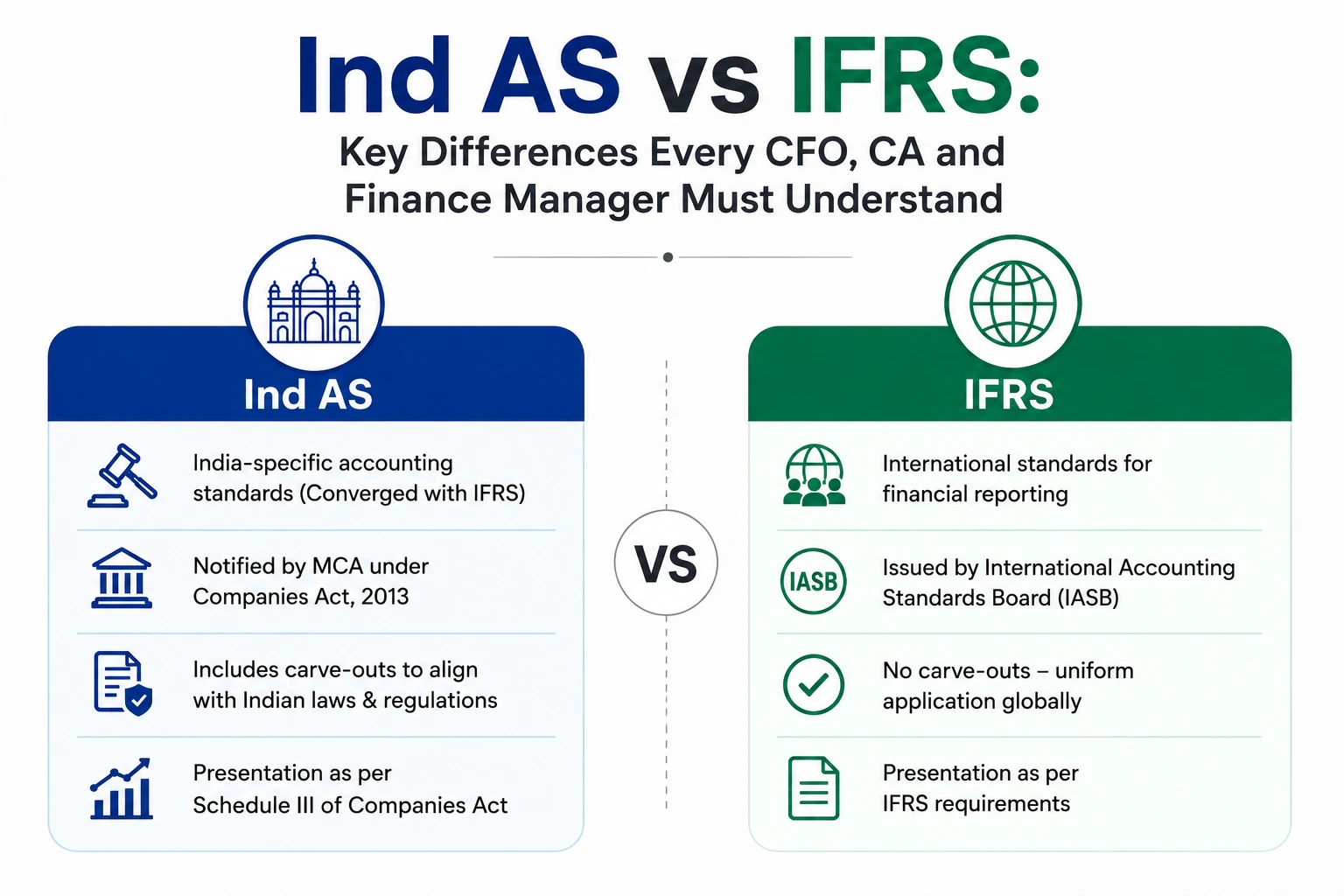











 ROI Calculator