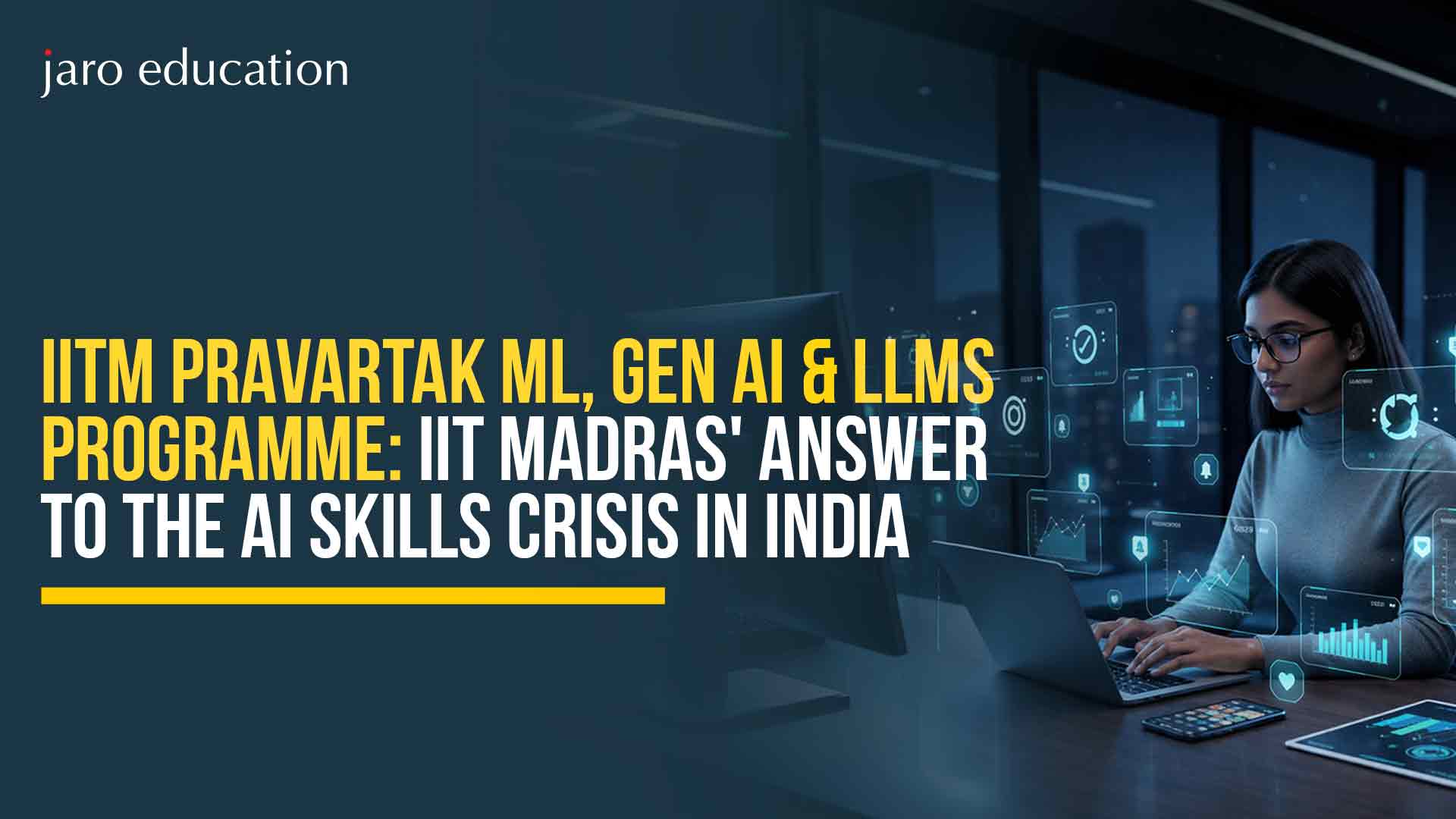
Artificial Intelligence is no longer a futuristic concept reserved for tech giants. From healthcare and banking to retail and manufacturing, AI-driven technologies are transforming how businesses operate. Yet, while demand for AI professionals continues to soar, India faces a significant shortage of industry-ready talent equipped with practical AI, Machine Learning (ML), Generative AI, and Large Language Model (LLM) expertise.
India’s AI industry is expanding rapidly. Organizations across sectors are investing heavily in automation, predictive analytics, intelligent chatbots, recommendation systems, and AI-powered decision-making tools. Technologies like Generative AI, Agentic AI, and Retrieval-Augmented Generation (RAG) are becoming central to enterprise transformation strategies.
However, the biggest challenge is not technology adoption—it is the shortage of professionals who can build, deploy, and scale AI systems in real-world business environments. Many professionals understand AI theoretically but lack hands-on experience with deployment pipelines, LLM fine-tuning, MLOps, and business applications.
This is where IITM Pravartak’s programme positions itself as a future-focused solution.
About IITM Pravartak
IITM Pravartak Technologies Foundation is a Section 8 company hosted by IIT Madras and funded by the Department of Science and Technology under the National Mission on Interdisciplinary Cyber-Physical Systems (NM-ICPS). The initiative focuses on developing cutting-edge technological capabilities in areas like AI, sensors, networking, robotics, and intelligent systems.
The programme reflects IIT Madras’ larger vision of preparing India’s workforce for emerging technologies and future digital transformation.
The Advanced Certificate Programme in Machine Learning, Generative AI & LLMs for Business Applications is structured to help learners move from foundational AI concepts to advanced enterprise-level AI implementation. According to the official programme details, the curriculum combines theoretical understanding with practical applications, live sessions, tutorials, projects, and capstone work.
Key Programme Details
Programme Duration: 10–11 Months
Mode: Hybrid (Online with optional campus immersion)
Class Schedule: Weekend classes
Target Audience: Working professionals and tech learners
Programme Fee: ₹1,30,000 + GST
Application Fee: ₹1,500 + GST
The weekend learning format makes the programme especially suitable for professionals who want to upskill without leaving their current jobs.
While many AI programmes still focus heavily on traditional machine learning, IITM Pravartak has integrated advanced Generative AI concepts into the curriculum. Learners explore:
These technologies are increasingly being used in chatbots, AI copilots, automation platforms, enterprise search systems, and content generation tools.
2. Industry-Oriented Learning
The curriculum is designed around practical implementation rather than theory alone. Participants work on:
Module 6: Building Integrated Generative AI Applications
22. Multimodal Generative AI Systems
Integrating Text, Image, and Audio Models
Case Studies: AI Art, Music Videos, Virtual Worlds
Developing Cross-Modal Retrieval Systems
23. Customizing and Extending Generative AI Models
Fine-Tuning LLMs for Multimodal Tasks
Building End-to-End Multimodal Pipelines
Deployment Strategies for Multimodal Applications
24. Capstone Project: Integrated Generative AI Application
Project Planning and Data Collection
Model Integration and Workflow Design
Final Testing, Optimization, and Presentation
Module 7: Productionizing the Applications – End-to-End Pipeline
25. Introduction to Productionizing AI Models
Overview of MLOps and Best Practices
Setting Up CI/CD Pipelines for AI Applications
Monitoring and Maintaining AI Models in Production
26. Deploying AI Models with Python Tools
Model Deployment with TensorFlow Serving and TorchServe
Scaling Applications with Docker and Kubernetes
27. End-to-End Pipeline for LLM and Generative AI Applications
Text-to-Speech (TTS) Systems with LLMs
Music and Sound Generation
Voice Cloning and Audio Enhancement
Who Should Apply?
Eligibility Criteria:
Graduate/4-year Engineering/Tech Degree/B.Sc./BCA/M.Sc./MCA from a recognized university (UGC/AICTE/DEC/AIU/State Government/recognized international universities).
Minimum 50% and above is required for qualification.
Industry Targeting (Preference): IT, Tech, Software, Engineering Research, Business Analytics, etc.
Professionals from a tech background must have a minimum of 1 year of work experience.
Assessment:
Homework, Final exam, project
Final Certifying examination with grades ranging from A to F, with A as the highest grade, and F indicating Failure.
50% weightage to homework/case studies and 50% to the final exam.
Attendance: 70% attendance is mandatory.
Career Opportunities After the Programme
The AI industry in 2026 offers opportunities across multiple sectors. After completing the programme, learners may explore roles such as:
As organizations increasingly integrate AI into workflows, professionals with applied AI knowledge are expected to remain in high demand.
Learning Methodology
The programme uses a blended learning structure consisting of:
Live online sessions
Tutorial sessions
Mini quizzes
Programming assignments
Project work
Reference materials
Optional campus immersion
This format ensures flexibility while maintaining academic rigor.
Why IITM Pravartak’s Programme Stands Out
Despite growing competition in the online AI education market, IITM Pravartak’s programme differentiates itself through:
IIT Madras-backed credibility
Strong focus on Generative AI and LLMs
Industry-oriented projects
Practical deployment exposure
Weekend-friendly structure
Hybrid learning model
Coverage of emerging AI trends
The programme aligns closely with the technologies currently reshaping global enterprises.
Final Thoughts
India’s AI transformation is accelerating rapidly, but the shortage of skilled AI professionals remains a major challenge. Programmes like the IITM Pravartak Advanced Certificate in ML, Gen AI & LLMs aim to bridge this gap by combining foundational AI education with practical, business-focused implementation.
For professionals looking to future-proof their careers in 2026, this programme offers exposure to some of the most in-demand AI technologies—from Machine Learning and Deep Learning to Generative AI, LLMs, Agentic AI, and enterprise AI deployment.
As AI continues to evolve, the ability to build scalable, intelligent systems will become one of the most valuable career skills of the decade.
Frequently Asked Questions
Yes, the programme is highly relevant for professionals looking to build expertise in Machine Learning, Generative AI, and Large Language Models. Its industry-focused curriculum and IIT Madras-backed credibility make it valuable for career growth in the rapidly evolving AI sector.
The programme is ideal for working professionals, software engineers, data analysts, business analysts, and AI enthusiasts who want to transition into AI-driven roles or upgrade their technical skills in emerging AI technologies.
Yes, the curriculum includes hands-on learning in GPT models, AI agents, Retrieval-Augmented Generation (RAG), diffusion models, MLOps, and real-world AI deployment strategies to help learners gain practical exposure.
Participants can explore roles such as Machine Learning Engineer, AI Consultant, NLP Engineer, Generative AI Specialist, Data Scientist, and LLM Application Developer across industries adopting AI technologies.
Absolutely. The programme is designed with weekend online classes and a flexible hybrid learning model, allowing professionals to upskill without interrupting their full-time careers.
Dr. Sanjay Kulkarni
Data & AI Transformation Leader
Dr. Sanjay Kulkarni is a Data & AI Transformation Leader with over 25 years of industry experience. He helps organizations adopt data-driven and responsible AI practices through strategic guidance and education. With experience across startups and global enterprises, he bridges the gap between theory and real-world application. His work empowers teams to innovate and thrive in AI-driven environments.
 HOME > BLOG > AI and Machine Learning > IITM Pravartak ML, Gen AI & LLMs Programme 2026: IIT Madras’ Answer to the AI Skills Crisis in India
 July 1, 2026
 7 min read




 ChatGPT
 Perplexity
 Claude
 Grok
Grok




 Admission Open
 Admission Open
 Admission Open
 Admission Open

 ROI Calculator



