HOME > BLOG > HR Management > What Is an HR Business Partner (HRBP)? Roles & Responsibilities Explained
HR Management
What Is an HR Business Partner (HRBP)? Roles & Responsibilities Explained
J
By Prerna Singh
June 5, 20268 min read
Published on June 5, 2026
SHARE THIS ARTICLE
Table Of Content
What Is an HR Business Partner (HRBP)?
HR Business Partner Roles and Responsibilities
How Jaro Education Can Help You Build a Career as an HR Business Partner
Conclusion
HR's role has moved far beyond the old image of a department that only handles hiring paperwork, payroll inputs, attendance records, and policy reminders. Those responsibilities have not disappeared, of course. They still keep the workplace running. But in most growing organisations, Human Resources is now expected to sit closer to business decisions. This is where an HR Business Partner, or HRBP, becomes useful.
An HR business partner is a professional who works closely with managers and leadership teams, understanding the business, identifying workforce challenges, and helping leaders make practical decisions.
In a traditional HR setup, the focus may be more on operations. This includes documentation, employee records, joining formalities, compliance, leave management, payroll coordination, and policy implementation. An HRBP may understand these areas, but their main contribution is different. They are expected to look at the larger picture.
For example, a business head may say that the team needs ten new employees. A regular response would be to begin hiring. An HRBP would first ask a few deeper questions, like:
Is the team short of people, or is the work not distributed properly?
Are the current employees trained enough?
Can some roles be filled internally?
Will the new hiring plan support the company’s long-term goals?
Are managers ready to handle a larger team?
The HR business partner role becomes especially important when an organisation starts growing quickly. In small teams, many people-related decisions happen informally. A founder, manager, or HR executive may handle issues as they come. But once the workforce expands, that approach often becomes difficult to manage.
This is why HRBPs are often viewed as internal advisors. They understand the concerns of leaders, but they also keep the employee experience in mind. Their job is to bring both sides into the same conversation and help the organisation make people decisions that are practical, fair, and aligned with business goals.
Active involvement in people-related business decisions
The difference does not mean traditional HR is less important. Instead, it shows how the HR function has expanded. Operational HR ensures systems run smoothly, while the HRBP ensures people strategies support business direction.
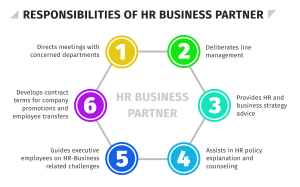
The responsibilities of an HR business partner can vary depending on the industry, company size, reporting structure, and maturity of the HR function. In some organisations, the HRBP may handle a broad mix of strategic and operational work. In others, the role may be more focused on leadership advisory, organisational design, and workforce planning.
However, the core purpose remains the same: to help the business achieve its goals through effective people management.
1. Workforce Planning
Workforce planning is one of the most important responsibilities of an HRBP. It involves understanding the current workforce, identifying future talent needs, and helping the organisation prepare for upcoming business requirements.
For example, if a technology company plans to launch a new product, the HRBP may work with product, engineering, sales, and customer support leaders to understand what kind of workforce will be required. The plan may include hiring new specialists, training existing employees, restructuring teams, or creating new leadership roles.
2. Talent Acquisition Support
Recruitment teams may manage the actual hiring process, but HRBPs often play an important role in making hiring more aligned with business needs. They help leaders define what kind of talent is required, which roles should be prioritised, and how hiring decisions will affect team performance.
In many companies, hiring managers may focus only on immediate vacancies. An HRBP brings a broader view. They assess whether a new hire is truly needed, whether the role can be filled internally, whether the job description is accurate, and whether the hiring plan supports long-term business priorities.
This part of the role also connects with the HR business partner resume because professionals applying for HRBP roles should highlight how they supported workforce planning, hiring strategy, and stakeholder coordination.
3. Employee Relations
Employee relations is one of the most sensitive parts of the HR business partner role. It requires judgment, confidentiality, patience, and a strong understanding of workplace policies. An HRBP often becomes the point of contact when managers need support in handling employee concerns or when employees need clarity on workplace matters.
Common employee relations responsibilities include:
Listening to employee concerns and documenting key issues
Guiding managers on difficult workplace conversations
Supporting grievance resolution processes
Ensuring policies are applied consistently
Helping prevent workplace conflicts from escalating
Maintaining confidentiality in sensitive matters
Encouraging respectful communication across teams
4. Performance Management
Performance management is another major responsibility included in most HR business partner job description documents. HRBP involvement in performance management may include:
Supporting goal-setting discussions
Helping managers prepare for review conversations
Identifying high-performing employees
Recognising employees who need additional support
Advising on performance improvement plans
Ensuring fairness in ratings and feedback
Analysing performance trends across teams
When done well, performance management does not feel like a control mechanism. It becomes a way to improve clarity, accountability, and growth.
5. Learning and Development Support
A business cannot grow if its people do not grow with it. This is where learning and development become an important responsibility for an HRBP. The HRBP may not personally design every training module, but they help identify what kind of learning the organisation actually needs. This makes their role different from a generic training coordinator.
For instance, if customer complaints are increasing, the issue may not always be poor service attitude. It could be a lack of product knowledge, weak communication skills, unclear escalation processes, or insufficient manager support. An HRBP can help identify the real gap and recommend the right intervention.
6. Change Management
Change is common in modern organisations. Companies restructure teams, introduce new technologies, revise policies, merge departments, expand into new markets, or change leadership models. While these decisions may be necessary for growth, they often create uncertainty among employees.
An HRBP plays a crucial role in making change easier to understand and implement. They help leaders communicate the reason for change, prepare managers for difficult conversations, and ensure employees receive timely information. They may also collect feedback, identify concerns, and help reduce confusion during the transition.
7. Employee Engagement and Retention
The HRBP studies engagement from a business perspective. They look at what employees are experiencing across teams and whether those experiences are affecting productivity, retention, or morale.
Some signs of low engagement may include:
Frequent resignations from a particular team
Poor participation in feedback surveys
Increase in absenteeism
Low internal mobility
Reduced performance levels
Repeated concerns about managers
Lack of enthusiasm for organisational initiatives
The HRBP’s role is to identify the real reason and recommend practical action.
8. Leadership Advisory
Leaders often make decisions that directly affect people: promotions, restructuring, hiring priorities, team design, performance ratings, succession planning, and employee exits. These decisions require more than authority. They require perspective, fairness, and awareness of long-term impact. An HRBP helps leaders think through these decisions carefully.
For example, if a manager wants to promote an employee, the HRBP may help evaluate whether the person is ready for the next role, whether the promotion is consistent with internal benchmarks, whether other employees may be affected, and whether the decision supports future team structure.
Similarly, if a leader wants to restructure a department, the HRBP may help assess role duplication, reporting lines, skill gaps, employee communication, and transition risks.
9. HR Analytics and Reporting
Modern HR decisions are increasingly data-driven. An HRBP must be comfortable using workforce data to identify patterns, risks, and opportunities. This does not mean the HRBP needs to be a data scientist. However, they should be able to interpret HR metrics and convert them into meaningful business insights.
Common HR metrics used by HRBPs include:
Metric
What It Helps Understand
Attrition rate
Employee exits and retention risks
Engagement score
Employee satisfaction and workplace sentiment
Hiring turnaround time
Recruitment efficiency
Absenteeism
Workforce discipline, stress, or morale concerns
Performance distribution
Team productivity and rating patterns
Internal mobility
Career growth and talent movement
Training completion
Learning participation and capability-building
The value of HR analytics lies in interpretation. Numbers alone do not solve problems. The HRBP must connect data with business context. This makes analytics a powerful part of the HR business partner role.
10. Culture Building
An HRBP contributes to culture by helping leaders and teams practise the behaviours the organisation claims to value. If a company says it values transparency, managers must communicate clearly. If it values performance, employees must understand expectations. If it values inclusion, workplace decisions must reflect fairness.
When the role is performed well, the HR business partner becomes more than an HR representative. They become a strategic advisor who helps the organisation build capable teams, responsible leaders, and a stronger workplace environment.
How Jaro Education Can Help You Build a Career as an HR Business Partner
Building a career as an HR business partner requires more than basic HR knowledge. The role demands business understanding, leadership awareness, data-backed decision-making, communication skills, and the ability to work closely with senior stakeholders. This is where professional upskilling can make a clear difference.
Jaro Education helps working professionals and aspiring HR leaders strengthen their management and business capabilities through industry-relevant online programmes offered in collaboration with reputed institutes. These programmes are designed for professionals who want to move beyond routine HR functions and prepare for strategic roles such as HR Business Partner, HR Manager, Talent Partner, People Strategy Consultant, or HR Leader.
For HR professionals, the next stage of growth is not just about knowing policies; it is about understanding how people decisions shape business outcomes. A structured learning journey can help bridge that gap with more confidence and clarity.
Explore Jaro Education’s programmes to build stronger HR and leadership capabilities.
An HR business partner plays a crucial role in connecting people strategy with business growth. The role goes beyond routine HR tasks and focuses on workforce planning, employee engagement, performance management, leadership support, and organisational development. As companies become more people-driven and data-focused, the HRBP position will continue to gain importance across industries. For professionals, this career path offers the opportunity to move from operational HR work to a more strategic and influential role.
Frequently Asked Questions
An HR business partner is an HR professional who works with business leaders to align people strategies with company goals. The role focuses on workforce planning, performance, engagement, and employee development.
An HR business partner job description usually includes workforce planning, employee relations, performance management, HR analytics, engagement, and leadership advisory. It may also include change management and talent development responsibilities.
The HR business partner’s salary in India depends on experience, industry, company size, and location. Entry-level HRBPs may earn around ₹5–8 LPA, while senior HRBPs can earn ₹18–30 LPA or more.
Not always. In some companies, HRBP and HR Manager are at a similar level, but the HRBP role is usually more strategic and business-facing. An HR Manager may handle broader HR operations, while an HRBP works closely with business leaders on people strategy.
Most HRBP roles require a bachelor’s or master’s degree in HR, business administration, or a related field. Employers also prefer candidates with experience in employee relations, performance management, workforce planning, and HR analytics.
Prerna Singh
Talent Acquisition Manager - India
Prerna Singh is a results-driven Talent Acquisition Manager with expertise in end-to-end HR management. She has a strong background in recruitment, employee engagement, and HR operations across IT domains. Skilled in ATS/HRIS platforms and vendor management, she is passionate about building productive workplaces. She is committed to aligning talent strategies with business growth.
Get Free Upskilling Guidance
Fill in the details for a free consultation
Related Courses
Explore our programs
Admission Open
Post Graduate Certificate Programme in Strategic Human Resource Management with AI & Analytics
 HOME > BLOG > HR Management > What Is an HR Business Partner (HRBP)? Roles & Responsibilities Explained
 June 5, 2026
 8 min read





 ChatGPT
 Perplexity
 Claude
 Grok
Grok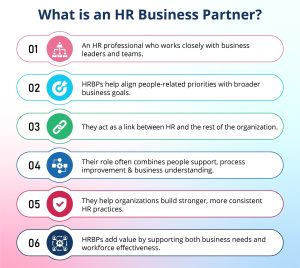




 Admission Open

 Admission Open
 Admission Open
 Admission Open
 ROI Calculator