 HOME > BLOG > Career Guidance > Top 10 Best Paying IT Jobs in India 2027: Roles, Salaries and Skills
Top 10 Best Paying IT Jobs in India 2027: Roles, Salaries and Skills
 September 25, 2024
 6 min read





Table Of Content
- Best Paying IT Jobs in India: At a Glance
- Why IT Salaries Are Rising in India in 2027
- Top 10 Best Paying IT Jobs in India in 2027
- How to Land the Best Paying IT Jobs: A Practical Roadmap
 Key Insights
- The best paying IT jobs in India in 2027 are concentrated in AI, cloud architecture, cybersecurity, data science and technology leadership.
- Experienced professionals in the highest paying IT jobs in India commonly earn ₹20 lakh to ₹60 lakh a year, and senior AI talent at global companies can earn more.
- Pay depends on skills, experience, employer type and city, not on the job title alone.
- Certifications, real projects and a clear specialisation are the fastest route into the highest paying tech jobs.
India's technology sector is going through its biggest reshuffle in a decade. Generative AI has moved from pilot projects to production, global companies are opening more engineering centres in the country, and employers are competing hard for a small pool of specialists. The result is a widening pay gap between routine roles and the highest paying IT jobs in India.
This guide explains the best paying IT jobs for 2027, what each role involves, what it typically pays, and which skills and certifications help you get there. Whether you are a student, fresher, or mid-career professional planning a switch, it provides a practical overview of career options and earning potential. Salaries can vary based on experience, location, skills, and employer.
 ChatGPT
 Perplexity
 Claude
 Grok
Best Paying IT Jobs in India: At a Glance
The following table highlights the top 10 best paying IT jobs in India, their typical senior-level annual salaries, and the core skills required for each role.
| Role | Typical senior-level pay (per annum) | Core skills |
| AI/ML Architect / Generative AI Engineer | ₹25–60 lakh+ | Python, LLMs, PyTorch, MLOps |
| Cloud Solutions Architect | ₹20–45 lakh | AWS, Azure, GCP, cloud security |
| Cybersecurity Architect / Manager | ₹20–40 lakh | SIEM, zero trust, risk management |
| Data Scientist / Data Architect | ₹18–35 lakh | Python, SQL, statistics, big data |
| Machine Learning Engineer | ₹18–40 lakh | MLOps, deep learning, deployment |
| Software Engineering Manager / Technology Director | ₹25–45 lakh | Leadership, system design, Agile |
| Solutions / Software Architect | ₹18–35 lakh | System design, integration |
| DevOps / Platform / SRE | ₹15–30 lakh | Kubernetes, Terraform, CI/CD |
| Blockchain Developer | ₹10–32 lakh | Solidity, cryptography |
| Senior Full-Stack Developer | ₹12–28 lakh | React, Node.js, APIs, microservices |
Salary Sources: GlassDoor, Ambition Box
Why IT Salaries Are Rising in India in 2027
- Rising technology investment: Businesses are increasing spending on AI, software, infrastructure, and digital solutions, creating greater need for technology expertise.
- Expansion of GCCs: Global Capability Centres are expanding their presence in India, creating opportunities across engineering, product development, analytics, and business operations.
- Shortage of specialised AI talent: The growing use of artificial intelligence has created a gap between the capabilities companies need and the talent available in the market.
- Growing AI and ML demand: Organisations are adopting AI and machine learning for automation, analysis, product development, and decision-making, increasing opportunities in these areas.
- Strong economic contribution: The IT-BPM sector continues to play an important role in India’s economy, supporting employment and business activity across multiple industries.
Together, these trends help explain why specialised technology skills are gaining value in India’s job market. However, actual salaries vary by role, experience, location, skill level, and employer.
Top 10 Best Paying IT Jobs in India in 2027
*ipemgzb
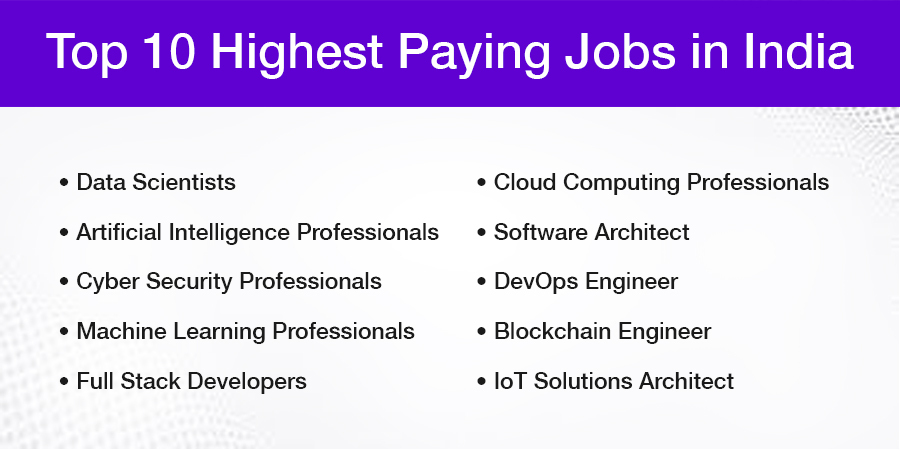
Here are the best paying IT jobs, ranked by typical pay at experienced levels.
1. AI/ML Architect and Generative AI Engineer
Typical pay: ₹25–60+ LPA
These professionals decide how AI is built into products and enterprise systems, from choosing models and frameworks to managing training, deployment and risk. It is arguably one of the highest paying IT jobs in India right now.
Key skills: Python, PyTorch, TensorFlow, LLMs, MLOps, cloud platforms.
A master’s degree helps, but strong projects and certifications can open doors too.
2. Cloud Solutions Architect
Typical pay: ₹20–45 LPA
Cloud architects design secure, scalable and cost-efficient environments as enterprises move to hybrid and multi-cloud setups. With AI workloads now running on the cloud, the role keeps gaining strategic weight and consistently features among the best paying IT jobs.
Key skills: AWS, Azure, Google Cloud, networking, cloud security, FinOps.
3. Cybersecurity Architect or Manager
Typical pay: ₹20–40 LPA
Stricter data regulations and more sophisticated attacks make security leaders hard to replace, which keeps them among the highest paying tech jobs. They design defences, lead incident response and report risk to senior management.
Key skills: Threat detection, SIEM, penetration testing, cloud security, zero-trust design.
4. Data Scientist and Data Architect
Typical pay: ₹18–35 LPA
Data scientists turn raw information into decisions through analytics and predictive models, while data architects design the platforms that make this possible across large, complex, and constantly evolving business environments.
Key skills: Python, R, SQL, statistics, Spark, data visualisation.
5. Machine Learning Engineer
Typical pay: ₹18–40 LPA
ML engineers build, test, deploy, and maintain machine learning models, ensuring they work reliably with real-world data and perform effectively in production environments. PayScale’s average across all experience levels is around ₹10 lakh, with compensation varying considerably based on seniority and employer
Key skills: MLOps, deep learning, cloud deployment, monitoring, automation.
6. Software Engineering Manager or Technology Director
Typical pay: ₹25–45 LPA
Software Engineering Managers oversee developers, assign technical work, review project progress, and coordinate software releases. Technology Directors define the technology roadmap, manage engineering resources, and make decisions on platforms, systems, and architecture.
Key skills: Leadership, Agile delivery, system design, stakeholder management .
7. Solutions Architect and Software Architect
Typical pay: ₹18–35 LPA
Solutions and software architects design end-to-end technology solutions, define system architecture, select suitable technologies, and ensure applications and components integrate effectively to meet business, security, and performance requirements.
Key skills: System design, enterprise integration, cloud architecture, APIs.
8. DevOps, Platform and Site Reliability Engineer
Typical pay: ₹15–30 LPA
DevOps, Platform, and Site Reliability Engineers build and maintain reliable technology infrastructure, automate software deployment and monitoring, manage cloud and platform environments, and improve system performance, scalability, and availability to support smooth application delivery.
Key skills: Kubernetes, Docker, Terraform, CI/CD pipelines, Prometheus, Grafana.
9. Blockchain Developer
Typical pay: ₹10–32 LPA
Blockchain developers build and maintain blockchain-based applications, smart contracts, and decentralised systems. They work with blockchain networks to create secure transactions, automate processes, and develop applications using distributed ledger technology.
Key skills: Solidity, cryptography, smart contracts, distributed systems.
10. Senior Full-Stack Developer
Typical pay: ₹12–28 LPA
Senior Full-Stack Developers build and maintain complete web applications, working across both frontend and backend systems. They design application architecture, develop APIs, manage databases, review code, and troubleshoot complex technical issues.
Key skills: JavaScript, React, Node.js, APIs, microservices, databases.
How to Land the Best Paying IT Jobs: A Practical Roadmap
- Build strong fundamentals: Master one programming language, data structures, databases, and basic networking.
- Choose a specialisation: Pick AI, cloud, cybersecurity, or data based on your interests and the requirements of your target role.
- Earn one or two relevant certifications: Depth in a single area is more valuable than a long list of unrelated credentials.
- Create proof of work: Build three to five solid projects with clear problem statements and working demonstrations on GitHub.
- Choose the right workplace: GCCs, product companies, and technology-focused organisations can provide exposure to complex projects and stronger career growth.
- Keep upskilling: Technology changes quickly, so regularly updating your knowledge can help you stay relevant and qualify for advanced opportunities.
- Move into leadership or architecture: Combine technical expertise with communication, decision-making, and people management to progress into senior technology positions.
How Jaro Education Helps You Build Skills for High-Paying IT Jobs
Jaro Education offers programmes designed around areas such as artificial intelligence, data science, machine learning, and cybersecurity. These programmes combine structured learning with practical exposure, helping learners build knowledge relevant to several high-paying IT career paths.
Programme | Duration | Eligibility | What It Covers |
6–8 months | Bachelor’s degree with 50% aggregate; work experience is preferable but not mandatory | Python, R, SQL, statistics, machine learning, deep learning, Generative AI, NLP, big data and cloud analytics | |
12 months | Bachelor’s degree with knowledge of C, Java or C++ | AWS, Azure, OpenStack, distributed systems, virtualisation, big data, NoSQL and cloud applications | |
IISc – Advanced Certification Programme in Generative AI & Large Language Models | 6 months | Bachelor’s degree in Computer Science, Engineering or related discipline; 1 year of work experience is preferred and may be relaxed for exceptional candidates | Deep learning, transformers, LLMs, GANs, VAEs, diffusion models and AI system development |
Final Thoughts
The best paying IT jobs in India in 2027 reward people who combine deep technical skill with business understanding. AI, cloud, cybersecurity and data lead the list, and the GCC boom is widening opportunities across cities. Use the roles above as a starting point, compare them with your interests and experience, and invest in skills that stay valuable for years. The highest paying IT jobs go to professionals who keep learning, so start building your edge today.
Frequently Asked Questions
AI and machine learning leadership roles, along with technology executives such as vice presidents of technology, sit at the top of the highest paying IT jobs in India. Senior AI/ML professionals at global capability centres can cross ₹60 lakh a year, while executive packages can be higher still.
Freshers rarely start at the top of the pay scale, but AI/ML, cloud, cybersecurity and data roles usually offer the best starting packages and the fastest growth. Entry-level pay commonly falls in the ₹3–8 lakh range, with higher offers at product companies and GCCs for candidates with strong projects.
Technology programme management, business technology consulting, IT product management and cybersecurity governance and risk roles pay well without heavy coding. Glassdoor-based data reported by Coursera shows medians of about ₹22 lakh for IT programme managers and business technology consultants.
Both are strong choices. AI and machine learning currently show the sharpest premiums and the widest talent gap, while cloud skills offer broader demand across industries and underpin most AI projects. Many of the highest paying tech jobs combine the two.
Widely respected options include AWS, Azure and Google Cloud architect certifications, CISSP and CISM for security, PMP for delivery leadership, and AI or data science certificates from recognised providers. Certifications work best alongside hands-on projects.
AI is automating routine coding and support tasks, but it is also creating demand for people who can build, secure and govern AI systems. Industry reports show a 36–40% supply gap in AI and data talent, so professionals who keep upskilling are better placed than those who do not.









Find a Program made just for YOU
We'll help you find the right fit for your solution. Let's get you connected with the perfect solution.
Is Your Upskilling Effort worth it?
 ROI Calculator


Are Your Skills Meeting Job Demands?
Try our Skill Gap tool
Experience Lifelong Learning and Connect with Like-minded Professionals
Explore Jaro Connect
