DSA Tutorial for Beginners: Complete Guide to Data Structures & Algorithms
J
By Shubham Lal
October 4, 20268 min read
Published on October 4, 2026
SHARE THIS ARTICLE
Table Of Content
What Is DSA?
Why Learn Data Structures and Algorithms?
Big-O Notation: Measuring Efficiency
Where DSA Is Used in Real Life
Key Insights
Data structures organise data and algorithms process it. Learning them together is what makes your code efficient and your problem-solving sharp.
Big-O notation lets you compare solutions by how they scale, which matters more than how fast a program runs on a small test.
Master a core set first: arrays, linked lists, stacks, queues, hash tables, trees and graphs, plus searching, sorting, recursion and basic dynamic programming.
Java's Collections Framework gives you ready-made data structures, but you should still build the basics by hand to understand how they work.
Consistent practice on real problems beats passive reading, so pair every concept with coding exercises.
In this blog, you'll learn the fundamentals of DSA, Java examples, a complexity cheat sheet, a learning roadmap and common mistakes to avoid.
If you want to become a software developer, you will keep hearing the same advice: learn data structures and algorithms. Interviewers test them, performance depends on them and every large system relies on them. Yet for beginners, DSA can feel abstract and intimidating.
This DSA tutorial breaks it down step by step. You will learn what DSA is, how to measure efficiency with Big-O, the core data structures and algorithms, Java examples you can run yourself and a roadmap to practise effectively.
A data structure is a way of organising and storing data so it can be used efficiently, such as an array, a list or a tree. An algorithm is a step-by-step procedure for solving a problem, such as searching for a value or sorting a list.
They work as a pair. The structure you choose decides how fast an algorithm can run. Looking up a name in an unsorted list means checking items one by one, while a hash table can find it almost instantly. For a broad overview, see our guide to types of data structures.
Efficient code: the right structure can turn a program that takes minutes into one that takes milliseconds.
Problem-solving skills: DSA trains you to break big problems into small, solvable steps.
Interviews: many technical interviews include DSA questions, so preparation pays off. Our DSA interview questions guide shows what to expect.
Foundation for advanced topics: databases, operating systems, machine learning and system design all build on these ideas.
Big-O Notation: Measuring Efficiency
Big-O notation describes how the running time or memory use of an algorithm grows as the input size (n) grows. It ignores machine speed and focuses on scaling.
O(1), constant: the time does not depend on input size, like reading an array element by index.
O(log n), logarithmic: the work shrinks by half each step, like binary search.
O(n), linear: the work grows with input size, like scanning a list.
O(n log n): typical for efficient sorting algorithms such as merge sort.
O(n²), quadratic: common in nested loops, like bubble sort.
Quick Complexity Cheat Sheet
Structure / algorithm
Common operation
Typical complexity
Array
Access by index
O(1)
Array
Search (unsorted)
O(n)
Linked list
Insert at head
O(1)
Linked list
Search
O(n)
Stack / queue
Push, pop, enqueue, dequeue
O(1)
Hash table
Lookup (average)
O(1)
Balanced binary search tree
Search, insert
O(log n)
Binary search (sorted array)
Search
O(log n)
Merge sort
Sort
O(n log n)
Bubble sort
Sort
O(n²)
These are typical values. Worst cases can differ, for example hash tables can degrade when many keys collide.
Where DSA Is Used in Real Life
DSA is not just interview theory. Navigation apps use graphs and shortest-path algorithms to find routes. Search engines use hash tables and trees to retrieve results quickly. Text editors use stacks to power undo and redo. Operating systems use queues to schedule tasks, and databases use tree-based indexes to find rows without scanning whole tables. Seeing these connections makes the concepts easier to remember, because you can ask yourself where a structure would help in software you already use.
An array stores elements of the same type in contiguous memory, giving fast access by index. Its size is fixed once created. Learn more in our guide to arrays in data structures.
Example
int[] marks = {72, 85, 90, 64, 78};
int total = 0;
for (int m : marks) { total += m; }
System.out.println(“Average: ” + (double) total / marks.length);
Output
Average: 77.8
2. Linked Lists
A linked list is a chain of nodes, where each node stores a value and a reference to the next node. Insertions at the head are fast, but finding an element means walking the list.
Example
class Node { int data; Node next; Node(int data) { this.data = data; } }
class LinkedList { Node head;
void addFirst(int value) { Node node = new Node(value); node.next = head; head = node; } }
3. Stacks and Queues
A stack follows last-in, first-out order, like a pile of plates. A queue follows first-in, first-out order, like people in a line. Stacks power undo features and function calls, while queues manage tasks and scheduling.
Deque<Integer> stack = new ArrayDeque<>(); stack.push(10); stack.push(20); System.out.println(stack.pop());
Deque<Integer> queue = new ArrayDeque<>(); queue.offer(1); queue.offer(2); System.out.println(queue.poll());
Output
20 1
4. Hash Tables
A hash table stores key-value pairs and uses a hash function to jump straight to where a value should be, giving average constant-time lookups. Read more in our guide to hashing in data structures.
A tree is a hierarchical structure of nodes. A binary search tree keeps smaller values on the left and larger on the right, making search fast when the tree is balanced. Heaps, a type of tree, power priority queues. See our binary tree guide for traversals and examples.
6. Graphs
A graph is a set of nodes connected by edges. It models maps, social networks and web links. You typically store a graph as an adjacency list, and explore it with breadth-first search (BFS) or depth-first search (DFS).
Core Algorithms Every Beginner Should Know
Searching
Linear search checks every element, while binary search repeatedly halves a sorted array. Our guide to binary search explains it step by step.
Example
static int binarySearch(int[] arr, int target) { int low = 0, high = arr.length – 1; while (low <= high) { int mid = low + (high – low) / 2; if (arr[mid] == target) return mid; if (arr[mid] < target) low = mid + 1; else high = mid – 1; } return -1; }
Sorting
Start with simple sorts such as bubble, selection and insertion to understand the idea, then move to merge sort and quick sort, which scale far better. For a walkthrough, read about sorting in data structures.
Recursion
Recursion solves a problem by solving smaller versions of itself, with a base case to stop. It underpins tree traversals, divide-and-conquer algorithms and backtracking. Practise with examples in our guide to recursion in data structures.
Greedy Algorithms
Greedy algorithms make the best local choice at each step, hoping for a global optimum. They work for problems like activity selection and coin change with certain denominations. Learn the idea in our guide to the greedy algorithm.
Dynamic Programming
Dynamic programming solves overlapping subproblems once and stores the results, turning exponential solutions into polynomial ones. Classic examples are Fibonacci, the knapsack problem and longest common subsequence.
DSA Tutorial in Java: Using the Collections Framework
Many learners search for a “DSA tutorial in Java” because Java is widely used in college courses and enterprise jobs. Java offers two ways to work with data structures: build them yourself to learn, and use the built-in Collections Framework in real projects.
According to the Oracle Java tutorials, the general-purpose implementations include HashSet, ArrayList and HashMap, and these are usually the right choice for most applications. LinkedList and PriorityQueue are the general-purpose queue implementations.
Concept
Java class
Use it for
Dynamic array
ArrayList
Ordered data with fast index access
Linked list
LinkedList
Frequent insertions and removals
Stack / queue
ArrayDeque
Stack and queue operations
Hash table
HashMap, HashSet
Fast lookups, unique values
Sorted map
TreeMap
Keys in sorted order
Heap
PriorityQueue
Always taking the smallest or largest item
Build each structure once by hand, then switch to the library. Our guide to Java collections shows how they fit together.
How to Use JavaTpoint-Style Tutorials Well
Learners often search for a “DSA tutorial JavaTpoint” because they want a simple reference with definitions and examples. Reference-style tutorials are useful for quick lookups, but reading alone will not build skill. To get the most out of any tutorial:
Type the code yourself: do not copy and paste. Typing forces you to notice details.
Change the examples: alter inputs, break the code and fix it.
Trace by hand: draw the data structure on paper and step through the algorithm.
Solve a related problem: apply the idea to a new exercise before moving on.
A Beginner's Roadmap to Learn DSA
Pick one language: Java works well, and Python and C++ are also common.
Learn complexity: understand Big-O before anything else.
Cover basic structures: arrays, strings, linked lists, stacks and queues.
Add hashing and trees: hash maps, binary trees, heaps.
Practice platforms such as LeetCode, HackerRank, Codeforces and CodeChef offer graded problems and contests. Start with easy problems in one topic, review other people’s solutions after your own attempt and keep a notebook of patterns, such as two pointers, sliding window, BFS and recursion with memoisation.
Set a small daily target, such as one problem or one concept, instead of marathon sessions. Track what you solve and revisit problems you needed hints for after a week. Study with a friend or in a group so you can explain solutions to each other. Progress in DSA feels slow at first and then speeds up once patterns start to repeat, so consistency matters more than raw talent.
Common Mistakes Beginners Make in DSA
Memorising instead of understanding: if you cannot explain why a solution works, you will struggle with variations.
Skipping complexity analysis: always ask how your solution scales.
Jumping to hard problems: build confidence with easy and medium problems first.
Ignoring edge cases: empty inputs, single elements and duplicates cause many bugs.
Not revisiting topics: spaced revision keeps ideas fresh.
Conclusion
Data structures and algorithms are the foundation of efficient, scalable software. Start with Big-O, learn the core structures and algorithms in a single language such as Java, build each from scratch once and practise steadily. Understanding beats memorising, and small daily progress adds up.
Pick one data structure this week, implement it from scratch and solve three problems with it. That simple habit is what turns reading into skill.
Frequently Asked Questions
DSA stands for data structures and algorithms. Data structures organise data, such as arrays, lists and trees, and algorithms are step-by-step methods for tasks like searching and sorting.
It feels hard at first because it is abstract. Learning one concept at a time, coding each example and practising regularly makes it manageable.
Java, Python and C++ are all common. Java is a good choice because it is widely taught and has a rich Collections Framework, but the concepts are the same in every language.
Most beginners need a few months of steady practice to become comfortable with the basics, and longer for advanced topics such as dynamic programming and graphs.
Basic maths and logic are enough to start. Concepts like logarithms and simple probability help with complexity analysis.
It teaches data structures and algorithms using Java code, usually including arrays, linked lists, stacks, queues, hashing, trees, graphs and sorting and searching algorithms.
They are helpful as quick references, but you should also type the code yourself, trace it by hand and solve practice problems to truly learn.
Solve problems by topic on a coding platform, learn common patterns, review solutions after your attempt and practise explaining your approach aloud.
Shubham Lal
Lead Software Developer
Shubham Lal joined Microsoft in 2017 and brings 8 years of experience across Windows, Office 365, and Teams. He has mentored 5,000+ students, supported 15+ ed-techs, delivered 60+ keynotes including TEDx, and founded AI Linc, transforming learning in colleges and companies.
Get Free Upskilling Guidance
Fill in the details for a free consultation
Related Courses
Explore our programs
Master of Science (Artificial Intelligence and Machine Learning)
 HOME > BLOG > IT/Software Development > DSA Tutorial for Beginners: Complete Guide to Data Structures & Algorithms
 October 4, 2026
 8 min read




 Key Insights
 ChatGPT
 Perplexity
 Claude
 Grok
Grok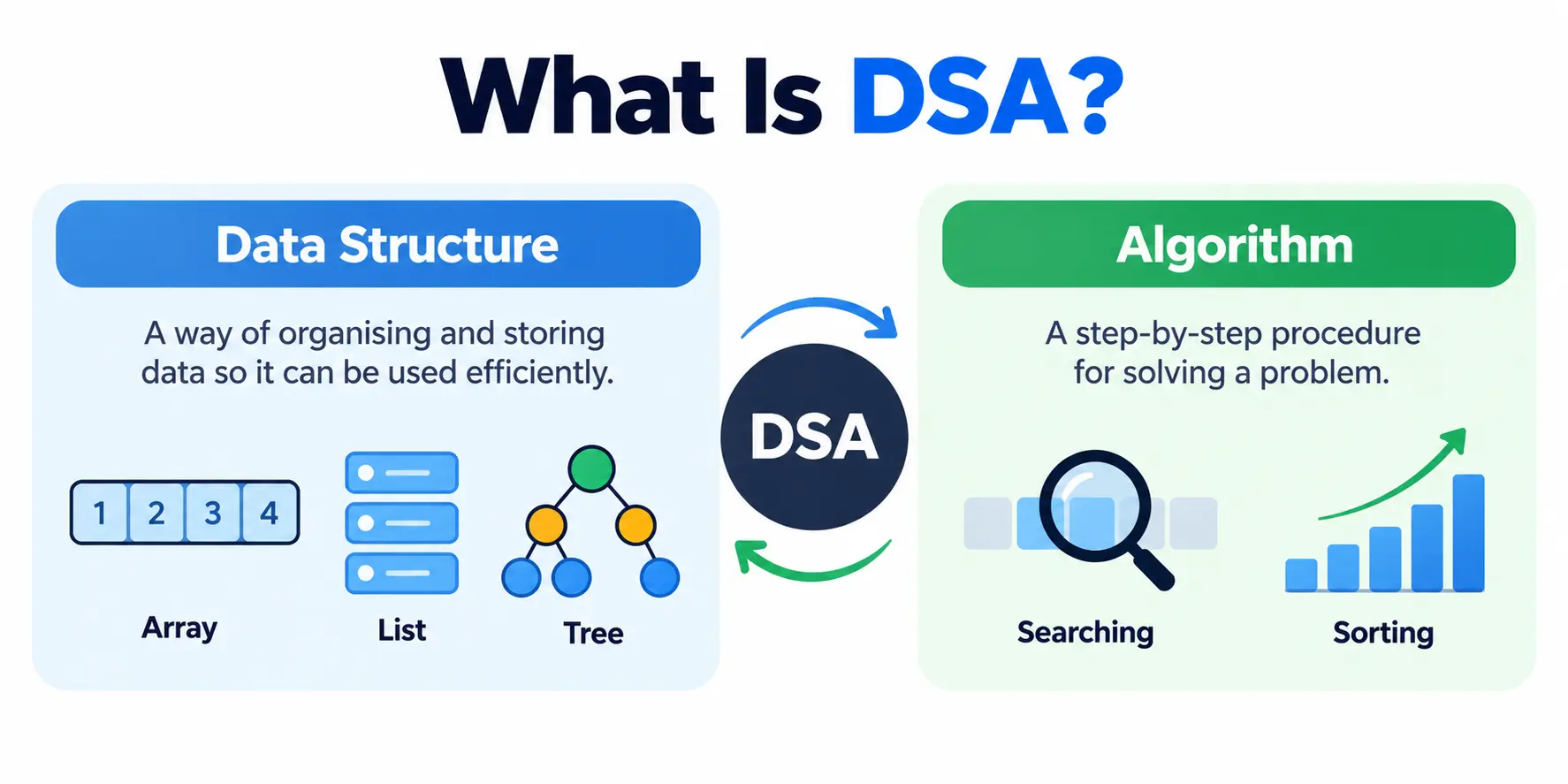











 ROI Calculator