A Demat account holds your shares, bonds, mutual funds and other securities in electronic form, so you do not need physical certificates.
India has two depositories, NSDL and CDSL, but you cannot open an account with them directly. You open one through a SEBI-registered Depository Participant, such as a broker or bank.
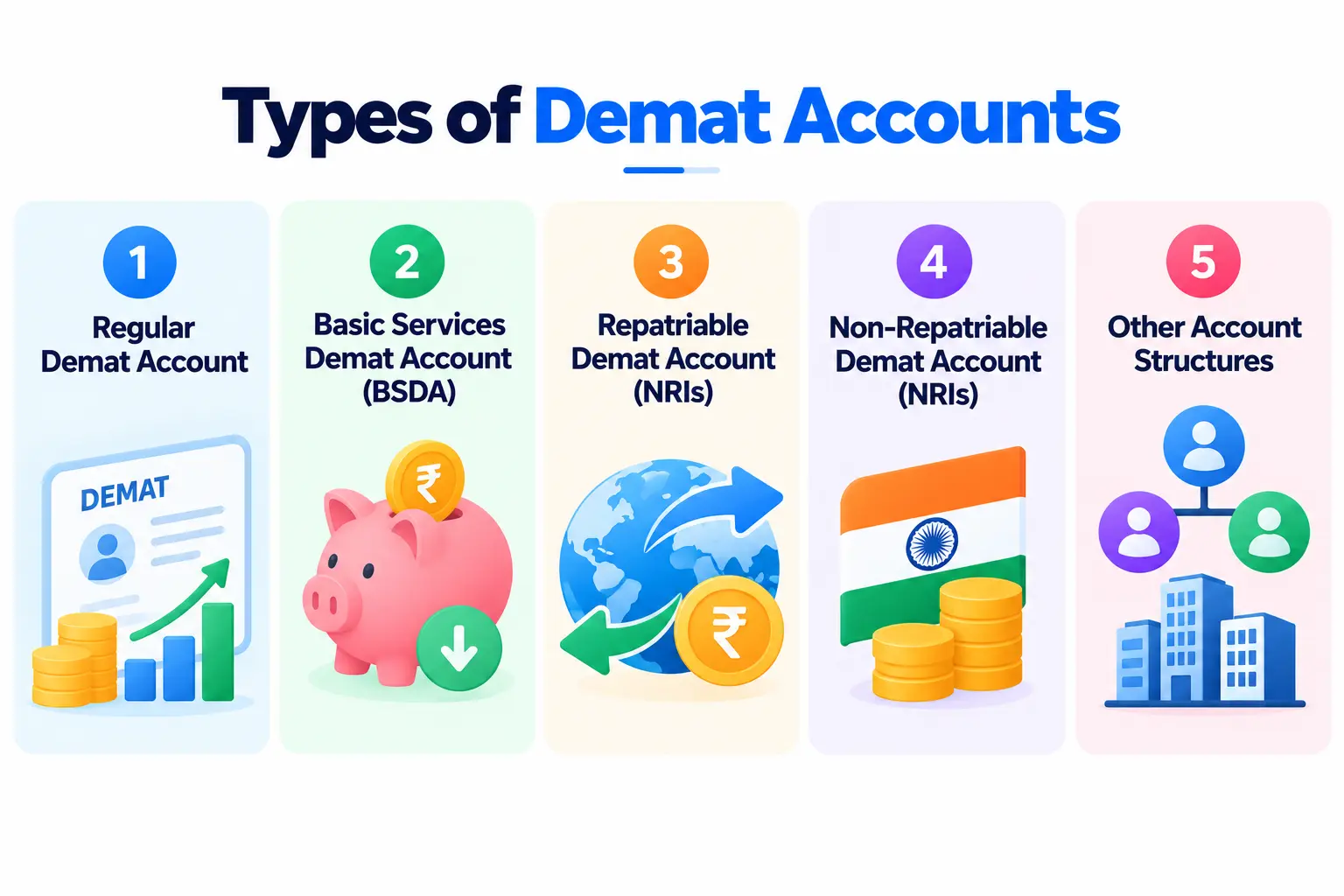
The main types are regular, Basic Services Demat Account (BSDA), and repatriable or non-repatriable accounts for NRIs.
You can open a Demat account online in a short time with PAN, Aadhaar-based eKYC, a linked bank account and a few other details.
You can transfer shares between Demat accounts online or with a Delivery Instruction Slip, and the process differs slightly for intra- and inter-depository transfers.
In this blog, you'll learn what a Demat account is, its types, how to open one, charges, how to transfer shares and how to choose a provider.
If you want to invest in shares, mutual funds or bonds in India, the first thing you will be asked is: "Do you have a Demat account?" It sounds technical, but the idea is simple. It is the electronic locker that holds your investments, much like a bank account holds your money.
This guide explains what a Demat account is, its types, how to open a Demat account, what it costs and how to transfer shares from one Demat account to another. It also covers safety and how to choose a provider.
“Demat” is short for dematerialised. A Demat account is an account that holds securities such as shares, government securities, bonds, exchange-traded funds and mutual fund units in electronic form instead of paper certificates. Before dematerialisation, investors received physical share certificates, which could be lost, stolen, forged or delayed in transfer. Holding them electronically removes these risks and makes buying, selling and transferring securities fast.
When you buy shares, they are credited to your Demat account. When you sell, they are debited, and the money flows through your trading account and linked bank account. If you are new to investing, our guide on financial planning is a useful companion.
Demat Account vs Trading Account vs Bank Account
Account
What it does
Demat account
Holds your securities electronically
Trading account
Lets you place buy and sell orders on the exchange
Savings bank account
Holds money and settles payments
To invest in the stock market, you usually need all three, linked together. Many brokers open the Demat and trading accounts together, which is sometimes called a 3-in-1 account when it includes the bank link.
How a Demat Account Works: Depositories and DPs
India has two depositories that hold securities electronically: NSDL (National Securities Depository Limited) and CDSL (Central Depository Services (India) Limited). As the SEBI investor website explains, both operate under SEBI’s supervision, and investors cannot open an account directly with them. Instead, you open it through a Depository Participant (DP), which is a SEBI-registered intermediary such as a broker or bank.
Think of the depository as the vault and the DP as the branch that serves you. Your ownership is recorded with the depository, not with the broker. This matters because your holdings remain recorded even if you change brokers, and you can move them, as explained below.
The standard account for resident Indians. It has no cap on the value of securities held and usually carries an annual maintenance charge (AMC).
2. Basic Services Demat Account (BSDA)
A low-cost option for small investors. Only individuals can hold it, and you can have only one BSDA across both depositories. SEBI revised the holding limit to ₹10 lakh in 2024, and brokers describe lower or nil AMC at smaller holding levels. Confirm the exact charges with your DP, since tariffs differ.
3. Repatriable Demat Account (NRIs)
For non-resident Indians whose investments are linked to an NRE account, allowing sale proceeds to be moved abroad subject to applicable rules.
4. Non-Repatriable Demat Account (NRIs)
For NRIs investing through an NRO account, where funds generally stay in India.
5. Other Account Structures
Minors can hold accounts through a guardian, joint accounts allow up to three holders, and corporate or institutional accounts serve companies and funds.
What Can You Hold in a Demat Account?
Equity shares and IPO allotments (see our explainer on what an IPO is)
Mutual fund units, as covered in our guide to mutual funds
Government securities and bonds
Exchange-traded funds and some other listed instruments
Understanding how these investments differ helps you build a balanced mix, which our article on debt vs equity financing touches on from the company side.
Free Courses
Free Finance Courses with Certificate – Finance for All
Safety: no risk of loss, theft or forgery of paper certificates.
Speed: trades settle electronically, and transfers are faster than paper.
Convenience: manage your holdings from an app or website.
Lower paperwork: corporate actions such as dividends, splits and bonus shares are credited directly.
Nomination: you can appoint nominees so heirs can claim securities more easily.
Single view: a consolidated statement shows holdings across depositories.
How to Open a Demat Account Online
Opening a Demat account is now mostly digital and can often be completed in a short sitting.
Documents You Need
PAN card (mandatory)
Aadhaar for eKYC, or other address proof
A bank account to link, with a cancelled cheque or bank statement
A photograph and signature
Mobile number and email linked to Aadhaar, for OTP verification
Steps to Open a Demat Account
Choose a DP: pick a SEBI-registered broker or bank. Compare charges, platform quality and customer support. Our overview of the best trading apps in India can help you shortlist.
Start the application: enter your mobile number, email and basic details on the DP’s website or app.
Complete KYC: verify PAN and Aadhaar, and upload any required documents.
Add bank details: link your bank account for fund transfers.
Do the in-person or video verification: many providers use a short video check.
Sign the agreement: e-sign the account opening form and terms.
Receive your account details: after verification, you receive your client ID and login credentials.
Add a nominee: update your nomination to protect your family’s access.
Always deal only with a SEBI-registered Depository Participant, and verify the registration before sharing documents.
Demat Account Charges
Charges vary by provider, so read the tariff sheet. Common charges include:
Account opening fee: often free, but some providers charge.
Annual maintenance charge (AMC): a yearly fee for holding the account.
Transaction or DP charges: a fee, usually per sell transaction.
Off-market transfer charges: a fee when you transfer securities outside the exchange.
Pledge and other service charges: for margin pledges, physical statements or similar services.
There is no minimum balance requirement for a Demat account. Because every provider’s fees are different, compare the total cost based on how often you trade rather than only the account opening fee.
How to Transfer Shares from One Demat Account to Another
You can move shares from one Demat account to another without selling them, for example when changing brokers. There are two main situations.
Intra-depository transfer: both accounts are with the same depository, such as CDSL to CDSL or NSDL to NSDL. This is also called an off-market transfer.
Inter-depository transfer: the accounts are with different depositories, such as NSDL to CDSL.
Offline: Using a Delivery Instruction Slip (DIS)
Get a Delivery Instruction Slip from your current DP.
Fill in your account number (the DP ID and client ID), the target account details, the ISIN and quantity of each security.
Tick the right transfer type: off-market for same-depository transfers, or inter-depository for different ones.
Sign and submit it to your current DP, and keep the acknowledgement.
The DP verifies and processes it, which commonly takes a few business days.
Online: Using NSDL SPEED-e or CDSL EASIEST
If your account supports it, register for NSDL’s SPEED-e or CDSL’s EASIEST facility, enter the target account and the securities, and authenticate the instruction, usually with an OTP.
Important Points Before You Transfer
Transfers are generally permitted between accounts in the same name or with the same joint holders in the same order.
Securities with a lock-in can only be moved within the same depository.
Brokers may charge a fee per ISIN or per instruction, so check first.
Moving shares between your own accounts is not a sale, but check the tax position for transfers to other people with a tax professional.
If you are closing your old account, you can ask for a closure-cum-transfer to move everything at once.
A Demat account is the electronic home for your investments. Open it with a SEBI-registered DP, choose the account type that fits your situation, compare charges, protect your credentials and learn how to transfer holdings when you switch providers. The earlier you start, the easier it is to build good investing habits.
If you want to build a career in banking and finance, the IIM Trichy Post Graduate Certificate Programme in Banking and Finance is a one-year online programme for graduates with at least five years of post-qualification experience. Its curriculum includes financial markets and institutions, covering the capital market, trading and settlement, along with risk management, fixed income and fintech. Please check the programme page for current batch details, and see our guide to the best finance courses in India for alternatives.
Frequently Asked Questions
A Demat account is an account that holds shares, bonds, mutual funds and other securities in electronic form instead of paper certificates. It is opened through a SEBI-registered Depository Participant and held with NSDL or CDSL.
Choose a SEBI-registered broker or bank, submit your PAN, Aadhaar-based eKYC, bank details, photograph and signature, complete verification, e-sign the agreement and receive your account details.
Yes, to hold listed shares electronically you need a Demat account. You also need a trading account to place orders.
Regular, Basic Services Demat Account (BSDA), and repatriable and non-repatriable accounts for NRIs. Minor, joint and corporate accounts are also available.
Submit a signed Delivery Instruction Slip to your current DP, or use NSDL SPEED-e or CDSL EASIEST. Choose off-market for same-depository transfers and inter-depository for transfers between NSDL and CDSL.
Yes, you can open more than one Demat account, with the same or different providers. Each regular account may carry its own charges, and only one BSDA is allowed across depositories.
No minimum balance is required, though you may pay annual maintenance and transaction charges depending on your provider.
A Demat account stores your securities, while a trading account is used to place buy and sell orders. You usually need both, along with a linked bank account.
Arif Siddiqui
Head of Accounting and Treasury
Arif Siddiqui is a finance leader specializing in accounting, treasury, and financial strategy. As Head of Finance at Generali Employee Benefits, he brings extensive experience in managing global financial operations. He is known for driving financial efficiency and governance across organizations. His leadership supports sustainable business growth and financial excellence.

 October 24, 2026
 7 min read




 Key Insights
 ChatGPT
 Perplexity
 Claude
 Grok








 ROI Calculator