
Degree vs Skills: What Do Employers Value Most in 2026?
 September 11, 2026
 8 min read




Table Of Content
- The Scale of the Shift: Degree-Based Hiring Is Losing Its Grip
- Why the "Skills or Degree" Question Feels More Relevant Than Ever
- What Are Skill-Based Degrees, and Why Are Employers Warming to Them?
- Top Skills: What Employers Value Most in 2026
 Key Insights
- Employers are increasingly looking beyond degrees and academic scores, giving more importance to practical skills, certifications, portfolios, internships, and project experience.
- AI and changing job requirements are increasing the value of skills such as problem solving, adaptability, decision making, communication, and continuous learning.
- Skill based degrees combine formal education with practical learning through projects, certifications, apprenticeships, and employer collaborations.
- Life skill degrees focus on durable skills such as communication, teamwork, critical thinking, adaptability, and problem solving that remain useful as technology changes.
- In this blog, you'll learn how skill vs degree is shaping hiring in 2026, where degree based hiring still matters, and how combining academic qualifications with practical and life skills can strengthen your career.
For decades, the traditional job path looked simple: get a degree, put it on your resume, and let the credential open doors for you. However, over the past few years, that formula is being rewritten. Walk into any HR conference or scroll through hiring reports in 2026, and you will hear the same refrain i.e. employers are no longer just asking what school you went to; they are asking what you can actually do. This has turned skill vs. degree into one of the defining debates of the modern workplace, and the answer is more nuanced and more interesting than a simple "skills win" headline suggests.
This blog uncovers where the data stands, why the shift is happening now, and how job seekers, career switchers, and even parents guiding students can make sense of the skills or degree dilemma in 2026.
 ChatGPT
 Perplexity
 Claude
 Grok
GrokThe Scale of the Shift: Degree-Based Hiring Is Losing Its Grip
The numbers tell a striking story. 34% of organizations reported often or almost always using skills-first strategies in hiring, while relevant work experience and demonstrated skills ranked as the top hiring factors. (SHRM.org)
Major employers, including IBM, Google, Delta Air Lines, and Bank of America, have publicly dropped four-year degree requirements for a significant share of their roles, and the trend has spread well beyond tech into finance, aviation, retail, and even state government hiring in parts of the United States.
In India, the traditional approach to hiring is gradually changing. While a bachelor’s degree continues to be an important qualification for many jobs, employers are increasingly looking beyond degrees and academic scores to assess what candidates can actually do. With AI, automation, and rapidly changing job requirements reshaping the workplace, practical skills and demonstrated abilities are becoming increasingly valuable.
This does not mean degree-based hiring is disappearing. Instead, a degree is becoming one signal among several. Certifications, portfolios, skill-based assessments, internships, and hands-on project experience are increasingly helping employers evaluate whether a candidate has the practical capabilities required for the role.
Why the "Skills or Degree" Question Feels More Relevant Than Ever
A few important factors are making this debate more relevant in 2026:
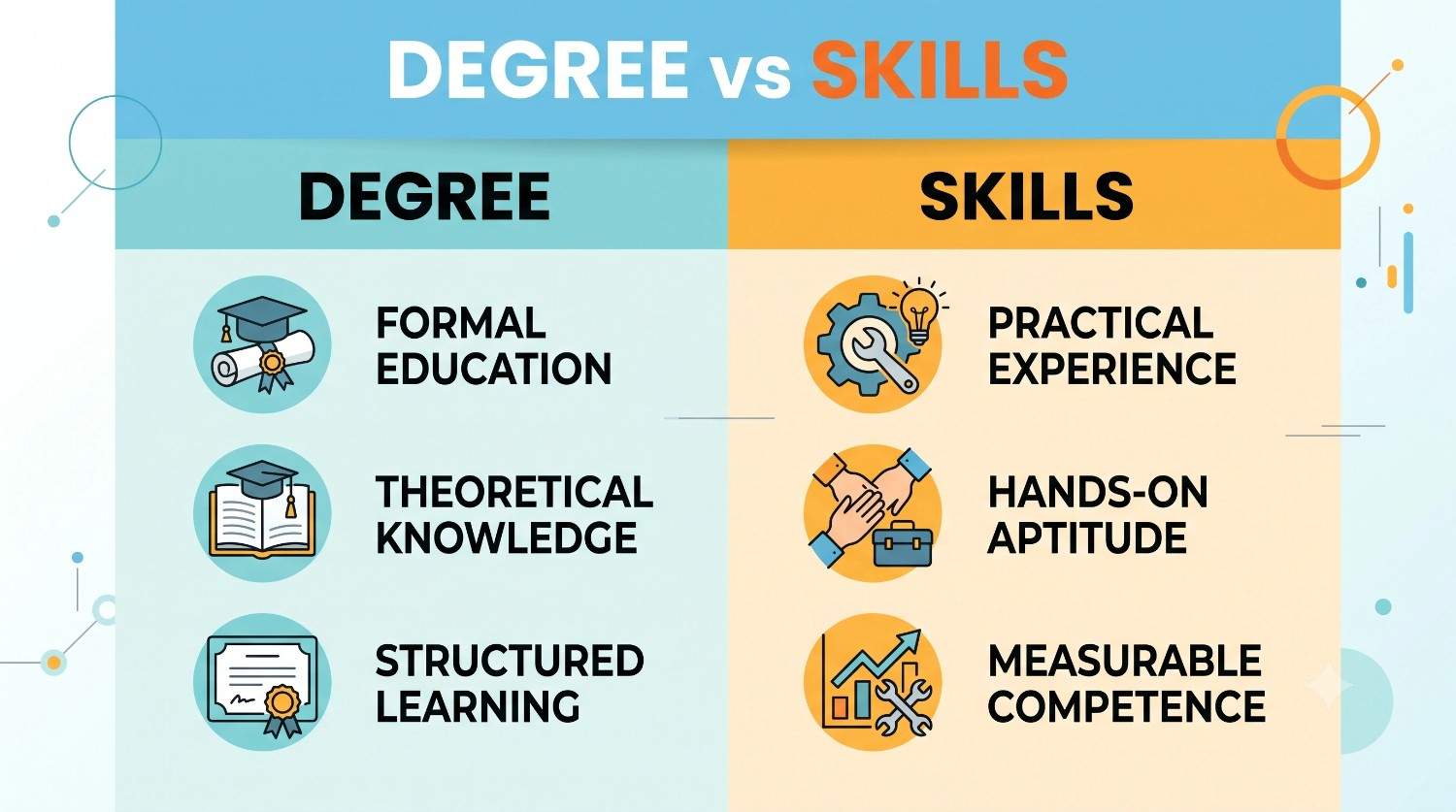
AI is changing what it means to be qualified. As AI takes over routine tasks, employers are giving more importance to skills such as problem-solving, adaptability, decision-making, and the ability to use AI tools. These skills may not always be clear from a degree, but they can be shown through assessments, portfolios, and practical projects.
Talent shortages are changing hiring practices. Many companies still struggle to find candidates with the right skills. Skills-based hiring can help employers reach a larger pool of capable candidates by reducing the focus on degree requirements that may exclude people who can perform the job well.
Skills are becoming a stronger measure of ability. Research suggests that assessing candidates based on their actual skills can be more effective than looking only at their educational qualifications. Companies using skills-based hiring are also reporting better hiring outcomes and improved employee retention.
Verifying skills is still a challenge. Many employers are interested in skills-based hiring but find it difficult to confirm whether candidates genuinely have the skills they claim. Checking a degree is simple, while verifying practical skills requires assessments, projects, interviews, or other forms of proof. This is influencing how hiring practices are evolving.
What Are Skill-Based Degrees, and Why Are Employers Warming to Them?
One important development in this area is the rise of skill-based degrees and certificate programmes that focus on practical, job-ready skills rather than only theoretical learning. Traditional degrees often focus on building broad subject knowledge, while skill-based programmes focus more on what students can actually do after completing the course. For example, can they build an application, analyze financial risk, run a digital marketing campaign, or manage a project?
These programmes often include practical projects, industry certifications, apprenticeships, and opportunities to work with employers. For learners, a skill degree offers a balance between formal education and practical learning. It provides the value and structure of a recognized program while helping students develop skills that employers need.
Employers are also showing growing interest in certifications and practical qualifications. Many hiring managers consider these credentials useful indicators of whether a candidate is ready for a job. This is one reason skill-based degrees, bootcamp-to-degree programmes, and short term micro credentials are becoming more popular. They help bridge the gap between what students learn and the skills employers expect.
Top Skills: What Employers Value Most in 2026
| Skill | Why It Matters in 2026 |
| AI & Generative AI | Helps professionals work efficiently with AI-powered tools and workflows. |
| Data Analysis | Enables better decision-making using data and business insights. |
| Digital & Technology Skills | Helps employees adapt to rapidly changing digital workplaces. |
| Cybersecurity | Increasingly important for protecting data, systems, and digital operations. |
| Communication | Supports effective collaboration, presentations, and stakeholder management. |
| Critical Thinking | Helps professionals analyse problems and make informed decisions. |
| Adaptability | Enables employees to learn new tools, technologies, and processes quickly. |
| Problem-Solving | Helps teams handle challenges and develop practical solutions. |
| Leadership | Important for managing teams, projects, and business responsibilities. |
| Project Management | Helps professionals plan, execute, and deliver projects effectively. |
| Creativity & Innovation | Supports new ideas, improved processes, and business growth. |
| Emotional Intelligence | Strengthens teamwork, relationship management, and workplace communication. |
Life Skill Degrees: The Quiet Category Gaining Attention
A related but distinct trend is the growing interest in life skill degrees, i.e., programs and credentials that build durable, transferable capabilities such as communication, financial literacy, critical thinking, emotional intelligence, negotiation, and adaptability, alongside or instead of narrow technical training.
This is important because technical skills can become outdated quickly. A programming language, software, or industry tool may change within a few years. However, skills such as communication, teamwork, problem-solving, adaptability, and continuous learning remain useful for a much longer time.
Employers are giving increasing importance to these soft skills, often called durable skills, along with technical knowledge. They are especially valuable in roles that involve leadership, working with clients, or collaborating with different teams.
Life skill degrees are becoming more popular because they help learners prepare for changing job requirements. These programmes focus on skills such as critical thinking, communication, adaptability, and problem-solving. Learning these skills can help professionals stay relevant even when specific technologies and tools change.



Where Degree-Based Hiring Still Holds Firm
It would be misleading to suggest degrees have become irrelevant. In several fields, degree based hiring remains not just common but essential:
- Regulated professions such as medicine, law, engineering, and accountancy, where the requirement of a license is legally tied to accredited degree completion.
- Research-intensive roles in science, academia, and advanced R&D, where deep theoretical grounding genuinely cannot be substituted by short-form skills training.
- Large corporate graduate programmes, particularly in professional services, consulting, and investment banking, which still use degree as an initial filter, even as they increasingly supplement it with skills assessments.
- Government and public sector roles, though notably, a growing number of state and federal bodies have begun formally removing degree requirements from job postings, signalling movement even in traditionally conservative hiring environments.
The honest takeaway is that the skill vs. degree question does not have a single universal answer rather, it depends heavily on the profession, the seniority of the role, and whether public trust or legal compliance is riding on the credential.
How to Decide: Skills or Degree for Your Own Career Path
For an individual weighing this decision, a few practical questions help make the right choice:
- Is your target field regulated or credential-gated? If you are aiming for medicine, law, or a licensed engineering track, the degree is non-negotiable regardless of hiring trends elsewhere.
- Can you demonstrate your ability directly? In fields like software development, digital marketing, design, data analytics, and project management, a strong portfolio, real project work, or a respected skills-based degree can carry as much or more weight than a traditional four-year degree, especially at small and mid-sized employers.
- Do you need the network and brand signal a degree provides? Traditional degrees, particularly from well-regarded institutions, still carry brand value that opens certain doors. Especially for first jobs, visa sponsorship in some countries, and access to certain graduate recruitment pipelines.
- How fast is your target field changing? In rapidly evolving domains such as AI, cybersecurity, and digital marketing, a stackable skill degree or certification that can be refreshed every couple of years may serve you better than a static degree completed once and rarely revisited.
There is no universally “right” answer to skills or degree!
The right choice depends on matching your credential strategy to the specific expectations of your target industry and role level.
The Hybrid Future: Neither Skills Nor Degrees Alone
Perhaps the most accurate way to frame 2026’s hiring landscape is not as a battle where one side wins, but as a convergence. The most forward-looking employers are not asking candidates to choose between skill and degree; they are building hiring processes that weigh both, alongside structured skills assessments, portfolios, and practical interviews.
Universities and training providers are responding in kind, increasingly designing programmes that combine academic depth with applied, skill-based degree components such as capstone projects, industry certifications, internships, and employer collaborations directly into the curriculum. The clearest sign of where things are heading is the growing number of institutions marketing their offerings explicitly as bridging this gap, rather than treating academic rigor and job readiness as separate goals.
Conclusion
The skill versus degree debate in 2026 is not about choosing skills over education or degrees over practical ability. It is about showing employers that you can do the job, communicate well, adapt to change, and continue learning.
This proof can come from a traditional degree, a skills-based degree, practical work, a portfolio, certifications, or programmes that develop important life skills. The key message for employers is simple: show what you can do, not just what qualifications you have.
For students and job seekers, the best approach is to build a combination of academic knowledge, practical skills, and strong human skills. This can help create a stronger profile and meet the changing expectations of employers.
Frequently Asked Questions
Employers increasingly value practical skills, relevant experience, certifications, and problem-solving abilities along with academic qualifications. The importance of a degree still depends on the industry and job role.
In some industries and roles, strong skills, certifications, portfolios, and practical experience can help candidates compete without a traditional degree. However, some professions still require specific academic qualifications.
Employers are placing greater importance on skills such as AI literacy, communication, problem solving, adaptability, critical thinking, teamwork, and continuous learning.
Students should ideally build both. A recognized degree can provide academic knowledge and credibility, while practical skills, certifications, projects, and internships can demonstrate job readiness.

Related Courses
Explore our programs



Find a Program made just for YOU
We'll help you find the right fit for your solution. Let's get you connected with the perfect solution.

Is Your Upskilling Effort worth it?
 ROI Calculator

Are Your Skills Meeting Job Demands?
Try our Skill Gap tool
Experience Lifelong Learning and Connect with Like-minded Professionals
Explore Jaro Connect

