HOME > BLOG > Career Development > How to Change Careers Without Quitting Your Job: A Step-by-Step Strategy
Career Development
How to Change Careers Without Quitting Your Job: A Step-by-Step Strategy
J
By Bhargavi R
September 1, 20269 min read
Published on September 1, 2026
SHARE THIS ARTICLE
Table Of Content
Why Consider a Career Change Without Quitting?
Career Change at 30: What Should You Consider?
Career Change at 40: How to Make It Strategic
Common Mistakes to Avoid During a Career Switch
Key Insights
Staying employed during a career change can provide financial stability and time to explore, learn, and plan your transition more carefully.
Identify your target career, research its requirements, and compare them with your existing transferable skills to create a realistic transition plan.
Build relevant skills through focused learning and test the new career through practical projects, freelance work, volunteering, networking, or opportunities within your current organization.
Reposition your resume and LinkedIn profile around transferable skills and achievements, while creating a financial safety net to reduce pressure during the transition.
In this blog, you'll learn how to plan a career change at 30, approach a career change at 40, build a portfolio, network effectively, avoid common career switch mistakes, and follow a simple 90-day transition plan.
Changing careers can feel like a risky decision, especially when your current job provides financial stability, professional experience, and a predictable routine. However, a career change does not always require you to resign first and figure everything out later. In fact, staying employed while exploring a new direction can give you the time, income, and confidence needed to make a more informed transition.
Whether you are considering a career change at 30, exploring new opportunities in your 40s, or simply feeling ready for a career switch, the smartest approach is to build a bridge between your current career and your desired one. You can research new roles, develop relevant skills, build experience, connect with professionals, and even test potential career paths while continuing to earn a salary.
Quitting your job before having a clear plan can create unnecessary financial and emotional pressure. Remaining employed gives you the flexibility to explore your options without making an immediate commitment.
A gradual transition also allows you to understand whether you genuinely want a new career or simply want to leave your current workplace. Sometimes, the problem is not the profession itself but the company culture, workload, manager, compensation, or lack of growth.
A planned approach helps you answer important questions:
What exactly do I want to change?
Which careers match my existing skills?
What new skills do I need?
Can I realistically enter the new field?
Will the transition affect my income?
How can I gain experience before leaving my current job?
Once you have answers, your career switch becomes a structured process rather than an impulsive decision.
Step 1: Identify Why You Want to Change Careers
Before searching for a new job, understand what is driving your decision.
Write down what you like and dislike about your current career. Consider your daily responsibilities, work environment, salary, growth opportunities, working hours, and long-term prospects.
For example, if you work in sales but dislike constant targets, you may not necessarily need to leave the entire business field. You might explore roles in business development, account management, customer success, or marketing.
Similarly, if you are unhappy with your current company but enjoy your profession, changing employers could solve the problem without requiring a complete career change.
The goal is to identify the actual problem before choosing the solution.
Step 2: Define Your Target Career
Avoid starting with a broad goal such as “I want a better career.” Instead, identify one or two specific career paths that interest you.
Research job descriptions, required qualifications, common responsibilities, salary expectations, and growth opportunities. Look at professionals currently working in those roles and study their career paths.
Ask yourself:
What does a typical day in this career look like?
What skills do employers expect?
What qualifications are commonly required?
Which of my current skills can I use?
What gaps do I need to close?
The more specific your target becomes, the easier it will be to create a transition plan.
Step 3: Audit Your Transferable Skills
One of the biggest mistakes during a career change is assuming that you are starting from zero.
Your current experience may be valuable in your target career. Skills such as communication, leadership, project management, problem-solving, data analysis, stakeholder management, sales, and client handling can often transfer across industries and functions.
Now compare the lists. The overlap represents your existing advantage, while the gaps show where you need to focus your learning.
This approach can make a career transition faster and more realistic because you are building on your experience rather than discarding it.
Step 4: Learn the Skills You Actually Need
Once you understand your skill gaps, create a focused learning plan.
You do not necessarily need another full degree. Depending on your target career, you may be able to develop relevant capabilities through online courses, certifications, workshops, professional programs, books, or practical projects.
For example, someone moving into digital marketing may need to learn SEO, analytics, paid advertising, and content strategy. Someone moving into product management may need knowledge of product strategy, customer research, analytics, roadmapping, and product development.
The important point is to avoid collecting qualifications without a purpose.
Choose learning opportunities that help you answer one question:
“Will this help me become qualified for the role I want?”
Set aside a specific number of hours every week for learning. Even a few focused hours can create meaningful progress when maintained consistently.
Step 5: Test the New Career Before You Commit
One of the safest ways to explore a new career is to experience some of the work before leaving your current position.
You can:
Take on a small freelance project
Volunteer for relevant work
Create portfolio projects
Shadow someone in the industry
Participate in professional communities
Attend industry events
Speak with people already working in the field
Take on relevant responsibilities within your current organization
This gives you practical exposure.
You may discover that the career you imagined is very different from the actual work. Finding that out while you still have a stable job is far better than discovering it after resigning.
Step 6: Build a Portfolio of Proof
Qualifications can demonstrate that you have learned something, but practical work can show that you know how to apply it.
If possible, create projects that demonstrate your new capabilities.
For example, an aspiring data analyst could create dashboards using sample datasets. Someone interested in content marketing could create a content strategy and sample campaigns. An aspiring product manager could develop a product case study, user research report, or product roadmap.
Your portfolio does not need to be huge. A few strong examples can be more useful than a long list of unfinished projects.
The objective is to give recruiters or hiring managers evidence that you can perform relevant tasks even though your previous job title may be different.
Step 7: Start Networking Before You Start Applying
Networking should begin before you leave your current job.
Connect with professionals working in your target field and learn about their experiences. Ask thoughtful questions rather than immediately asking for a job.
You can discuss:
How they entered the industry
Skills that matter most
Common entry-level challenges
Certifications that are actually useful
Roles suitable for career changers
Skills employers currently value
Networking can also help you discover opportunities that may not be obvious through traditional job searches.
Your existing professional network can be especially valuable because former colleagues, clients, managers, and industry contacts may know about opportunities that align with your new direction.
Step 8: Reposition Your Resume and LinkedIn Profile
A resume designed for your old career may not communicate your value for your new one.
Instead of focusing entirely on your previous job title and responsibilities, emphasize achievements and transferable skills that connect with the target role.
For example, rather than simply stating that you “managed a team,” explain the outcome you achieved through leadership.
Your professional profile should also communicate your new direction clearly. If you are moving from operations into project management, your profile should highlight project coordination, stakeholder management, process improvement, and leadership experience.
The objective is to make your career transition look intentional rather than random.
Step 9: Use Your Current Job as a Transition Platform
Your existing organization may provide opportunities to make your career transition easier.
Look for internal projects, cross-functional assignments, training programs, or opportunities to collaborate with the department you want to enter.
For example, someone working in finance who wants to move into business analyticscould volunteer for reporting or data-related projects. A marketing professional interested in product management could collaborate with product teams on customer research or product launches.
An internal move can sometimes be easier than entering an entirely new organization because you already understand the company, its processes, and its culture.
Step 10: Create a Financial Safety Net
Financial planning is one of the most important parts of a successful career transition.
Before resigning, review your monthly expenses, savings, debt obligations, family responsibilities, and expected costs for learning or certification.
Create a realistic transition budget.
Consider:
How much money you need for essential expenses
Whether your new role may initially pay less
The cost of additional education
Potential gaps between jobs
Emergency savings
Insurance and other benefits
A financial cushion gives you greater flexibility when evaluating opportunities. It also reduces the pressure to accept the first job available.
A career change at 30 can be a strategic opportunity to redirect your professional life while building on the experience you have already gained.
By this stage, you may have several years of professional experience and a clearer understanding of your strengths and interests. Instead of completely starting over, look for adjacent careers where your existing skills can provide an advantage.
For example, an IT professional might move into product management, a finance professional could explore business analytics, or a sales professional might transition into customer success.
The key is to focus on skill transfer rather than starting from scratch.
Career Change at 40: How to Make It Strategic
A career change at 40 may require more financial and family planning, but age does not automatically make a transition unrealistic.
Professionals with significant experience often have valuable advantages, including industry knowledge,leadership experience, professional networks, and a strong understanding of business operations.
The strategy should therefore be different from that of someone entering the workforce for the first time.
Instead of positioning yourself as a beginner, identify roles where your previous experience provides value. You may be able to move into consulting, leadership, strategy, training, business development, product roles, or another adjacent field.
If the transition requires a significant skill change, consider a phased approach: continue working, learn the required skills, gain practical experience, and begin applying once you have credible evidence of your capabilities.
Free Courses
Finance for All – Free Finance Certification Course
A career switch becomes much easier when you avoid common mistakes.
Quitting before researching: Leaving your job without understanding the target career can create unnecessary financial pressure.
Changing careers because of temporary frustration: Make sure you want to leave the profession, not just your current workplace.
Learning without practicing: Courses are useful, but practical projects help demonstrate your capabilities.
Trying to change everything at once: Changing industry, function, location, and seniority simultaneously can make the transition significantly harder.
Ignoring transferable skills: Your existing experience can be one of your strongest assets.
Expecting an immediate salary increase: A career transition may require patience, especially when moving into a new function or industry.
A Simple 90-Day Career Change Plan
You can break your transition into three phases.
Days 1–30: Research and Planning
Identify your target career, research job descriptions, audit your transferable skills, and identify your biggest skill gaps.
Days 31–60: Learning and Experience
Start targeted learning, build one or two practical projects, connect with professionals, and seek relevant opportunities within your current organization.
Days 61–90: Positioning and Job Search
Update your resume and LinkedIn profile, prepare your career-change story, build your portfolio, reach out to your network, and begin applying for carefully selected roles.
After 90 days, evaluate your progress. You may be ready to pursue opportunities actively, or you may discover that you need more experience or training before making the final move.
A successful career change does not have to begin with a resignation letter. In many cases, the smarter strategy is to stay employed while you explore, learn, experiment, network, and build proof of your capabilities.
Whether you are planning a career change at 30, considering a career change at 40, or simply looking for a meaningful career switch, focus on creating a practical bridge between where you are today and where you want to be.
The goal is not to make a dramatic leap. It is to reduce uncertainty step by step until your next career move becomes a calculated decision rather than a risky guess.
Frequently Asked Questions
Yes. You can research new careers, develop skills, complete certifications, build portfolio projects, network with professionals, and explore internal opportunities while remaining employed. This approach can reduce financial pressure and help you make a more informed decision.
No. A career change at 30 can be an opportunity to use your existing professional experience while moving toward a role that better matches your skills and interests. Identifying transferable skills can make the transition more manageable.
Yes, but it usually requires careful planning. Professionals considering a career change at 40 should evaluate their financial responsibilities, transferable skills, learning requirements, and target roles before making a transition.
There is no fixed timeline. An adjacent move may happen relatively quickly, while a transition involving a completely new industry and function may require substantially more time. Your timeline will depend on your existing skills, the target role, required qualifications, and opportunities available.
Not always. The right choice depends on the target career. Some roles require formal qualifications, while others can be entered through focused certifications, practical experience, and transferable skills. Research the requirements of your target roles before investing in a new degree.
Bhargavi R
HR Professional
Bhargavi Reddy is an HR professional with over 6 years of experience in IT recruitment and talent acquisition. She specializes in hiring across technologies like Java, DevOps, Python, and Data Engineering. With strong expertise in full-cycle recruitment and stakeholder management, she focuses on building high-performing teams. Currently, she works as an HR Manager driving strategic hiring initiatives.
 HOME > BLOG > Career Development > How to Change Careers Without Quitting Your Job: A Step-by-Step Strategy
 September 1, 2026
 9 min read




 Key Insights
 ChatGPT
 Perplexity
 Claude
 Grok
Grok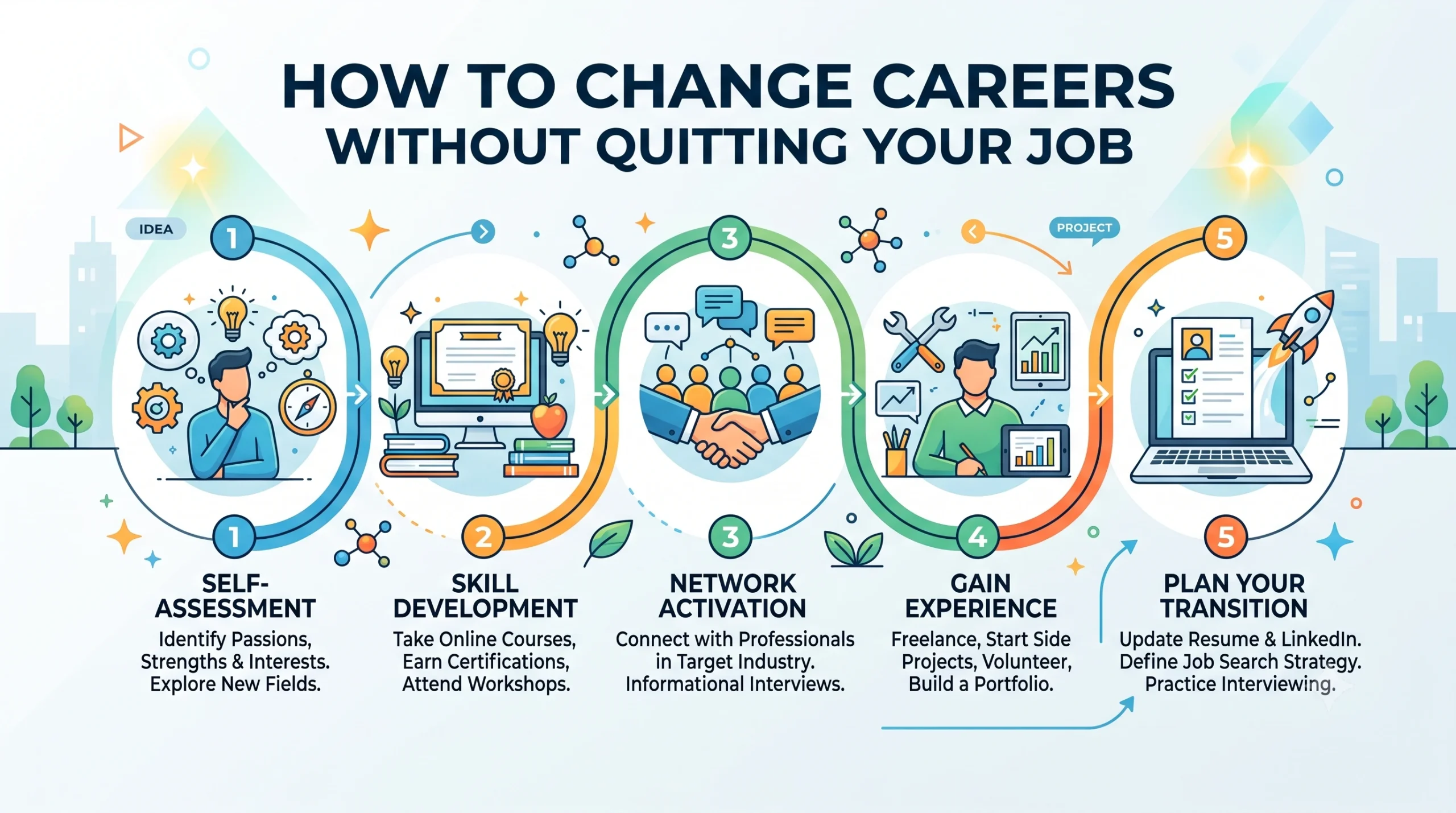










 ROI Calculator