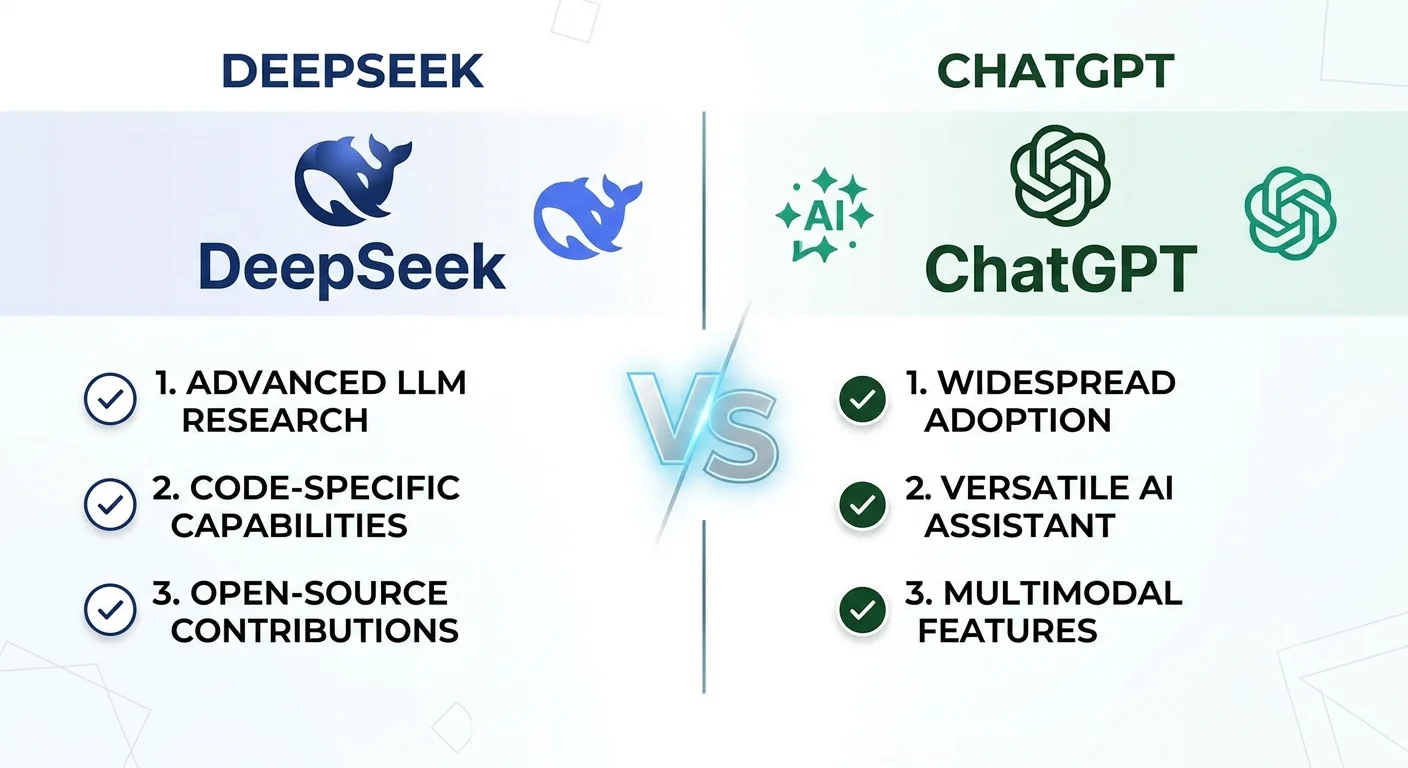
DeepSeek focuses strongly on reasoning, coding, mathematics, and openly released AI models, while ChatGPT offers a broader AI assistant ecosystem.
The difference between DeepSeek and ChatGPT extends across reasoning, coding, writing, research, multimodal capabilities, and available tools.
Both DeepSeek and ChatGPT can support complex tasks, but the experience can vary based on the model, prompt, task, and available tools.
Choosing DeepSeek or ChatGPT depends on individual requirements, such as AI model experimentation, programming, research, writing, voice, image generation, or professional workflows.
In this blog, you'll learn about the DeepSeek vs ChatGPT comparison, their key differences, reasoning and coding capabilities, writing and research features, multimodal functionality, use cases, and factors to consider when choosing between them.
Artificial intelligence has moved far beyond simple chatbots. In 2026, AI tools are being used for writing, coding, research, data analysis, content creation, problem-solving, and even complex multi step workflows. Among the most discussed platforms are DeepSeek and ChatGPT, both of which have evolved rapidly in recent years.
So, when it comes to DeepSeek vs ChatGPT, what actually sets them apart? Is DeepSeek better for reasoning and coding? Does ChatGPT offer a broader set of features? And when should you choose DeepSeek or ChatGPT?
The answer depends on what you want to accomplish. This blog explains the difference between DeepSeek and ChatGPT, their key features, strengths, use cases, and how they compare in 2026.
DeepSeek and ChatGPT are both AI powered platforms, but their development approaches and product ecosystems are different.
DeepSeek has gained attention for its reasoning focused models and open model approach. Its V3 and R1 releases helped establish the platform as a significant competitor in AI, particularly for mathematics, coding, and reasoning tasks. DeepSeek has continued releasing newer models in 2026, including the V4 family and V4.1 Flash.
ChatGPT, developed by OpenAI, has evolved into a broader AI assistant that combines language models with tools for research, coding, image generation, voice conversations, documents, and other workflows. OpenAI’s 2026 updates include GPT 5.6 and the introduction of GPT 6 Astra for selected organizations.
Quick Comparison of DeepSeek and ChatGPT
Feature
DeepSeek
ChatGPT
Primary focus
Reasoning, coding and AI models
General purpose AI assistant
Reasoning
Strong reasoning focused models
Advanced reasoning models and automatic model selection
Coding
Strong coding and technical capabilities
Coding, debugging and agentic workflows
Open model approach
Several models and weights released openly
Primarily proprietary models
Multimodal capabilities
Newer V4 models support multimodal capabilities
Strong text, image, voice and multimodal capabilities
Research
Search and research capabilities
Web search and deep research features
Voice
Available features vary by product and model
Dedicated voice models and experiences
Ecosystem
Primarily AI models, API and chat platform
Broader consumer and professional AI ecosystem
The exact capabilities can change as both companies release new models and features.
The biggest difference between DeepSeek and ChatGPT is not simply the quality of their answers. It is the way their AI models and products are designed and the range of tasks they are intended to support.
1. Model Approach
DeepSeek has built several models around different types of workloads. DeepSeek R1, for example, was designed with a strong emphasis on reasoning, while the V3 family focused on general capabilities, coding, and other tasks. DeepSeek’s releases have also included openly available model weights under the MIT License.
ChatGPT uses OpenAI’s GPT model family and provides access to different levels of reasoning depending on the task and user’s plan. In 2026, OpenAI simplified its model picker around Instant, Thinking, and Pro options, while automatic switching can select a suitable reasoning level.
This means the comparison is increasingly about the complete AI experience rather than simply comparing two individual models.
DeepSeek vs ChatGPT for Reasoning
Reasoning is one of the areas where DeepSeek vs ChatGPT comparisons have received significant attention.
DeepSeek R1 was specifically introduced as a reasoning model, with DeepSeek highlighting mathematics, coding and general logic as important strengths.
Later DeepSeek releases continued improving reasoning and agent capabilities. The company’s 2026 V4.1 Flash update reports improvements across coding, mathematics, agent tasks, and multimodal understanding.
ChatGPT has also developed dedicated reasoning capabilities. OpenAI’s GPT 5.4 introduced improvements across reasoning, coding, and agentic workflows, while later GPT 5.6 updates expanded model capabilities further.
For users, the practical difference is that both platforms can handle complex problems, but the experience can differ depending on the model, prompt, task and available tools.
For developers, coding is another important part of the DeepSeek vs ChatGPT debate.
DeepSeek has consistently highlighted programming as a major capability. Its V3 updates included improvements in coding and front end development, while later releases added stronger agent capabilities.
ChatGPT also has a strong focus on coding. OpenAI has developed models and tools for coding, debugging and agentic programming workflows. GPT 5.4, for example, combined improvements in reasoning and coding with support for professional tasks involving software environments and tools.
For a student learning programming, either platform can be useful for explaining code and finding errors. For professional developers, the choice may depend more on repository size, tool integrations, coding workflow, model access and the type of development task.
DeepSeek vs ChatGPT for Writing
Writing is another area where the difference can become noticeable.
ChatGPT is designed as a general purpose assistant and can help with blogs, emails, reports, summaries, brainstorming, editing, and creative writing. OpenAI has also highlighted improvements in instruction following and writing quality across its GPT models.
DeepSeek has also improved its writing capabilities. DeepSeek V3 updates specifically highlighted improvements in Chinese writing and longer form content generation.
For everyday writing, the better option can depend on your preferred tone, language, formatting requirements and how much editing is needed after generation.
DeepSeek vs ChatGPT for Research
Research has become an increasingly important AI use case.
ChatGPT offers web search and deep research capabilities designed to investigate questions, work with multiple sources, and produce structured research outputs. OpenAI’s 2026 deep research updates added more control over websites and connected applications that can be used as trusted sources.
DeepSeek also provides search related capabilities, with its V3 updates describing improvements for report generation and web search scenarios.
However, users should verify important information regardless of the platform. AI systems can still produce incorrect or outdated information, particularly when a question involves rapidly changing facts.
DeepSeek vs ChatGPT: Multimodal Capabilities
Multimodal AI can work with more than just text. It may involve images, voice, and other forms of input.
DeepSeek’s newer V4.1 Flash model includes native multimodal visual understanding, marking an expansion beyond its earlier text focused releases.
ChatGPT has had multimodal capabilities across text and image interactions, while its 2026 updates have expanded voice and image generation experiences. GPT Live 1, for example, supports more natural voice interaction and can work with text and images within conversations.
This makes multimodal functionality an important factor when comparing the two platforms.
The question of DeepSeek or ChatGPT depends largely on your requirements.
Choose DeepSeek when:
You want to experiment with openly released AI models and model weights.
Your work involves reasoning, mathematics, or programming.
You are interested in running or experimenting with AI models in technical environments.
You want to explore DeepSeek’s evolving model ecosystem and API options.
DeepSeek’s open model releases have been an important part of its appeal, with R1 and subsequent releases providing developers and researchers with access to models and technical resources.
Choose ChatGPT when:
You need an AI assistant for a wide range of everyday and professional tasks.
You want writing, research, coding, image, and voice capabilities in one ecosystem.
You need tools for complex research and multi step workflows.
You want an integrated conversational experience rather than only access to an AI model.
ChatGPT’s 2026 ecosystem includes model choices, deep research, voice, image generation, and integrations designed around different types of work.
DeepSeek and ChatGPT: What Is the Future?
The competition between DeepSeek and ChatGPT reflects a broader change in artificial intelligence.
AI development is no longer focused only on producing better text responses. Models are increasingly expected to reason, write code, understand images, use tools, search for information, and complete multi step tasks.
DeepSeek’s rapid model development demonstrates how quickly open and relatively accessible AI models can evolve. Its 2026 releases show continued movement toward stronger reasoning, multimodal understanding, and agent capabilities.
ChatGPT is moving in a similarly broad direction, with OpenAI developing AI systems that can work across research, coding, documents, presentations, voice, and other professional workflows. The introduction of GPT 6 Astra in September 2026 further shows the industry’s movement toward more capable AI systems that can handle complex tasks.
For users, this means the difference between DeepSeek and ChatGPT may become less about one chatbot being universally better and more about which platform fits a particular workflow.
DeepSeek vs ChatGPT: Final Takeaway
The DeepSeek vs ChatGPT comparison has changed considerably as both platforms have developed.
DeepSeek has established a strong identity around reasoning, coding, and openly released models, while continuing to expand into multimodal and agentic capabilities. ChatGPT has developed into a broader AI assistant with advanced reasoning, research, coding, voice, image and productivity features.
So, when deciding between DeepSeek or ChatGPT, think about the task first. A developer interested in model experimentation may have different requirements from a content writer, researcher, student, or business professional.
Rather than asking which platform is universally better, consider what you need from an AI tool: reasoning, coding, writing, research, multimodal interaction, integrations, or a combination of these capabilities. As both DeepSeek and ChatGPT continue to evolve, the most useful choice can change with the task and the model available at the time.
Frequently Asked Questions
The main difference between DeepSeek and ChatGPT lies in their model ecosystems and product focus. DeepSeek has a strong emphasis on reasoning, coding, and openly released models, while ChatGPT provides a broader AI assistant experience with reasoning, research, coding, voice, image, and productivity capabilities.
Both DeepSeek and ChatGPT offer strong coding capabilities. DeepSeek has focused heavily on coding and reasoning, while ChatGPT combines coding with tools and workflows designed for debugging, software development, and other professional tasks.
Both can support research, but their features and workflows differ. ChatGPT offers web search and deep research capabilities, while DeepSeek also provides search and report generation features. For important research, information should always be checked against reliable sources.
Both platforms provide access to their services with availability and limits that can vary by product, model, API, and subscription. Features available to users can also change as new models and plans are introduced.
Dr. Sanjay Kulkarni
Data & AI Transformation Leader
Dr. Sanjay Kulkarni is a Data & AI Transformation Leader with over 25 years of industry experience. He helps organizations adopt data-driven and responsible AI practices through strategic guidance and education. With experience across startups and global enterprises, he bridges the gap between theory and real-world application. His work empowers teams to innovate and thrive in AI-driven environments.
Get Free Upskilling Guidance
Fill in the details for a free consultation
Related Courses
Explore our programs
Chief Technology & AI Officer Post Graduate (PG) Certificate Program

 September 27, 2026
 7 min read




 Key Insights
 ChatGPT
 Perplexity
 Claude
 Grok
Grok







 ROI Calculator