 HOME > BLOG > AI and Machine Learning > Claude vs ChatGPT: An Honest Comparison From a Team That Uses Both
Claude vs ChatGPT: An Honest Comparison From a Team That Uses Both
 August 21, 2026
 6 min read





Table Of Content
- So, Why Are We Even Comparing Claude and ChatGPT?
- Where ChatGPT Still Pulls Ahead for Us
- Where Claude Quietly Wins the Day
- What Happens When You Put Claude vs ChatGPT on the Same Task?
 Key Insights
- ChatGPT stands out for its broad ecosystem, including custom GPTs, image generation, voice, file handling, web search, and connected apps.
- Claude can be particularly effective for long-context work, nuanced writing, substantial documents, data analysis, and larger coding tasks.
- The best choice depends on the task: ChatGPT is often preferred for polished content and creative workflows, while Claude can be stronger when deeper information analysis is required.
- Both tools involve trade-offs such as cost, usage limits, learning curves, expanding ecosystems, and workflow lock-in, making replacement of one platform with another less straightforward.
- In this blog, you'll learn how Claude and ChatGPT compare across writing, research, creative work, document analysis, coding, integrations, and team workflows, and how to evaluate which tool fits your team's needs.
AI tools have become part of everyday work for our team. We use them for writing, research, brainstorming, coding, editing, analysis, and the occasional task that starts with “this should only take five minutes” and somehow becomes an hour-long experiment.
And that is exactly why claude vs chatgpt is an interesting comparison for us.
We don't use one tool exclusively. We use both, and over time, we've noticed that they behave differently depending on the job. ChatGPT often gives us the broader set of tools and integrations we need, while Claude can feel particularly strong when we're working with long documents, nuanced writing, or substantial coding tasks.
So this isn't a “which AI is smarter?” debate. It's a practical look at where each tool fits, what frustrates us, and why some people are adding Claude to their workflow rather than abandoning ChatGPT altogether.
 ChatGPT
 Perplexity
 Claude
 Grok
GrokSo, Why Are We Even Comparing Claude and ChatGPT?
At this point, both Claude and ChatGPT are mainstream AI assistants. The interesting question for a team isn’t necessarily which one has the better model on paper.
It’s which one works better for the task in front of you.
That distinction matters because AI tools have become much more than chatbots. ChatGPT now combines conversational AI with features such as custom GPTs, image generation, voice, file handling, web search, and connected apps.
Claude, meanwhile, has developed its own ecosystem around long-context work, Artifacts, coding, research, and connectors.
For our team, that means the comparison isn’t about choosing a winner once and for all. It’s about knowing when to reach for which tool.
Where ChatGPT Still Pulls Ahead for Us
Let’s start with where ChatGPT genuinely has the advantage.
The biggest difference is the breadth of the ecosystem. ChatGPT isn’t just a model in a chat window anymore. Custom GPTs can be configured with instructions, knowledge, selected capabilities, apps, and actions, making it possible to create specialized workflows around recurring tasks.
Then there’s image generation.
When a task moves from “write this” to “help me make this,” ChatGPT becomes particularly convenient. Its image tools can generate and edit visuals directly inside the product.
Voice is another practical advantage. ChatGPT supports natural voice conversations, with its Live experience allowing spoken back-and-forth within a chat.
For teams, integrations matter too. ChatGPT supports connected apps that can bring external tools and data into the conversation, allowing users to work across services without constantly switching contexts.
There’s also the simple factor of familiarity. ChatGPT has been around many people’s workflows for longer, so introducing it across a team can feel relatively straightforward.
If we need one AI workspace that does a lot of different things, ChatGPT is often the easier choice.
Where Claude Quietly Wins the Day
Claude doesn’t always feel like it’s trying to do everything. But when a task fits its strengths, the difference can be noticeable.
The first is long-context work.
Claude’s current Opus line has supported a 1-million-token context window in beta, while Anthropic has continued to focus heavily on long-running tasks and large codebases.
For us, that matters when we’re feeding an AI a large amount of material and don’t want to spend half the interaction breaking it into smaller pieces.
Writing is another area where Claude often wins our preference. Its responses can feel less templated and more natural, particularly when we’re asking for nuanced rewrites, long-form content, or writing that needs a specific voice.
Then there are Artifacts.
Instead of leaving a substantial piece of work buried inside a chat thread, Claude can place certain standalone content into a dedicated workspace that can be edited, reused, or developed further. Artifacts can also be used to create interactive apps and tools.
Coding is another area where Claude deserves credit. Anthropic has specifically developed Claude’s coding capabilities around larger codebases, debugging, code review, and longer-running agentic tasks.
So while ChatGPT often wins on breadth, Claude can win on depth for certain kinds of work.



What Happens When You Put Claude vs ChatGPT on the Same Task?
This is where the claude vs chatgpt comparison becomes more useful, because the differences are easier to notice when both tools are given the same task.
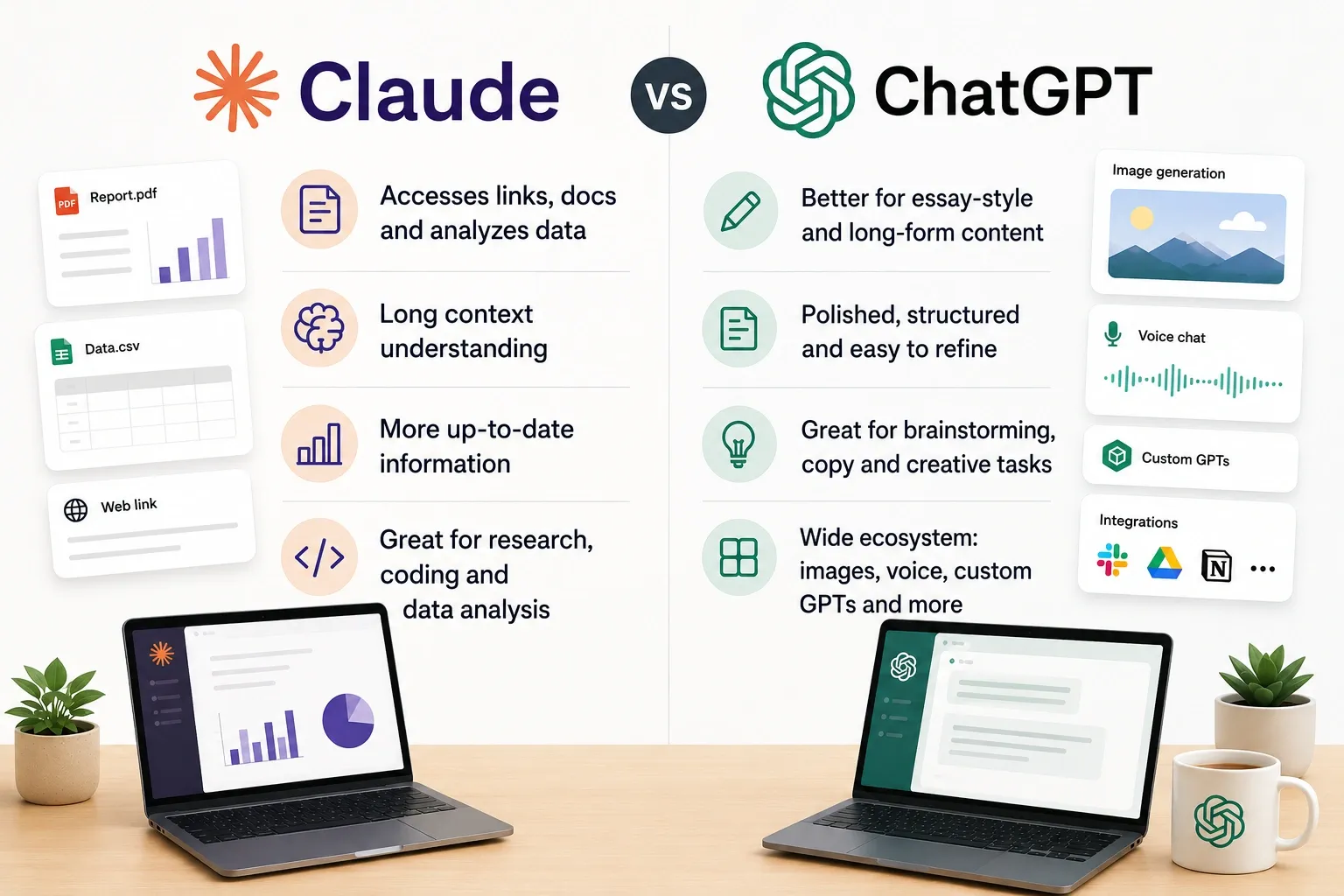
Take a long report that needs to be turned into an article or essay. For essay-style and long-form content, ChatGPT is often our preference. It tends to produce polished, well-structured writing that is easy to refine and adapt.
Now give both tools a task that requires working with information first. Claude can access links and documents, analyze data, and then use those findings to build the response. We also find it particularly useful when the task requires working with more current information.
Suppose we’re brainstorming a campaign and need copy, variations, visual concepts, and perhaps an image. ChatGPT becomes more attractive because several creative capabilities can stay within the same workflow.
For coding and data-heavy tasks, Claude can often be the stronger choice, particularly when the task involves analyzing substantial source material before arriving at a result.
That’s the important lesson from claude vs chatgpt: there isn’t one universal winner. ChatGPT is often our go-to for polished content, while Claude stands out when the task involves accessing, analyzing, and working with information before producing the final answer.
The Trade-offs Nobody Talks About
Neither tool is perfect.
The first trade-off is cost. Paid plans and usage limits vary, and the right option depends heavily on how intensively a person or team uses AI.
Then there’s the ecosystem trade-off.
ChatGPT has a mature and expanding ecosystem of GPTs, apps, and capabilities. Claude has also expanded significantly through connectors and integrations.
So neither platform is isolated anymore.
There’s also a learning curve. The more powerful these products become, the more time teams need to understand how to use them effectively. A tool with ten capabilities isn’t necessarily better for a person who only needs two.
And finally, there’s workflow lock-in.
Once a team has built custom workflows, prompts, integrations, connected apps, and habits around one platform, moving entirely to another isn’t as simple as cancelling one subscription and starting another.
That’s why we think “Which one should we replace?” is often the wrong question
Which AI Tool Should Your Team Actually Use?
Our answer is: start with the work, not the brand.
If your team’s priorities are broad research, image creation, voice interaction, custom GPTs, connected apps, and having many capabilities in one environment, ChatGPT has a strong case.
If your team’s work involves substantial documents, nuanced writing, long-context analysis, or serious coding, Claude deserves a proper trial.
And if your team does both?
Use both.
The easiest way to decide is to take three real tasks your team performs regularly and run them through both tools. Don’t test them with generic prompts. Give them the messy brief, the long document, the difficult code, or the awkward piece of copy that actually represents your work.
Then compare not just the first response, but the entire workflow:
Which required less editing? Which followed instructions better? Which handled your context more effectively? Which integrated better with the rest of your work?
That tells you much more than a leaderboard ever will.
Conclusion
After using both, we’ve stopped looking for a definitive winner in the claude vs chatgpt debate.
ChatGPT remains incredibly useful when we need breadth, multiple capabilities, and a wider ecosystem. Claude often becomes our preference when the work demands long context, careful writing, or deeper coding support.
And that’s probably the most honest conclusion we can offer.
AI tools are becoming too capable, and too different, to reduce the decision to one winner. For teams, the better approach may be to understand where each tool performs best and build the workflow around that.
If your team uses both, the real question isn’t which one you prefer. It’s which one you trust with which job.
Frequently Asked Questions
It depends on the task. ChatGPT is strong for essay-style content and creative workflows, while Claude can be useful for documents, data analysis, and coding.
Some users prefer Claude for its long-context capabilities, writing style, and ability to work with documents and data.
Yes. Claude can work with documents and data, analyze the information, and use the findings in its response.
Both are useful, but Claude can be particularly effective for substantial coding, debugging, and larger source materials.

Related Courses
Explore our programs





Find a Program made just for YOU
We'll help you find the right fit for your solution. Let's get you connected with the perfect solution.
Is Your Upskilling Effort worth it?
 ROI Calculator

Are Your Skills Meeting Job Demands?
Try our Skill Gap tool
Experience Lifelong Learning and Connect with Like-minded Professionals
Explore Jaro Connect
