HOME > BLOG > Finance > CFA vs MBA in Finance 2026: Which Qualification Actually Gets You Further in India?
Finance
CFA vs MBA in Finance 2026: Which Qualification Actually Gets You Further in India?
J
By Arif Siddiqui
June 8, 20268 min read
Published on June 8, 2026
SHARE THIS ARTICLE
Table Of Content
What the CFA Actually Is — And What It Is Not
What an MBA in Finance Actually Is — And What It Is Not
CFA vs MBA in Finance: Direct Comparison for India 2026
The Third Option: IIM and IIT Finance Certificates
Finance professionals in India face a decision that comes up repeatedly at career inflection points: do I pursue the CFA or is an MBA in Finance the better investment? The question sounds simple, but the answer is rarely clean — because the two qualifications are built for fundamentally different career outcomes, and choosing between them without understanding that difference is how people end up with the right qualification for the wrong role.
This blog covers what each qualification actually builds, which careers each opens or accelerates, how they compare on time, cost, and market perception, and where IIM and IIT finance certifications fit as a third option that many professionals overlook.
What the CFA Actually Is — And What It Is Not
The CFA (Chartered Financial Analyst) designation is awarded by the CFA Institute, a US-based global professional body. It consists of three levels of examinations covering investment analysis, portfolio management, ethics, and financial reporting — with a global pass rate across all levels that makes it one of the most rigorous financial qualifications available.
What the CFA is: A professional qualification built specifically for investment professionals. It is the gold standard for roles in equity research, fund management, investment banking analysis, and asset management.
What the CFA is not: It is not a management degree, not a leadership credential, and not a gateway to general management or non-investment finance roles. A CFO of a manufacturing company does not need a CFA. A fund manager at a mutual fund almost certainly does.
Key facts for 2026:
CFA Level 1 pass rate: approximately 37–44% globally. All three levels combined: fewer than 20% of candidates who start complete all three
Average time to complete all 3 levels: 4–5 years while working full-time
Total cost (exam fees + study materials): approximately ₹3–5 lakh at current USD/INR exchange rates
No classroom component — entirely self-study and examination-based
Recognised globally — particularly strong in Singapore, Hong Kong, UK, and the US for investment roles
What an MBA in Finance Actually Is — And What It Is Not
An MBA with a Finance specialisation is a general management degree with a focused second-year in finance subjects. It builds a broad management foundation — strategy, operations, marketing, HR, analytics — and then deepens into corporate finance, financial modelling, investment analysis, and financial management in the specialisation track.
What the MBA in Finance is: A management credential that opens general management, senior finance leadership, and strategic roles across all industries. The CFO of most Indian companies has an MBA — often from an IIM or a strong deemed university.
What the MBA in Finance is not: A specialised investment credential. An MBA in Finance does not prepare you for the depth of investment analysis that a CFA covers. Fund managers and equity analysts at serious asset management firms typically want CFA alongside or instead of an MBA.
Online MBA in Finance options through Jaro Education in 2026 include: Symbiosis SSODL online MBA — where the IRM affiliation adds a risk and governance dimension specifically relevant for finance professionals; Amrita MBA FinTech — for professionals targeting the digital finance and payments sector; and Amrita MBA in Business Analytics — for data-driven finance roles.
The Third Option: IIM and IIT Finance Certificates
Most professionals comparing CFA and MBA overlook a third category that is particularly well-suited for senior working professionals in India: executive finance certificates from IIMs and IITs. These are neither a professional qualification like CFA nor a full degree like an MBA — but they provide IIM-level financial frameworks in a targeted, time-efficient format.
These certificates occupy a specific niche: they are built for professionals who already have a degree and work experience and want a focused IIM or IIT credential in a specific finance domain — without the 2-year MBA commitment or the 4-year CFA grind.
Career Path Decision Framework: Which One Is Right for You?
Choose CFA if:
You are targeting equity research, fund management, or investment analysis roles specifically
You work in or want to move into an asset management company, hedge fund, or investment bank’s research division
You are in the early stages of your career (0–5 years) with time to invest 4–5 years in all 3 levels
You are targeting international finance roles — CFA’s global recognition is particularly strong in Singapore, Hong Kong, and London.
You already have an MBA or other management degree and want investment-specific depth on top of it.
Choose an MBA in Finance if:
You want a formal management degree that opens general management, CFO-track, and cross-functional leadership roles.
You are transitioning from engineering, operations, or a non-finance background and need the full management foundation alongside finance depth
You want the alumni network and institutional credibility of a recognised university — particularly IIM, Symbiosis, or Amity
Budget is a consideration — online MBAs from UGC-approved universities are available from ₹80,000, significantly lower than CFA’s total cost
You need the qualification within 2 years — CFA takes twice as long on average
Choose an IIM/IIT Finance Certificate if:
You already have a degree and specific domain experience — you need depth, not breadth
You are an executive in junior and middle management, an entrepreneur, or a finance professional who needs governance and reporting frameworks — IIM Ahmedabad FRCG is built precisely for you
You want IIM-level credibility in a shorter span without longer learning commitments
You are a senior professional targeting board roles, audit committee positions, or CFO-level governance responsibilities
Here is the honest picture of how CFA and MBA are perceived by Indian employers in 2026:
Asset management and mutual funds: CFA is king. SEBI-registered investment advisers and fund managers increasingly need or expect CFA. An MBA alone is not sufficient for a senior research analyst role at a serious AMC.
Corporate finance (CFO, finance director, treasury): MBA dominates, particularly from IIM, Symbiosis, or Amity. CFA is respected but not required. Most Indian CFOs are MBAs, not CFAs.
BFSI (banking, financial services, insurance): Both are valued. For product and relationship roles — MBA. For risk, investment, and analytics roles, CFA increasingly relevant. IIM certificates from FRCG or IIM Trichy are well-regarded for senior BFSI positions.
FinTech: MBA (especially with a FinTech specialisation like Amrita- Online MBA in FinTech) is more relevant than a CFA for product and strategy roles. CFA matters for the investment/lending analytics side.
Consulting (Big Four, strategy consulting): An MBA from a strong institution is the primary credential. CFA is a plus for financial advisory and M&A practices.
Salary Comparison: CFA vs MBA Finance in India 2026
Role / Level
CFA Holder
MBA Finance (Strong Institute)
IIM Finance Certificate
Entry Level (0–3 yrs)
₹6–12 LPA (research/investment roles)
₹5–10 LPA (corporate finance/mgmt trainee)
N/A — senior professional credential
Mid Level (3–7 yrs)
₹12–25 LPA (fund manager, senior analyst)
₹12–22 LPA (finance manager, senior manager)
₹15–28 LPA (with IIM cert as accelerant)
Senior Level (7–15 yrs)
₹25–60 LPA (portfolio manager, CIO)
₹25–50 LPA (VP Finance, CFO track)
₹28–55 LPA (CFO, finance director)
CXO Level (15+ yrs)
₹50L–₹2Cr+ (CIO, Managing Director)
₹50L–₹2Cr+ (CFO, Group CFO)
Dependent on role and organisation
Conclusion
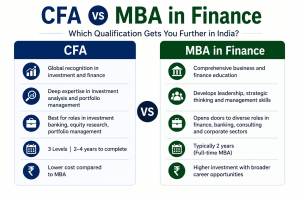
Choosing between a CFA and an MBA in Finance in 2026 depends on the kind of finance career you want to build in India. The CFA programme is highly specialised and best suited for professionals aiming for careers in investment banking, equity research, portfolio management, and financial analysis. It offers deep technical expertise and global recognition in the finance industry. On the other hand, an MBA in Finance provides broader business and management exposure along with leadership, networking, and placement opportunities, making it ideal for professionals targeting managerial and corporate finance roles.
Neither qualification is universally better — the right choice depends on your career goals, experience level, budget, and preferred learning style. If you want specialised investment-focused expertise, CFA may be the stronger option. If you want management growth, business exposure, and campus recruitment opportunities, an MBA in Finance can offer greater flexibility and career diversification in the Indian job market.
Frequently Asked Questions
Yes — and for serious investment finance careers, many professionals do both. The typical path: complete an MBA first (especially an online MBA, which allows you to work simultaneously), then pursue CFA Levels while gaining investment work experience. The IIM Ahmedabad FRCG, IIM Mumbai Corporate Finance, and IIT Bombay Investment certificates can also complement both.
CFA is a global professional designation recognised in India’s private financial sector. It does not hold the same formal government-recognised status as CA (ICAI) or CMA (ICMAI) for statutory audit or cost audit purposes. For government and PSU finance roles, an MBA from a UGC-approved university or ICAI/ICMAI qualifications are more directly applicable.
They are not directly comparable. CFA is significantly more demanding in terms of examination rigour and pass rate — fewer than 20% complete all three levels. MBA requires consistent academic performance over 2 years but is structured to be completable. CFA is a self-study marathon; MBA is a structured programme.
The IIM Ahmedabad Financial Reporting and Corporate Governance programme is an executive certificate that covers financial reporting standards, statement analysis, and corporate governance — areas that overlap with CFA’s financial reporting curriculum but are approached from a governance and management lens rather than an investment analysis lens. FRCG is for governance professionals; the CFA Level 1 financial reporting section is for investment analysts. They are complementary, not competing.
For BFSI and governance roles: Symbiosis SSODL online MBA. For FinTech careers: Amrita MBA FinTech × Grant Thornton. For the broadest finance specialisation options: explore Jaro Education Online MBA. For IIM-level finance credentials without a full MBA: IIM Ahmedabad FRCG, IIM Mumbai Corporate & Strategic Finance, or IIM Trichy Banking & Finance.
Arif Siddiqui
Head of Accounting and Treasury
Arif Siddiqui is a finance leader specializing in accounting, treasury, and financial strategy. As Head of Finance at Generali Employee Benefits, he brings extensive experience in managing global financial operations. He is known for driving financial efficiency and governance across organizations. His leadership supports sustainable business growth and financial excellence.

 June 8, 2026
 8 min read















 ROI Calculator