
Best Courses and Career Options After BA
 September 4, 2026
 7 min read





Table Of Content
- What Can I Do After BA?
- Best Courses After BA Graduation
- BA Career Options in the Private Sector
- Government Career Options After BA
 Key Insights
- A BA degree offers diverse career paths, including higher education, government careers, private-sector jobs, teaching, law, media, marketing, and specialised professional courses.
- Popular courses after BA include MA, MBA, LLB, B.Ed, postgraduate diplomas, and certifications in areas such as digital marketing, data analytics, design, content writing, and communication.
- BA graduates can explore private-sector roles in HR, marketing and sales, content writing, digital marketing, public relations, and communications by building relevant skills.
- Choosing the right course requires considering your interests, career goals, strengths, eligibility requirements, course duration, cost, and opportunities for practical skill development.
- In this blog, you'll learn about the best courses after BA graduation, BA career options, private- and government-sector opportunities, creative career paths, and how to choose the right next course after completing a BA.
Completing a Bachelor of Arts (BA) opens the door to a wide range of academic and professional opportunities. In India, the BA is the most commonly awarded undergraduate degree, making it a popular choice among students from diverse academic backgrounds. However, once you have completed your degree, the question naturally arises: what can I do after BA? You can pursue higher education, prepare for competitive examinations, enter the private sector, or take up specialised professional courses. The right choice depends on your interests, strengths, career goals, and the kind of work you want to pursue. If you have recently completed your BA graduation, this guide will help you understand the most suitable BA career options, courses, and job opportunities available after graduation.
 ChatGPT
 Perplexity
 Claude
 Grok
GrokWhat Can I Do After BA?
If you are wondering what can we do after BA, there is no single answer. A BA degree provides flexibility because graduates can move into education, management, law, media, marketing, human resources, government services, research, and several skill-based careers.
Some of the most popular options after BA include:
- Pursuing an MA or another postgraduate degree
- Choosing an MBA or management programme
- Studying LLB for a career in law
- Pursuing B.Ed for teaching
- Preparing for government and competitive examinations
- Taking professional courses in digital marketing, analytics, design, or communication
- Entering private-sector jobs
- Exploring journalism, content, media, and public relations
- Pursuing social work or development-sector careers
Therefore, after BA what next depends largely on whether you want to study further, start earning, prepare for a government career, or develop specialised skills.
Best Courses After BA Graduation
Choosing the best course after BA graduation depends on your career objective. Here are some of the most popular courses after BA graduation to consider.
1. Master of Arts (MA)
An MA is one of the most natural post graduation courses after BA. It allows you to specialise further in the subject you studied during your bachelor’s degree.
You can consider MA programmes in subjects such as:
- English
- Economics
- Psychology
- Sociology
- History
- Political Science
- Geography
- Public Administration
An MA can be suitable for students interested in academics, teaching, research, writing, civil services preparation, or subject-specific careers.
If you are asking about best course after BA, an MA can be a strong choice when you want to build deeper expertise in your graduation subject.
2. Master of Business Administration (MBA)
An MBA is among the most popular professional options for graduates who want to enter the corporate sector. You do not necessarily need a commerce or management background to consider management education.
Depending on the programme, you can specialise in areas such as:
- Marketing
- Human Resources
- Finance
- Operations
- Business Analytics
- International Business
An MBA can help BA graduates move towards management, marketing, HR, sales, business development, and other corporate roles.
For students looking for professional courses after degree, an MBA can be considered when the goal is to transition from a general arts background into business and management.
3. Bachelor of Laws (LLB)
If you have an interest in law, an LLB can be another option after completing BA. A law degree can prepare you for legal practice and other law-related careers, subject to the applicable eligibility and professional requirements.
Students interested in legal research, corporate law, litigation, legal consultancy, or compliance can explore this path.
LLB is particularly worth considering if you enjoy reading, analysing information, understanding rules, and building arguments.
4. Bachelor of Education (B.Ed)
Teaching is another established career route after BA. Students interested in education can consider B.Ed and subsequently pursue teaching opportunities according to the relevant eligibility requirements.
A BA followed by B.Ed can be particularly relevant if you want to teach subjects connected to your academic background.
This path can also be suitable for graduates who enjoy explaining concepts, working with students, and developing learning materials.
5. Postgraduate Diploma and Certification Courses
Not everyone wants to spend several years pursuing another full-time degree. Shorter programmes and certifications can help you develop specialised skills.
Some options include:
- Digital marketing
- Data analytics
- Graphic design
- UI/UX design
- Content writing
- Search engine optimisation
- Social media marketing
- Human resource management
- Journalism and mass communication
- Foreign languages
These are useful PG courses after BA or skill-development options for graduates who want to add practical capabilities to their existing degree.
BA Career Options in the Private Sector
A BA degree does not limit you to academic careers. Many organisations recruit graduates for entry-level roles where communication, research, organisation, problem-solving, and interpersonal skills are valuable.
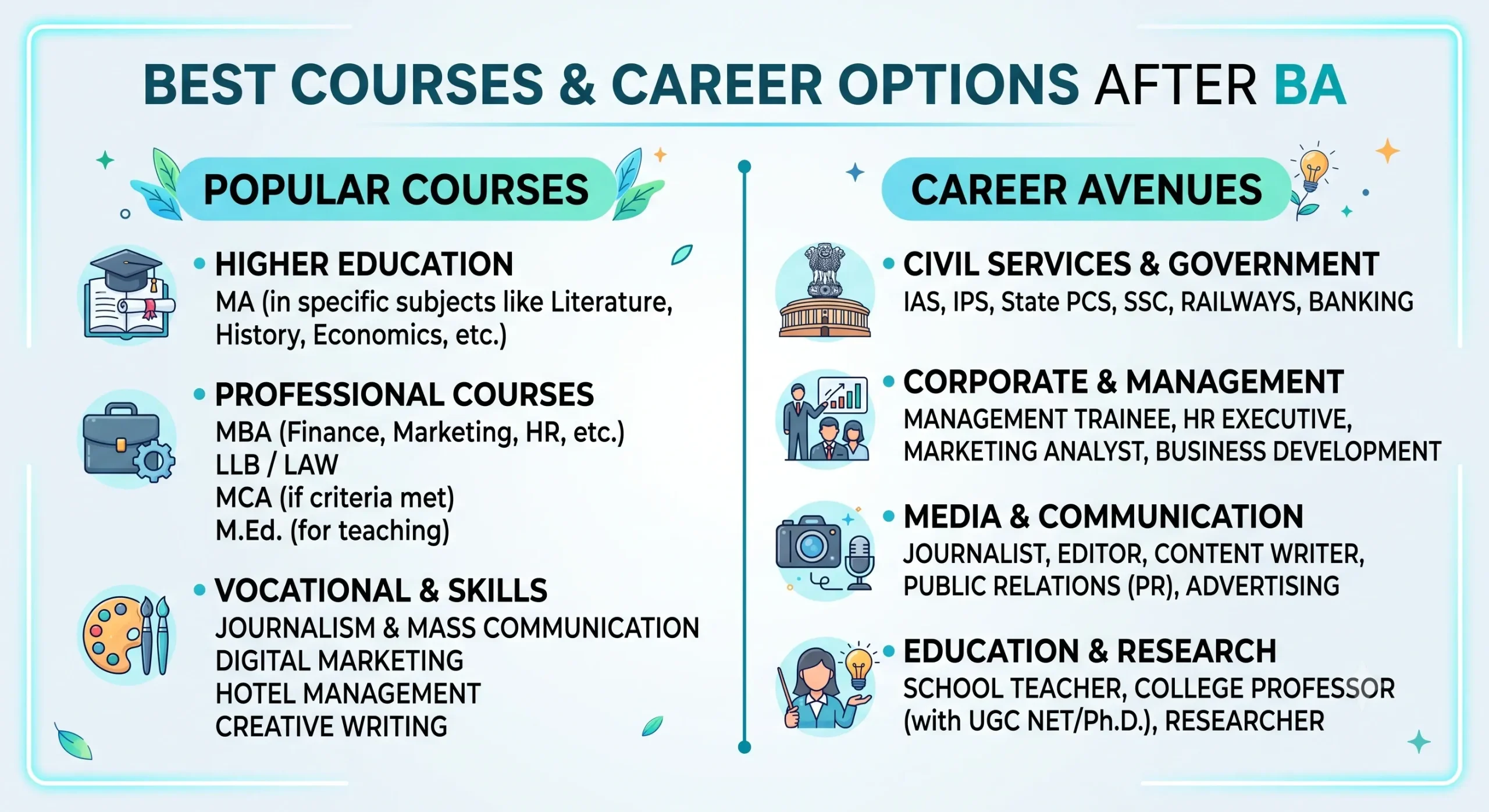
Some common BA course jobs include:
Human Resources
BA graduates can explore roles such as HR executive, recruitment coordinator, talent acquisition associate, or HR assistant. Additional qualifications in HR can strengthen your profile.
Marketing and Sales
If you are comfortable communicating with people and understanding customer needs, marketing and sales can be potential career paths. Roles may include marketing executive, sales executive, business development associate, or marketing coordinator.
Content Writing
Graduates with strong writing and communication skills can explore content writing, copywriting, editing, blogging, and content strategy.
This can be particularly relevant for students who studied English, journalism, communication, literature, or related subjects.
Digital Marketing
Digital marketing is another skill-based option. You can learn areas such as SEO, social media marketing, email marketing, content marketing, and paid advertising through specialised courses.
For graduates who want a relatively skill-focused career path, digital marketing can be one of the options after BA worth exploring.
Public Relations and Communications
Students who enjoy communication, networking, writing, and media can consider public relations and corporate communications.
Possible roles include PR executive, communications associate, media coordinator, and social media executive.
Government Career Options After BA
Government employment is another major choice for BA graduates. Depending on eligibility, graduates can prepare for competitive examinations conducted for civil services, staff selection, banking, railways, and other government positions.
Popular areas include:
- Civil services
- Staff selection examinations
- Banking examinations
- Railway examinations
- State-level competitive examinations
- Defence-related examinations
The preparation path can require considerable time and consistency, so it is important to choose an examination based on your interests and eligibility rather than simply following what others are doing.
If your main goal is a government career, you may not need to immediately pursue another degree. Instead, you can focus on examination preparation while developing relevant skills.





Career Options in Media and Creative Fields
A BA can also provide a foundation for careers in creative and communication-oriented industries.
Students interested in this area can explore:
- Journalism
- Publishing
- Content creation
- Advertising
- Public relations
- Social media
- Editing
- Scriptwriting
- Photography
- Graphic design
- Digital media
A specialised diploma, certification, internship, or portfolio can complement your BA and demonstrate practical skills to employers.
What to Do After Graduation in Arts?
If you are confused about what to do after graduation in arts, begin by identifying your career objective instead of selecting a course simply because it is popular.
Ask yourself:
- Do I want to study further?
- Do I want a government job?
- Do I want to enter the corporate sector?
- Do I enjoy teaching?
- Do I want to work in law?
- Do I prefer creative or communication-based work?
- Do I want to develop a specialised skill quickly?
- Do I want to change my career direction completely?
Your answers can make it easier to shortlist the right courses after Bachelor of Arts.
For example, a student interested in academics may choose MA, while someone interested in management may choose MBA. A graduate interested in teaching may consider B.Ed, whereas someone interested in law may explore LLB.
Courses After BA: Which One Should You Choose?
There is no universally best course after BA graduation. The right choice depends on what you want from your career.
| Career Goal | Suitable Option |
| Subject specialization | MA |
| Corporate career | MBA |
| Teaching | B.Ed |
| Legal career | LLB |
| Government career | Competitive exam preparation |
| Digital career | Digital marketing/analytics |
| Creative career | Design/media courses |
| Communication career | Journalism/PR/content |
| Social sector | MSW/development-related programmes |
The important thing is to look beyond the name of the course. Consider the curriculum, duration, eligibility, practical exposure, career opportunities, cost, and whether the course matches your long-term plans.
How to Choose Your Next BA Course
Before selecting your next BA course, use a simple decision-making process:
Identify Your Interest
Think about the subjects and activities you genuinely enjoy. Your interests can help you avoid choosing a course solely because it is considered popular.
Check Career Requirements
Some careers require specific qualifications. For example, teaching and law have their own educational and eligibility requirements. Check these before enrolling.
Consider Your Strengths
If you are good at writing and communication, content, journalism, PR, or marketing may suit you. If you enjoy numbers and logical problem-solving, analytics-related courses may be worth exploring.
Compare Course Duration and Cost
A two-year postgraduate degree and a short-term certification have very different time and financial commitments. Compare them according to your circumstances.
Focus on Practical Skills
Whatever course you choose, look for opportunities to develop practical skills through projects, internships, assignments, portfolios, or real-world exposure.
Final Thoughts
So, what can i do after BA? You have several possibilities. You can pursue MA, MBA, LLB, B.Ed, professional certifications, government examination preparation, or private-sector employment. You can also build a career in marketing, HR, content, digital media, journalism, communication, research, or other fields.
If your BA graduation complete status has left you wondering after BA what next, avoid making a decision based only on what your friends or classmates are choosing. Instead, consider your interests, strengths, financial situation, preferred work environment, and long-term career goals.
The right BA career options are the ones that connect your existing education with skills and qualifications relevant to the career you want. Whether you choose a postgraduate degree, a professional course, or a job, having a clear direction can help you make your next step more purposeful.
Frequently Asked Questions
There is no single best course for every BA graduate. MA, MBA, LLB, B.Ed, digital marketing, analytics, journalism, and other specialised courses can be considered depending on your career goals and interests.
Yes. BA graduates can explore entry-level roles in areas such as sales, HR, marketing, customer support, administration, content, business development, and operations. Developing job-specific skills can improve your career prospects.
Yes, an MBA can be considered by BA graduates interested in management and corporate careers. Specialisations such as marketing, HR, operations, finance, and business analytics can provide different career directions.
Popular professional courses after BA include digital marketing, data analytics, UI/UX design, graphic design, content writing, HR, journalism, public relations, and foreign-language courses. The best choice depends on your interests and desired career path.

Related Courses
Explore our programs




Find a Program made just for YOU
We'll help you find the right fit for your solution. Let's get you connected with the perfect solution.
Is Your Upskilling Effort worth it?
 ROI Calculator

Are Your Skills Meeting Job Demands?
Try our Skill Gap tool
Experience Lifelong Learning and Connect with Like-minded Professionals
Explore Jaro Connect

